

Claude New Updates 2026 for Enterprises: Security, Compliance, and Governance Enhancements Explained


Claude new updates 2026 for enterprises mark a clear shift: Claude is no longer positioned as an experimental assistant, but as a governed enterprise platform that must align with security operations, compliance supervision, and identity governance. The most consequential changes this year center on the Claude Compliance API, deeper integrations with established governance vendors, and security tooling for developers through Claude Code Security.
This article explains what changed, why it matters for enterprise risk teams, and how to operationalize security, compliance, and governance for Claude at scale.

What Is New in 2026: Claude as a Governed Enterprise System
Enterprise adoption of AI assistants is overwhelmingly work-driven. Harmonic Security reports that approximately 74.6% of time spent in AI tools involves business work, and even personal activity frequently occurs inside enterprise-licensed plans such as Claude Enterprise. This creates a governance reality: controls cannot focus only on blocking public AI sites. They must extend into the enterprise tenant where the work actually happens.
As enterprises operationalize Claude for drafting, analysis, coding, and decision support, the key 2026 enhancements address three pillars:
- Security visibility into prompts, responses, files, projects, and administrative actions
- Compliance supervision for regulated communications, retention, and eDiscovery
- Governance integration with identity, data security, and API control planes already in use across the enterprise
Claude Compliance API: The Foundation for Enterprise Auditability
The Claude Compliance API is the centerpiece of enterprise governance in 2026. It exposes Claude Enterprise and Claude Platform activity - including prompts, responses, uploaded files, logs, and admin actions - to external security and governance tools. For many organizations, this is the capability that enables Claude to fit into existing control frameworks rather than operating as a separate, ungoverned stack.
Proofpoint Integration: Converged DLP, Insider Risk, and Communications Governance
In May 2026, Proofpoint announced integration with the Claude Compliance API to extend two established enterprise programs into Claude:
- Data security and insider risk: Claude conversations and activity logs can be ingested into Proofpoint, allowing existing DLP policies, classifiers, and behavioral risk models to evaluate prompts, responses, files, projects, and admin activity.
- Digital Communications Governance (DCG): Claude Enterprise conversations can be captured for supervision workflows, retention policies, eDiscovery, and investigation processes common in regulated industries such as financial services.
Operationally, this enables consistent controls across endpoint, cloud, email, and AI. Instead of building a standalone AI security workflow, teams can extend their current governance logic to AI interactions and investigate incidents within a familiar risk framework.
SailPoint Integration: Identity Governance for Claude Access and Entitlements
SailPoint announced a connector for the Claude Compliance API that supports identity security and governance for Claude Enterprise. The enterprise value is direct:
- Inventory and visibility into who has access to Claude
- Access reviews to certify that entitlements remain appropriate
- Lifecycle governance aligned with joiner-mover-leaver processes and least privilege principles
AI access is now as sensitive as access to collaboration suites, customer data platforms, or code repositories. Claude should be treated as a governed SaaS application, not an unmanaged browser tool.
Enterprise Security Controls That Matter Most in 2026
Guidance from security vendors and platform engineers converges on a consistent point: governance must be applied at multiple layers, not only within the AI product interface.
1) Content-Aware DLP for Prompts, Outputs, and File Uploads
Concentric AI highlights a behavioral risk: employees often perceive Claude as a safe environment and may upload sensitive data with less caution than they would in other contexts. That perception can increase exposure when classification and guardrails are weak.
For enterprise deployments, prioritize content-aware controls that can:
- Inspect prompts and file uploads for sensitive data categories such as PII, payment data, credentials, and regulated records
- Enforce policies that block or warn on disallowed content
- Log events for investigation and audit evidence
When integrated via the Claude Compliance API into tools like Proofpoint, organizations can reuse established classifiers and DLP policies rather than reimplementing detection logic specifically for AI.
2) Unified Insider Risk Monitoring That Includes AI Activity
As Claude becomes part of day-to-day workflows, insider risk programs need visibility into AI interactions the same way they monitor email, cloud storage, and endpoints. The objective is not only preventing data leakage, but also identifying anomalous patterns such as systematic extraction of internal documents through AI-assisted workflows.
Key capabilities to design for:
- Correlation of Claude activity with identity, device posture, and historical user behavior
- Detection of unusual volumes, repeated sensitive queries, or suspicious file upload patterns
- Investigation workflows that preserve context: the prompt, the output, associated files, and administrative actions
3) Regulated Communications Supervision, Retention, and eDiscovery
In sectors such as financial services, regulated communications rules require supervision and retention of relevant electronic communications. Proofpoint extending DCG into Claude Enterprise is significant because it treats AI conversations as supervised communication artifacts, not informal drafts.
Enterprise compliance teams should determine whether AI-assisted drafting falls under supervision rules, then operationalize:
- Retention schedules aligned to existing archives
- Supervision sampling and risk-based review for AI-assisted content
- eDiscovery readiness: the ability to produce records of prompts, model outputs, and related artifacts during litigation or regulatory inquiry
Claude Code Security: AI-Assisted Vulnerability Discovery with Human Oversight
Anthropic introduced Claude Code and a security-focused capability called Claude Code Security, available in Claude Code on the web and in a limited research preview to Enterprise and Team customers. The focus is security scanning that reasons about codebases rather than relying solely on signature or pattern matching.
Claude Code Security is designed to:
- Trace data flows through an application in a manner similar to a human security researcher
- Understand interactions between components to surface complex vulnerabilities
- Suggest targeted patches for human review, with no automatic patch application
For enterprises, the governance angle is important: treat AI security scanning as part of DevSecOps. Organizations building internal capability in secure AI engineering can supplement these workflows with structured training such as AI certifications, cybersecurity credentials, and governance programs for teams working at the intersection of AI and Web3.
Claude Code Must Be Governed Like Critical Developer Infrastructure
MintMCP documented vulnerabilities affecting Claude Code infrastructure, including CVE-2025-59536 and CVE-2026-21852. The broader takeaway applies beyond any single tool: AI development environments must be secured with the same rigor applied to CI/CD systems and code hosting platforms.
Minimum enterprise controls for Claude Code and agent tooling include:
- Network segmentation and controlled egress paths
- Secret management and robust credential hygiene
- Patching and configuration management with clear ownership
- Logging and audit trails for developer actions and tool invocations
Architectural Governance Patterns: Gateways, MCP Connector Controls, and Observability
Security engineering guidance from sources such as TrueFoundry and Kong points to architectural control points that make Claude governable at scale.
AI Gateways for Policy Enforcement and Visibility
Kong describes using an AI gateway to govern Claude Code traffic and other Claude API calls. This pattern is increasingly common in enterprises because it centralizes:
- Authentication and authorization for LLM usage
- Rate limiting, quotas, and abuse prevention
- Request and response logging for investigations and audits
- Policy-driven routing and integration with existing API security programs
For platform teams, an AI gateway positions Claude as a governed API service endpoint like any other enterprise integration.
MCP Governance and Agent Tool Controls
As agentic workflows expand, risk shifts from the core model to the tools the agent can invoke and the credentials those tools can access. TrueFoundry highlights practical governance for Claude across web, desktop, and CLI contexts, including Model Context Protocol (MCP) connector controls, sandboxing, and network governance.
Enterprise best practices for agent and MCP governance include:
- Maintain a registry of approved connectors and tools
- Define which roles and agents can call which tools, and under what conditions
- Record end-to-end audit trails of tool calls initiated by Claude
Implementation Checklist: Applying Security, Compliance, and Governance to Claude
Use this checklist to translate the Claude new updates 2026 for enterprises into an actionable program:
- Integrate with governance tooling via the Claude Compliance API to export prompts, responses, files, and admin actions into your monitoring stack.
- Extend DLP and insider risk policies to AI content, reusing existing classifiers for PII, PCI, trade secrets, and regulated data.
- Bring Claude into identity governance using enterprise SSO, RBAC, and periodic access reviews through tools such as SailPoint.
- Define regulated communications scope for AI-assisted drafting, and implement retention, supervision, and eDiscovery workflows.
- Secure developer and agent environments with segmentation, secrets management, patching, and observability, including governance for MCP connectors.
- Establish human oversight for code and security changes suggested by Claude Code Security and for high-impact business decisions supported by AI outputs.
Conclusion: Claude Governance in 2026 Is About Integration, Not Isolation
The Claude new updates 2026 for enterprises reflect a mature direction: Claude is being integrated into the same security, compliance, and governance architecture that already governs email, cloud applications, and APIs. The Claude Compliance API enables vendor integrations such as Proofpoint for DLP, insider risk, and communications governance, and SailPoint for identity governance. Claude Code Security extends Claude into DevSecOps as a reasoning-based security assistant, while published security advisories reinforce that AI developer tooling must itself be secured and audited.
For enterprise leaders, the priority is to treat Claude as critical infrastructure: instrument it, govern it through existing control planes, and design for auditability from the start. That approach reduces blind spots, supports regulatory alignment, and enables responsible scale.
Related Articles
View All
Claude Ai
Claude Fable 5 Responsible AI: Security, Ethics, and Governance
Explore Claude Fable 5 Responsible AI considerations, including security guardrails, ethical risks, governance controls, and enterprise best practices.
Claude Ai
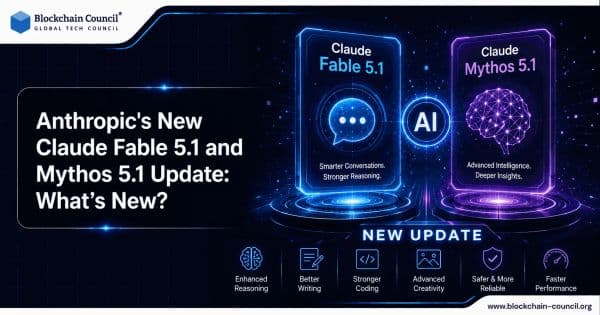
Anthropic's New Claude Fable 5.1 and Mythos 5.1 Update: What's New?
Anthropic’s Claude Fable 5.1 and Mythos 5.1 update brings stronger coding, long-running agentic workflows, research, vision, and knowledge-work capabilities. Fable 5.1 is generally available and introduces cheaper cache reads, potentially reducing typical workload costs by about 25% and highly agentic workloads by up to 45%. Mythos 5.1 uses the same underlying model but offers expanded cybersecurity and biology capabilities to vetted organizations through trusted-access programs.

Claude Ai
Claude Sonnet 5 Explained: Key Features, Capabilities, and Use Cases
Claude Sonnet 5 brings 1M-token context, adaptive reasoning, stronger agent workflows, and enterprise safety controls for coding and knowledge work.
Trending Articles
The Role of Blockchain in Ethical AI Development
How blockchain technology is being used to promote transparency and accountability in artificial intelligence systems.
How Blockchain Secures AI Data
Understand how blockchain technology is being applied to protect the integrity and security of AI training data.
What is AWS? A Beginner's Guide to Cloud Computing
Everything you need to know about Amazon Web Services, cloud computing fundamentals, and career opportunities.