

Claude Mythos in Web3: Using Claude to Analyze Smart Contracts, Tokenomics, and On-Chain Data
 Suyash Raizada
Claude Mythos in Web3 describes a fast-growing narrative among builders and enterprises that Anthropic's Claude models, especially Claude Code, are becoming workflow-native tools for smart contract analysis, tokenomics evaluation, and on-chain data processing. The term is less about speculation and more about a practical shift: long-context reasoning, terminal-first automation, and integrations that let developers move from reading blockchain code to acting on it, with fewer context switches and fewer handoffs.
In 2026, Claude's toolchain expanded into code-heavy professional workloads with features like million-token context, agentic desktop workflows, and connector-style integrations via the Model Context Protocol (MCP). For Web3 teams, this matters because audits, protocol design, and analytics are rarely single-file problems. They are cross-repo, cross-chain, and data-intensive.

Analyze smart contracts, tokenomics, and on-chain data using Claude Mythos by mastering secure AI systems through an AI Security Certification, building blockchain data pipelines using a Node JS Course, and scaling analytics solutions via an AI powered marketing course.
What "Claude Mythos in Web3" Actually Means
The phrase Claude Mythos in Web3 is shorthand for how developers increasingly treat Claude as a co-worker embedded into their daily blockchain workflows. Instead of a chatbot that only explains code, Claude is used in ways that resemble an assistant engineer:
Terminal-native execution through Claude Code, including shell commands and git operations.
Repository-level reasoning across many files, not just snippets.
Integration-first architecture via MCP to connect nodes, APIs, and databases.
This narrative is reinforced by enterprise traction. By early 2026, Claude reportedly reached $14 billion in annualized revenue and was used by 70% of Fortune 100 companies, signaling strong adoption for high-stakes work like code review and security. Those same enterprise behaviors translate directly to Web3, where the cost of mistakes can be immediate and irreversible.
Why 2026 Is a Turning Point for Claude in Web3
Three 2026-era capabilities explain why Claude moved from useful to transformative for many Web3 tasks.
1) Million-Token Context for Protocol-Scale Analysis
Claude Opus 4.6 launched in February 2026 with a context window reported at up to 1 million tokens. In Web3 terms, that supports workflows like:
Reviewing a multi-contract protocol (factories, routers, oracles, vaults) in one session.
Comparing two versions of a system (pre-upgrade vs. post-upgrade) while maintaining full context.
Analyzing large on-chain datasets or long event logs without losing earlier assumptions.
This matters because many vulnerabilities are cross-file business logic issues, not single-function bugs. Large context enables the model to keep invariants, roles, and value flows in view while inspecting code paths.
2) Claude Code as a Senior Engineer in Your Terminal
Claude Code is a CLI-based assistant that can read and write local files, run shell commands, manage git, and connect to external services via MCP. For Web3 teams, this bridges the gap between analysis and action:
Scan a repository, summarize architecture, then open and edit targeted files.
Generate patches and tests, then run linting or test suites.
Create repeatable audit checklists as structured prompts and run them per pull request.
Claude Code adoption metrics have been reported as strong, with daily installs increasing from 17.7 million to 29 million alongside significant revenue growth across 2025. Even for smaller Web3 teams, these trends indicate sustained investment in tooling for code-centric workflows.
3) Integrations via MCP and Marketplace-Style Connectors
MCP enables Claude to connect to external systems such as blockchain nodes, analytics APIs, and databases. Combined with the Claude Marketplace (launched March 2026) and enterprise integrations such as GitLab for code review and PR analysis, the path to Web3-specific plugins becomes straightforward.
In practice, this means Claude can assist not only with Solidity and Rust code, but also with the surrounding operational layer: deployment scripts, monitoring dashboards, and analytics pipelines.
Use Case 1: Smart Contract Analysis and Audit Assistance
Smart contract audits are a natural fit for Claude's long-context and cross-file reasoning. Developers use Claude Code to perform semantic reviews across the codebase, identify business logic flaws, and draft patches in natural language.
What Claude Can Do Well in Audits
Business logic tracing: Follow value flows across multiple contracts (deposit, mint, borrow, repay, liquidate).
Role and permission review: Enumerate privileged functions, admin roles, upgrade controls, and timelocks.
Invariant extraction: Propose protocol invariants and map where they can be broken.
Patch generation: Suggest concrete fixes and add missing checks, events, or tests.
How to Structure a Claude-Assisted Audit Workflow
Repository intake: Ask Claude to summarize contract roles, key state variables, and external dependencies.
Threat modeling: Identify trust assumptions, privileged actors, and attack surfaces (oracles, callbacks, reentrancy points).
Deep dives: Review the top 10 critical code paths with cross-file context preserved.
Verification: Run tests, static analysis, or fuzzing and feed results back for interpretation.
PR gating: Use GitLab-style review integrations to generate change impact summaries per pull request.
For teams formalizing this workflow, internal training topics align closely with certifications in smart contract development and blockchain security, covering audit methodology and secure design patterns.
Use Case 2: Tokenomics Evaluation and Stress Testing
Tokenomics analysis often falls short when it stays at the slide-deck level. The practical value Claude brings to this area comes from using structured prompts to turn tokenomics into executable analysis: scenarios, simulations, and risk metrics.
Tokenomics Tasks Claude Is Used For
Emissions schedule sanity checks: Model circulating supply, unlock cliffs, and inflation rates under multiple adoption assumptions.
Liquidity and reflexivity analysis: Evaluate how incentives might shift liquidity across pools or chains.
Risk metrics: Compute Value at Risk (VaR) and Expected Shortfall, including approaches like Cornish-Fisher adjustments.
Monte Carlo simulations: Stress-test under shocks such as a 50% BTC drawdown, correlated asset moves, or liquidity evaporation.
Rebalancing policies: Compare rebalancing triggers, cooldowns, and fee impacts for treasury management.
The benefit is not that Claude predicts markets. The benefit is that Claude helps formalize assumptions, build reproducible models, and document decision logic. That documentation becomes useful for governance proposals, risk committees, and audits of treasury policy.
Use Case 3: On-Chain Data Processing and Analytics
On-chain analysis typically involves a mix of node access, indexers, SQL, and BI tooling. Claude becomes valuable when it can connect to those sources, maintain long time horizons in context, and generate structured reports.
Practical On-Chain Workflows Enabled by Integrations
Transaction history analysis: Summarize user cohorts, protocol revenue drivers, and fee patterns.
Token distribution diagnostics: Identify concentration risk, whale behavior, and unlock-related movement.
Governance analytics: Track voting power changes and proposal participation over time.
Multi-chain visibility: Use MCP-style connectors to query multiple chains and normalize outputs.
With longer context, Claude can also keep project definitions consistent throughout an analysis session - for example, remembering how your team defined "active user," "organic volume," or "wash trading heuristic" from start to finish.
What Makes Claude Different for Web3 Teams
Several reported benchmarks and adoption indicators help explain why Claude is commonly chosen for these tasks:
High coding performance: Opus 4.6 has been reported at approximately 80.8% on SWE-bench Verified, a widely used coding benchmark.
Long-context reasoning: Analyzing large repositories or datasets in a single prompt reduces fragmented reviews.
Professional usage skew: A large share of enterprise API usage is reported as professional, aligning with engineering team needs.
Reliability framing: Anthropic's Constitutional AI approach is designed to support consistent reasoning in high-stakes environments, relevant to audits and risk work.
Claude does not replace specialized tooling like static analyzers, fuzzers, formal verification, or dedicated on-chain indexing stacks. The strongest results come from pairing Claude with those tools and using it to orchestrate workflows and interpret outputs.
Limitations and Best Practices for Responsible Use
Web3 is adversarial by default. Using Claude effectively requires guardrails:
Never treat outputs as proofs: Validate findings with tests, reproduction steps, and independent tools.
Constrain the task: Ask for explicit assumptions, threat models, and what would falsify a given conclusion.
Secure your environment: Review what files, keys, and secrets Claude Code can access in your terminal workflow.
Audit the audit: Maintain human sign-off for any change that affects funds, admin privileges, or upgrades.
For teams building repeatable processes, formal training in smart contract security, DeFi risk, and blockchain analytics provides a structured foundation. Certifications in blockchain development and security can standardize terminology and methodology across engineering, product, and risk stakeholders.
Leverage AI reasoning for Web3 analytics and decision-making by gaining expertise through an AI Security Certification, implementing data models using a Python certification, and promoting blockchain insights via a Digital marketing course.
Future Outlook: From Assistant to End-to-End Web3 Operator
Claude's direction points toward deeper embedding in Web3 workflows through several developments:
Marketplace expansion for blockchain-specific plugins (nodes, indexers, simulation tools, governance platforms).
Full-protocol audits that keep architecture, tests, deployments, and documentation in one context window.
Agentic pipelines that move from issue detection to patch, test generation, and PR creation with review gates at each stage.
The Claude Mythos in Web3 is trending toward an audit-to-deploy operational model. The teams that benefit most will be those combining strong engineering fundamentals with disciplined verification, not those looking for a shortcut.
Conclusion
Claude Mythos in Web3 reflects a real shift in how blockchain work gets done: larger context windows for protocol-scale reasoning, terminal-native automation through Claude Code, and integration patterns that connect AI to on-chain and off-chain systems. For smart contract analysis, tokenomics stress testing, and on-chain data processing, Claude can compress timelines and improve clarity, particularly when paired with proven security and analytics tools.
The most durable advantage comes from process: clear prompts, explicit assumptions, reproducible scripts, and human verification. Used that way, Claude becomes less of a narrative and more of an engineering instrument for modern Web3 teams.
FAQs
1. What is Claude Mythos in Web3?
Claude Mythos in Web3 refers to advanced prompting techniques used with Claude to analyze blockchain data. It focuses on extracting insights from smart contracts, tokenomics, and on-chain activity.
2. How can Claude be used in Web3 analysis?
Claude can analyze smart contracts, summarize tokenomics models, and interpret blockchain data. It helps users understand complex Web3 systems more easily.
3. What is smart contract analysis with Claude?
It involves reviewing contract code to identify logic, risks, and functionality. Claude can explain code behavior and highlight potential vulnerabilities.
4. Can Claude detect vulnerabilities in smart contracts?
Claude can identify common issues and patterns in code. However, results should be verified with professional audits and security tools.
5. How does Claude help with tokenomics analysis?
Claude can break down token supply, distribution, and incentives. It helps users evaluate sustainability and economic design.
6. What is on-chain data analysis using Claude?
On-chain analysis involves interpreting blockchain transactions and activity. Claude can summarize trends and provide insights from raw data.
7. Why is prompt engineering important for Web3 tasks?
Clear prompts guide Claude to focus on specific aspects like security or economics. This improves accuracy and relevance of outputs.
8. What types of blockchain data can Claude analyze?
Claude can work with transaction logs, wallet activity, and contract interactions. It helps convert complex data into understandable insights.
9. Can beginners use Claude for Web3 analysis?
Yes, Claude simplifies complex blockchain concepts. Beginners can use it to learn and explore Web3 systems effectively.
10. What are the benefits of using Claude in Web3?
Benefits include faster analysis, improved understanding, and reduced manual effort. It supports research and decision-making.
11. How accurate is Claude for smart contract insights?
Claude provides useful explanations but may miss critical details. Human review and specialized tools are still necessary.
12. What are common use cases for Claude in Web3?
Use cases include auditing contracts, evaluating token models, and analyzing transaction patterns. It is also used for research and education.
13. How can Claude assist in DeFi analysis?
Claude can explain protocols, liquidity mechanisms, and risks. It helps users understand DeFi platforms and strategies.
14. What are the limitations of Claude in Web3 analysis?
Limitations include lack of real-time data and potential inaccuracies. It should not replace expert audits or financial advice.
15. How can users improve Claude’s Web3 outputs?
Users can provide clear prompts, include relevant data, and specify analysis goals. Iterative prompting improves results.
16. Can Claude integrate with blockchain tools?
Claude can be used alongside blockchain explorers and analytics platforms. Integration depends on workflow and tools used.
17. How does Claude handle complex tokenomics models?
Claude can simplify and explain economic structures. It helps users understand supply mechanisms and incentives.
18. Is Claude suitable for professional Web3 research?
It can support research but should not be the sole source. Combining AI insights with expert analysis is recommended.
19. How does Claude help with risk assessment in Web3?
Claude can highlight potential risks in contracts and token models. It supports informed decision-making but requires validation.
20. What is the future of AI like Claude in Web3?
AI will play a growing role in blockchain analysis and automation. It will enhance efficiency but still require human oversight.
Related Articles
View All
Claude Ai
Using Claude Sonnet 5 for Web3 Content Creation, Community Management, and Automation
Learn how Claude Sonnet 5 supports Web3 content creation, community management, governance reporting, and automation with safe, practical workflows.
Claude Ai
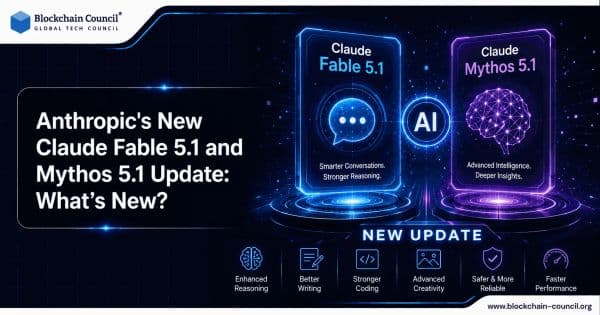
Anthropic's New Claude Fable 5.1 and Mythos 5.1 Update: What's New?
Anthropic’s Claude Fable 5.1 and Mythos 5.1 update brings stronger coding, long-running agentic workflows, research, vision, and knowledge-work capabilities. Fable 5.1 is generally available and introduces cheaper cache reads, potentially reducing typical workload costs by about 25% and highly agentic workloads by up to 45%. Mythos 5.1 uses the same underlying model but offers expanded cybersecurity and biology capabilities to vetted organizations through trusted-access programs.

Claude Ai
How Claude Sonnet 5 Could Transform Blockchain Development and Smart Contract Auditing
Claude Sonnet 5 could reshape blockchain development by improving smart contract testing, audit triage, agentic DevSecOps, and compliance workflows.
Trending Articles

Top 5 DeFi Platforms
Explore the leading decentralized finance platforms and what makes each one unique in the evolving DeFi landscape.
How Blockchain Secures AI Data
Understand how blockchain technology is being applied to protect the integrity and security of AI training data.
Claude AI Tools for Productivity
Discover Claude AI tools for productivity to streamline tasks, manage workflows, and improve efficiency.