

Claude Code Subagents Documentation

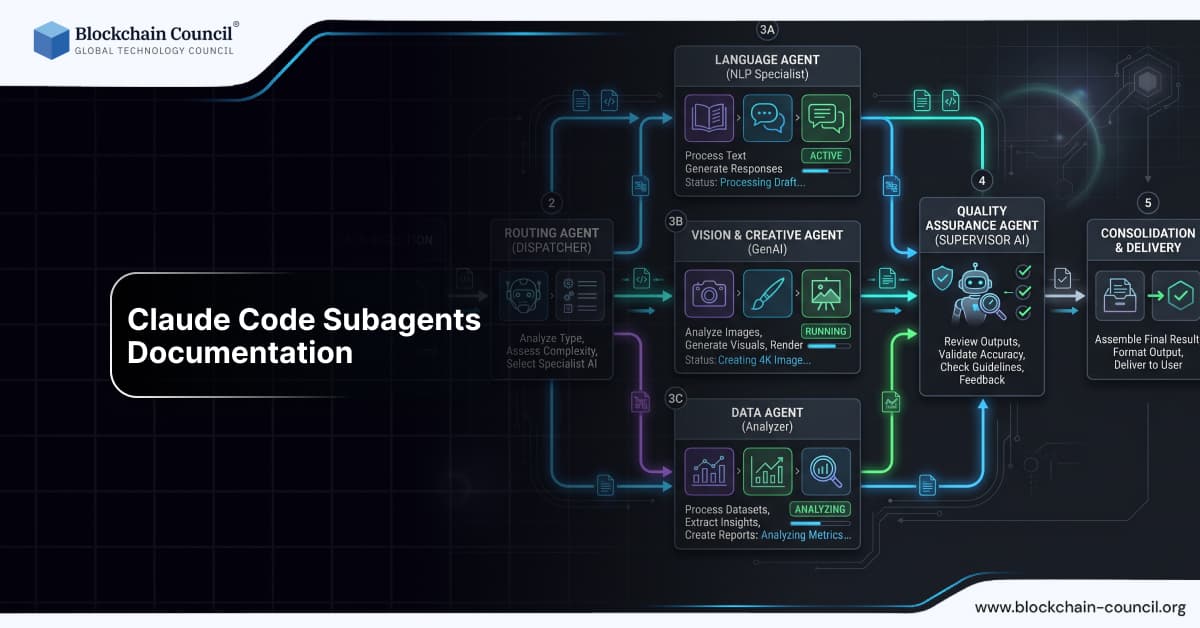
Artificial intelligence has moved far beyond single task systems. Modern AI platforms now rely on multi agent architectures, where specialized components collaborate to perform complex tasks. Within this evolution, Claude Code subagents represent an advanced approach to structuring AI workflows.
Subagents are modular AI components designed to handle specific responsibilities within a larger system. They allow developers to break down complex operations into manageable units, improving efficiency, scalability, and maintainability.

Professionals who want to understand and implement such systems often begin with structured learning paths like the Claude Code Certification and the AI expert certification.
What Are Claude Code Subagents
Claude Code subagents are smaller, specialized AI modules that operate under a primary system or controller.
Key Concept
Instead of relying on a single AI model to handle everything, tasks are distributed among multiple subagents, each with a defined role.
Core Characteristics
Task specialization
Modular design
Independent execution
Coordinated collaboration
This structure mirrors real world teams where individuals focus on specific responsibilities.
Why Subagents Are Important
Complexity Management
Breaking large problems into smaller tasks makes them easier to handle.
Scalability
Systems can grow by adding more subagents without redesigning the entire architecture.
Efficiency
Each subagent performs a focused task, improving overall performance.
Architecture of Subagent Systems
Controller Agent
The main agent coordinates tasks and delegates responsibilities.
Worker Subagents
Each subagent handles a specific function such as coding, testing, or documentation.
Communication Layer
Agents exchange information through structured communication protocols.
How Subagents Work in Claude Code
Claude Code uses subagents to enhance development workflows.
Task Delegation
The main system assigns tasks to appropriate subagents.
Parallel Execution
Multiple subagents can work simultaneously.
Result Aggregation
Outputs from subagents are combined into a final result.
Real World Examples
Example 1: Software Development
One subagent generates code, another tests it, and a third documents it.
Example 2: Data Analysis
Different subagents handle data cleaning, analysis, and visualization.
Example 3: Customer Support Systems
Subagents manage queries, sentiment analysis, and response generation.
Benefits of Using Subagents
Improved Productivity
Tasks are completed faster through parallel processing.
Better Accuracy
Specialized agents reduce errors.
Flexibility
Systems can adapt to changing requirements.
Challenges in Subagent Systems
Coordination Complexity
Managing multiple agents requires careful design.
Communication Overhead
Data exchange between agents can slow performance.
Debugging Difficulty
Identifying issues across agents can be complex.
Documentation of Subagents
Proper documentation is essential for effective use.
Key Elements
Purpose of each subagent
Input and output formats
Communication protocols
Dependencies
Clear documentation ensures maintainability and scalability.
Best Practices for Subagent Documentation
Use Clear Descriptions
Explain the role and function of each subagent.
Maintain Consistency
Use standard formats across documentation.
Update Regularly
Keep documentation aligned with system changes.
Role of AI in Subagent Management
AI helps manage and optimize subagent systems.
Task Allocation
AI assigns tasks based on capabilities.
Performance Monitoring
Tracks efficiency and identifies bottlenecks.
Optimization
Improves workflows dynamically.
Developers can deepen their understanding through the AI Powered coding expert Course.
Subagents vs Monolithic AI Systems
Monolithic Systems
Single model handles all tasks.
Subagent Systems
Multiple specialized agents collaborate.
Key Difference
Subagent systems offer greater flexibility and scalability.
Security Considerations
Access Control
Each subagent should have limited permissions.
Data Protection
Sensitive information must be handled securely.
Monitoring
Track activities across agents.
Integration with Development Tools
IDE Integration
Subagents can assist directly within development environments.
APIs
Enable communication between systems.
Cloud Platforms
Support scalable deployment.
Recent Developments
Advanced Coordination Models
Improved communication between agents.
AI Orchestration Tools
Tools for managing complex workflows.
Increased Adoption
More organizations are using subagent architectures.
Future of Subagent Systems
Autonomous Collaboration
Agents will work together with minimal human input.
Enhanced Intelligence
Subagents will become more capable and adaptive.
Broader Applications
Use cases will expand across industries.
Impact on the Tech Industry
Development Practices
Shift toward modular AI systems.
Job Roles
Developers focus on system design and orchestration.
Innovation
New tools and frameworks will emerge.
Subagents in Business and Marketing
AI subagents are used beyond development.
Marketing Automation
Different agents handle campaigns, analytics, and content.
Customer Engagement
Subagents manage interactions and responses.
Professionals can explore this further through the AI powered marketing course.
Why Subagents Matter
Subagents represent a major step forward in AI system design.
Key Advantages
Modular architecture
Scalable systems
Improved efficiency
Conclusion
Claude Code subagents documentation is a critical aspect of modern AI development. By breaking complex tasks into specialized components, subagents improve efficiency, scalability, and flexibility.
As AI systems continue to evolve, subagent architectures will play a central role in enabling advanced capabilities. Developers who understand and implement these systems will be better positioned to build the next generation of intelligent applications.
FAQs
1. What are Claude Code subagents?
Claude Code subagents are specialized AI modules designed to handle specific tasks within a larger system. They operate under a central controller and collaborate to complete complex workflows. By dividing responsibilities, subagents improve efficiency and scalability. This modular approach makes systems easier to manage and extend over time.
2. How do subagents work?
Subagents work by receiving tasks from a central controller and executing them independently or in parallel. They communicate results back to the main system, which aggregates outputs into a final result. This process allows multiple tasks to be handled simultaneously. It significantly improves performance and efficiency.
3. Why are subagents important?
Subagents are important because they simplify complex systems by dividing tasks into manageable components. They enable scalability and flexibility, allowing systems to grow without major redesign. This approach improves accuracy and performance. It is essential for modern AI applications.
4. What is subagent documentation?
Subagent documentation describes the roles, functions, and interactions of each subagent in a system. It includes details about inputs, outputs, and communication protocols. Proper documentation ensures maintainability and clarity. It is critical for collaboration and system updates.
5. Can beginners use subagent systems?
Beginners can learn to use subagent systems with proper guidance and practice. While the concept may seem complex, understanding basic principles makes it manageable. Starting with simple implementations is recommended. Over time, skills can be expanded.
6. What are the benefits of subagents?
Benefits include improved efficiency, scalability, and flexibility. Tasks can be processed in parallel, reducing time and effort. Specialized agents reduce errors and improve accuracy. This approach enhances overall system performance.
7. What challenges do subagents present?
Challenges include coordination complexity and communication overhead. Debugging across multiple agents can be difficult. Proper design and monitoring are required. Addressing these challenges ensures effective implementation.
8. How do subagents improve productivity?
Subagents improve productivity by dividing tasks and enabling parallel execution. This reduces bottlenecks and speeds up workflows. Developers can focus on higher level tasks. Efficiency increases significantly.
9. Are subagents secure?
Subagents can be secure if proper access controls and monitoring are implemented. Each agent should have limited permissions. Security practices must be followed. This reduces risks and protects data.
10. What industries use subagents?
Industries such as technology, finance, and healthcare use subagents. They support complex workflows and data processing. Adoption is growing rapidly. Their impact is significant.
11. What is the future of subagents?
The future includes more autonomous and intelligent subagent systems. AI will improve coordination and performance. Use cases will expand across industries. Innovation will continue.
12. How can developers learn subagents?
Developers can learn through courses, certifications, and hands on practice. Understanding AI and system design is important. Continuous learning helps improve skills. Experience is key.
13. What tools support subagents?
Tools include orchestration platforms, APIs, and development environments. These tools enable communication and coordination. They simplify implementation. Proper tools enhance efficiency.
14. How do subagents handle communication?
Subagents communicate through structured protocols and data exchanges. This ensures consistency and reliability. Effective communication is essential for coordination. It supports system functionality.
15. What is modular AI design?
Modular design involves breaking systems into smaller components. Each component handles a specific task. This improves flexibility and scalability. It is a key principle in subagent systems.
16. Can subagents replace developers?
Subagents assist developers but do not replace them. Human expertise is needed for design and decision making. AI enhances productivity. Collaboration is essential.
17. What is orchestration in AI?
Orchestration involves managing and coordinating multiple agents. It ensures tasks are executed efficiently. Proper orchestration improves performance. It is critical for subagent systems.
18. How do subagents scale?
Subagents scale by adding more agents or expanding capabilities. This allows systems to handle increased demand. Scalability is a major advantage. It supports growth.
19. How can users stay updated?
Users can follow industry trends, documentation, and updates. Continuous learning is important. Staying informed helps adapt to changes. Knowledge improves outcomes.
20. Why are subagents important?
Subagents are important because they enable advanced AI systems to function efficiently. They improve scalability and flexibility. Their role in modern development is growing. They represent the future of AI architecture.
Related Articles
View All
Claude Ai
How to Use Claude Fable 5.1 for Free
Find out whether Claude Fable 5.1 is available for free, which Claude plans provide access, and what users need to know before trying Anthropic’s latest AI model.

Claude Ai
Anthropic's New Claude Fable 5.1 and Mythos 5.1 Update: What's New?
Anthropic’s Claude Fable 5.1 and Mythos 5.1 update brings stronger coding, long-running agentic workflows, research, vision, and knowledge-work capabilities. Fable 5.1 is generally available and introduces cheaper cache reads, potentially reducing typical workload costs by about 25% and highly agentic workloads by up to 45%. Mythos 5.1 uses the same underlying model but offers expanded cybersecurity and biology capabilities to vetted organizations through trusted-access programs.

Claude Ai
Fable 5 vs Claude vs ChatGPT: Which AI Model Should You Choose?
Compare Fable 5, Claude, and ChatGPT across coding, research, DevOps, cost, context, and governance to choose the right AI model.
Trending Articles

Top 5 DeFi Platforms
Explore the leading decentralized finance platforms and what makes each one unique in the evolving DeFi landscape.
How Blockchain Secures AI Data
Understand how blockchain technology is being applied to protect the integrity and security of AI training data.
What is AWS? A Beginner's Guide to Cloud Computing
Everything you need to know about Amazon Web Services, cloud computing fundamentals, and career opportunities.