

Claude AI Pricing

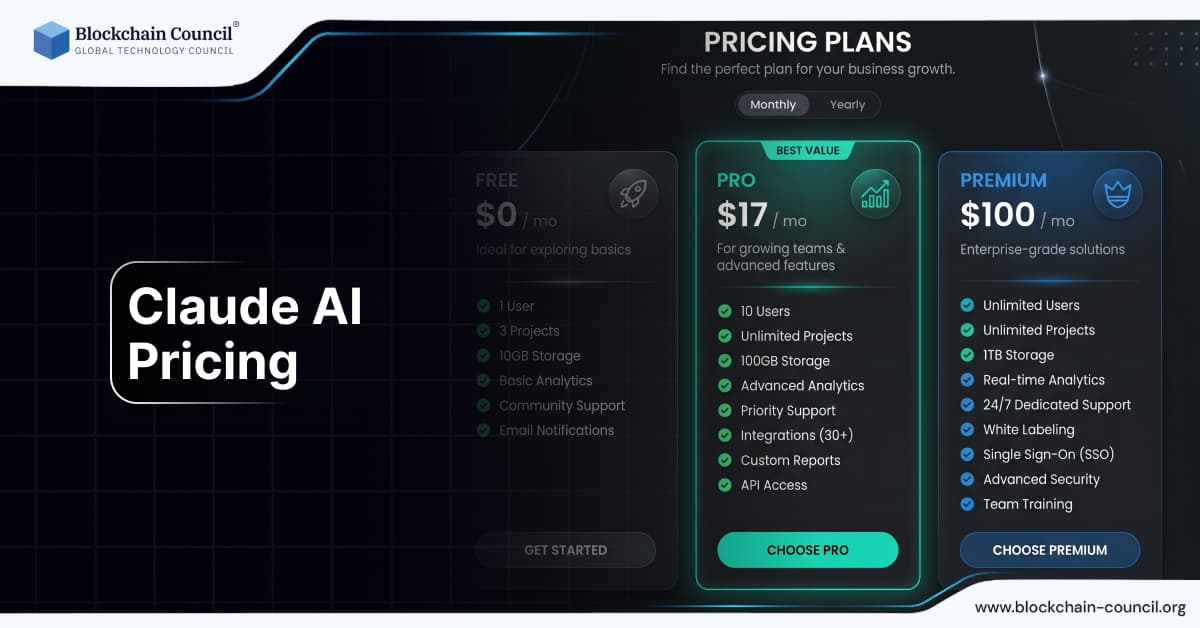
Artificial intelligence tools have rapidly become essential for businesses, developers, and individuals. Among the leading platforms, Claude AI stands out for its strong reasoning capabilities, safety focus, and versatility. However, understanding Claude AI pricing is critical before adopting it at scale.
Pricing is not just about cost. It reflects value, scalability, and long-term usability. Whether you are a developer, a startup, or an enterprise, choosing the right pricing tier can significantly impact your productivity and budget.

To build a deeper understanding of AI systems and their cost structures, professionals often begin with structured programs like the Claude Code Certification and the AI expert certification.
What Is Claude AI Pricing
Claude AI pricing refers to the cost structure associated with using Anthropic’s AI models. It typically depends on usage, features, and access level.
Key Pricing Factors
Token usage or input and output size
Model type and capability
Access level such as API or subscription
Additional enterprise features
Unlike fixed pricing models, AI platforms often use usage-based pricing, which scales with demand.
Types of Claude AI Pricing Models
Subscription-Based Plans
Some platforms offer monthly subscriptions for individual users.
Usage-Based Pricing
Developers pay based on the number of tokens processed.
Enterprise Pricing
Custom pricing is available for large organizations.
Claude AI Free vs Paid Plans
Free Access
Claude AI often provides limited free access for basic usage.
Restricted usage limits
Access to standard models
Suitable for testing and learning
Paid Plans
Paid plans unlock advanced features.
Higher usage limits
Access to premium models
Priority performance
Pricing Based on Tokens
Token-based pricing is the most common model.
What Are Tokens
Tokens represent pieces of text processed by the AI.
How Pricing Works
Input tokens are charged
Output tokens are charged
Total cost depends on volume
This model ensures users only pay for what they use.
Claude AI Pricing for Developers
Developers typically use API-based pricing.
API Costs
Charged per token
Varies by model complexity
Scales with usage
Benefits for Developers
Flexible integration
Pay-as-you-go model
Scalable for applications
Developers can enhance their expertise through the AI Powered coding expert Course.
Claude AI Pricing for Businesses
Small Businesses
Lower cost entry
Suitable for automation and support
Enterprises
Custom pricing
Advanced security features
Dedicated support
ROI Considerations
Businesses evaluate pricing based on productivity gains and efficiency improvements.
Real World Examples of Pricing Usage
Example 1: Startup Automation
A startup uses Claude AI for customer support automation. The usage-based pricing allows them to scale without high upfront costs.
Example 2: Content Creation Agency
An agency uses Claude AI to generate marketing content. Subscription pricing helps manage predictable costs.
Example 3: Enterprise Integration
A large company integrates Claude AI into its workflow, benefiting from custom pricing and scalability.
Factors That Affect Claude AI Pricing
Model Complexity
Advanced models cost more due to higher computational requirements.
Usage Volume
Higher usage leads to increased costs.
Features and Integrations
Additional features may increase pricing.
Support Level
Enterprise support often comes at a premium.
Comparing Claude AI Pricing with Competitors
Competitive Landscape
Claude AI competes with other AI platforms offering similar services.
Key Comparison Points
Cost per token
Model performance
Scalability
Safety features
Claude is often preferred for its balance between performance and safety.
Hidden Costs to Consider
Overuse
Uncontrolled usage can increase costs.
Integration Expenses
Developing and maintaining integrations may require additional resources.
Training and Onboarding
Teams may need training to use AI effectively.
Cost Optimization Strategies
Efficient Prompt Design
Reducing unnecessary tokens lowers costs.
Usage Monitoring
Tracking usage helps control expenses.
Choosing the Right Model
Selecting appropriate models avoids overspending.
Role of AI in Pricing Optimization
AI tools themselves help optimize costs.
Automated Monitoring
AI tracks usage patterns.
Predictive Analysis
Forecasts future costs.
Resource Allocation
Optimizes system performance.
Claude AI Pricing in Marketing
Marketing teams use AI for campaigns and analytics.
Cost Benefits
Reduced manual effort
Faster content creation
Improved targeting
Professionals can explore advanced strategies through the AI powered marketing course.
Security and Compliance Costs
Data Protection
Ensuring data security may involve additional expenses.
Regulatory Compliance
Organizations must comply with data laws.
Risk Management
Proper safeguards reduce financial risks.
Recent Developments in Claude AI Pricing
Improved Models
New models offer better performance at optimized costs.
Flexible Pricing Options
More adaptable pricing structures are emerging.
Increased Competition
Competition is driving pricing innovation.
Future Trends in AI Pricing
Dynamic Pricing
Costs may adjust based on demand and usage.
Subscription Expansion
More tiered subscription plans are expected.
AI Cost Reduction
Advancements may reduce overall costs.
Why Understanding Pricing Matters
Understanding pricing helps users maximize value and avoid unnecessary expenses.
Financial Planning
Helps allocate budgets effectively.
Strategic Decision Making
Supports long-term planning.
Efficiency Improvement
Ensures optimal resource usage.
Conclusion
Claude AI pricing reflects the broader trend of usage-based and scalable AI services. While costs can vary depending on usage and features, the value it provides often outweighs the investment.
By understanding pricing structures and optimizing usage, individuals and organizations can fully leverage Claude AI’s capabilities. As AI technology continues to evolve, pricing models will become more flexible and accessible.
FAQs
1. What is Claude AI pricing?
Claude AI pricing refers to the cost structure for using Anthropic’s AI models. It typically depends on usage, features, and access level. Users may pay through subscriptions or token-based pricing. Understanding these models helps manage costs effectively.
2. Is Claude AI free to use?
Claude AI often offers limited free access for basic usage. However, advanced features and higher usage limits require payment. Free plans are suitable for testing and learning. Paid plans provide full functionality.
3. How does token-based pricing work?
Token-based pricing charges users based on the amount of text processed. Both input and output tokens are counted. Costs increase with usage volume. This model ensures fair pricing.
4. Is Claude AI expensive?
The cost depends on usage and requirements. For small users, it can be affordable. Large-scale usage may increase costs. Proper management helps control expenses.
5. What affects Claude AI pricing?
Factors include model complexity, usage volume, and additional features. Enterprise support may also impact costs. Understanding these factors helps in planning budgets.
6. Can businesses afford Claude AI?
Yes, businesses can adopt Claude AI with scalable pricing options. Small businesses can start with lower costs. Enterprises can negotiate custom pricing. ROI often justifies the expense.
7. What is the difference between free and paid plans?
Free plans offer limited access and features. Paid plans provide higher limits and advanced capabilities. Businesses typically use paid plans. The choice depends on needs.
8. How can users reduce costs?
Users can optimize prompts, monitor usage, and choose appropriate models. Efficient usage reduces unnecessary expenses. Cost management is essential.
9. Does Claude AI offer enterprise pricing?
Yes, enterprise pricing is available for large organizations. It includes advanced features and support. Pricing is customized based on requirements. It supports scalability.
10. Is pricing predictable?
Subscription plans offer predictable costs. Usage-based pricing may vary. Monitoring helps maintain control. Planning is important.
11. What is included in enterprise plans?
Enterprise plans include advanced security, support, and scalability. They are designed for large-scale operations. Custom features may be included. They provide flexibility.
12. How does Claude AI compare to competitors in pricing?
Claude AI offers competitive pricing with strong performance and safety features. Costs vary depending on usage. It is often chosen for reliability. Comparison depends on needs.
13. Are there hidden costs?
Hidden costs may include integration and training expenses. Usage overages can also increase costs. Awareness helps avoid surprises. Proper planning is key.
14. Can developers use Claude AI affordably?
Yes, developers can use pay-as-you-go pricing. This allows flexibility and scalability. Costs depend on usage. Efficient coding reduces expenses.
15. What industries use Claude AI pricing models?
Industries such as technology, marketing, and finance use these models. Adoption is growing across sectors. AI pricing supports scalability. It is widely applicable.
16. How often does pricing change?
Pricing may change based on market conditions and technology advancements. Providers update pricing periodically. Staying informed is important. Changes are expected.
17. What is the future of AI pricing?
AI pricing will become more flexible and competitive. Costs may decrease with technological improvements. New models will emerge. The market will evolve.
18. Can individuals use Claude AI?
Yes, individuals can access Claude AI through free or paid plans. It is useful for learning and productivity. Costs depend on usage. Accessibility is improving.
19. How does AI improve cost efficiency?
AI automates tasks and reduces manual effort. This leads to cost savings. Efficiency improves productivity. Businesses benefit significantly.
20. Why is understanding pricing important?
Understanding pricing helps manage budgets and maximize value. It prevents overspending. It supports strategic decisions. It is essential for effective AI adoption.
Related Articles
View All
Claude Ai
How to Use Claude Fable 5.1 for Free
Find out whether Claude Fable 5.1 is available for free, which Claude plans provide access, and what users need to know before trying Anthropic’s latest AI model.

Claude Ai
Anthropic's New Claude Fable 5.1 and Mythos 5.1 Update: What's New?
Anthropic’s Claude Fable 5.1 and Mythos 5.1 update brings stronger coding, long-running agentic workflows, research, vision, and knowledge-work capabilities. Fable 5.1 is generally available and introduces cheaper cache reads, potentially reducing typical workload costs by about 25% and highly agentic workloads by up to 45%. Mythos 5.1 uses the same underlying model but offers expanded cybersecurity and biology capabilities to vetted organizations through trusted-access programs.

Claude Ai
Fable 5 vs Gemini: Features, Performance, Pricing, and Use Cases Compared
Compare Fable 5 vs Gemini across features, benchmarks, pricing, multimodal support, coding, agents, and enterprise use cases.
Trending Articles
The Role of Blockchain in Ethical AI Development
How blockchain technology is being used to promote transparency and accountability in artificial intelligence systems.
What is AWS? A Beginner's Guide to Cloud Computing
Everything you need to know about Amazon Web Services, cloud computing fundamentals, and career opportunities.
Claude AI Tools for Productivity
Discover Claude AI tools for productivity to streamline tasks, manage workflows, and improve efficiency.