

Fable 5 Pricing and Availability: Plans, Credits, and Access Options

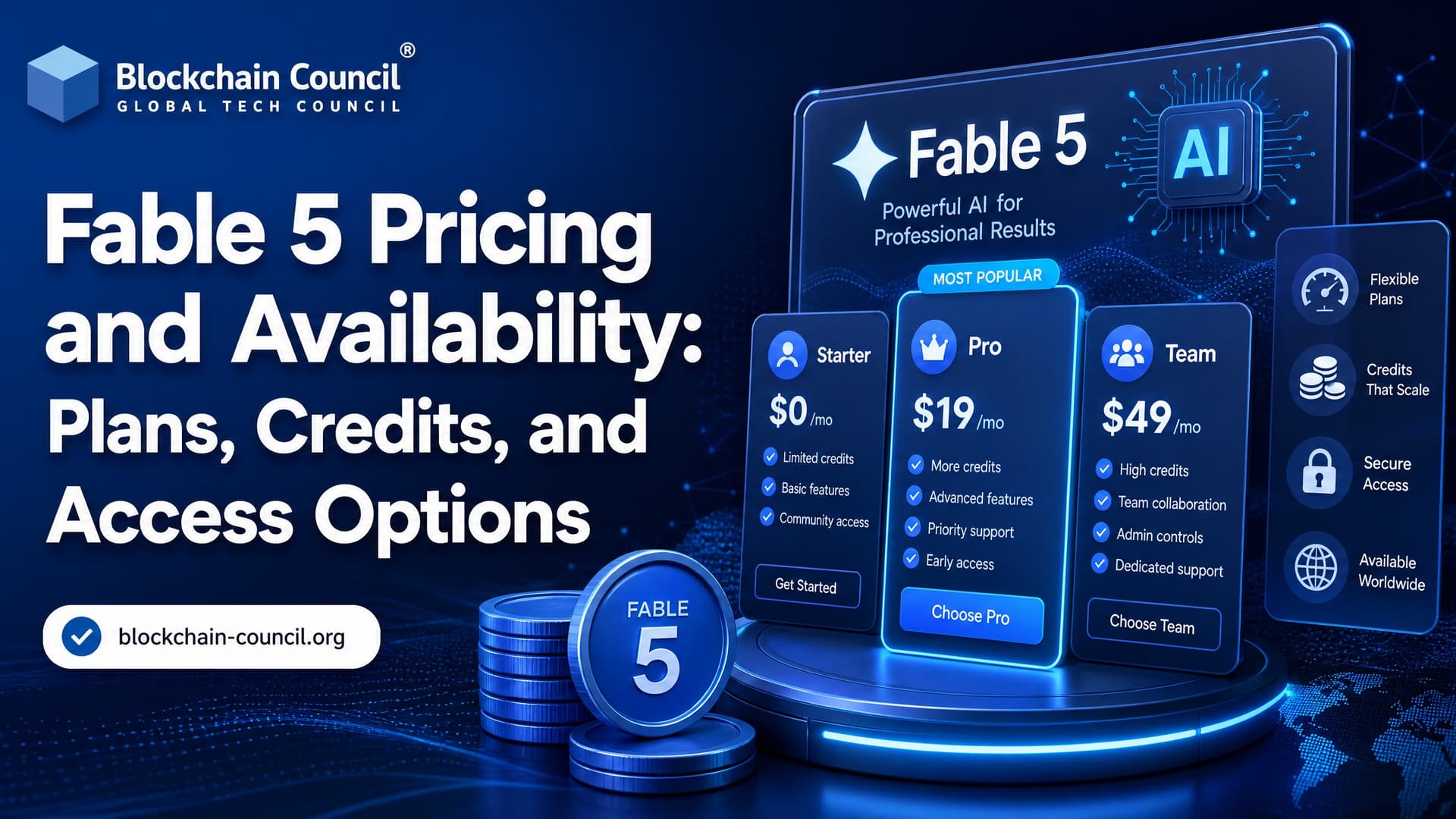
Fable 5 pricing is simple at the API level and messy at the subscription level. The public rate is $10 per million input tokens and $50 per million output tokens for the standard Claude API. If your job can run asynchronously, the Batch API cuts that to $5 per million input tokens and $25 per million output tokens. The bigger change is access. Fable 5 is now centered on API billing and usage credits after the promotional subscription windows ended.
That matters if you are building agents, code tools, research workflows, or enterprise AI systems. A model with a 1 million token context window can burn through budget fast. Very fast.

What is Claude Fable 5?
Claude Fable 5 is Anthropic's most capable publicly available Claude model, positioned as a Mythos-class frontier model for autonomous knowledge work, advanced coding, and complex reasoning. Anthropic launched it publicly on June 9, 2026, as the accessible version of Mythos technology, while Mythos 5 itself remains limited to vetted high-security partners.
OpenRouter lists Fable 5 with a 1,000,000 token context window and support for text, image, and file inputs with text output. That makes it useful for tasks such as:
- Reviewing a large codebase before writing a patch
- Reading long technical documents, contracts, or research files
- Running multi-step agent sessions without constant context trimming
- Combining screenshots, diagrams, and source files in one workflow
TechCrunch described Fable 5 as Anthropic's most powerful public model, with strengths in software engineering, knowledge work, and vision. The trade-off is governance. In high-risk domains such as cybersecurity, biology, chemistry, and model distillation, Anthropic says Fable 5 may refuse a request or fall back to Claude Opus 4.8. Anthropic has also stated that at least 95 percent of Fable sessions run entirely on Fable 5 responses, without Opus substitution.
One detail enterprises should not miss: Fable 5 traffic has a 30 day retention requirement, even for organizations that previously had zero-retention arrangements. If your privacy review process assumes zero retention by default, this model needs a separate approval path.
Fable 5 pricing: Standard API vs Batch API
The cleanest way to understand Fable 5 pricing is to start with the API. Across Anthropic materials and third-party listings, the public rate is consistent.
Standard API pricing
- Input: $10 per million tokens
- Output: $50 per million tokens
- Model name:
claude-fable-5
Finout and TechCrunch both noted that this is roughly double Claude Opus 4.8 pricing. Finout also placed it around 2x GPT-5.5's listed input price, so treat Fable 5 as a premium reasoning model, not a default chat model.
Batch API pricing
- Input: $5 per million tokens
- Output: $25 per million tokens
Use the Batch API when your workload does not need real-time output. Examples include overnight code audits, large document review, benchmark runs, synthetic test generation, or back-office research. If a user is waiting in a chat interface, Batch is the wrong fit. If a pipeline can finish in the background, Batch should be your first cost-control option.
What does a Fable 5 request actually cost?
TechTimes gave a useful example. An agentic turn that reads 50,000 input tokens and writes 10,000 output tokens costs about $1.00 on the standard API. The math is straightforward:
- 50,000 input tokens at $10 per million = $0.50
- 10,000 output tokens at $50 per million = $0.50
- Total = $1.00
That sounds manageable until your agent loops. If your coding agent rereads a 50,000-token repository map on every step, then runs ten verification cycles, you have paid for that context ten times unless your architecture avoids repeated context stuffing. This is the beginner mistake I see most often in agent builds. People polish the prompt wording but ignore repeated context ingestion.
DevelopersDigest reported that heavy tasks can consume 500,000 tokens or more. At Fable 5 rates, a single large job can run from a few dollars to $25 or more depending on how much output the model writes. Output is the expensive side. Ask for full rewritten files when you only need diffs, and your invoice will remind you.
Are subscription plans included?
Not in the way many early users experienced at launch. Fable 5 was initially included at no additional cost for Pro, Max, Team, and seat-based Enterprise plans through June 22, 2026. That was a promotional window, not a permanent entitlement.
TechTimes later reported a short redeployment from July 1 through July 7, where eligible paid subscribers could use Fable 5 for up to 50 percent of weekly usage limits. After that, Fable 5 shifted to credits-only access for those subscription tiers.
Here is the current post-July 7 access model:
- Pro, Max, Team, and premium Enterprise users need usage credits for Fable 5
- Standard Enterprise seats do not receive bundled Fable 5 access unless the organization enables credits
- If credits are not enabled, Fable 5 access can stop rather than convert automatically to metered billing
- Anthropic has not published a clear public credit-to-dollar mapping for subscription users
That last point is critical. DevelopersDigest has warned that community credit estimates are speculative. For planning, use the API price of $10 input and $50 output per million tokens as your anchor.
Fable 5 availability: where you can access it
Claude API
Developers and organizations can access Fable 5 through the Claude API using claude-fable-5, subject to usage billing, safety rules, and the 30 day retention requirement. This is the most direct path if you are building custom software, internal copilots, or agent workflows.
Consumption-based Enterprise
Consumption-based Enterprise customers have had Fable 5 access from launch, billed at the standard per-token rates. These customers were not affected by the June 22 and July 7 subscription cliffs because their contracts already use metered consumption.
Cloud platforms
DevelopersDigest notes that access through major cloud platforms such as Amazon Bedrock, Google Vertex AI, and Foundry was not affected by the subscription change. Exact cloud pricing can vary by platform, so check the provider's current model card and billing page before deploying.
Aggregators and developer tooling
OpenRouter lists Claude Fable 5 with the same $10 and $50 per million token pricing and a 1M token context window. Tools such as MindStudio also document Fable 5 usage flows, which points to its role as a high-end reasoning backend for custom applications and agents.
Who should pay for Fable 5?
To be blunt, Fable 5 is not the right default for every AI workload. Use it when the task has enough complexity to justify the price.
Good fits
- Large codebase work: architecture review, refactoring, test planning, and multi-file changes
- Long document reasoning: technical due diligence, policy review, legal summaries, research synthesis
- High-stakes orchestration: a manager model that plans work for cheaper specialist models
- Vision-assisted analysis: diagrams, screenshots, mockups, and scanned files mixed with text
Poor fits
- Short summarization jobs
- Basic classification
- Simple customer support drafts
- High-volume autocomplete
- Workloads where latency matters less than cost and Batch is not being used
For many teams, Claude Opus 4.8 or a lower-cost model will be close enough for routine work. Community commentary on YouTube has argued that Opus 4.8 at lower settings can be nearer to Fable 5 than the marketing suggests for everyday tasks. I would not treat that as a universal rule, but it is a sensible cost test. Benchmark before you standardize.
Cost-control tactics for Fable 5 teams
If you plan to use Fable 5 in production, set budget controls before the first enthusiastic internal demo. A single agent that runs continuously can create surprise spend. Reddit practitioners have estimated full-time Fable 5 agent costs from $4,000 to $10,000 per month, though those numbers depend heavily on prompts, tool calls, and output length.
- Route by task difficulty. Send simple subtasks to cheaper models. Reserve Fable 5 for planning, verification, and hard reasoning.
- Use Batch API for offline work. It halves input and output costs.
- Limit output length. Ask for patches, summaries, or structured findings instead of full rewrites.
- Stop rereading static context. Chunk repositories and documents intelligently. Do not paste the same giant file set into every turn.
- Log cost per workflow. Track tokens by feature, team, and user, not just total API spend.
- Set kill switches. Long-running agents need maximum turn counts, spending caps, and human approval on expensive loops.
If your team is building these workflows, structured AI training helps. Blockchain Council readers may want to connect this topic with learning paths such as Certified AI Expert™, Certified Generative AI Expert™, and Certified Prompt Engineer™. For developer-heavy teams, pair model training with secure software engineering and AI governance practices.
What to expect next
Anthropic has signaled that usage credits are partly a capacity management tool. The company has also said it intends to restore Fable 5 as a standard subscription feature when capacity allows. No date has been announced.
The near-term pattern is clear. Fable 5 stays premium, metered, and carefully governed. Enterprises will use it selectively, often as the top-level reasoning layer in a hybrid model stack. Subscription users should not assume flat-rate access will return quickly.
Your next step is practical: estimate one real workflow. Count expected input tokens, expected output tokens, number of agent turns, and whether the Batch API can run the job. If the task still justifies Fable 5 after that math, use it. If not, route the work to a cheaper Claude model and save Fable 5 for the parts where frontier reasoning actually pays for itself.
Related Articles
View All
Claude Ai
How to Use Fable 5 for Free: Claude Access Options Explained
Learn how to use Fable 5 for free through Claude plan promotions, Claude Code, and GitLab Duo trials, plus limits, pricing, and smart test cases.

Claude Ai
Fable 5 vs Gemini: Features, Performance, Pricing, and Use Cases Compared
Compare Fable 5 vs Gemini across features, benchmarks, pricing, multimodal support, coding, agents, and enterprise use cases.

Claude Ai
Claude Fable 5 and Claude Mythos 5: Capabilities, Access, and Enterprise Impact
Claude Fable 5 and Claude Mythos 5 bring Mythos-class AI to coding, analytics, and restricted cyber defense, with major implications for enterprises.
Trending Articles

Top 5 DeFi Platforms
Explore the leading decentralized finance platforms and what makes each one unique in the evolving DeFi landscape.
What is AWS? A Beginner's Guide to Cloud Computing
Everything you need to know about Amazon Web Services, cloud computing fundamentals, and career opportunities.

Can DeFi 2.0 Bridge the Gap Between Traditional and Decentralized Finance?
The next generation of DeFi protocols aims to connect traditional banking with decentralized finance ecosystems.