

How to Build Closed-Loop AI Systems for Continuous Learning and Optimization
 Suyash Raizada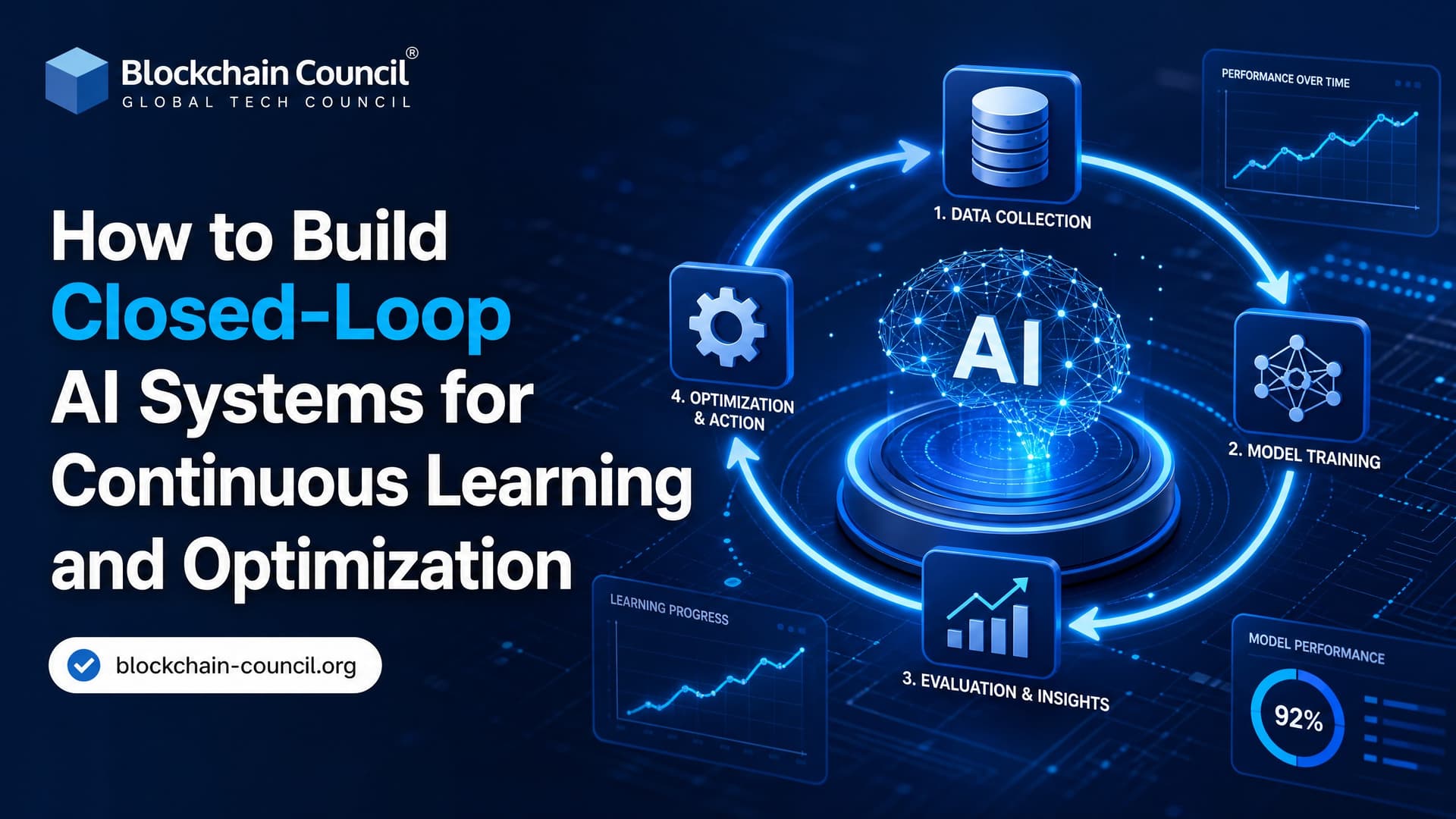
Closed-loop AI systems turn production feedback into model improvement. Instead of shipping a model once and hoping it survives drift, you build a controlled cycle: collect outcomes, evaluate behavior, retrain or adjust policy, redeploy safely, and monitor again.
That sounds simple. It is not. The hard part is deciding what feedback is trusted, when learning should happen, and where humans must stop the automation. Get those choices wrong and a self-improving system becomes a self-amplifying mistake.

As organizations increasingly deploy advanced language models in production, a Claude AI Certification can help professionals build practical expertise in prompt engineering, AI evaluation, model governance, and responsible enterprise AI deployment.
What Is a Closed-Loop AI System?
A closed-loop AI system is an architecture where outputs and real-world outcomes are captured and fed back into the system to improve future decisions. The loop usually runs through prediction, action, measurement, learning, and redeployment.
In a recommendation engine, the loop may use clicks, purchases, skips, and ratings. In fraud detection, analyst decisions and confirmed fraud cases become training signals. In a generative AI support tool, thumbs-down feedback, corrected answers, and escalation outcomes can become evaluation data or fine-tuning examples.
There is a second meaning in enterprise AI. Some teams use closed-loop AI to describe a private environment where data, prompts, logs, feedback, and learning signals stay inside the organization. This matters in finance, healthcare, legal operations, and any setting where sending sensitive feedback to external systems creates risk.
Core Architecture of Closed-Loop AI Systems
A practical closed-loop design has six layers. Skip one and the loop becomes fragile.
Data and event capture: Collect inputs, predictions, user actions, business outcomes, and error reports.
Feedback validation: Filter noisy, malicious, incomplete, or low-confidence feedback.
Evaluation: Measure accuracy, latency, cost, fairness, policy compliance, and business impact.
Learning mechanism: Retrain, fine-tune, update prompts, adjust rules, or update a reinforcement learning policy.
Deployment control: Use model versioning, staged rollout, rollback, and approval gates.
Observability: Log decisions, failures, drift, tool calls, and user-visible outcomes.
Do not start with retraining. Start with measurement. I have watched teams automate weekly retraining before they had a clean label definition. The result was worse than a stale model, because the pipeline learned from mixed labels and duplicated events.
Step 1: Define the Objective and Guardrails
Closed-loop optimization needs a target. Be precise.
Bad target: improve model quality.
Better target: reduce false positives in account takeover alerts by 12 percent while keeping confirmed fraud recall above 94 percent and average review time under 3 minutes.
Your metric set should include:
Model metrics: precision, recall, F1, AUC, calibration, hallucination rate, pass rate on eval sets.
Operational metrics: latency, cost per request, throughput, failure rate.
Business metrics: conversion, retention, fraud loss, support resolution time, downtime avoided.
Risk metrics: bias, toxicity, privacy exposure, unsafe action rate, policy violations.
Pick your trade-offs openly. A medical triage assistant should favor safety and escalation over aggressive automation. A product recommendation model can tolerate more experimentation, as long as privacy rules hold.
Step 2: Build Feedback Pipelines You Can Trust
Feedback is not automatically truth. A five-star rating may mean the answer was correct, or it may mean the user liked the tone. A click may signal interest, confusion, or an accidental tap.
Capture feedback in structured form:
User rating with reason codes such as incorrect, outdated, unsafe, incomplete, or irrelevant.
Ground-truth labels from analysts, auditors, clinicians, or support agents.
Behavioral signals such as conversion, abandonment, retry, escalation, and refund.
System signals such as timeout, tool failure, retrieval miss, or policy block.
Store feedback with lineage. You should know which model version produced the output, which prompt template was used, which retrieval documents were shown, and which user segment saw it.
A small detail that saves real pain: include immutable IDs for model_version, prompt_version, dataset_version, and trace_id in every event. Without those, root-cause analysis becomes guesswork.
Step 3: Choose the Right Learning Strategy
Batch Retraining
Use batch retraining when you can collect verified labels over time and retrain on a schedule or trigger. This fits fraud models, credit risk models, demand forecasting, and many classification systems.
It is predictable and easier to audit. It is also slower.
Online Learning
Online learning updates model parameters as new examples arrive. It works well for streaming environments where patterns change quickly, such as ad ranking, pricing, market signals, and anomaly detection.
Use it carefully. Online learning can chase noise. If attackers can influence your feedback, they can poison the system unless you add validation and rate limits.
Continual Learning
Continual learning helps models adapt to new tasks while retaining prior skills. The known failure mode is catastrophic forgetting, where the model improves on recent data but loses older capability.
For large language models, many production teams avoid continuous weight updates. They prefer safer loops: retrieval updates, prompt tuning, evaluation set expansion, human-reviewed fine-tuning batches, or tool policy changes.
Reinforcement Learning
Use reinforcement learning when the system makes sequential decisions and can learn from rewards. Examples include logistics routing, energy optimization, robotics, warehouse control, and industrial process control.
RL is powerful, but it is the wrong first choice for most business AI projects. If you cannot define the reward clearly, simulate safely, or constrain exploration, start with supervised learning and decision rules.
Step 4: Automate Continuous Training With MLOps
Continuous training is the MLOps practice that connects production data to model updates. Google Cloud and other MLOps references treat it as a core capability for systems that must adapt after deployment.
A production-grade continuous training pipeline should include:
Data validation, including schema checks, missing value checks, and distribution drift tests.
Feature generation with versioned transformation code.
Training jobs with reproducible configs and fixed random seeds where practical.
Evaluation against baseline, holdout, stress, fairness, and regression test sets.
Model registry updates with metadata, lineage, and approval status.
Canary or shadow deployment before full rollout.
Rollback when live metrics breach thresholds.
A practitioner note: if you use MLflow, register the model before trying to transition stages. A common failure during rushed automation is RESOURCE_DOES_NOT_EXIST: Registered Model not found. It usually means the pipeline logged artifacts but never created or referenced the registered model name correctly.
Step 5: Add AI Observability From Day One
Closed-loop AI systems need observability because the feedback loop depends on accurate measurement. For classic models, log inputs, features, prediction scores, labels, latency, and drift. For AI agents, log tool calls, retrieval context, intermediate decisions where allowed, policy checks, identity context, and failure paths.
For LLM applications, track:
Prompt version and system instruction version.
Model name, provider, temperature, max tokens, and retrieval settings.
Retrieved document IDs and similarity scores.
User feedback and reviewer labels.
Safety filter results and escalation events.
Cost per interaction and latency by step.
One quiet setting can change output quality: temperature. For factual support answers, a temperature of 0.2 is often safer than 0.9 because it reduces variation. For creative ideation, higher values may help. Log it either way.
A Tech Certification can further strengthen these capabilities by providing broader knowledge of emerging technologies, cloud platforms, software engineering, observability, and digital systems that support reliable AI applications in production.
Step 6: Keep Humans in the Loop Where Risk Is High
Human-in-the-loop control is not a temporary crutch. In regulated or safety-critical systems, it is part of the architecture.
Use human review when:
The model affects eligibility, credit, hiring, healthcare, legal rights, or account access.
The system sees a new pattern outside the training distribution.
A model update would change a high-impact decision policy.
Feedback labels are ambiguous or adversarial.
The system produces content that may be harmful, defamatory, or privacy-sensitive.
Reviewer decisions should not live in spreadsheets forever. Convert them into structured labels, add reviewer confidence, capture disagreement, and feed only approved examples into training or evaluation.
Governance and Compliance Considerations
Closed-loop learning changes the compliance question. You are not only approving a model once. You are approving a process that can change the model.
The EU AI Act uses a risk-based approach to AI governance, and it has pushed organizations to document logging, human oversight, transparency, and risk management for higher-risk systems. For adaptive systems, that means you need evidence of what changed, why it changed, who approved it, and how it performed after release.
At minimum, maintain:
Training data lineage and consent records where applicable.
Model cards or equivalent documentation.
Evaluation reports for every candidate model.
Approval records for deployment.
Rollback history and incident reports.
Access controls for feedback data and model artifacts.
To be blunt, governance added after deployment rarely works well. Build it into the pipeline.
Common Use Cases for Closed-Loop AI Systems
Healthcare
Closed-loop healthcare systems can combine patient records, monitoring data, clinician feedback, and treatment outcomes. The goal is not to replace clinical judgment. The better design is decision support with strong review, audit trails, and escalation.
Industrial Optimization
Industrial AI controllers use historical plant data, simulations, deep learning, and offline reinforcement learning to recommend real-time adjustments. This is a strong fit, because small efficiency gains can be valuable and the process produces continuous sensor feedback.
Recommendation and Personalization
Recommendation systems are classic closed-loop AI. Every click, skip, purchase, and rating changes the signal landscape. The danger is feedback bias, where the system learns only from what it already chose to show.
Generative AI Support Systems
For customer support and internal knowledge assistants, a good loop captures failed answers, missing documents, agent corrections, and resolution status. Often the best first update is not fine-tuning. It is fixing retrieval quality and adding better source documents.
Skills You Need to Build Closed-Loop AI
You need more than model training skills. You need data engineering, MLOps, evaluation design, observability, security, and governance. Developers should be comfortable with tools such as MLflow, Kubeflow, Airflow, Kafka, feature stores, vector databases, model registries, and cloud monitoring stacks.
If you are building a learning path, consider related Blockchain Council programs such as the Certified Artificial Intelligence (AI) Expert™ for AI foundations and the Certified Generative AI Expert™ for generative AI system design. For teams working with AI agents, prompt engineering, and enterprise automation, these topics pair well with hands-on MLOps practice.
Best Practices Checklist
Define the business objective before choosing an algorithm.
Separate raw feedback from verified labels.
Version prompts, models, datasets, features, and evaluation suites.
Use drift and performance triggers, not blind retraining alone.
Run shadow or canary deployments before full release.
Keep humans in approval loops for high-risk updates.
Monitor live behavior after every model change.
Design for auditability from the first sprint.
Final Takeaway
The best closed-loop AI systems do not learn from everything. They learn from trusted signals, under controlled conditions, with clear rollback paths. That is the difference between continuous optimization and uncontrolled drift.
Your next step: build a small loop around one production model. Add trace IDs, capture verified feedback, create an evaluation set, and automate retraining only after the measurement layer is stable. Then expand the loop with governance, observability, and human review.
As AI-powered products continue to expand across industries, a Marketing Certification can also help professionals understand product positioning, user adoption, stakeholder communication, and go-to-market strategies for innovative AI solutions.
FAQs
1. What Is a Closed-Loop AI System?
A closed-loop AI system continuously collects data, evaluates outcomes, learns from feedback, and improves future decisions or actions through repeated optimization cycles.
2. Why Are Closed-Loop AI Systems Important?
They help organizations improve accuracy, reduce errors, adapt to changing conditions, and optimize business processes without relying only on static rules or one-time model training.
3. How Does a Closed-Loop AI System Work?
It follows a cycle of data input, AI prediction or action, performance measurement, feedback collection, model or workflow adjustment, and continuous monitoring. Machines learning from mistakes, what a concept.
4. What Is Continuous Learning in AI?
Continuous learning means an AI system keeps improving by learning from new data, user behavior, outcomes, and feedback after deployment.
5. How Is Closed-Loop AI Different from Traditional AI?
Traditional AI is often trained once and updated periodically. Closed-loop AI keeps monitoring performance and uses feedback to improve over time.
6. What Are the Core Components of a Closed-Loop AI System?
Core components include data pipelines, AI models, feedback mechanisms, evaluation metrics, monitoring tools, retraining workflows, automation rules, and human oversight.
7. What Role Does Feedback Play in Closed-Loop AI?
Feedback shows whether AI outputs are useful, accurate, or flawed. It helps teams improve models, prompts, workflows, and decision rules.
8. How Can Businesses Build Closed-Loop AI Systems?
Businesses should define goals, collect reliable data, deploy AI models, track outcomes, gather feedback, retrain systems, and monitor performance continuously.
9. What Metrics Should Be Used to Measure Closed-Loop AI Performance?
Useful metrics include accuracy, error rate, response quality, latency, customer satisfaction, conversion rate, cost savings, productivity gains, and model drift indicators.
10. What Is Model Drift in Closed-Loop AI?
Model drift happens when real-world data changes and the AI model becomes less accurate. Closed-loop monitoring helps detect and correct it early.
11. How Does Human-in-the-Loop Support Closed-Loop AI?
Human reviewers validate outputs, correct mistakes, approve high-risk decisions, and provide feedback that improves future AI performance.
12. Can Closed-Loop AI Improve Generative AI Workflows?
Yes. It can evaluate AI-generated content, collect user feedback, refine prompts, improve retrieval quality, and reduce hallucinations over time.
13. How Do AI Agents Use Closed-Loop Systems?
AI agents use feedback to assess task outcomes, adjust workflows, improve future actions, and operate more reliably within defined limits.
14. What Technologies Support Closed-Loop AI?
Common technologies include machine learning models, LLMs, AI agents, APIs, MLOps platforms, data warehouses, vector databases, monitoring tools, and analytics dashboards.
15. What Are the Benefits of Closed-Loop AI?
Benefits include continuous optimization, better decision-making, higher accuracy, reduced manual effort, faster adaptation, improved user experience, and stronger operational efficiency.
16. What Challenges Exist When Building Closed-Loop AI?
Challenges include poor data quality, feedback bias, privacy risks, retraining costs, system complexity, unclear metrics, and over-automation. Naturally, the hard part is making the loop useful instead of just circular.
17. How Can Organizations Reduce Risk in Closed-Loop AI?
They should use governance policies, human oversight, access controls, audit logs, validation checks, model monitoring, and clear escalation rules.
18. Which Industries Use Closed-Loop AI Systems?
Industries such as finance, healthcare, marketing, manufacturing, logistics, cybersecurity, retail, customer support, and education use closed-loop AI for continuous improvement.
19. What Common Mistakes Should Businesses Avoid?
Avoid collecting feedback without acting on it, retraining on bad data, ignoring model drift, tracking too many KPIs, and removing human review from high-impact decisions.
20. What Is the Future of Closed-Loop AI Systems?
Closed-loop AI will become central to intelligent automation, AI agents, and adaptive enterprise systems. Organizations that combine continuous learning, strong monitoring, and human oversight will build more reliable, efficient, and self-improving AI systems.
Related Articles
View All
Claude Ai
Human-in-the-Loop Engineering: Best Practices for Safe and Reliable AI Systems
Learn how human-in-the-loop engineering improves AI safety, reliability, governance, and compliance through feedback, oversight, audit logs, and risk-based review.

Claude Ai
How to Build Reusable Skills in Anthropic's Claude AI
Learn how to build reusable Skills in Anthropic's Claude AI using SKILL.md, metadata, templates, scripts, testing, and workflow best practices.

Claude Ai
How to Use Claude Fable 5.1 for Free
Find out whether Claude Fable 5.1 is available for free, which Claude plans provide access, and what users need to know before trying Anthropic’s latest AI model.
Trending Articles
How Blockchain Secures AI Data
Understand how blockchain technology is being applied to protect the integrity and security of AI training data.
What is AWS? A Beginner's Guide to Cloud Computing
Everything you need to know about Amazon Web Services, cloud computing fundamentals, and career opportunities.
Claude AI Tools for Productivity
Discover Claude AI tools for productivity to streamline tasks, manage workflows, and improve efficiency.