

Human-in-the-Loop Engineering: Best Practices for Safe and Reliable AI Systems
 Suyash Raizada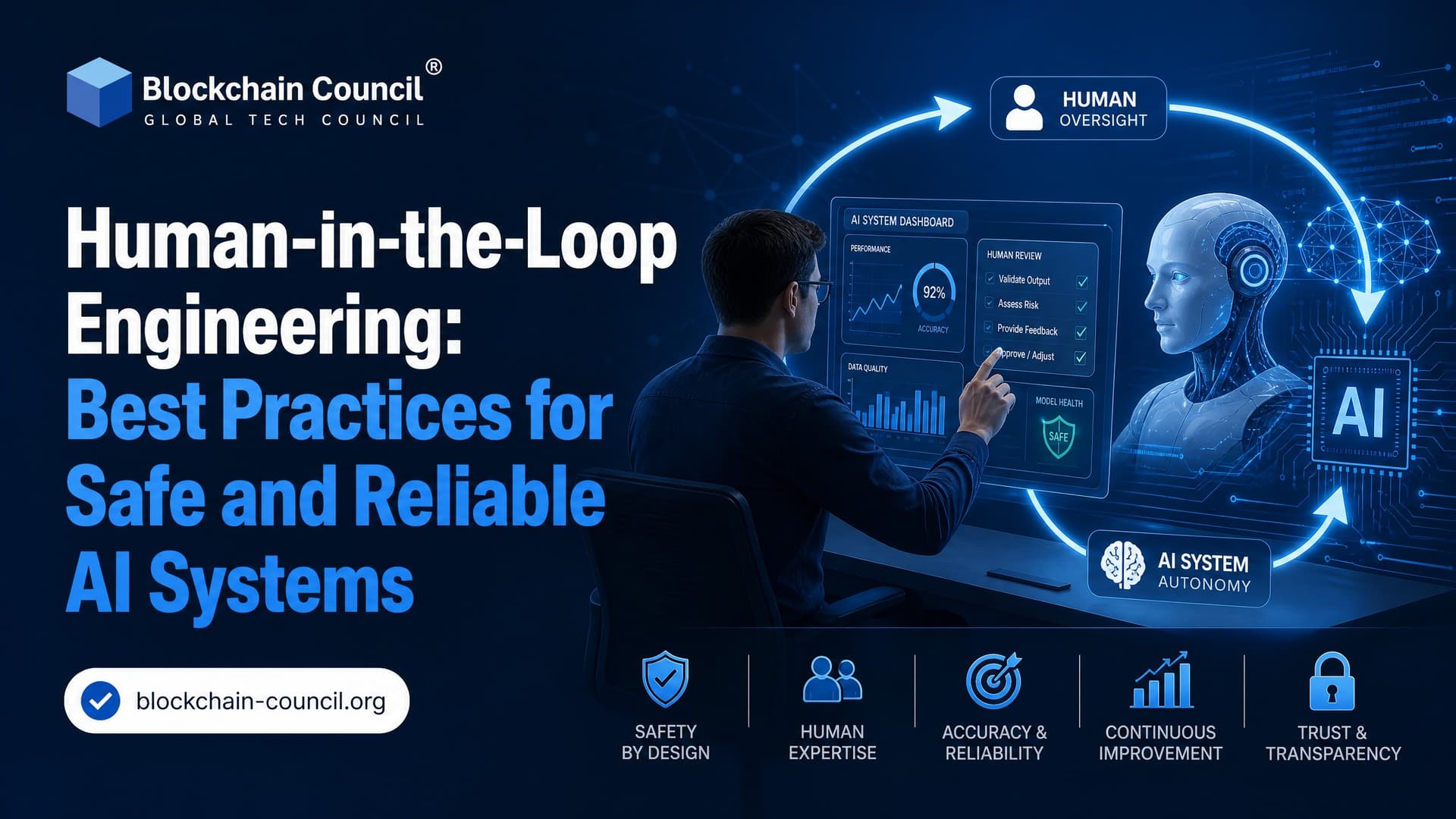
Human-in-the-loop engineering is now a core design practice for AI systems that touch safety, money, health, legal rights, or critical operations. The idea is simple: do not leave every judgment to a model. Put trained humans at the points where their review, feedback, or override can reduce harm.
That sounds obvious. It is not easy. A weak HITL workflow turns into a queue where reviewers click approve because the dashboard is noisy and the deadline is brutal. A good one gives people the context, authority, and time to make a better decision than the model would make alone.

As organizations increasingly deploy advanced language models in high-stakes environments, a Claude AI Certification can help professionals develop practical expertise in prompt engineering, AI governance, human oversight, and responsible deployment of enterprise AI systems.
What Is Human-in-the-Loop Engineering?
Human-in-the-loop engineering, often shortened to HITL, is the practice of intentionally embedding human participation across the AI lifecycle. Humans may label training data, compare model outputs, test dangerous prompts, review low-confidence predictions, approve sensitive decisions, or stop a system that is behaving badly.
In production, HITL usually means routing selected cases to a person based on:
Model confidence: Send low-confidence or uncertain outputs for review.
Business rules: Escalate transactions above a value threshold or claims with missing documents.
Risk signals: Flag medical, legal, biometric, financial, or safety-related outputs.
Regulatory triggers: Require documented review where law or policy demands human oversight.
The engineering part matters. You need queues, reviewer interfaces, audit logs, model version tracking, escalation rules, and feedback loops. Without those, "human oversight" is just a sentence in a policy document.
Why HITL Matters for Safe AI
AI systems fail in ways that classic software usually does not. They can be confident and wrong. They can drift when the input data changes. Generative AI can produce fluent nonsense. In high-risk environments, that is not a small inconvenience.
OpenAI's InstructGPT research showed why human feedback became central to modern model alignment. Human demonstrators and reviewers ranked model responses, those rankings trained a reward model, and reinforcement learning then tuned the base model to follow instructions better. Anthropic later popularized Constitutional AI, used in the Claude family of models, where written principles guide critique and revision of model outputs. These approaches do not remove human judgment. They move it upstream into the training and alignment process.
For enterprises, the lesson is practical. Human feedback improves reliability when it is structured, measured, and fed back into the system. Random review is better than nothing, but it will not scale.
Regulation Is Making Human Oversight Mandatory
EU AI Act Article 14
The EU AI Act places human oversight at the center of high-risk AI governance. Article 14 requires high-risk AI systems to be designed so natural persons can oversee them effectively throughout their lifecycle. Human overseers must be able to understand system capabilities and limits, monitor operation, detect anomalies, recognize automation bias, and intervene when needed.
That last part is important. The overseer must be able to decide not to use the system, override or reverse outputs, or stop operation in a safe way. For some biometric identification uses, automated identification must be confirmed by at least two competent human reviewers before action is taken.
NIST AI Risk Management Framework
The NIST AI Risk Management Framework gives teams a practical structure through its Govern, Map, Measure, and Manage functions. The core message fits HITL well: match oversight intensity to risk. Do not treat a spelling suggestion, a loan denial, and a clinical alert as if they need the same review process.
GDPR and Automated Decisions
GDPR Article 22 is often discussed in relation to the right to obtain human review of certain automated decisions. Whether you work in credit, hiring, insurance, or public services, you need a clear delegation chain. Who approved the AI action? What did they see? What policy allowed it? Can you prove it later?
Best Practices for Human-in-the-Loop Engineering
1. Start With Risk Classification
Before you draw a workflow, classify the use case. Ask what happens if the model is wrong. A hallucinated product description is not the same as a wrong dosage recommendation or a frozen bank account.
Use a risk matrix based on:
Impact on health, safety, and legal rights
Financial exposure
Scale of affected users
Reversibility of the decision
Regulatory obligations
Then define the oversight goal. Are you trying to prevent catastrophic harm, catch edge cases, reduce bias, provide explainability, or support appeals? Be precise.
2. Build Explicit Human Decision Points
Do not bolt review onto the end of the pipeline. Design decision points into the architecture.
A common pattern looks like this:
The model produces a prediction, classification, or generated response.
A policy layer checks confidence, risk category, user profile, and business rules.
Low-risk outputs proceed automatically.
Medium-risk outputs go to sampling or secondary checks.
High-risk outputs require human approval before action.
Give reviewers more than approve or reject. They should be able to edit, escalate, request more data, or mark the case as unsuitable for automation.
One practical detail teams often miss: confidence thresholds are not stable across model versions. If model v2 is recalibrated, a 0.82 confidence score may not mean what it meant in v1. Treat threshold changes like production code changes. Test them, document them, and watch the queue size after deployment.
3. Make the Reviewer Interface Useful
A reviewer cannot make a meaningful decision from a single model output and a green confidence badge. Show the input data, source documents, previous decisions, policy rules, model version, timestamp, and reason for escalation.
For predictive models, tools such as SHAP can help show feature attribution. For document AI, show the extracted text next to the original scan. For LLM outputs, show the system prompt, user prompt, retrieved sources, and policy checks. Hide this context, and you are asking humans to guess.
4. Fight Automation Bias Directly
Automation bias is the tendency to trust machine output too much. It gets worse when people are tired or when dashboards make the AI recommendation look official.
Use these controls:
Train reviewers on known model failure modes.
Blind the AI recommendation for a subset of cases to measure independent human judgment.
Track override rates by team, task type, and model version.
Review near misses, not only incidents.
Use two-person approval for irreversible or high-impact actions.
To be blunt, a human who has three seconds per case is not oversight. It is theater.
5. Use Human Feedback in Training and Evaluation
HITL is not only about production review. It also improves the model itself.
For generative AI, reinforcement learning from human feedback remains the main alignment pattern. Human reviewers compare outputs, rank better responses, and help train reward models. For enterprise LLMs, human evaluation should include adversarial prompts, policy-sensitive scenarios, multilingual examples, and domain-specific edge cases.
For classification and extraction tasks, active learning is often more efficient than random labeling. Let the system select uncertain, novel, or high-value examples for human annotation. You get better training data for less review effort.
6. Assign Authority, Not Just Tasks
Reviewers need the authority to stop, reverse, or escalate an AI decision. The EU AI Act is clear on this point for high-risk systems. From an engineering perspective, that means override buttons must actually work. Stop mechanisms must bring the system to a safe state. Access controls should bind actions to named individuals or roles.
Keep tamper-evident logs of:
Input snapshot
Model name and version
Prompt or feature set used
Reviewer identity or role
Decision taken
Reason code
Timestamp
This helps with audits, but it also helps when production behavior surprises you.
7. Monitor Oversight Effectiveness
If you only monitor model accuracy, you are missing half the system. Monitor the human loop too.
Useful metrics include:
Escalation rate
Human override rate
Average time to review
Queue backlog
Disagreement rate between reviewers
Near-miss count
Post-deployment drift
Coverage of high-risk decision categories
Run no-blame reviews after serious escalations. Was the model wrong? Was the policy unclear? Did the interface hide key context? Was the reviewer overloaded? Usually the answer is a mix.
Where HITL Is Used Today
Large Language Models
LLMs use human preference data during alignment, and enterprises add review layers for regulated content, legal summaries, customer messages, and security-sensitive outputs. Claude's Constitutional AI approach is a strong example of principles shaping model behavior, but production teams still need human review for high-risk use cases.
Document Processing
Insurance and finance teams use HITL with OCR and document extraction for claims, know-your-customer checks, invoices, and contracts. Amazon has described workflows using Textract and Amazon Augmented AI where ambiguous cases are routed to human reviewers, with reported reductions in processing time when review is targeted rather than manual for every case.
Autonomous Systems
Autonomous driving research uses human feedback and intervention to handle edge cases that are hard to simulate. Waymo has acknowledged that its vehicles can request guidance from remote specialists in difficult scenarios, while the vehicle remains responsible for driving execution.
Healthcare
Clinical AI is usually decision support, not autonomous decision-making. Clinicians must validate outputs, understand uncertainty, and retain responsibility for patient care. HITL design here must support shared decision-making, not bury doctors under alerts.
A Tech Certification can further strengthen these capabilities by providing broader knowledge of emerging technologies, cloud platforms, software engineering, and digital systems that support secure, reliable, and human-centered AI deployments.
Skills Professionals Need Next
If you are building or governing AI systems, focus on three skill areas: model evaluation, AI risk management, and production workflow design. Prompt engineering is useful, but it is not enough for high-risk systems.
For structured learning, Blockchain Council's Certified Artificial Intelligence (AI) Expert™ helps professionals build a foundation in AI concepts and governance. Developers working with LLMs and feedback pipelines can also consider the Certified Generative AI Expert™ to connect model behavior, prompt design, and responsible deployment practices.
Final Takeaway
Human-in-the-loop engineering works when humans are treated as part of the system design, not as a last-minute safety net. Start with risk. Build clear decision lanes. Give reviewers context and authority. Measure whether oversight is catching real failures.
Your next step: pick one AI workflow in your organization and map every automated decision, escalation trigger, reviewer action, and audit log. If you cannot explain who can override the model and how, your HITL design is not ready for high-risk use.
As AI-powered products continue to expand across industries, a Marketing Certification can also help professionals understand product positioning, stakeholder communication, user adoption, and go-to-market strategies for innovative AI solutions.
FAQs
1. What Is Human-in-the-Loop (HITL) Engineering?
Human-in-the-Loop (HITL) engineering is an AI development approach where human expertise is integrated into AI workflows to review outputs, provide feedback, validate decisions, and improve system performance while maintaining oversight.
2. Why Is Human-in-the-Loop Engineering Important?
HITL engineering helps improve AI accuracy, reduce errors, minimize bias, increase transparency, and ensure that critical decisions receive human review before important actions are taken.
3. How Does Human-in-the-Loop Engineering Work?
The process combines AI automation with human oversight. AI generates recommendations or performs tasks, humans review or validate the results when needed, provide feedback, and that feedback is used to improve future performance.
4. How Is Human-in-the-Loop Different from Fully Autonomous AI?
Fully autonomous AI operates with minimal human involvement, while HITL systems include human review, approval, or intervention at key stages to improve safety, quality, and accountability.
5. What Are the Key Components of Human-in-the-Loop Engineering?
Core components include AI models, human reviewers, feedback mechanisms, performance monitoring, decision validation, workflow automation, governance policies, and continuous improvement processes.
6. Why Is Human Oversight Important in AI Systems?
Human oversight helps identify AI mistakes, verify outputs, handle complex situations, ensure ethical decision-making, and prevent incorrect or harmful actions in high-impact applications.
7. How Does HITL Improve AI Accuracy?
Humans review AI outputs, correct inaccuracies, identify edge cases, and provide feedback that improves prompts, workflows, or future model performance through continuous learning.
8. How Can Human Feedback Improve Generative AI?
Human feedback helps refine prompts, evaluate response quality, reduce hallucinations, improve factual accuracy, and align AI-generated content with business or user requirements.
9. What Role Does HITL Play in AI Agents?
Human oversight ensures AI agents operate within defined boundaries, validates critical decisions, reviews exceptions, and monitors autonomous workflows for safety and reliability.
10. Which Industries Use Human-in-the-Loop AI?
Healthcare, finance, legal services, cybersecurity, manufacturing, education, government, customer support, human resources, autonomous vehicles, and retail all use HITL approaches.
11. How Does Human-in-the-Loop Support AI Governance?
HITL strengthens governance by introducing approval workflows, accountability, auditability, compliance checks, and documented review processes for AI-assisted decisions.
12. How Can HITL Reduce AI Bias?
Human reviewers can identify biased outputs, evaluate fairness, review training data quality, and recommend improvements that help reduce unfair or discriminatory AI behavior.
13. Which Technologies Support Human-in-the-Loop Engineering?
Common technologies include large language models (LLMs), AI agents, workflow automation platforms, MLOps tools, prompt management systems, monitoring dashboards, APIs, and analytics platforms.
14. What Are the Benefits of Human-in-the-Loop Engineering?
Benefits include improved AI reliability, higher accuracy, stronger compliance, better risk management, greater transparency, increased trust, continuous learning, and safer AI deployment.
15. What Challenges Exist When Implementing HITL Systems?
Organizations may face challenges such as balancing automation with manual reviews, reviewer consistency, operational costs, workflow complexity, scalability, reviewer fatigue, and response time requirements.
16. How Can Businesses Build Effective Human-in-the-Loop Workflows?
Businesses should define review criteria, identify high-risk decisions, assign appropriate human reviewers, monitor AI performance, document feedback, and continuously refine workflows using measurable KPIs.
17. What Skills Are Needed for Human-in-the-Loop Engineering?
Professionals should understand AI fundamentals, prompt engineering, machine learning, workflow automation, data analysis, AI governance, quality assurance, risk management, and business process design.
18. How Can Organizations Measure the Success of HITL Systems?
Success can be measured through AI accuracy, reduced error rates, faster review times, improved customer satisfaction, compliance performance, reviewer agreement, operational efficiency, and business outcomes.
19. What Common Mistakes Should Organizations Avoid When Implementing Human-in-the-Loop Engineering?
Avoid reviewing every AI output regardless of risk, providing reviewers with unclear guidelines, collecting feedback without using it, failing to monitor reviewer quality, and assuming human review guarantees perfect results. Effective HITL systems rely on clear governance, well-defined escalation paths, continuous feedback, and regular performance evaluation.
20. How Will Human-in-the-Loop Engineering Shape the Future of AI?
Human-in-the-Loop engineering will remain essential as AI systems become more capable and autonomous. By combining AI automation with expert human judgment, organizations can build systems that are more accurate, transparent, and reliable. As regulations evolve and AI adoption expands, HITL will play a central role in supporting responsible AI deployment, strengthening governance, reducing operational risks, and maintaining trust in AI-powered decision-making.
Related Articles
View All
Claude Ai
Fable 5 API Guide: Integration, Use Cases, and Developer Best Practices
A practical Fable 5 API guide covering integration paths, effort tuning, long-running agents, enterprise use cases, pricing, and production best practices.

Claude Ai
Claude Sonnet 5 in AI-Powered Crypto Trading: Opportunities, Risks, and Best Practices
Claude Sonnet 5 can support AI-powered crypto trading through research, monitoring, and strategy support, but execution needs strict controls.

Claude Ai
Claude Prompt vs Claude Looping: Key Differences, Use Cases, and Best Practices
Learn the practical difference between Claude prompting and Claude looping, including when to use each, key risks, agent workflows, and best practices.
Trending Articles
The Role of Blockchain in Ethical AI Development
How blockchain technology is being used to promote transparency and accountability in artificial intelligence systems.

Top 5 DeFi Platforms
Explore the leading decentralized finance platforms and what makes each one unique in the evolving DeFi landscape.
What is AWS? A Beginner's Guide to Cloud Computing
Everything you need to know about Amazon Web Services, cloud computing fundamentals, and career opportunities.