

Why Companies Are Investing in Blockchain Technology?
 Suyash Raizada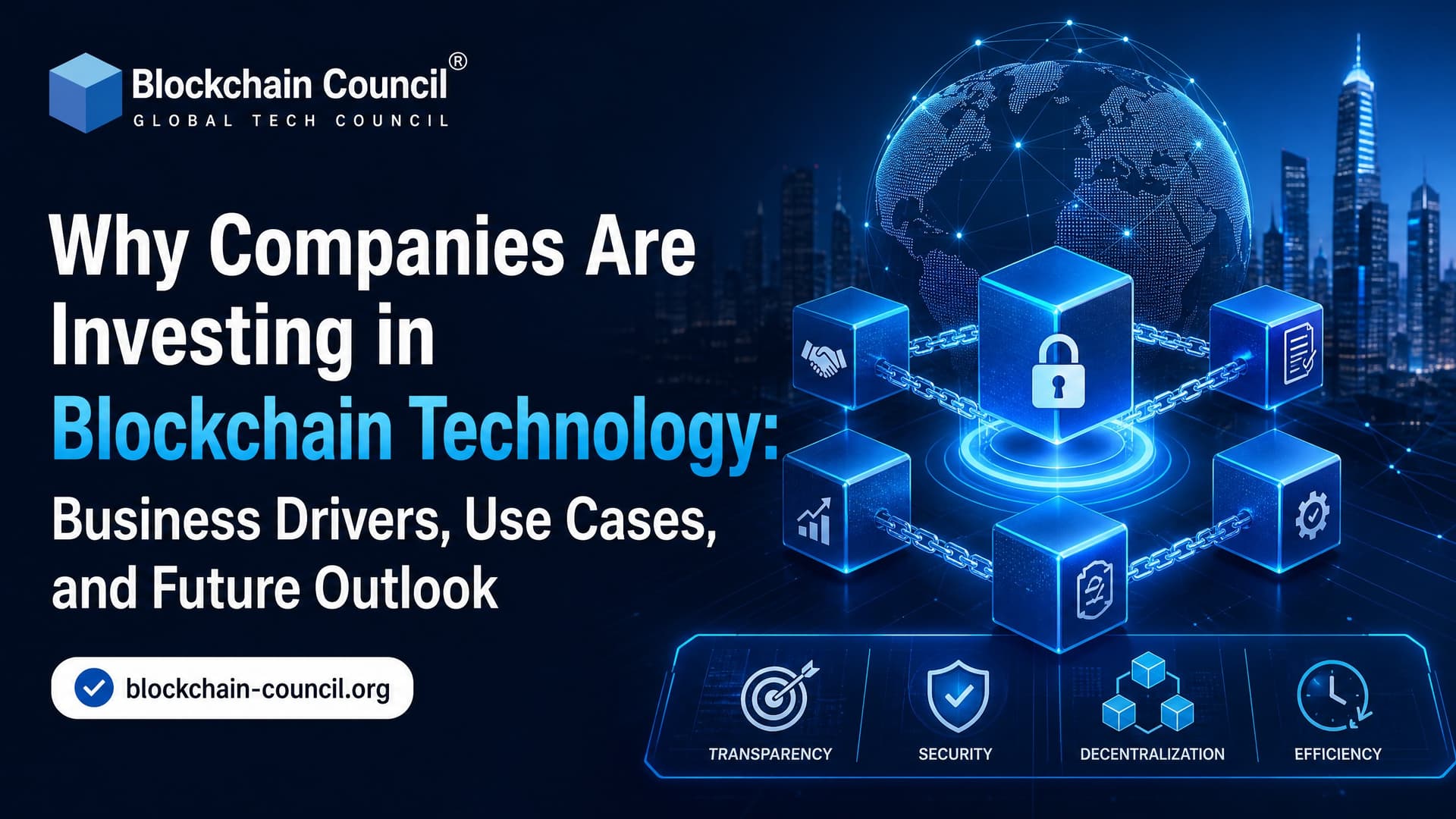
Why companies are investing in blockchain technology has become a central question for executives, developers, investors, and technology teams. Blockchain is no longer viewed only as the infrastructure behind cryptocurrencies. It is increasingly used to reduce intermediaries, improve transparency, strengthen data integrity, automate transactions, and create new digital business models across industries.
At its core, blockchain is a distributed database that allows multiple participants to share synchronized records without relying on a single central administrator. AWS describes blockchain as a shared, immutable ledger that supports trusted transactions across business networks. This matters because many business processes still depend on fragmented databases, repeated verification, manual reconciliation, and expensive intermediaries.

For companies, the appeal is practical. Blockchain can lower costs, speed up settlement, improve auditability, and make assets programmable. It can also support newer models such as tokenized assets, stablecoin payments, digital identity, play-to-earn gaming, and traceable supply chains.
What Makes Blockchain Valuable for Companies?
Blockchain combines several technical properties that address long-standing business challenges:
Decentralization: Data is shared across multiple nodes instead of being controlled by one party.
Immutability: Once transactions are recorded, they are extremely difficult to alter, creating a reliable audit trail.
Transparency: Participants can access a common view of relevant data, while permissioned systems protect sensitive information.
Smart contracts: Business rules can be coded into the network so transactions execute automatically when conditions are met.
Security: Cryptographic validation and distributed storage reduce single points of failure.
These features make blockchain useful in industries where trust, verification, and coordination are costly. Commonfund has described blockchain as a generational platform shift with potential impact comparable to the early internet. That perspective helps explain why corporate interest has expanded from experimentation to strategic investment.
Why Companies Are Investing in Blockchain Technology Now
1. Reducing Costs and Operational Friction
One of the strongest reasons companies invest in blockchain is cost reduction. Many enterprise workflows involve multiple parties maintaining their own records, then spending time and money reconciling differences. Blockchain replaces duplicated record-keeping with a shared ledger that all authorized participants can reference.
This is especially valuable in financial services, logistics, trade finance, and insurance. For example, blockchain-based settlement can reduce delays caused by clearing houses and correspondent banking networks. In supply chains, shared ledgers can reduce paperwork, verification costs, and disputes between suppliers, shippers, distributors, and retailers.
PixelPlex identifies the need to simplify business processes as a major driver of enterprise blockchain investment. When smart contracts are added, companies can automate payments, approvals, claims, and compliance checks, reducing manual intervention and administrative overhead.
2. Improving Trust, Transparency, and Auditability
Trust is expensive in business. Companies pay auditors, banks, insurers, custodians, registries, and compliance teams to verify facts and reduce risk. Blockchain offers a shared, tamper-resistant source of truth that can reduce dependency on some of these verification layers.
In regulated sectors such as finance, healthcare, food, and pharmaceuticals, auditability is a major advantage. Transactions can be traced from origin to destination, and records can be verified without relying entirely on paper documents or siloed databases. Thornburg has highlighted blockchain's ability to improve accountability and efficiency throughout global supply chains by accurately recording the origin and movement of goods.
This level of transparency is also relevant for environmental, social, and governance reporting. Companies can use blockchain to support claims about sustainable sourcing, ethical labor practices, carbon tracking, and product authenticity.
3. Strengthening Supply Chain Traceability
Supply-chain disruption, counterfeiting, and regulatory pressure have made traceability a board-level concern. Blockchain helps companies trace products from source to shelf by recording each handoff in a shared ledger.
In food and agriculture, blockchain can help verify origin, safety checks, storage conditions, and recall information. In pharmaceuticals, it can help track medicines and reduce counterfeit risk. In luxury goods, it can prove authenticity and ownership history.
Because the records are difficult to manipulate, blockchain-based traceability can improve consumer confidence and regulatory compliance. It also gives enterprises faster visibility into bottlenecks, quality issues, and supplier performance.
4. Enabling Digital Assets and Tokenization
The growth of digital assets is another major reason companies are investing in blockchain technology. Invesco notes that digital assets have reached meaningful scale and are increasingly seen as a distinct asset class within the global financial system.
Tokenization allows real-world or digital assets to be represented as tokens on a blockchain. This can apply to securities, real estate, commodities, invoices, carbon credits, intellectual property, and loyalty points. Tokenized assets can support fractional ownership, faster transfer, programmable rights, and potentially around-the-clock markets.
For financial institutions, tokenization creates opportunities in custody, trading, settlement, fund administration, and asset management. For enterprises, it can support new financing models, customer engagement strategies, and digital marketplaces.
5. Modernizing Payments and Settlement
Payments remain one of the most visible enterprise blockchain use cases. Invesco has noted that large, well-known companies are already using blockchain-based solutions such as stablecoins for payments and settlement.
Stablecoins and tokenized deposits can help companies move value more quickly, particularly across borders. Traditional cross-border payments can be slow, costly, and dependent on multiple intermediaries. Blockchain-based payment rails can offer near real-time settlement, lower transaction costs, and better transparency into payment status.
This is relevant for fintech companies, multinational enterprises, marketplaces, gig economy platforms, and remittance providers. It also supports financial inclusion by enabling peer-to-peer transfers for users who may not have full access to traditional banking infrastructure.
6. Creating New Business Models
Blockchain is not only about improving existing systems. It also enables business models that were previously difficult to implement.
Blockchain gaming: Players can own in-game assets as tokens and trade them outside a single platform.
Play-to-earn economies: Users can earn digital assets through participation, creating new incentive structures.
Decentralized platforms: Communities can coordinate ownership, governance, and rewards through tokens.
Digital identity: Users can control credentials and share verified information selectively.
Creator economies: Artists, musicians, and publishers can track ownership, royalties, and licensing through smart contracts.
Commonfund has pointed to blockchain gaming and digital scarcity as examples of how verifiable ownership can reshape digital economies. For companies, these models offer new ways to build communities, reward participation, and monetize digital experiences.
Real-World Corporate Use Cases
Financial Services
Banks, asset managers, exchanges, and fintech firms are exploring blockchain for settlement, custody, tokenized funds, digital assets, compliance, and cross-border payments. Deloitte reports that corporates are increasingly investing in crypto and blockchain infrastructures to support new ecosystems and business models.
Real Estate
Blockchain can create immutable title registries and reduce friction in property transactions. Commonfund notes that title registries represent a market of about 22 billion USD, and blockchain could streamline parts of the work currently handled by title companies and insurers.
Healthcare
Healthcare organizations can use blockchain for pharmaceutical traceability, clinical trial data integrity, consent management, and secure record sharing. Permissioned blockchain networks are especially relevant because healthcare data requires strict privacy controls.
Logistics and Manufacturing
Manufacturers and logistics providers use blockchain to track raw materials, components, certifications, shipping events, and compliance documents. This helps reduce disputes and gives customers more confidence in product provenance.
Challenges Companies Must Consider
Despite its benefits, blockchain is not a universal solution. Companies need to evaluate whether a shared ledger is truly necessary. If only one organization controls the data and all users already trust that organization, a traditional database may be simpler and more cost-effective.
Key challenges include:
Regulation: Rules for digital assets, custody, privacy, and smart contracts continue to evolve.
Integration: Blockchain systems must connect with ERP, CRM, cloud, and legacy infrastructure.
Scalability: Networks must handle enterprise transaction volumes reliably.
Governance: Participants need clear rules for access, upgrades, dispute resolution, and data ownership.
Talent: Companies need professionals who understand blockchain architecture, security, compliance, and business strategy.
This is where structured education becomes important. Professionals can build relevant capabilities through Blockchain Council programs such as the Certified Blockchain Expert, Certified Blockchain Developer, and related blockchain certification courses, which help readers move from awareness to practical implementation skills.
The Future of Corporate Blockchain Investment
Three major trends are likely to shape the future of blockchain investment. First, more pilots will move into production as companies identify use cases with clear return on investment. Second, tokenization will expand across financial and real-world assets. Third, blockchain will increasingly integrate with AI, IoT, cloud infrastructure, and digital identity systems.
Regulation will also play a central role. As stablecoins, tokenized securities, and blockchain-based payment systems become more common, companies will need compliant architectures and strong governance. Permissioned networks, regulated custodians, and enterprise-grade security controls are likely to become more important.
In the long term, blockchain may become less visible as a standalone technology and more embedded within business infrastructure. Much like cloud computing, its value will come from enabling faster, more trusted, and more programmable digital operations.
Conclusion
Why companies are investing in blockchain technology comes down to a combination of efficiency, trust, security, innovation, and strategic positioning. Blockchain helps companies reduce intermediaries, improve auditability, trace assets, automate workflows, and participate in emerging digital asset ecosystems.
The strongest business cases are found where multiple parties need to share trusted data, transfer value, verify provenance, or coordinate complex processes. While challenges remain in regulation, integration, scalability, and governance, the direction is clear: blockchain is moving from experimental technology to enterprise infrastructure.
For professionals and organizations, understanding blockchain is becoming a practical advantage. Building expertise now can help teams evaluate use cases more effectively, manage risk, and design systems that are ready for the next phase of digital transformation.
Related Articles
View All
Blockchain
Blockchain Explained: The Technology Changing How We Trust & Transact
Blockchain explained from the ground up: what it is, why it was created, centralised vs decentralised systems, how blocks, nodes, and ledgers work, how data is stored, security, real-world examples, and how blockchain compares with traditional databases.

Blockchain
Blockchain Train Technology: Rail Use Cases, Benefits, and Limits
Blockchain train technology is moving from pilots to practical rail use cases in freight, ticketing, asset records, IoT security, and audit trails.

Blockchain
Beyond Cryptocurrency: How Blockchain Is Transforming Real-World Industries
Explore how blockchain works beyond cryptocurrency in banking, supply chains, healthcare, tokenisation, CBDCs, and government, plus key challenges and career paths.
Trending Articles

Top 5 DeFi Platforms
Explore the leading decentralized finance platforms and what makes each one unique in the evolving DeFi landscape.
What is AWS? A Beginner's Guide to Cloud Computing
Everything you need to know about Amazon Web Services, cloud computing fundamentals, and career opportunities.

Can DeFi 2.0 Bridge the Gap Between Traditional and Decentralized Finance?
The next generation of DeFi protocols aims to connect traditional banking with decentralized finance ecosystems.