

Top 5 Blockchain Implementations by China
 Toshendra Kumar Sharma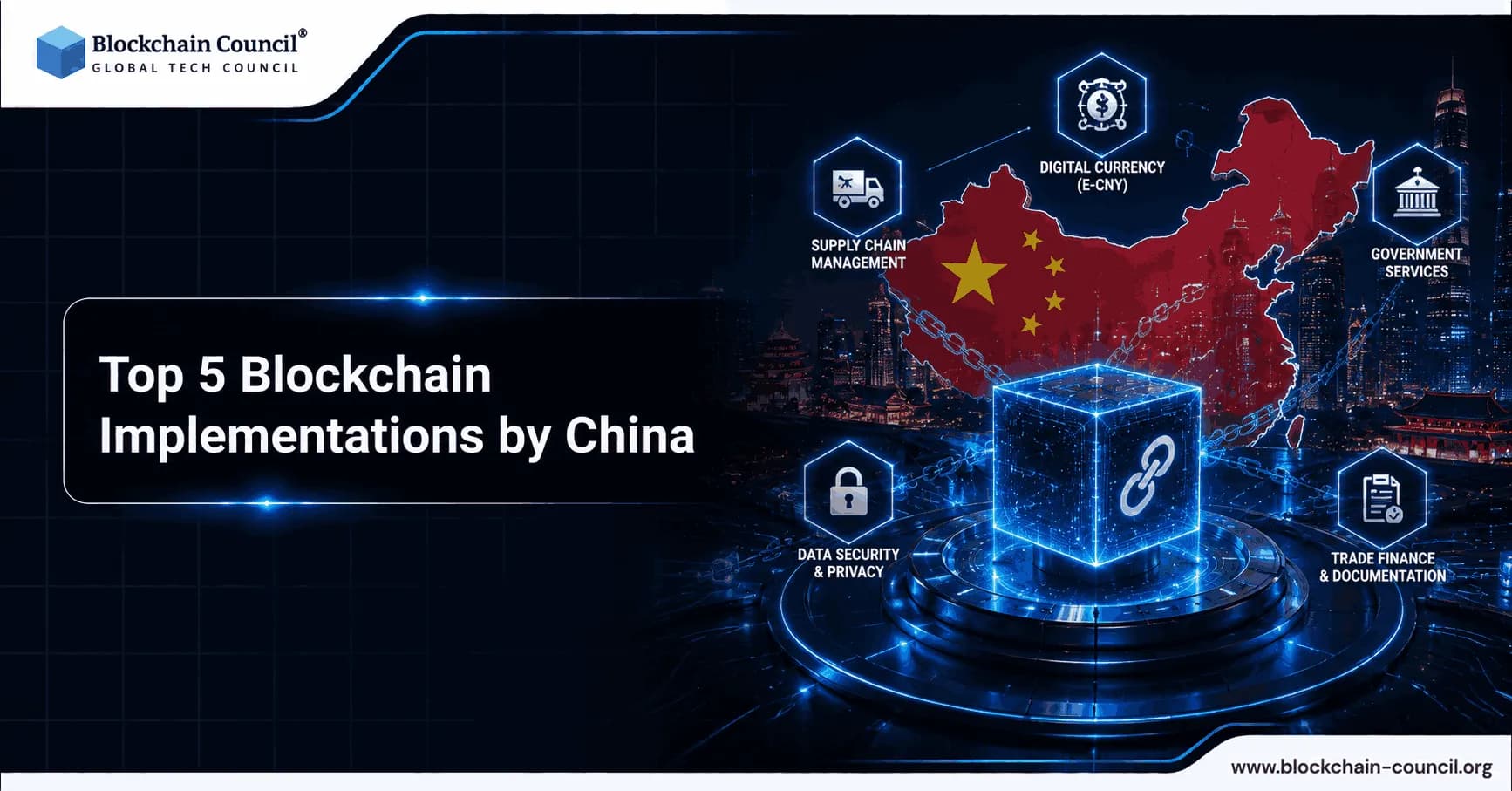
China has taken an approach to blockchain that looks almost nothing like the rest of the world's. While most countries let private markets lead cryptocurrency and blockchain adoption, China banned cryptocurrency trading and mining outright, then poured state resources into building blockchain infrastructure it fully controls. The results are staggering in scale. The country's digital yuan has processed more than 3.4 billion transactions worth roughly 2.3 trillion dollars as of late 2025, and its state-backed blockchain network now operates in more than 20 countries worldwide. Understanding China's five most significant blockchain implementations reveals a genuinely different model for how a major economy can deploy this technology, one built on centralized coordination rather than decentralized experimentation.
Making sense of implementations built at this scale, and understanding exactly how they differ from blockchain projects elsewhere in the world, requires real technical grounding. A recognized Certified Blockchain Expert credential gives professionals the foundation needed to evaluate China's blockchain strategy on genuine technical substance rather than headline transaction volumes alone.

1. The Digital Yuan, China's Central Bank Digital Currency
The e-CNY, commonly known as the digital yuan, stands as the world's most advanced central bank digital currency implementation. Nearly a decade after its first pilot tests began, the People's Bank of China has moved the digital yuan from an experimental phase into a genuinely mature, operational system. As of the end of November 2025, it had processed more than 3.4 billion transactions worth approximately 2.3 trillion dollars, an increase of over 800 percent compared to 2023, with the number of active digital wallets climbing past 2 billion.
Starting January 1, 2026, the digital yuan entered an entirely new phase, becoming interest-bearing for the first time, a first among any central bank digital currency globally. This shift moves the e-CNY from functioning like digital cash toward operating as a genuine digital deposit, with wallet balances treated as liabilities of commercial banks under central bank oversight. The People's Bank of China has also begun including digital yuan holdings in official deposit reserves, giving Beijing a level of direct monetary policy integration no other major economy has yet achieved with its own digital currency.
2. The Blockchain-Based Service Network (BSN)
Launched in 2020 and led by the state-backed firm Red Date Technology, the Blockchain-based Service Network provides a standardized, low-cost platform that lets developers deploy blockchain applications without building infrastructure from scratch. Within China, more than 120 public city nodes, essentially regional data centers, give developers access to the network across the country, while an international version called BSN Spartan has expanded aggressively into the Middle East, Africa, and Southeast Asia, establishing nodes in more than 20 countries by early 2025.
BSN has been described by policy analysts as a kind of digital Belt and Road initiative, extending China's infrastructure influence into blockchain the same way earlier state-backed programs extended physical infrastructure like ports and railways into partner countries. Notably, BSN prohibits independent cryptocurrencies from operating on the network entirely, meaning any blockchain-integrated payment services built on top of it, from utility billing to trade settlement, default naturally toward using the digital yuan instead, reinforcing e-CNY adoption through the network's own architecture.
Understanding the deeper Web3 and decentralized infrastructure concepts BSN deliberately excludes, and why China chose that specific architectural path, is exactly the kind of technical distinction a Certified Web3 Expert credential helps clarify, giving professionals the grounding to evaluate why China's blockchain model diverges so sharply from the permissionless, cryptocurrency-native systems dominant elsewhere in the world.
3. Project mBridge, Cross-Border CBDC Settlement
Project mBridge represents China's most significant push into cross-border digital currency infrastructure, a multi-central-bank digital currency bridge designed to let participating countries settle international transactions directly using digital currencies rather than routing through traditional correspondent banking systems. The platform has processed thousands of cross-border payments with a cumulative value equivalent to tens of billions of dollars, with digital yuan transactions accounting for the overwhelming majority, over 95 percent, of total settlement volume on the network.
The system settles transactions within seconds at near-zero cost by deliberately bypassing traditional settlement infrastructure like SWIFT, removing correspondent banking intermediaries, and using smart contracts to handle compliance checks, fixed exchange rates, and cryptographic verification automatically. Policy researchers have characterized mBridge, alongside BSN, as part of a deliberate strategy to build alternative financial infrastructure resilient to external pressure, giving China new tools for economic influence independent of dollar-denominated payment rails.
4. China's Judicial Blockchain System
China operates one of the world's most extensive blockchain implementations specifically built for legal evidence and judicial proceedings. Internet courts in cities including Hangzhou, Beijing, and Guangzhou use blockchain technology to timestamp and verify digital evidence, ranging from electronic contracts to intellectual property records, creating a tamper-proof chain of custody that courts can rely on without lengthy manual authentication processes.
This system addresses a genuinely practical problem at national scale: digital evidence, screenshots, chat logs, electronic signatures, is notoriously easy to fabricate or dispute in court, and China's judicial blockchain infrastructure gives litigants and judges a verifiable, court-recognized way to confirm that a piece of digital evidence has not been altered since it was recorded. The approach has since expanded beyond the original pilot courts into broader use across China's legal system, reflecting genuine institutional confidence in blockchain's evidentiary value rather than treating it as an experimental pilot.
5. Ant Group's Enterprise Blockchain Infrastructure
Ant Group, the financial technology affiliate of Alibaba, has built one of the largest enterprise blockchain patent portfolios in the world, numbering in the thousands of filings, and has deployed that technology commercially across supply chain finance, cross-border payments, and trade settlement. Ant Group's blockchain platform supports real-time verification for trade finance transactions, letting banks and trading partners confirm shipment status, invoice authenticity, and payment conditions without the manual, paper-heavy verification process traditional trade finance has relied on for decades.
This enterprise-focused implementation illustrates a distinct but complementary track within China's broader blockchain strategy, one led by a private technology giant rather than the state directly, but still operating firmly within China's broader regulatory framework that channels commercial blockchain innovation toward supply chain, trade, and financial infrastructure applications rather than speculative cryptocurrency trading.
Evaluating enterprise blockchain implementations at this scale, spanning patent strategy, trade finance integration, and commercial deployment across a genuinely massive user base, requires real technical depth. A structured Tech Certification in blockchain development gives engineering and product teams the practical skills needed to understand how systems like Ant Group's actually function architecturally, rather than relying on patent counts alone as a proxy for real capability.
What China's Approach Reveals About State-Led Blockchain Strategy
Taken together, these five implementations tell a consistent story. China has pursued blockchain not as a decentralized, permissionless technology in the Bitcoin or Ethereum tradition, but as controllable, state-aligned infrastructure serving specific national goals: monetary policy integration through the digital yuan, global infrastructure influence through BSN, alternative cross-border settlement rails through mBridge, judicial efficiency through evidence verification, and commercial trade facilitation through enterprise platforms like Ant Group's. Each implementation reinforces the others, with BSN's architecture funneling payments toward e-CNY, and mBridge extending e-CNY's reach beyond China's own borders entirely.
Future-Ready Skills
As technology becomes increasingly important across industries, students need opportunities to develop future-ready skills early in their education. A Tech Olympiad can introduce students to areas such as artificial intelligence, coding, cybersecurity, robotics, and computational thinking while encouraging curiosity and continuous learning.
Final Thoughts
China's top blockchain implementations reveal a government treating this technology as core national infrastructure rather than a speculative financial instrument, a sharp contrast to how blockchain has evolved in most of the rest of the world. From the digital yuan's unprecedented transaction volume to BSN's expanding international footprint and mBridge's growing role in cross-border settlement, these five systems collectively represent one of the most ambitious, coordinated blockchain strategies any single country has ever attempted.
Explaining a strategy this different, and this significant, to audiences outside China who may only be familiar with decentralized, cryptocurrency-native blockchain models takes real communication skill. That is where a well-rounded Marketing Certification becomes genuinely valuable, helping analysts, businesses, and platforms translate China's state-led blockchain approach into messaging that a global audience can actually understand and contextualize against blockchain models they may already be familiar with.
FAQs
1. What are the top 5 blockchain implementations in China?
Five major areas of blockchain implementation in China are the Blockchain-based Service Network, blockchain-enabled trade and supply-chain systems, blockchain-based electronic invoicing and government services, judicial blockchain applications, and blockchain infrastructure supporting financial and digital-asset innovation. These projects demonstrate China's preference for controlled, enterprise-oriented distributed-ledger systems rather than unrestricted cryptocurrency ecosystems.
2. What is China's Blockchain-based Service Network?
The Blockchain-based Service Network, commonly known as BSN, was developed as infrastructure intended to make blockchain applications easier and less expensive to deploy. It provides standardized environments for organizations and developers building distributed applications. BSN represents China's broader strategy of treating blockchain as digital infrastructure that can support enterprise and government applications without depending on speculative cryptocurrency markets.
3. Why is BSN considered an important Chinese blockchain implementation?
BSN is significant because it approaches blockchain as shared infrastructure rather than as a single application. Developers and organizations can use standardized services instead of building every blockchain component independently. This model can reduce technical barriers and support applications across government, finance, supply chains, identity, and enterprise services. It also illustrates China's preference for governed blockchain environments.
4. How has China used blockchain for electronic invoices?
Chinese cities and technology companies have experimented with blockchain-based electronic invoicing to improve invoice verification and reduce fraud. Shenzhen became particularly well known for blockchain-enabled electronic invoices. Businesses could issue digitally verifiable invoices while authorized systems maintained auditable records, potentially simplifying reimbursement, taxation, and accounting processes.
5. Why is blockchain useful for China's tax and invoice systems?
Invoices are important for taxation, reimbursement, and business accounting, making authenticity essential. Blockchain can create tamper-evident records showing when invoices were issued and processed. Authorized organizations can verify the information more efficiently, reducing opportunities for duplicate or fraudulent invoices. The technology works best when integrated with government tax platforms and conventional enterprise accounting systems.
6. How has China implemented blockchain in supply chains?
Chinese businesses have explored blockchain for product provenance, manufacturing, logistics, food safety, luxury goods, and cross-border trade. Important events such as production, inspection, shipment, customs processing, and delivery can be recorded or cryptographically verified. China's enormous manufacturing sector makes supply-chain blockchain particularly relevant because products frequently pass through numerous independent companies before reaching consumers.
7. How can blockchain improve food traceability in China?
Food producers and retailers can associate products with digital identities and record selected supply-chain events. Consumers or regulators can potentially verify information about origin, processing, inspection, and distribution. Blockchain can make historical records harder to alter, although reliable physical inspections and data-entry procedures remain necessary. A distributed ledger can preserve a claim about a cabbage; it cannot personally interrogate the cabbage.
8. How is blockchain being used in Chinese trade finance?
Blockchain can connect exporters, importers, banks, logistics companies, insurers, and customs-related systems through shared transaction records. Trade finance traditionally involves extensive documentation and reconciliation between organizations. Distributed-ledger platforms can digitize selected documents and automate verification, potentially reducing processing time and improving transparency while operating within regulatory requirements.
9. How has China used blockchain in its courts?
Chinese courts have explored blockchain for preserving and authenticating electronic evidence. Cryptographic records can help demonstrate that digital evidence existed at a particular time and has not subsequently been modified. Internet courts and related judicial systems have considered blockchain evidence in appropriate circumstances, making legal evidence one of China's more distinctive blockchain applications.
10. What is a judicial blockchain?
A judicial blockchain is a distributed-ledger system designed to help courts, notaries, technology platforms, and other authorized participants preserve evidence and verify its integrity. Documents, online transactions, intellectual-property records, or other digital evidence can be cryptographically timestamped. The blockchain helps establish provenance and integrity, while courts still determine admissibility, relevance, and legal significance.
11. How can blockchain protect intellectual property in China?
Creators and companies can generate cryptographic proofs associated with documents, images, designs, software, and other digital works. These records can help establish that particular content existed at a certain time. Blockchain does not automatically grant copyright or determine who legally owns a work, but it can provide useful supporting evidence in intellectual-property management and disputes.
12. How is blockchain being used in Chinese government services?
Local and regional government initiatives have explored blockchain for certificates, administrative records, data sharing, business services, and document verification. Distributed ledgers can help government departments verify information across organizational boundaries. Sensitive citizen information generally should remain in protected databases, while blockchain stores selected proofs or transaction records where immutability and shared verification provide genuine benefits.
13. Is China's digital yuan a blockchain implementation?
The digital yuan, or e-CNY, should not simply be described as a blockchain cryptocurrency. It is a central bank digital currency issued under the authority of the People's Bank of China and uses a centrally governed architecture. Some technologies and experiments surrounding digital currency can intersect with distributed ledgers, but e-CNY is fundamentally different from decentralized cryptocurrencies such as Bitcoin.
14. How is blockchain used in China's financial sector?
Chinese financial institutions have explored distributed ledgers for trade finance, supply-chain finance, cross-border services, asset management, transaction verification, and other enterprise applications. Permissioned blockchain systems are particularly relevant because regulated institutions require privacy, identity controls, predictable governance, and compliance. The objective is generally operational efficiency rather than creating unrestricted decentralized financial markets.
15. What role do Chinese technology companies play in blockchain?
Large Chinese technology companies have invested in blockchain platforms, enterprise services, cloud infrastructure, supply-chain solutions, digital evidence, and financial applications. Their scale allows blockchain systems to integrate with existing commerce, logistics, cloud, and payment ecosystems. This enterprise focus has been an important part of China's blockchain development even as cryptocurrency activities faced strict restrictions.
16. Why does China support blockchain but restrict cryptocurrency?
China distinguishes between distributed-ledger technology and decentralized speculative assets. Blockchain can support industrial data, government services, supply chains, finance, and document verification without enabling unrestricted cryptocurrency trading. Authorities have viewed blockchain as potentially useful infrastructure while expressing concerns about cryptocurrency speculation, capital flows, financial crime, and financial stability.
17. How are AI and blockchain being combined in China?
AI can analyze industrial, financial, logistics, and government data, while blockchain can provide provenance, identity, and integrity verification. The technologies could work together in manufacturing, supply chains, digital content, autonomous systems, and data marketplaces. As AI-generated information becomes more common, cryptographic provenance may become increasingly valuable for establishing where selected digital records originated.
18. What challenges does China face with blockchain implementation?
Challenges include interoperability, scalability, privacy, cybersecurity, data quality, regulatory compliance, integration with legacy systems, and determining when blockchain actually provides an advantage over conventional databases. Large blockchain initiatives also require cooperation between organizations. Consensus between computers is reasonably well understood; consensus between several government departments and corporations remains a more ambitious protocol.
19. What makes China's approach to blockchain different from other countries?
China's approach emphasizes government-supported infrastructure, enterprise applications, permissioned networks, industrial digitization, and regulatory control. Other major blockchain markets often place greater emphasis on public cryptocurrencies, decentralized finance, and open Web3 ecosystems. China's model demonstrates that a country can invest heavily in blockchain technology while maintaining restrictive policies toward decentralized cryptocurrency markets.
20. What are the five most important lessons from China's blockchain implementations?
China's blockchain development demonstrates five particularly important applications.
First, shared blockchain infrastructure: initiatives such as BSN show how distributed-ledger capabilities can be offered as standardized infrastructure for developers and organizations.
Second, electronic invoicing and government services: blockchain can improve verification and auditability for administrative and commercial documents.
Third, supply chains and trade: distributed ledgers can help manufacturers, logistics companies, retailers, banks, and authorities verify product and transaction histories.
Fourth, judicial evidence: cryptographic timestamps and tamper-evident records can support the authentication of digital evidence.
Fifth, financial infrastructure: permissioned blockchain can support trade finance, supply-chain finance, settlement, and other regulated financial processes.
The common theme is important. China has generally focused on blockchain as infrastructure for trusted digital coordination, not simply as machinery for creating cryptocurrencies.
This distinction explains why China's blockchain policy can appear contradictory from outside: the country can restrict Bitcoin trading or crypto-related activity while simultaneously supporting substantial distributed-ledger development.
There is no real contradiction once blockchain and cryptocurrency are treated as related but separate concepts.
China's broader experiment therefore offers a useful lesson for governments and enterprises elsewhere: blockchain adoption does not require putting every public service on a token economy. Sometimes the most significant implementation is the boring one that verifies an invoice correctly.
Boring infrastructure, annoyingly, is often where technology becomes genuinely useful.
Related Articles
View All
Blockchain
Top Blockchain Use Cases in Banks and Financial Services
Explore the top blockchain use cases in banks, from payments and trade finance to tokenization, settlement, lending, KYC, and digital asset services.

Blockchain
Blockchain Careers in Europe: Top Jobs, Skills, Salaries, and Certification Paths
A practical guide to blockchain careers in Europe, covering top roles, salary benchmarks, key skills, remote work trends, and certification paths.

Blockchain
Top Blockchain Intelligence Tools for Tracking Wallets, Transactions, and DeFi Activity
Explore the top blockchain intelligence tools for wallet tracking, transaction tracing, DeFi analytics, compliance screening, and market research.
Trending Articles
How Blockchain Secures AI Data
Understand how blockchain technology is being applied to protect the integrity and security of AI training data.

Can DeFi 2.0 Bridge the Gap Between Traditional and Decentralized Finance?
The next generation of DeFi protocols aims to connect traditional banking with decentralized finance ecosystems.
Claude AI Tools for Productivity
Discover Claude AI tools for productivity to streamline tasks, manage workflows, and improve efficiency.