

Will Tokenized Securities Bring Traditional Markets onto Blockchain?
 Michael Willson
Yes, tokenized securities are on track to bring traditional markets onto blockchain. In 2025, global institutions from Nasdaq to BlackRock have taken major steps toward integrating tokenized assets into mainstream finance. The goal is clear: combine the trust and regulation of traditional markets with the speed, transparency, and accessibility of blockchain. But how close are we to seeing this shift happen at scale? Let’s explore the latest developments, the opportunities, and the challenges ahead.
For investors and professionals who want to understand these changes in depth, building expertise is crucial. A Crypto certification is one way to gain the skills needed to evaluate tokenized projects with confidence.

What Are Tokenized Securities?
Tokenized securities are traditional financial instruments—such as stocks, bonds, or funds—that are issued and traded as blockchain tokens. Unlike synthetic derivatives or wrapped assets, these tokens carry the same legal rights and protections as their original counterparts.
The promise is simple: you can hold or trade a stock, bond, or fund unit on blockchain, with settlement and ownership recorded instantly, rather than waiting days through legacy systems.
Nasdaq’s Bold Step
One of the most important moves came when Nasdaq filed with the SEC to allow tokenized securities trading on its primary exchange. If approved, this would mark the first time a major U.S. stock exchange integrates blockchain-based assets directly into its trading infrastructure.
The filing clarifies that only securities providing the same rights as traditional stocks or bonds will qualify. The plan could go live as early as Q3 2026, once supporting systems like the Depository Trust Company (DTC) are ready. This is a strong signal that tokenization is not limited to experimental pilots but is moving into mainstream equity markets.
Real-World Examples Already Live
Galaxy Digital
In 2025, Galaxy Digital tokenized its own stock using Superstate, making it the first U.S.-registered firm to do so. The shares are recorded on Solana, with over 32,000 shares already digitized. Importantly, holders of these tokens have the same rights as traditional shareholders, from voting to dividends.
This distinction matters: these are not synthetic products, but directly equivalent to the original securities.
BlackRock’s Tokenized Fund
BlackRock launched its BUIDL fund on Ethereum, which quickly became the largest tokenized money market fund in the world. By mid-2025, it had reached several billion dollars in assets. This fund demonstrates how institutional players see tokenization not as a gimmick but as a practical way to improve efficiency and liquidity.
JPMorgan’s Onyx Platform
JPMorgan continues to pilot tokenized collateral and settlements under Project Guardian in Singapore. More than 24 global financial institutions are part of the project, exploring tokenized bonds, repo transactions, and cross-border trades. These trials showcase tokenization as a global experiment, not just a local trend.
Policy and Regulation Shaping the Future
United States
The regulatory climate is shifting. The Trump administration released a 166-page policy blueprint in 2025 to define how digital assets, including tokenized securities, should be treated. At the same time, the SEC is under pressure to clarify its stance, especially with Nasdaq and Galaxy pushing boundaries.
United Kingdom
The UK’s Digital Securities Sandbox, managed by the FCA and the Bank of England, has opened the door for live testing of tokenized securities under real-world conditions but with flexible regulation. This allows firms to innovate without being penalized by outdated rules.
European Union
The EU’s DLT Pilot Regime has already supported tokenized bonds in Switzerland and France, with exchanges like SIX Digital Exchange (SDX) taking the lead. These pilots show that Europe is willing to experiment with tokenization on existing regulated platforms.
Asia-Pacific
Singapore remains a hub through Project Guardian, while Japan is advancing tokenized bond markets with support from major banks. In contrast, other regions like Indonesia have leaned toward raising taxes on digital assets, creating mixed incentives for adoption.
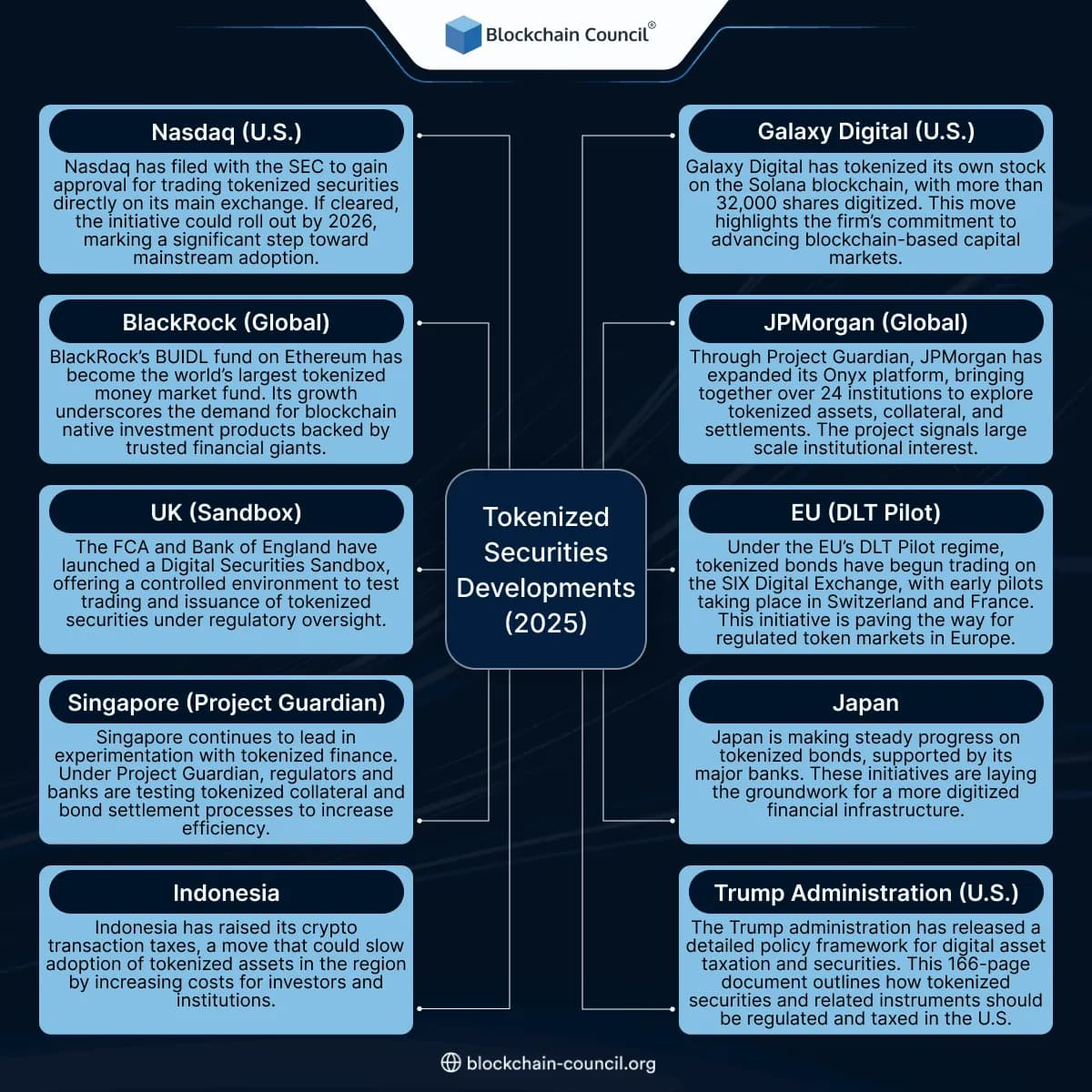
Tokenized Securities Developments (2025)
Nasdaq (U.S.)
Nasdaq has filed with the SEC to gain approval for trading tokenized securities directly on its main exchange. If cleared, the initiative could roll out by 2026, marking a significant step toward mainstream adoption.
Galaxy Digital (U.S.)
Galaxy Digital has tokenized its own stock on the Solana blockchain, with more than 32,000 shares digitized. This move highlights the firm’s commitment to advancing blockchain-based capital markets.
BlackRock (Global)
BlackRock’s BUIDL fund on Ethereum has become the world’s largest tokenized money market fund. Its growth underscores the demand for blockchain-native investment products backed by trusted financial giants.
JPMorgan (Global)
Through Project Guardian, JPMorgan has expanded its Onyx platform, bringing together over 24 institutions to explore tokenized assets, collateral, and settlements. The project signals large-scale institutional interest.
UK (Sandbox)
The FCA and Bank of England have launched a Digital Securities Sandbox, offering a controlled environment to test trading and issuance of tokenized securities under regulatory oversight.
EU (DLT Pilot)
Under the EU’s DLT Pilot regime, tokenized bonds have begun trading on the SIX Digital Exchange, with early pilots taking place in Switzerland and France. This initiative is paving the way for regulated token markets in Europe.
Singapore (Project Guardian)
Singapore continues to lead in experimentation with tokenized finance. Under Project Guardian, regulators and banks are testing tokenized collateral and bond settlement processes to increase efficiency.
Japan
Japan is making steady progress on tokenized bonds, supported by its major banks. These initiatives are laying the groundwork for a more digitized financial infrastructure.
Indonesia
Indonesia has raised its crypto transaction taxes, a move that could slow adoption of tokenized assets in the region by increasing costs for investors and institutions.
Trump Administration (U.S.)
The Trump administration has released a detailed policy framework for digital asset taxation and securities. This 166-page document outlines how tokenized securities and related instruments should be regulated and taxed in the U.S.
Why Does Tokenization Matter?
Tokenization offers several potential benefits:
- Efficiency: Settlement times could be reduced from days to minutes.
- Liquidity: Assets like real estate or private equity could be fractionalized and traded more easily.
- Global access: 24/7 blockchain trading could connect investors worldwide.
- Transparency: Immutable ledgers improve trust in ownership records.
But challenges remain:
- Infrastructure readiness: Systems like DTC must adapt to support blockchain-based assets.
- Regulatory clarity: Rules vary widely across countries.
- Market trust: Investors must believe tokenized securities are as safe as traditional ones.
Should Investors Care?
The rise of tokenized securities signals a major shift in how capital markets may function. For retail investors, this could mean faster, cheaper, and more flexible access to assets. For institutions, it could reduce costs and increase efficiency.
If you are exploring the data side of these markets, a Data Science Certification can help you analyze market patterns with confidence. And for business leaders, a Marketing and Business Certification can provide the insights needed to navigate the intersection of finance and blockchain innovation.
Final Takeaway
Tokenized securities are no longer a futuristic concept. They are being tested, traded, and supported by some of the largest players in global finance. From Nasdaq’s SEC filing to BlackRock’s billion-dollar fund, the momentum is undeniable.
Will tokenization bring all of traditional markets onto blockchain? Probably not overnight. But the trend is clear: step by step, regulated financial markets are moving toward blockchain integration. For investors, professionals, and regulators, the time to learn and prepare is now.
Related Articles
View All
Blockchain
Go-to-Market Strategy for Blockchain Products in Competitive Web3 Markets
Learn how to build a go-to-market strategy for blockchain products with value-first positioning, token design, community, security, and Web3 metrics.

Blockchain
Blockchain Product Manager vs Traditional Product Manager: Key Differences Explained
Learn how a blockchain product manager differs from a traditional PM across tokens, wallets, governance, analytics, metrics, risk, and skills.

Blockchain
Blockchain vs Traditional Databases: Key Differences, Advantages, and Limitations
Compare blockchain vs traditional databases across trust, performance, auditability, privacy, scalability, and enterprise architecture choices.
Trending Articles
How Blockchain Secures AI Data
Understand how blockchain technology is being applied to protect the integrity and security of AI training data.
Claude AI Tools for Productivity
Discover Claude AI tools for productivity to streamline tasks, manage workflows, and improve efficiency.
Blockchain in Supply Chain Provenance Tracking
Supply chains are under pressure to prove not just efficiency, but also authenticity, sustainability, and fairness. Customers want to know if their coffee really is fair trade, if the diamonds are con