

How Blockchain Enables Trustworthy AI
 Suyash Raizada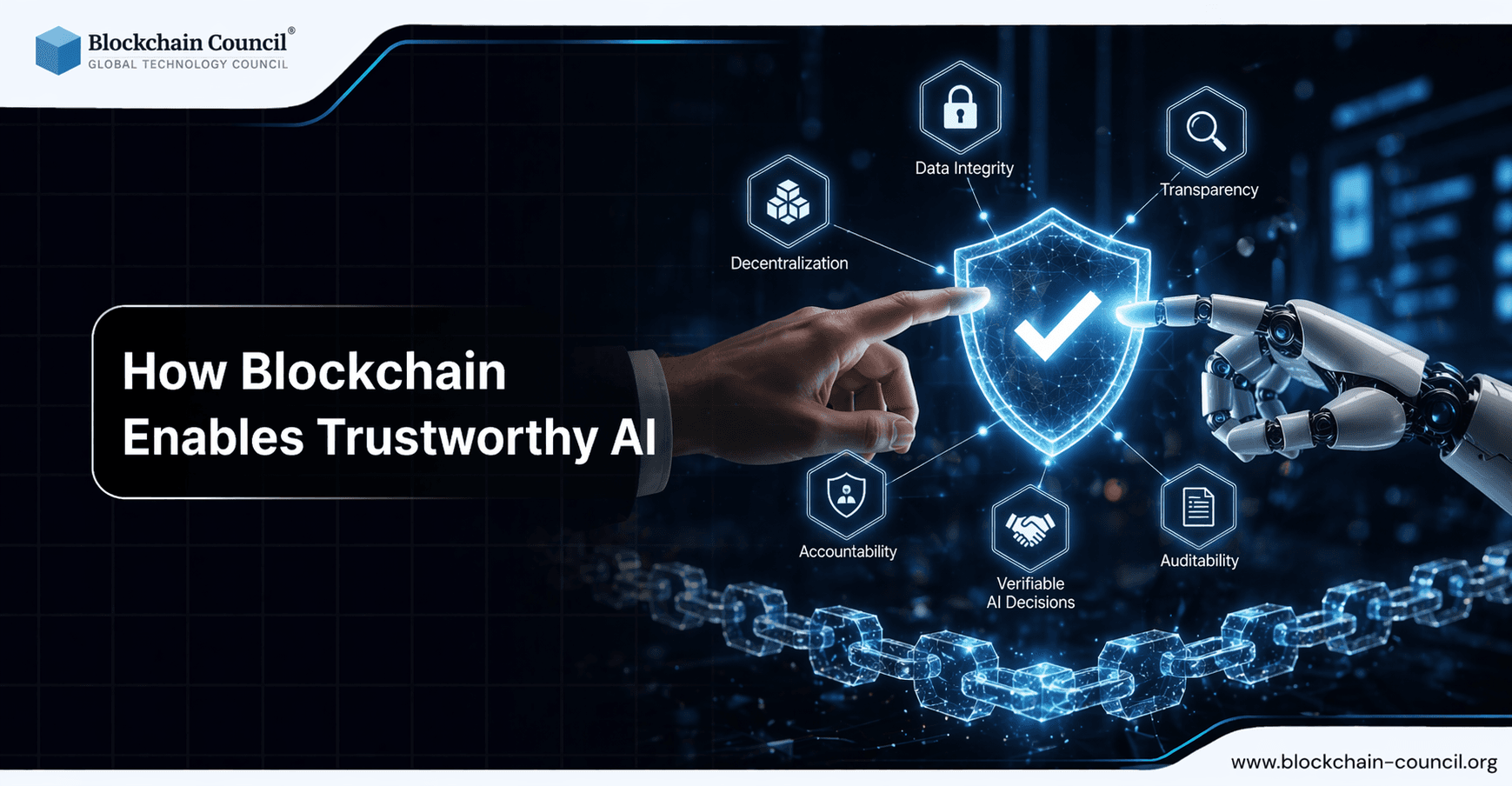
Blockchain enables trustworthy AI by anchoring critical AI inputs and events to an immutable ledger. When organizations can prove where data came from, whether it was altered, who accessed it, and how decisions were produced, AI becomes far easier to validate in regulated and high-stakes environments. Many AI failures trace back to weak data foundations, limited traceability, and opaque decision paths - and blockchain directly addresses all three.
As of 2026, the most practical pattern is a hybrid approach: blockchain secures data inputs, governance, and audit trails, while AI extracts insights and detects anomalies at scale. Together, they reduce AI vulnerabilities like data tampering, unverifiable model lineage, and the black box problem that complicates compliance audits.

Build transparent and verifiable AI systems using blockchain by mastering decentralized systems through a Certified Blockchain Expert, securing models via Cyber security certifications, and driving awareness through a Digital marketing course.
Why Trustworthy AI Needs Data Integrity and Traceability
Trustworthy AI is not only about model accuracy. It also requires evidence that the system is operating on reliable data and that its outputs can be explained and audited. In many enterprises, data readiness remains the biggest barrier to AI adoption, and data quality has become a top operational priority. When data pipelines are fragile, AI becomes a garbage-in, garbage-out system where small manipulations or undocumented changes can cause significant downstream risk.
Key trust gaps that repeatedly surface in real deployments include:
Data tampering and silent edits in training sets, feature stores, and labeling workflows.
Unclear provenance for datasets sourced from vendors, partners, or multiple internal systems.
Weak auditability of model inputs, versions, and decision paths, especially when multiple teams and tools are involved.
Periodic, manual audits that cannot match the pace of automated decision-making.
How Blockchain Enables Trustworthy AI
Blockchain strengthens AI governance by providing a shared, append-only record of events. It does not replace data lakes, ML pipelines, or observability tools. Instead, it acts as a verifiable backbone for integrity and accountability.
1) Immutable Data Integrity Controls
A core reason blockchain enables trustworthy AI is its tamper-evident design. When organizations write cryptographic hashes of datasets, labels, or critical pipeline artifacts to a blockchain, any subsequent changes become detectable. This supports integrity across the full AI lifecycle, from ingestion and labeling to training and deployment monitoring.
Practical integrity patterns include:
Dataset fingerprinting: storing a cryptographic hash for each dataset version to prove it was not modified after approval.
Chain-of-custody logging: recording who handled data, when, and what actions were taken (ingest, transform, approve, export).
Policy attestation: recording that required checks were completed, such as PII screening, consent validation, bias testing, and security scans.
2) Verifiable Data Provenance for Training and Inference
Provenance answers a fundamental question: where did this data come from? For AI, this applies to training data, evaluation data, and production inputs. Blockchain helps create a verifiable provenance layer by recording source identifiers, timestamps, and approvals, and by linking to off-chain storage using content hashes.
This is especially useful when AI systems depend on data from multiple parties such as suppliers, labs, exchanges, or consortium members. A shared ledger makes it straightforward to confirm that the training corpus used for a model matches an approved and compliant lineage.
3) Audit Trails That Reduce Black Box Risk
Many AI audits fail not because a model is inherently unknowable, but because the organization cannot reconstruct what happened. Blockchain-based audit trails make reconstruction feasible by logging key events in a consistent, time-ordered manner. This can include:
Model versioning events: which model was deployed, by whom, and when.
Data-to-decision linkage: references to input data version, feature set version, and policy rules in effect at the time of a decision.
Human-in-the-loop actions: approvals, overrides, and escalations.
In regulated environments, auditability is often the difference between acceptable and unacceptable AI. Enterprises are increasingly shifting from quarterly reviews to continuous verification, where controls are validated as decisions occur rather than after the fact.
What Is Changing in 2026: Hybrid Systems and Continuous Verification
Recent convergence trends show blockchain and AI being used together in operational workflows rather than isolated pilots. A common enterprise model pairs the two technologies by function:
Blockchain for integrity, provenance, and compliance-grade logging
AI for anomaly detection, pattern recognition, and triage prioritization
This approach is visible in compliance and threat detection platforms that enable real-time queries across multiple blockchains while integrating AI-driven insights directly into analyst workflows. The practical goal is moving from noisy, low-confidence alerts to higher-confidence detection that can withstand regulatory scrutiny.
Use Cases Where Blockchain Enables Trustworthy AI
Bioanalysis and Regulated Labs: ALCOA+ Compliance Meets AI Speed
In bioanalytical workflows, blockchain provides tamper-evident logging aligned with ALCOA+ principles: attributable, legible, contemporaneous, original, and accurate, plus completeness, consistency, enduring availability, and traceability. These principles support inspection readiness and reduce audit failures by making records durable and provable.
A practical pattern works as follows: a technician logs sample handling steps to a blockchain-backed system, creating immutable, timestamped records. If someone alters a record, the system flags the discrepancy. AI then operates on the dataset to detect anomalies. In one documented bioanalytical deployment involving 1,200 samples, AI identified 18 outliers, saving several days of manual review and reducing compliance risk.
Fraud Detection and Crypto Compliance: Better Signal from Immutable Data
Fraud teams often face challenges with data quality and adversarial behavior. Public blockchains already provide an immutable transaction record, and AI can analyze transaction graphs and behavioral patterns to identify suspicious activity that traditional rules-based systems miss. Reported outcomes show detection rates improving from under 1% to over 25% when AI is applied to blockchain transaction data.
For compliance teams, the key advantage is evidence quality. When an alert is raised, analysts can trace funds, counterparties, and behavior across time, then preserve the full reasoning trail for audit and regulatory reporting.
Supply Chain and Pharma Integrity: Provenance That Scales Across Partners
Supply chains require multi-party trust where no single participant can be the sole source of truth. Blockchain networks can provide shared provenance for high-risk goods like pharmaceuticals. Projects such as MediLedger demonstrate how blockchain strengthens data integrity across complex regulatory environments by recording product events and transfers in a way that is resistant to falsification.
For AI, this verified provenance becomes training-grade data. Forecasting, anomaly detection, and quality models perform better when inputs are consistent and verifiable. This directly supports trustworthy AI in procurement, anti-counterfeit operations, and product recall management.
AI Transparency and Governance: Proving What a Model Saw and Why It Acted
For internal governance, blockchain can log decision-path metadata around AI outputs. While blockchain does not inherently explain a neural network's internal reasoning, it can preserve the surrounding evidence needed for governance review: input version, model version, policy configuration, and reviewer actions.
This is particularly important in high-stakes decisions where stakeholders need answers to questions such as:
Was the model approved for this specific use case?
Was the training dataset the approved version?
Were the latest controls and thresholds active at the time of the decision?
Who changed what, and when?
Data NFTs, Decentralized AI, and the Next Wave of Provenance
Tokenization is becoming a practical mechanism for dataset ownership and permissions management. Data NFTs and Model NFTs can help clarify who owns a dataset, what rights are attached to it, and which models were trained on it. This is relevant for cross-organizational collaboration and for reducing overreliance on centralized AI providers - a key driver behind decentralized AI (DeAI) initiatives.
As these systems mature, expect more on-chain attestations for dataset licensing, model lineage, and controlled access, paired with off-chain storage and privacy-preserving techniques where regulatory or commercial requirements demand it.
Implementation Blueprint: How to Adopt Blockchain for Trustworthy AI
Most teams succeed when they start with narrow, high-impact controls rather than attempting to move all data on-chain from the outset.
Identify high-stakes AI processes
Focus on decisions with regulatory, financial, or safety impact.
Prioritize workflows where auditability is weak or disputes are common.
Define the provenance and audit schema
Decide which events must be recorded: dataset approval, feature changes, model deployment, and override actions.
Standardize identifiers for datasets, models, and policies.
Anchor proofs on-chain, keep sensitive data off-chain
Store hashes, timestamps, and signatures on-chain.
Store raw data in secure repositories with appropriate access controls.
Automate continuous verification
Replace periodic sampling audits with near real-time control checks.
Use AI to prioritize review of high-risk events and detected anomalies.
Pilot, measure, and scale
Measure reductions in manual reconciliation time, investigation time, and audit findings.
Expand to upstream partners once the internal model is stable and validated.
Ensure trust and accountability in AI pipelines by combining expertise from an AI Course, strengthening infrastructure with a Python Course, and promoting solutions via an AI powered marketing course.
Conclusion: Blockchain as the Trust Layer for AI
Blockchain enables trustworthy AI by making integrity and provenance verifiable, and by converting audits into continuous, evidence-based processes. The most effective deployments treat blockchain as a control plane for AI data and decision accountability, while AI delivers the scale and speed needed for detection and monitoring.
As organizations prioritize data quality, privacy, security, and governance, blockchain-backed audit trails and provenance logs provide a reliable mechanism for closing the trust gap that currently prevents AI from moving safely into high-stakes production environments.
FAQs
1. What does trustworthy AI mean?
Trustworthy AI refers to systems that are reliable, transparent, fair, and secure. It ensures decisions can be explained and verified. This builds user confidence and supports compliance.
2. How does blockchain help make AI trustworthy?
Blockchain provides immutable records of data and model activity. It ensures transparency and prevents tampering. This helps verify how AI systems operate.
3. Why is transparency important in AI systems?
Transparency allows users to understand how decisions are made. It reduces bias and improves accountability. This is essential for ethical and regulated use.
4. What is the role of immutable logs in AI?
Immutable logs store records that cannot be changed. They track data usage, model training, and outputs. This supports auditing and trust.
5. How does blockchain improve data integrity in AI?
Blockchain ensures that data cannot be altered once recorded. This protects against manipulation. Reliable data leads to more accurate AI models.
6. Can blockchain prevent AI bias?
Blockchain cannot eliminate bias directly but can improve transparency. It helps track data sources and model decisions. This makes bias easier to detect and address.
7. What is data provenance in AI and blockchain?
Data provenance tracks the origin and history of data. Blockchain records this information securely. This ensures data authenticity and traceability.
8. How do smart contracts support trustworthy AI?
Smart contracts automate rules and enforce compliance. They ensure processes are followed without manual intervention. This improves reliability and consistency.
9. What are the benefits of combining AI and blockchain?
Benefits include improved transparency, security, and accountability. It also supports decentralized data sharing. This enhances trust in AI systems.
10. How does blockchain support AI auditability?
Blockchain provides a clear and verifiable record of AI processes. Auditors can review decisions and data flows. This simplifies compliance and oversight.
11. What industries benefit from trustworthy AI with blockchain?
Industries such as healthcare, finance, and supply chain benefit the most. These sectors require high levels of trust and compliance. Adoption is growing rapidly.
12. How does blockchain protect AI models from tampering?
Model updates and configurations can be recorded on the blockchain. This prevents unauthorized changes. It ensures model integrity.
13. What challenges exist in using blockchain for AI trust?
Challenges include scalability, integration complexity, and cost. Blockchain systems can be resource-intensive. Careful design is required for efficiency.
14. How does blockchain support decentralized AI?
Blockchain enables distributed systems without central control. Participants can collaborate securely. This reduces reliance on a single authority.
15. Can blockchain improve AI security?
Yes, blockchain enhances security by protecting data and transactions. It reduces risks of unauthorized access and tampering. However, additional security measures are still needed.
16. What is explainability in AI and how does blockchain help?
Explainability refers to understanding how AI decisions are made. Blockchain can store decision logs for review. This improves transparency and accountability.
17. How does blockchain help with regulatory compliance in AI?
Blockchain provides audit trails and transparent records. This helps meet regulations like GDPR and AI governance rules. It simplifies reporting and verification.
18. What is the role of encryption in blockchain-based AI systems?
Encryption protects sensitive data stored or referenced on the blockchain. It ensures confidentiality while maintaining integrity. Secure key management is essential.
19. How scalable is blockchain for AI applications?
Scalability is a challenge due to transaction limits and latency. Solutions include off-chain processing and hybrid systems. Ongoing improvements are addressing these issues.
20. What is the future of blockchain in trustworthy AI?
Blockchain will play a growing role in AI governance and transparency. Integration with AI systems will improve. Trustworthy AI will become a key focus across industries.
Related Articles
View All
Blockchain
Blockchain Certification Programs You Can Join Online
Discover the best blockchain certification programs you can join online. Learn blockchain fundamentals, smart contracts, enterprise blockchain, and career opportunities with globally recognized certifications.

Blockchain
Agile for Blockchain Teams: Managing Sprints, Smart Contracts, and Decentralized Roadmaps
Learn how agile for blockchain teams works when sprints, smart contracts, audits, governance, and decentralized roadmaps are planned around risk.

Blockchain
How to Write a PRD for Blockchain Products: Key Sections, Examples, and Best Practices
Learn how to write a PRD for blockchain products with key sections, practical examples, tokenomics, security, governance, and success metrics.
Trending Articles
The Role of Blockchain in Ethical AI Development
How blockchain technology is being used to promote transparency and accountability in artificial intelligence systems.

Top 5 DeFi Platforms
Explore the leading decentralized finance platforms and what makes each one unique in the evolving DeFi landscape.
How Blockchain Secures AI Data
Understand how blockchain technology is being applied to protect the integrity and security of AI training data.