

Case Studies of Blockchain in AI
 Suyash Raizada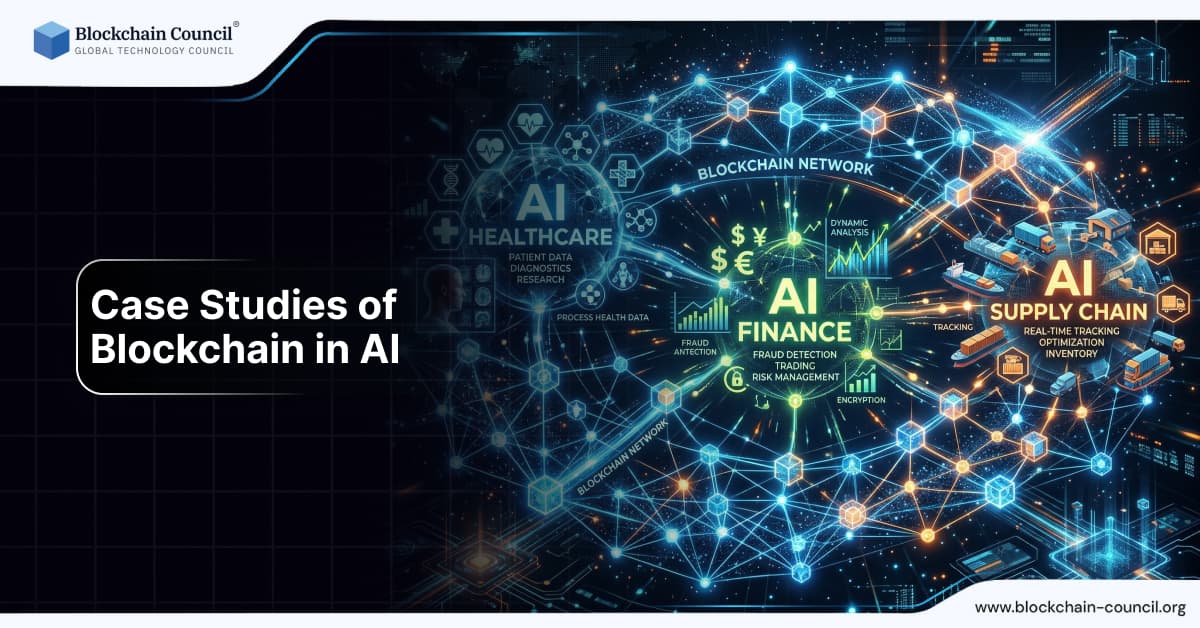
Case studies of blockchain in AI show a practical pattern across industries: blockchain adds integrity, auditability, and controlled sharing, while AI turns trusted data into predictions, automation, and decision support. Together, they address a core constraint of modern digital systems - how to use sensitive or high-value data without losing control, provenance, or compliance. This article reviews real-world use cases in healthcare, finance, and supply chains, focusing on what is being built today and what is likely next.
Real-world blockchain + AI systems rely on transparency, provenance, and automation-build expertise with a Certified Blockchain Expert, implement solutions using a Python Course, and explore business adoption via an AI powered marketing course.

Why Blockchain Plus AI Works in Production Systems
AI systems are only as reliable as the data they train on and the logs that prove how decisions were made. Blockchain helps by creating immutable, time-stamped records and permissioned access controls for data sharing. AI contributes by analyzing patterns across large datasets, detecting anomalies, and automating workflows through predictive models and decision engines.
In regulated environments such as healthcare and finance, the combined value often comes from:
Data integrity: tamper-evident history of records, events, and updates.
Consent and access governance: patient or participant-controlled permissions with auditable logs.
Operational automation: smart contracts executing policy-based actions, with AI assisting risk scoring and exception handling.
Security and monitoring: AI-based anomaly detection on top of an immutable event trail.
Regulatory alignment is a major driver. Permissioned networks with audit trails can support privacy and security obligations under frameworks such as GDPR and HIPAA when designed with least-privilege access, encryption, and clear data stewardship policies.
Healthcare Case Studies of Blockchain in AI
Healthcare is a natural fit for blockchain-AI integration because medical data is sensitive, fragmented across institutions, and frequently exchanged among providers, labs, payers, and researchers. The goal is to share data safely while keeping provenance and consent clear, and to let AI use verified records for diagnostics and prediction.
1) Secure Electronic Health Records (EHRs) with AI-Ready Provenance
A common pattern is to store references, hashes, and access policies on blockchain while keeping large clinical files off-chain in secure storage. Blockchain provides a tamper-evident ledger of who wrote or accessed what and when, while AI consumes verified data to support clinical decision-making, such as radiology triage, risk stratification, and population health analytics.
Benefits typically include:
Reduced manipulation risk due to immutable logging and distributed consensus.
Higher confidence in AI outputs because training and inference data has clearer provenance.
Better cross-organization collaboration without relying on a single central database.
2) Patient-Controlled Consent and Privacy Management
Consent is not just a legal checkbox in healthcare. It is a technical requirement that determines whether data can be used for treatment, billing, quality improvement, or research. Blockchain-based permissioning supports patient-controlled access where patients can grant or revoke permissions, and every access attempt is logged immutably. AI systems then operate within these constraints, which is especially important for sensitive data and secondary uses.
This architecture is often paired with:
Fine-grained access rules for providers, specialists, and researchers.
Audit trails that support internal compliance reviews and external reporting.
AI-based monitoring to detect unusual access patterns that may indicate insider risk or compromised credentials.
3) Decentralized Healthcare Data Sharing
Decentralized data sharing networks aim to connect hospitals, labs, and other stakeholders without introducing a single point of failure. Platforms such as Akiri have been associated with enabling secure, decentralized sharing of healthcare data across organizations. In this model, blockchain-backed identity, permissions, and logging support trust, while AI can be applied to shared datasets for tasks such as operational forecasting, cohort identification, and anomaly detection.
The key implementation lesson is interoperability: value emerges only when data exchange standards, identity, and governance align across parties, including legacy systems that were not designed for decentralized sharing.
4) Unified Patient Records with Patient-Controlled Access
Another real-world approach is patient-owned medical records, where access is managed via patient-controlled keys and provider-specific permissions. Medicalchain is often cited as an example of this direction, enabling a unified record that can be shared with clinicians under explicit authorization. When AI is applied to these records, it can support more personalized medicine by drawing on longitudinal, cross-provider history that is both verified and permissioned.
Practical considerations include key management, revocation workflows, and ensuring that emergency access policies are clearly defined and auditable.
5) Clinical Trials: Immutable Logging for Trust and Speed
Clinical trials depend on accurate timestamps for consent, protocol changes, and results. Blockchain can create immutable logs for trial events, reducing the risk of manipulation and improving trust among sponsors, sites, regulators, and participants. AI can then analyze validated trial data for signal detection, safety monitoring, and operational optimization - such as predicting dropout risk or site performance issues.
While precise adoption statistics vary by region and program, the direction is consistent: trustworthy, time-stamped data pipelines support faster review and higher confidence in reported outcomes.
6) Pharmaceutical Supply Chain Integrity and AI Forecasting
Counterfeit drugs and distribution disruptions create direct patient safety risks. Blockchain enables end-to-end traceability for pharmaceuticals by recording custody events across manufacturers, distributors, and providers. AI can use these immutable event streams to detect irregularities and forecast shortages based on pattern changes, shipping delays, and demand signals.
This is a strong example of why case studies of blockchain in AI matter: AI models can be undermined by bad data, but a tamper-evident ledger improves the quality and accountability of the underlying inputs.
Finance Case Studies of Blockchain in AI
Finance benefits from blockchain because it reduces reconciliation friction and increases transparency across parties. AI adds fraud detection, risk assessment, and compliance automation on top of transaction and identity data. The combination is particularly relevant where multiple stakeholders need a shared source of truth.
1) Fraud Detection and Anomaly Monitoring on Immutable Ledgers
AI is widely used for fraud detection, but traditional systems can struggle with incomplete or inconsistent event histories across institutions. Blockchain can provide a shared, tamper-evident transaction trail, enabling AI to spot anomalies with better context and fewer gaps. This is useful for monitoring unusual transaction patterns, identity misuse, and policy violations.
A key enterprise requirement is strong governance around data visibility. Many financial use cases rely on permissioned networks where participants see only what they are authorized to see, while still benefiting from shared verification and auditability.
2) Automated Insurance Claims Using Smart Contracts
Claims processing is a high-friction workflow involving providers, payers, and patients. Smart contracts can automate parts of the claims lifecycle, such as eligibility checks, pre-authorization logic, and payment triggers when conditions are met. AI complements this by:
Classifying claims and routing exceptions for human review.
Detecting potential fraud using historical patterns and provider behavior signals.
Predicting claim outcomes to reduce disputes and delays.
The combined result can be faster approvals and fewer disagreements because both the underlying events and the decision logic can be made more transparent and auditable.
3) Programmable Stablecoins and AI-Supported Compliance
Programmable stablecoins have been increasingly discussed as a way to reduce cross-border payment friction through faster settlement and programmable rules. When paired with AI, these systems can support compliance operations such as transaction monitoring, sanctions screening, and risk scoring. Blockchain provides traceability and settlement finality, while AI helps manage scale and reduce false positives in compliance workflows.
Supply Chain Case Studies of Blockchain in AI
Supply chains are built on multi-party coordination where trust, provenance, and timing matter. Blockchain creates a shared ledger for provenance and custody events, and AI uses that data for detection and forecasting.
1) Drug Traceability: Ledger Integrity and AI Anomaly Detection
In pharmaceutical and medical supply chains, traceability is essential for authenticity, recalls, and patient safety. Blockchain records product lineage and custody changes, while AI identifies suspicious patterns such as unexpected route deviations, repeated scan anomalies, or improbable handoff timings that may indicate counterfeit insertion or diversion.
2) Healthcare Logistics: Shortage Prediction Using Immutable Operational Data
Shortages can be caused by demand spikes, manufacturing constraints, or distribution bottlenecks. AI can forecast risk using historical consumption, delivery performance, and external signals, but it requires consistent and reliable data. Blockchain improves the reliability of operational events across organizations, which can make AI forecasting more actionable for procurement and distribution planning.
Implementation Challenges to Plan For
Case studies of blockchain in AI also reveal recurring obstacles that should be addressed early:
Interoperability with legacy systems: many organizations need phased integration and middleware.
Data standardization: AI quality depends on consistent schemas, coding systems, and metadata.
Scalability and cost: choose appropriate architectures, often permissioned networks and off-chain storage for large files.
Regulatory and governance alignment: privacy, consent, retention, and audit requirements must be designed into the system from the start.
Future Outlook: What to Watch Through 2030
Blockchain and AI are expected to deepen their integration in areas such as advanced medical imaging, predictive analytics, and transparent research collaboration models - sometimes described as decentralized science. Security upgrades such as post-quantum cryptography are also expected to become more relevant for long-lived medical records. Domain-specific AI tools for compliance and operations, combined with verifiable credentials for clinicians and suppliers, can further strengthen trust across ecosystems.
IoT is likely to amplify this trend: sensors generate continuous data streams, blockchain can anchor integrity and access control, and AI can automate early warnings for preventive care and operational risk.
Conclusion
These case studies of blockchain in AI highlight a clear real-world pattern. Blockchain strengthens trust through tamper-evident records, auditable access, and shared provenance. AI turns that trusted foundation into value through diagnostics, anomaly detection, forecasting, and automation. In healthcare, the impact spans secure EHRs, consent management, clinical trials, and pharmaceutical integrity. In finance, it improves fraud detection, claims workflows, and cross-border payment compliance. In supply chains, it enables traceability and disruption prediction.
Combining blockchain with AI requires integrating smart contracts with data pipelines-develop this capability with a Blockchain Course, strengthen ML systems via a machine learning course, and align solutions with real-world use cases through a Digital marketing course.
FAQs
1. What are case studies of blockchain in AI?
Case studies of blockchain in AI are real-world examples where both technologies are used together. They show how blockchain enhances transparency and AI improves data-driven decisions.
2. Why combine blockchain and AI in real-world applications?
Blockchain provides secure and transparent data management, while AI analyzes and learns from that data. Together, they create more reliable and efficient systems.
3. What is a common use case of blockchain in AI?
A common use case is secure data sharing for AI models. Blockchain ensures data integrity while AI processes and analyzes the data.
4. How is blockchain used in AI for healthcare?
Blockchain secures patient data, while AI analyzes it for diagnosis and treatment. This improves privacy and data accuracy.
5. How do supply chains benefit from blockchain and AI?
Blockchain tracks goods and ensures transparency. AI analyzes data to optimize logistics and predict demand.
6. What role does blockchain play in AI data validation?
Blockchain verifies data authenticity and prevents tampering. This ensures AI models are trained on reliable data.
7. How is blockchain used in AI for finance?
Blockchain secures transactions, while AI detects fraud and analyzes trends. This improves security and decision-making.
8. What are examples of blockchain in AI for cybersecurity?
Blockchain secures logs and data, while AI detects threats and anomalies. This combination strengthens security systems.
9. How does blockchain support AI model transparency?
Blockchain records model inputs and outputs. This creates a traceable history for auditing and compliance.
10. What is decentralized AI and how does blockchain enable it?
Decentralized AI distributes processing across multiple nodes. Blockchain manages coordination and ensures trust among participants.
11. How do smart contracts interact with AI systems?
Smart contracts automate processes based on AI outputs. They execute actions when predefined conditions are met.
12. What challenges are seen in blockchain-AI case studies?
Challenges include scalability, integration complexity, and high costs. These issues can limit adoption.
13. How does blockchain improve AI data privacy?
Blockchain controls access and tracks data usage. This helps protect sensitive information used in AI systems.
14. What industries are leading in blockchain-AI adoption?
Industries like healthcare, finance, logistics, and energy are leading. They benefit from improved transparency and automation.
15. How do case studies help businesses adopt blockchain and AI?
Case studies provide practical insights and proven strategies. They help organizations understand benefits and challenges.
16. Can small businesses benefit from blockchain and AI integration?
Yes, but adoption depends on resources and use cases. Smaller implementations can still provide value.
17. How does blockchain ensure trust in AI systems?
Blockchain creates immutable records of data and actions. This builds trust in AI decisions and processes.
18. What is the role of tokenization in blockchain-AI case studies?
Tokenization enables digital representation of assets and data. AI can analyze and manage these tokens efficiently.
19. What are the limitations of current blockchain-AI solutions?
Limitations include performance issues, regulatory uncertainty, and technical complexity. These factors affect scalability.
20. What is the future of blockchain and AI integration?
Integration will continue to grow as technologies mature. Improved tools and standards will drive wider adoption.
Related Articles
View All
Blockchain
Blockchain Certification Programs You Can Join Online
Discover the best blockchain certification programs you can join online. Learn blockchain fundamentals, smart contracts, enterprise blockchain, and career opportunities with globally recognized certifications.

Blockchain
Agile for Blockchain Teams: Managing Sprints, Smart Contracts, and Decentralized Roadmaps
Learn how agile for blockchain teams works when sprints, smart contracts, audits, governance, and decentralized roadmaps are planned around risk.

Blockchain
How to Write a PRD for Blockchain Products: Key Sections, Examples, and Best Practices
Learn how to write a PRD for blockchain products with key sections, practical examples, tokenomics, security, governance, and success metrics.
Trending Articles
The Role of Blockchain in Ethical AI Development
How blockchain technology is being used to promote transparency and accountability in artificial intelligence systems.
AWS Career Roadmap
A step-by-step guide to building a successful career in Amazon Web Services cloud computing.

Top 5 DeFi Platforms
Explore the leading decentralized finance platforms and what makes each one unique in the evolving DeFi landscape.