

Blockchain vs IoT: How Decentralized Networks and Connected Devices Work Together
 Suyash Raizada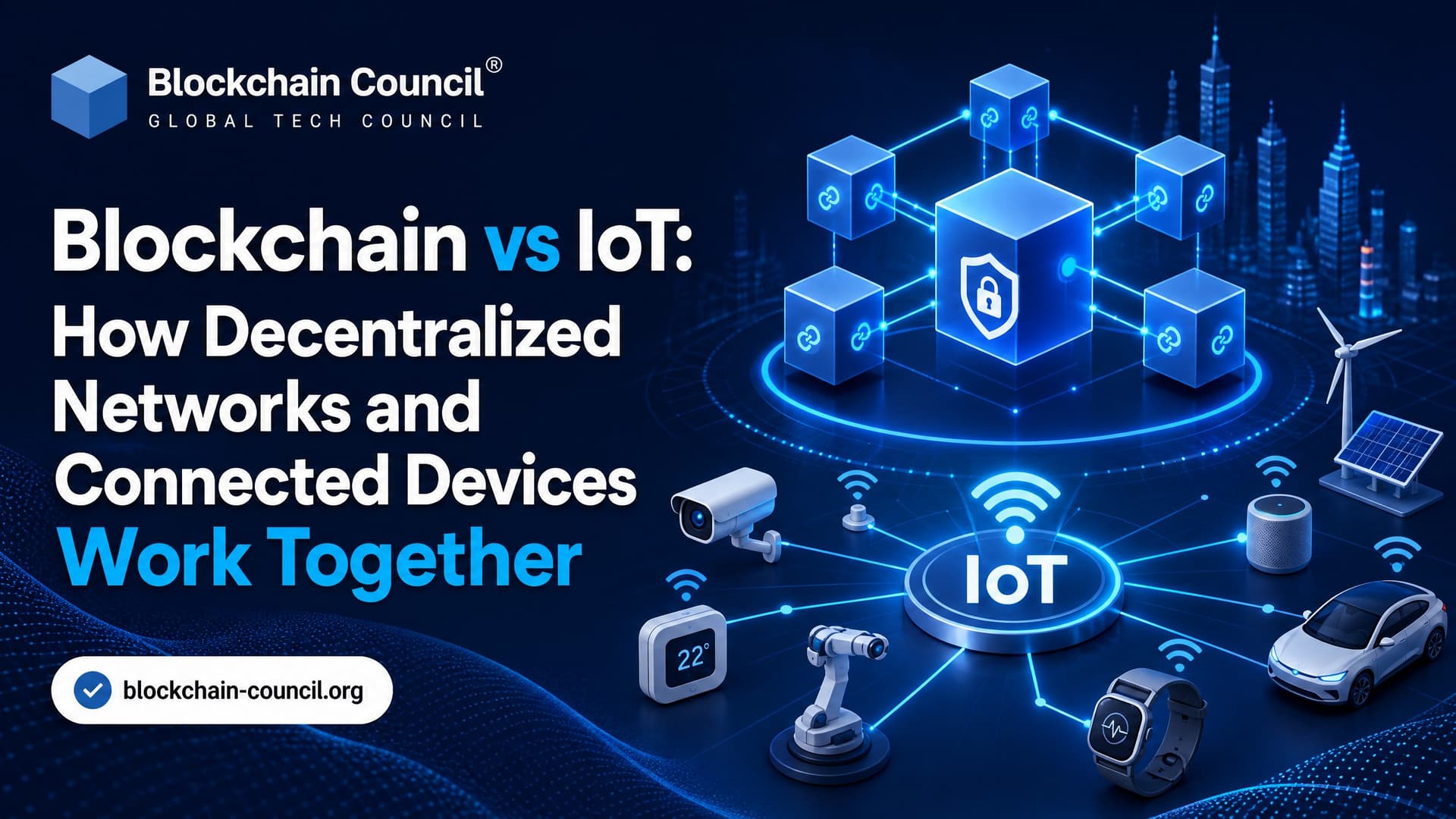
Blockchain vs IoT is not really a fight between two technologies. IoT captures what happens in the physical world. Blockchain gives multiple parties a shared way to trust, verify, and act on that data. Put simply: connected devices produce the evidence, decentralized networks protect the record.
This matters because IoT systems are growing fast across supply chains, factories, hospitals, vehicles, energy grids, and homes. Yet many still depend on centralized servers, single-vendor platforms, and fragile trust assumptions. Blockchain IoT integration attacks that weak point by adding cryptographic identity, tamper-resistant records, and smart contract automation.

Professionals who want to design secure decentralized systems can benefit from developing the skills of a Blockchain Expert, including distributed ledger architecture, smart contracts, cryptographic security, and enterprise blockchain implementation across industries.
Blockchain vs IoT: What Each Technology Does
What IoT brings
The Internet of Things refers to connected sensors, machines, meters, cameras, wearables, vehicles, and industrial devices that collect data from the physical environment. A cold-chain sensor may record temperature every minute. A smart meter reports energy usage. A vehicle publishes maintenance data, location, and driving behavior.
IoT is good at real-time measurement. The problem is trust. If five companies need to rely on the same shipment temperature log, who owns the database? Who can edit it? What happens if a device is spoofed?
What blockchain brings
Blockchain is a distributed ledger secured by cryptography and consensus. Depending on the design, it may be public, private, permissioned, or hybrid. In IoT systems, blockchain usually does not store every raw sensor reading. That is the first design mistake beginners make.
A practical pattern looks like this:
An IoT sensor captures data, such as location, temperature, or pressure.
A gateway or edge node validates and formats the reading.
The raw data is stored off-chain in a database, data lake, IPFS-style storage layer, or enterprise system.
A hash, timestamp, device identity, or event summary is written to the blockchain.
A smart contract triggers an action if a rule is met.
IBM has described this model for private blockchain networks where IoT devices contribute tamper-resistant records to shared business processes, especially in asset tracking and supply chains.
How Blockchain and IoT Work Together Technically
1. Device identity and authentication
IoT devices are often attacked through weak passwords, cloned identities, or insecure firmware. Blockchain can support cryptographic device identities, where each device holds keys and verifiable credentials. A gateway can reject data from an unknown device instead of trusting a simple device ID string.
This helps in multi-party environments. A logistics provider, manufacturer, insurer, and regulator can all verify that a reading came from the approved sensor without relying on one central database administrator.
2. Data integrity through hashing
Blockchain does not magically make bad sensor data true. If a faulty sensor reports 4°C when the real value is 12°C, the ledger will preserve the wrong reading. Garbage in, permanent garbage out.
What blockchain does well is detect tampering after capture. If a shipment temperature file is hashed and anchored on-chain, any later edit changes the hash. That gives auditors, insurers, or trading partners a reliable way to check whether records were altered.
3. Smart contracts for automated action
Smart contracts can respond to verified IoT events. For example:
Release payment when a shipment reaches a warehouse and the temperature stayed within range.
Trigger an insurance workflow if a vehicle sensor confirms an accident event.
Settle peer-to-peer energy trades based on smart meter readings.
Issue a maintenance alert when vibration data crosses a threshold.
If you build this with Solidity 0.8.x, keep the contract small and event-driven. Do not push high-frequency sensor streams directly to Ethereum mainnet, whose chain ID is 1. Even a 32-byte hash per reading gets expensive at scale. I have seen teams prototype beautifully on Hardhat and then hit reality when gas costs turned a simple hourly sensor update into a budget problem. Use batching, rollups, permissioned ledgers, or off-chain aggregation where the business case requires frequent writes.
Common Blockchain-IoT Architectures
Permissioned blockchain networks
Most enterprise IoT use cases fit permissioned networks better than public chains. Known participants, such as manufacturers, shippers, distributors, hospitals, utilities, or city agencies, can share records without exposing sensitive data to the public.
This model works well when governance is clear. Who can add devices? Who validates transactions? Who pays infrastructure costs? If those questions are vague, the pilot usually stalls.
Hybrid on-chain and off-chain systems
Hybrid design is the sensible default. Store large IoT datasets off-chain. Anchor hashes, proofs, access events, and settlement records on-chain. This cuts storage load while preserving verifiability.
It also helps with privacy. Sensitive health data, home camera metadata, or industrial process readings should not be written directly to an immutable ledger. In regulated sectors, immutability can conflict with privacy obligations if architects are careless.
Edge and gateway-centric designs
Many IoT devices cannot run full blockchain clients. Battery-powered sensors, low-cost microcontrollers, and industrial devices with limited compute need help. Edge gateways can handle signing, batching, encryption, policy checks, and blockchain submission.
This creates a trade-off. Gateways improve performance, but they also become important trust points. You still need secure boot, key protection, firmware updates, and monitoring.
Current State: Mostly Pilots, Not Mass Deployment
The research picture is promising but cautious. A 2025 review in Frontiers in Computer Science analyzed recent scientific publications on blockchain-based IoT security. Most of that work focuses on security, privacy, and trust, but much of the evidence still comes from pilots and prototypes rather than mature production systems.
Other 2025 systematic studies on blockchain and IoT integration reach a similar view: interest is broad, use cases are real, but deployment stays limited by performance, governance, interoperability, energy use, and cost.
To be blunt, blockchain is overused in some IoT proposals. If one company owns all devices, all data, and all decisions, a signed database with good access controls may be enough. Blockchain earns its place when several parties need a shared record and none of them should have unilateral control.
Real-World Use Cases for Blockchain IoT Integration
Supply chain and logistics
This is one of the strongest fits. IoT sensors track location, temperature, humidity, shock, and handling conditions. Blockchain records key events so participants can verify provenance and detect tampering.
In cold-chain logistics, a smart contract could flag a vaccine shipment when temperature thresholds are exceeded. It could also support claims processing by proving when and where the breach happened.
Smart cities
Smart cities run on traffic lights, parking sensors, pollution monitors, energy meters, and public infrastructure devices. Blockchain can help agencies and private operators share trusted records without placing all control in one system.
Energy-focused smart city projects are especially relevant. Smart meters can feed consumption and generation data into systems for demand response, settlement, or local energy trading.
Healthcare and wearables
Wearables and medical IoT devices can capture heart rate, glucose levels, medication adherence, or patient movement. Blockchain can support integrity checks, consent records, and controlled sharing between providers.
Privacy is the sensitive point. Do not store patient health data directly on-chain. Use off-chain storage, encryption, selective disclosure, and strict access governance.
Automotive and mobility
Connected vehicles generate data about performance, battery condition, maintenance, location, and driving behavior. Blockchain can help create trusted maintenance histories, usage-based insurance records, automated tolling logs, and secure data exchange for shared mobility services.
Agriculture and food systems
Farm sensors monitor soil moisture, weather, crop health, storage conditions, and transport events. Blockchain can connect those readings to traceability systems, giving buyers stronger evidence about origin, handling, and quality.
Energy grids
Smart meters and grid sensors produce granular data on consumption, generation, and grid status. Blockchain can support peer-to-peer energy trading, transparent settlement, and auditable demand-response programs when paired with reliable IoT inputs.
As connected ecosystems become more sophisticated, an IoT Expert can help organizations design secure sensor networks, edge computing architectures, device management strategies, and data integration frameworks that maximize the value of connected infrastructure alongside blockchain technologies.
Key Challenges You Should Plan For
Scalability: IoT systems can generate huge data volumes. Public blockchains are not built for raw sensor streams.
Latency: Some industrial systems need millisecond response times. Blockchain confirmation delays may be unacceptable for control loops.
Energy efficiency: Constrained devices cannot handle heavy cryptographic workloads without careful architecture.
Privacy: Immutable ledgers are risky if sensitive data is written directly.
Interoperability: Device vendors, cloud platforms, ledgers, and enterprise systems rarely speak the same language out of the box.
Governance: Multi-party networks need rules for onboarding, dispute resolution, data access, and cost sharing.
The Role of AI in Blockchain and IoT Systems
The next step is not blockchain plus IoT alone. Many industrial teams are combining IoT, blockchain, and AI. IoT collects operational data. AI detects patterns, predicts failures, or recommends actions. Blockchain preserves provenance and records decisions or settlements.
Predictive maintenance shows this well. Sensors detect vibration and temperature. An AI model predicts bearing failure. A blockchain record proves which data and model output triggered a maintenance order. That audit trail matters when downtime, warranty claims, or safety reports are involved.
Skills Professionals Need
If you work with connected devices, you do not need to become a protocol researcher first. You need enough blockchain knowledge to design sane architectures and ask the hard questions early.
Focus on:
Public vs permissioned blockchain design
Smart contract basics and security testing
Cryptographic identity and key management
Off-chain storage with on-chain proofs
IoT threat modeling
Data governance and privacy by design
For structured learning, Blockchain Council readers can explore paths such as Certified Blockchain Expert™, Certified Blockchain Developer™, and Certified Smart Contract Developer™. If your role includes AI-based automation, pair blockchain training with AI governance and model validation skills.
What Comes Next for Blockchain vs IoT
The future of Blockchain vs IoT will be decided less by theory and more by deployment discipline. The winning systems will not write every sensor value to a chain. They will use blockchain where shared trust is needed, keep heavy data off-chain, protect device identities, and define governance before production.
Your next step: pick one narrow use case, such as cold-chain tracking or smart meter settlement. Map the data flow, identify who must trust whom, decide what belongs on-chain, then build a small prototype with real devices and real failure cases. That exercise will teach you more than any generic architecture diagram.
As blockchain and IoT solutions continue moving into commercial markets, a Marketing Certification can help professionals understand product positioning, customer engagement, digital marketing strategies, and go-to-market planning for emerging technology solutions across enterprise and consumer sectors.
FAQs
1. What Is Blockchain?
Blockchain is a decentralized digital ledger that records transactions across a distributed network of computers. It helps ensure data integrity, transparency, and security without relying on a single central authority.
2. What Is the Internet of Things (IoT)?
The Internet of Things (IoT) is a network of physical devices, sensors, vehicles, appliances, and industrial equipment connected to the internet to collect, exchange, and analyze data.
3. How Do Blockchain and IoT Differ?
Blockchain is primarily a technology for secure, decentralized data management and transaction validation, while IoT focuses on connecting physical devices to collect and share data. They serve different purposes but can complement each other.
4. How Can Blockchain and IoT Work Together?
Blockchain can provide a secure, tamper-resistant record of IoT data, automate device interactions through smart contracts, improve trust among connected systems, and support decentralized coordination between devices.
5. Why Is Blockchain Valuable for IoT?
Blockchain can help improve data integrity, device authentication, auditability, and trust in multi-party IoT environments where devices and organizations need to exchange information securely.
6. What Are Smart Contracts in IoT?
Smart contracts are self-executing programs stored on a blockchain that can automatically trigger actions when predefined conditions are met, such as authorizing payments, managing device access, or recording sensor events.
7. How Does IoT Collect Data?
IoT devices use sensors to monitor physical conditions such as temperature, pressure, location, humidity, motion, energy usage, or machine status, then transmit that information for processing and analysis.
8. How Does Blockchain Improve IoT Security?
Blockchain can strengthen IoT security by providing immutable transaction records, decentralized verification, cryptographic authentication, and transparent audit trails. It does not eliminate all IoT security risks, which also depend on device hardware, software, and network security.
9. What Industries Benefit from Blockchain and IoT Integration?
Industries exploring this combination include:
Supply chain and logistics
Manufacturing
Healthcare
Agriculture
Energy and utilities
Smart cities
Transportation
Retail
Automotive
Environmental monitoring
10. How Does Blockchain Improve Supply Chain IoT?
Blockchain can create a shared record of data generated by IoT sensors, helping organizations track shipments, verify product origins, monitor storage conditions, and improve traceability throughout the supply chain.
11. Can Blockchain Help Manage Smart Cities?
Yes. Blockchain can support smart city initiatives by helping manage IoT-generated data for transportation, energy distribution, waste management, parking systems, and public infrastructure, depending on the system's design.
12. How Does Blockchain Support Industrial IoT (IIoT)?
In industrial environments, blockchain can help record machine data, improve equipment traceability, support predictive maintenance records, automate workflows, and strengthen collaboration across multiple organizations.
13. What Are the Benefits of Combining Blockchain and IoT?
Potential benefits include:
Improved data integrity
Greater transparency
Better device authentication
Automated workflows
Enhanced traceability
Reduced reliance on intermediaries
More efficient multi-party collaboration
14. What Challenges Exist When Combining Blockchain and IoT?
Common challenges include scalability, transaction throughput, storage requirements, latency, interoperability, energy consumption on some blockchain networks, device resource limitations, and regulatory considerations.
15. Does Every IoT Application Need Blockchain?
No. Many IoT systems function effectively with traditional centralized databases. Blockchain is most valuable when multiple independent parties need a shared, verifiable record without relying on a single trusted intermediary.
16. Which Blockchain Networks Are Commonly Used for IoT?
Organizations may choose public, private, or consortium blockchains depending on their security, scalability, governance, and compliance requirements. The appropriate platform depends on the specific use case rather than a universally "best" blockchain.
17. What Skills Are Needed to Build Blockchain-IoT Solutions?
Useful skills include blockchain development, IoT architecture, embedded systems, networking, cloud computing, cybersecurity, smart contract development, APIs, data analytics, and edge computing.
18. What Are Common Misconceptions About Blockchain and IoT?
Common misconceptions include:
Blockchain automatically solves every IoT security problem.
Every IoT deployment requires decentralization.
Blockchain can replace IoT sensors.
Blockchain guarantees that sensor data is accurate. If a sensor reports incorrect information, blockchain preserves that record faithfully. It cannot distinguish truth from faulty hardware.
19. How Should Businesses Evaluate Blockchain for IoT Projects?
Organizations should first identify business problems, determine whether multiple stakeholders require shared trust, evaluate scalability and compliance needs, assess integration costs, and conduct pilot projects before large-scale deployment. Adding blockchain where a conventional database already meets every requirement is an expensive way to admire fashionable architecture.
20. What Is the Future of Blockchain and IoT?
As connected devices continue to expand across industries, blockchain is expected to play a growing role in applications that require trusted data sharing, automated coordination, and transparent record-keeping among multiple organizations. Rather than replacing existing IoT infrastructure, blockchain is likely to complement cloud computing, edge computing, and artificial intelligence to build more secure, resilient, and interoperable digital ecosystems.
Related Articles
View All
Blockchain
Agile for Blockchain Teams: Managing Sprints, Smart Contracts, and Decentralized Roadmaps
Learn how agile for blockchain teams works when sprints, smart contracts, audits, governance, and decentralized roadmaps are planned around risk.

Blockchain
Blockchain Wallets Explained: How They Work, Types, and Security Best Practices
Blockchain wallets manage keys, sign transactions, and secure digital assets. Learn wallet types, risks, best practices, and how to choose the right setup.

Blockchain
How Blockchain Was Introduced: Bitcoin and the Birth of Decentralized Ledgers
Learn how blockchain was introduced through Bitcoin, from timestamping research and digital cash to proof-of-work, mining, and decentralized ledgers.
Trending Articles
How Blockchain Secures AI Data
Understand how blockchain technology is being applied to protect the integrity and security of AI training data.
What is AWS? A Beginner's Guide to Cloud Computing
Everything you need to know about Amazon Web Services, cloud computing fundamentals, and career opportunities.
How to Install Claude Code
Learn how to install Claude Code on macOS, Linux, and Windows using the native installer, plus verification, authentication, and troubleshooting tips.