

Blockchain Strategy Professional: Role, Skills, and Career Path
 Suyash Raizada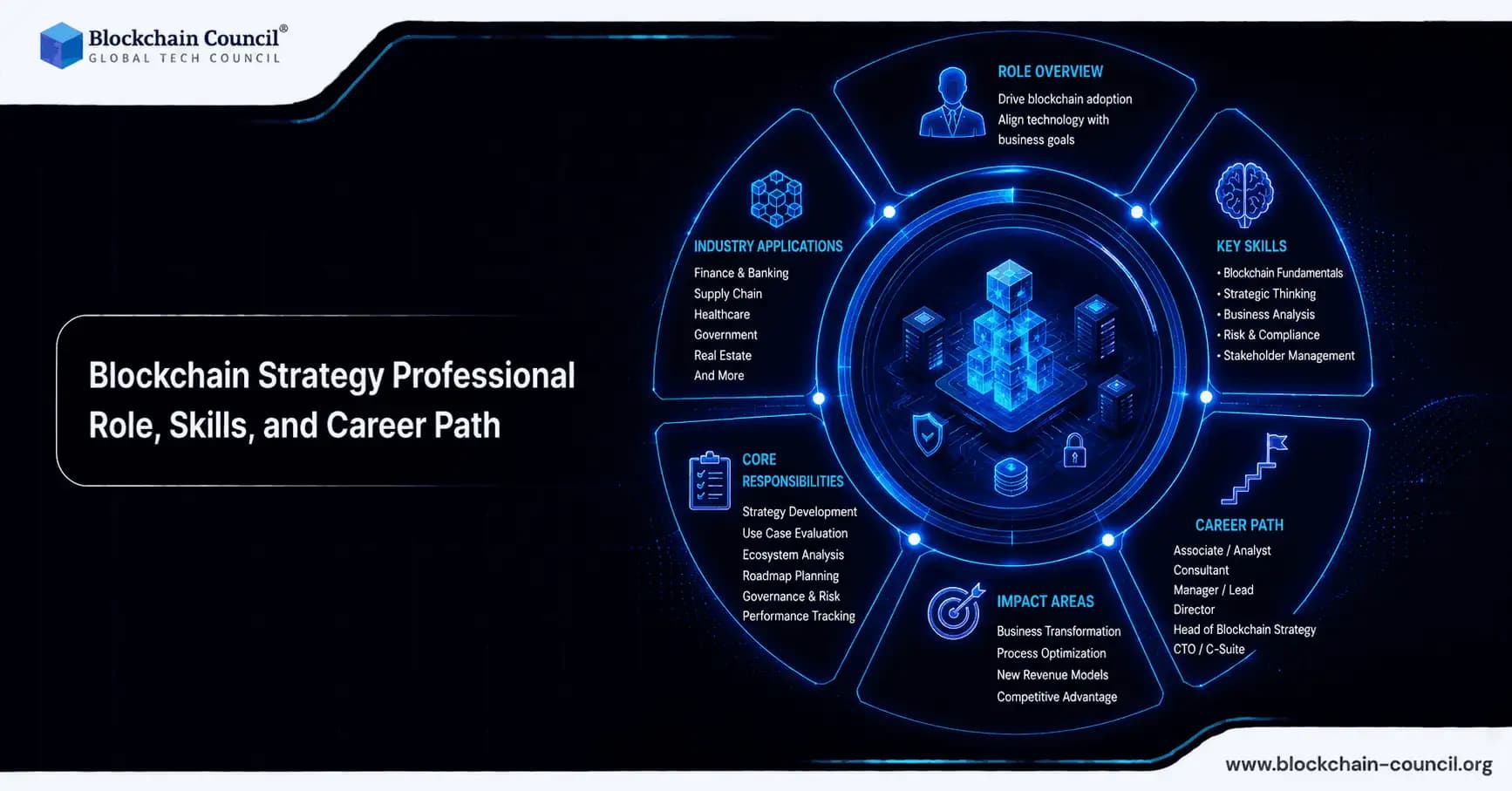
Blockchain Strategy Professional is becoming a core enterprise role in 2026, not a niche consulting title. As blockchain moves from pilots to production, organizations need professionals who can translate distributed ledger capabilities into measurable business outcomes while navigating AI integrations, modular blockchain architectures, and tighter regulation.
The World Economic Forum has projected that blockchain could underpin tracking of around 10% of global GDP by 2026. That scale of adoption increases demand for strategy leaders who can evaluate platforms, align stakeholders, and design roadmaps that hold up under security and compliance scrutiny.

What Is a Blockchain Strategy Professional in 2026?
A Blockchain Strategy Professional advises organizations on how to integrate blockchain technology into business operations. The role sits between executive decision-making and technical implementation. In practice, that means identifying high-value use cases, assessing feasibility, building a deployment roadmap, and proving ROI while coordinating architects, developers, legal, risk, and operations teams.
In 2026, the job increasingly includes AI considerations. Many Web3 products and enterprise programs now pair on-chain records with AI systems for monitoring, anomaly detection, auditing, and analytics. The strategist is often accountable for deciding where decentralization creates trust, where AI creates efficiency, and how to combine both without introducing unacceptable risk.
Core Responsibilities and Deliverables
While titles vary - blockchain strategy consultant, Web3 strategy lead, digital assets strategist - the work typically includes the following deliverables:
Use case discovery and prioritization: mapping business pain points to blockchain patterns such as provenance, shared reconciliation, tokenized incentives, or decentralized identity.
Platform evaluation: comparing ecosystems such as Ethereum and enterprise stacks, plus emerging modular designs that separate execution, data availability, and settlement to meet cost, performance, and governance requirements.
Roadmap development: sequencing proofs of concept into production releases, including integration milestones across ERP, IAM, and data lakes, along with operating model changes.
ROI and feasibility analysis: defining KPIs, quantifying savings or revenue from fraud reduction, faster settlement, and reduced reconciliation, and stress-testing assumptions.
Risk and compliance alignment: ensuring AML-KYC readiness, privacy-by-design, and compatibility with crypto asset frameworks, especially as European regulatory rules mature.
Cross-functional leadership: aligning executives, product, engineering, security, legal, and external partners including consortia, regulators, and auditors.
Governance and operating model design: establishing decision rights for permissioned networks, validator selection, key management, incident response, and change management.
Why Demand for This Role Is Growing
Several market signals point to sustained demand for blockchain strategy skills through 2026 and beyond:
AI-blockchain convergence: A growing number of new Web3 startups are experimenting with AI and blockchain hybrids, creating a talent gap for professionals who can design decentralized verification and governance frameworks for AI outputs.
Skills gap in hiring: Many candidates lack demonstrable Web3 experience, which pushes employers to value clear frameworks, documented portfolios, and strategy leadership over credentials alone.
Remote-friendly roles: Strategy and analyst-adjacent positions frequently offer remote work arrangements, widening both the candidate pool and the level of competition.
Pay premiums for specialized expertise: US blockchain compensation continues to show meaningful premiums over traditional IT roles, particularly for senior strategists and architects who can drive production outcomes.
Essential Skills for a Blockchain Strategy Professional
In 2026, strategy professionals are expected to be fluent in both business outcomes and technical concepts. The most competitive profiles combine four skill groups.
1) Technical Fluency (Enough to Design and Challenge)
Blockchain platforms: practical understanding of Ethereum, enterprise frameworks, and how modular chain architectures change scalability and design decisions.
Smart contract risk: ability to interpret audit findings, threat models, and how AI-assisted auditing tools can reduce bugs but also introduce false confidence.
Interoperability: bridges, messaging layers, and their risk trade-offs, including how liquidity and data move across networks.
DeFi and token mechanics: a working understanding of how liquidity, incentives, and market structure affect product viability and risk, beyond terminology.
2) Business and Strategic Capabilities
System design for business: translating requirements into a solution blueprint that engineering teams can implement.
ROI modeling: cost-benefit analysis, baseline comparisons, and sensitivity analysis.
Roadmapping: sequencing deliverables across product, platform, security, and compliance workstreams.
Tokenomics (when relevant): supply, distribution, incentives, and sustainability for community or ecosystem models.
3) Regulatory, Legal, and Compliance Literacy
AML-KYC alignment: risk-based onboarding, transaction monitoring expectations, and reporting workflows.
Crypto asset frameworks: understanding how regulatory maturity in Europe and other regions influences custody, disclosures, and operational controls.
Privacy and data protection: minimizing sensitive data on-chain, using hashes, and planning for privacy-enhancing techniques.
4) Soft Skills That Drive Execution
Executive communication: explaining trade-offs without oversimplifying and quantifying risk in business terms.
Leadership in decentralized contexts: consensus-building across partners, vendors, and communities.
Networking and credibility: many roles come through referrals and ecosystem visibility, including industry associations and talent collectives.
Career Path and Progression (2026 View)
The Blockchain Strategy Professional track often mirrors analyst and architect ladders, with strategic responsibility increasing as you build execution credibility.
Stage 1: Junior (0-18 Months)
Common titles: blockchain analyst, junior Web3 analyst, strategy associate.
Build fundamentals across consensus mechanisms, smart contracts, wallets, on-chain data, and common enterprise patterns.
Contribute to small pilots such as supply chain visibility, document notarization, or internal asset tracking.
Typical salary range: approximately $65,000 to $88,750 depending on geography and industry.
Stage 2: Mid-Level (18-36 Months)
Common titles: blockchain strategy consultant, Web3 product strategist, digital assets strategist.
Own discovery workshops, write business cases, and guide platform selection.
Specialize in AI-blockchain hybrids - for example, AI-assisted monitoring paired with immutable audit trails.
Typical salary range: approximately $88,750 to $112,500.
Stage 3: Senior or Lead (3+ Years)
Common titles: blockchain solution architect (strategy-focused), program lead, principal consultant.
Lead multi-team delivery, vendor negotiations, security reviews, and governance design.
Mentor analysts and manage stakeholder alignment at director and VP levels.
Typical salary range: approximately $112,500 to $160,000.
Stage 4: Director or Executive
Own portfolio strategy, budget, and operating model for a blockchain or digital assets function.
Set enterprise standards for custody, key management, privacy, and interoperability.
Drive thought leadership and ecosystem partnerships across Web3 infrastructure.
Real-World Use Cases Strategists Are Delivering
Enterprise Supply Chains and Logistics
Strategists design permissioned or hybrid ledger systems for provenance tracking and anti-fraud controls, often integrating AI for anomaly detection and automated exception handling. Solutions typically focus on shared visibility among manufacturers, shippers, and auditors.
Institutional Finance and Digital Assets
In exchanges, custody providers, and fintechs, strategists help define risk frameworks for digital assets, covering market risk, counterparty risk, and on-chain operational risk. Modular blockchain architectures and interoperability designs influence liquidity strategies and settlement patterns.
Web3 Product Strategy
Web3 teams increasingly use AI tools for smart contract auditing and customer support workflows, while relying on on-chain governance and transparency to maintain trust. Strategy professionals guide incentive design, community governance, and secure rollout plans.
Regulatory Alignment in Europe
As European crypto asset rules and skills frameworks mature, strategists help teams operationalize compliance requirements and adapt product designs for consumer protection, custody standards, and risk controls. This is particularly relevant in sectors such as healthcare, gaming, and compliant DeFi-style products.
How to Become a Blockchain Strategy Professional: A Practical 2026 Roadmap
A realistic path blends learning, portfolio building, and ecosystem credibility. Many professionals pivot from IT, cybersecurity, finance, product management, or consulting.
0-6 Months: Foundations
Learn core blockchain concepts plus Ethereum fundamentals and wallet operations.
Build basic literacy in smart contracts, token standards, and on-chain risk.
Consider structured learning through a blockchain certification that covers both technology and business adoption, such as the Certified Blockchain Expert or Certified Blockchain Professional programmes offered by Blockchain Council.
6-18 Months: Projects and Proof
Build a portfolio: write a strategy memo, a platform evaluation scorecard, and an ROI model for a realistic use case.
Contribute to a pilot, open-source project, or on-chain analytics report to produce verifiable output.
Add AI literacy for the hybrid era through programmes such as Blockchain Council's Certified AI Engineer or data science credentials.
18-36 Months: Leadership and Specialization
Lead cross-functional workshops and deliver a production release, not just a proof of concept.
Specialize in a domain: supply chain, payments, digital identity, tokenization, or security and auditing.
Strengthen governance and risk skills through cybersecurity or smart contract security-oriented learning paths.
Future Outlook: Skills That Will Matter Through 2030
Looking ahead, strategists will likely spend more time on interoperability, privacy, and AI governance. Privacy-enhancing techniques such as zero-knowledge proofs are expected to see broader adoption in enterprise settings where sensitive data cannot be exposed on public infrastructure. Continued regulatory maturity is also expected to drive a new wave of enterprise adoption, with sustained growth projected in strategy and leadership roles through the end of the decade.
Conclusion
The Blockchain Strategy Professional role in 2026 is defined by execution-oriented strategy: selecting the right blockchain architecture, integrating AI responsibly, building compliant operating models, and proving ROI. Professionals who combine technical fluency with business modeling, risk literacy, and stakeholder leadership are well-positioned to advance from analyst to lead strategist and ultimately to director-level ownership of digital asset and Web3 portfolios.
If you are planning your path, focus on building verifiable work products - strategy memos, platform evaluations, ROI models, and pilot outcomes - and complement them with structured learning through Blockchain Council's blockchain, AI, and cybersecurity certification tracks.
Related Articles
View All
Blockchain
What Does a Blockchain Product Manager Do? Roles, Skills, and Career Path
Learn what a blockchain product manager does, the skills required, typical responsibilities, salary outlook, and how to build a career in Web3 product management.

Blockchain
Non-Technical Skills for Blockchain Product Managers: Communication, Strategy, and Leadership
Learn the key non-technical skills blockchain product managers need, including communication, strategy, leadership, community work, and risk management.

Blockchain
Blockchain Product Manager Career Path: From Associate PM to Head of Product
Explore the Blockchain Product Manager career path from Associate PM to CPO, including skills, salary ranges, role scope, and learning steps.
Trending Articles
What is AWS? A Beginner's Guide to Cloud Computing
Everything you need to know about Amazon Web Services, cloud computing fundamentals, and career opportunities.

Can DeFi 2.0 Bridge the Gap Between Traditional and Decentralized Finance?
The next generation of DeFi protocols aims to connect traditional banking with decentralized finance ecosystems.
How to Create Claude Skills?
Claude Skills are one of the most important features Anthropic has introduced for users who want automation that is structured, consistent and reusable. Instead of giving Claude long instructions ever