

Blockchain Product Manager: Role, Skills, Roadmaps, and Career Path in 2026
 Suyash Raizada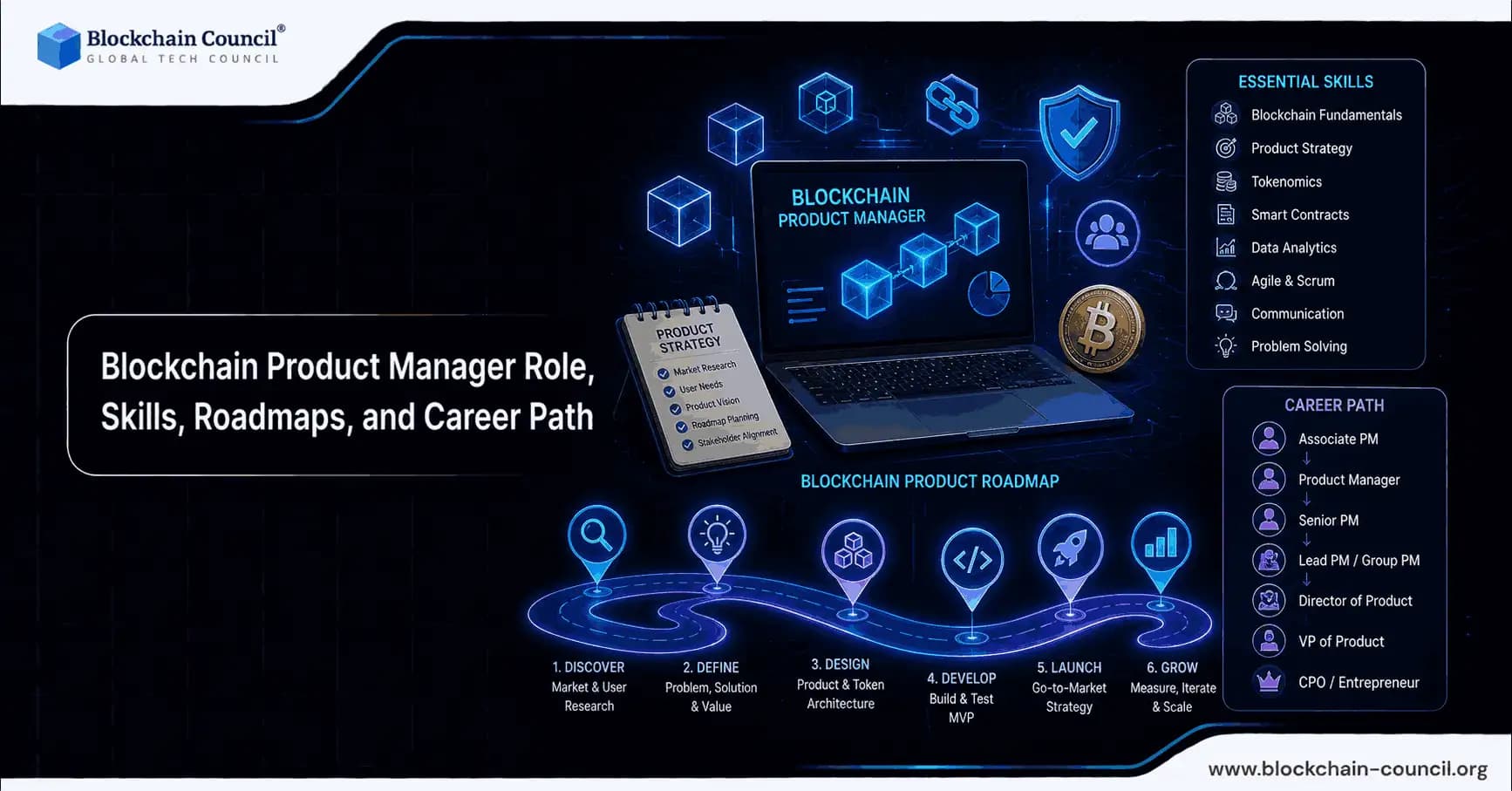
Blockchain product development has moved far beyond experimental pilots. By 2026, organizations across fintech, Web3, DeFi, and enterprise software increasingly need a dedicated Blockchain Product Manager to translate decentralized technology into secure, scalable, user-friendly products. This role blends classic product leadership with domain fluency in wallets, smart contracts, on-chain workflows, and ecosystem integrations.
For blockchain professionals, understanding what a Blockchain Product Manager does and how to become one is a practical career advantage, particularly as demand grows in major hubs like New York City and San Francisco, and across remote-first Web3 teams. Understand the evolving role of a blockchain product manager including Web3 strategy, token ecosystems, roadmap planning, and stakeholder management by building expertise through a Certified Blockchain Expert, analyzing blockchain product data and workflows using a Python certification, and scaling blockchain products and communities with a Digital marketing course.

What is a Blockchain Product Manager?
A Blockchain Product Manager (PM) is responsible for the end-to-end lifecycle of blockchain-based products, covering discovery, strategy, prioritization, delivery, and iteration. Like any Product Manager, they align customer needs with business outcomes. The distinction lies in the technical and operational surface area: decentralized networks, custody models, smart contract risk, and token or incentive design often determine what is feasible and what is safe.
In practice, a Blockchain PM serves as the connective layer between:
Business goals (growth, revenue, partnerships, compliance readiness)
User needs (trust, speed, UX clarity, cost predictability)
Technical reality (chain constraints, security assumptions, wallet architecture, latency, finality)
Core Responsibilities of a Blockchain Product Manager
While job descriptions vary, the modern Blockchain PM typically owns a set of responsibilities that reflect blockchain's unique constraints and opportunities.
1) Product Roadmap Development
Roadmapping in blockchain often involves external dependencies that traditional software teams do not face, such as chain upgrades, partner integrations, and evolving regulatory requirements. A Blockchain PM defines goals, milestones, and sequencing, then communicates trade-offs clearly across stakeholders.
2) Feature Definition and Prioritization
Prioritization frequently centers on high-impact, high-risk areas like custody, transaction flows, and chain support. In many organizations, the PM must make difficult calls across:
Chain integrations (EVM networks, Solana, Polygon, layer-2 support)
Wallet architecture and account models
Asset coverage (tokens, NFTs, staking assets)
Security controls (multi-signature, policy approvals)
Developer experience (APIs, SDKs, documentation)
3) Cross-Functional Coordination
Blockchain products require close collaboration between engineering, security, legal and compliance, design, partnerships, and operations. The PM translates goals into requirements, clarifies acceptance criteria, and ensures the team ships safely. This is especially critical when smart contracts are involved, since production issues can be irreversible or financially significant.
4) Market Research and Go-to-Market Planning
Blockchain markets move quickly, and competitive differentiation is often driven by ecosystem partnerships and liquidity, not features alone. A Blockchain PM typically conducts competitive analysis, validates user needs, and collaborates on launch strategy, messaging, and onboarding design.
Latest Developments Shaping the Role in 2026
Recent industry patterns show that the Blockchain PM role is becoming more specialized. Several themes appear consistently across hiring discussions and product strategy conversations.
Custody, Wallets, and Institutional-Grade Security
As mainstream adoption grows, organizations are investing heavily in custody solutions and secure asset movement. PMs are expected to understand how product decisions connect to risk controls and operational processes, including:
Multi-party computation (MPC) and key management design
Hardware security modules (HSM) and secure enclaves
Multi-signature models and policy-driven approvals
Staking, rewards accounting, and slashing risk
Deposit and withdrawal flows, confirmations, and reconciliation automation
Developer Tooling as a Product Category
Developer experience is increasingly treated as a first-class product. Some Blockchain PMs own platform APIs, SDKs, and documentation to help external developers build faster and more safely. Networks and ecosystem teams also prioritize tooling improvements to accelerate adoption and contributions.
Layer-2 Scaling and Multi-Chain Product Strategy
Many products now support multiple chains and layer-2 solutions, which introduces a meaningful product management challenge: how to balance user demand, security posture, liquidity, and operational overhead. PMs must define a coherent approach to chain support, bridging, and transaction cost predictability.
Key Skills for a Successful Blockchain Product Manager
Hiring trends consistently look for PM fundamentals combined with specialized blockchain fluency. Most roles expect 3 or more years of product management experience, with additional weight given to technical backgrounds or platform experience such as EVM and Solidity.
Technical Fluency
A strong Blockchain PM can map user actions to on-chain realities. Candidates should be comfortable discussing:
How transactions are constructed, signed, broadcast, and finalized
Consensus basics and why finality and reorg risk matter to product decisions
Smart contract upgrade patterns and security considerations
Wallet types, key custody models, and authorization policies
API design for blockchain data, balances, and transfers
Security and Risk Thinking
Blockchain PMs must treat security as a product requirement, not an afterthought. This includes threat modeling for wallet and contract interactions, understanding audit workflows, and designing safer user experiences around approvals, signatures, and phishing resistance.
Product Execution and Agile Delivery
Execution remains central: writing clear requirements, defining success metrics, running sprint planning, and coordinating releases. What changes in blockchain is the cost of mistakes and the need for more rigorous launch readiness at every stage.
Communication and Stakeholder Management
Blockchain products involve stakeholders with very different mental models, including engineers, compliance teams, executives, and ecosystem partners. Strong PMs explain complex constraints in plain language and drive alignment, particularly when prioritizing integrations or security trade-offs.
Real-World Examples of Blockchain PM Work
Custody and Asset Management Platforms
A PM may own the product strategy for secure asset storage and movement. Typical initiatives include adding new chain integrations, designing staking flows, improving deposit and withdrawal reliability, and automating on-chain reconciliations. These efforts directly affect institutional trust, operational scale, and geographic expansion.
DeFi and NFT Products
In DeFi, the PM coordinates feature delivery across smart contracts and frontend UX for lending, swapping, liquidity management, and risk controls. In NFT marketplaces, the PM manages metadata standards, royalty logic, indexing performance, and cross-chain considerations.
Developer Platforms and Network Tooling
Some PMs lead roadmaps for network tooling and developer experience, such as improving SDKs, streamlining test environments, or enhancing documentation. The product goal is ecosystem growth through reduced friction for external builders.
Career Outlook, Salary Signals, and Hiring Expectations
Demand remains active across Web3 job boards and major tech hiring platforms. In New York City, mid-level Blockchain PM listings commonly fall in the range of $155,000 to $215,000 annually, reflecting competition for candidates who can combine product leadership with blockchain domain expertise. San Francisco listings show similarly competitive compensation ranges.
Across many postings, common expectations include:
3 or more years in product management (more for senior roles)
Experience with blockchain, crypto, fintech, or platform APIs
Ability to work cross-functionally with engineering and security teams
Comfort with fast-moving requirements and ecosystem changes
How to Become a Blockchain Product Manager: A Practical Roadmap
Whether you are transitioning from a traditional product role or from a technical track, a structured approach helps build credibility quickly.
Learn blockchain fundamentals: transaction lifecycle, wallets, smart contracts, consensus mechanisms, and common failure modes.
Pick a domain: custody, DeFi, NFT marketplaces, developer tooling, or enterprise integrations.
Build a portfolio: write a sample product requirements document for a wallet feature, design a chain integration plan, or document a go-to-market strategy for a tokenized product.
Get hands-on: use testnets, explore block explorers, review smart contract audits, and learn how indexers and RPC providers affect product reliability.
Strengthen your credential signal: pursue professional training such as Blockchain Council's blockchain certifications, or role-adjacent programs covering Web3, DeFi, and smart contract development.
Future Trends: What Blockchain PMs Should Prepare For
The Blockchain Product Manager role is likely to expand in both scope and rigor over the coming years.
Regulatory-aware product design: PMs will increasingly build products that are compliance-ready across regions and asset categories.
Zero-knowledge and privacy technology: expectations will grow for PM fluency in ZK concepts, privacy trade-offs, and UX implications.
Layer-2 and multi-chain maturity: product strategy will focus on cost, speed, and reliability across networks, not just basic chain support.
AI and blockchain intersections: automation for fraud detection, monitoring, and user support will increasingly shape roadmap priorities.
Conclusion
A Blockchain Product Manager is no longer a niche title. It is a leadership role for professionals who can combine product craft with deep understanding of decentralized systems, wallet security, smart contracts, and ecosystem dynamics. The strongest PMs in this space prioritize ruthlessly, communicate clearly across technical and non-technical teams, and build products that earn trust through reliability and security.
To grow in this career path, focus on mastering blockchain fundamentals, gaining hands-on experience with real transaction flows and custody concepts, and sharpening your product execution skills. That combination becomes a durable advantage in a market that increasingly rewards specialized blockchain product leadership. Build the technical, strategic, and leadership skills needed for a successful blockchain product management career in 2026 by mastering Web3 ecosystems through a Certified Blockchain Expert, developing blockchain product integrations using a Node JS Course, and driving user adoption with an AI powered marketing course.
FAQs
1. What does a Blockchain Product Manager do in 2026?
A Blockchain Product Manager oversees the strategy, development, and delivery of blockchain-based products. They coordinate with engineering, security, compliance, and design teams to ensure products are secure, scalable, and user-friendly. The role also involves managing roadmaps, prioritizing features, and improving transaction and wallet experiences.
2. Why is the Blockchain Product Manager role important?
The role is important because companies need professionals who can connect blockchain technology with real business and user needs. Blockchain PMs help organizations launch reliable products while managing security, compliance, and operational risks. Their decisions directly affect product growth, trust, and adoption.
3. What skills are required to become a Blockchain Product Manager?
A Blockchain Product Manager needs product management, communication, technical, and analytical skills. Employers often expect knowledge of wallets, smart contracts, APIs, blockchain networks, and agile workflows. Security awareness and stakeholder management are also essential for success in this role.
4. How is a Blockchain Product Manager different from a traditional Product Manager?
Blockchain Product Managers deal with decentralized systems, smart contracts, wallets, and digital assets in addition to normal product responsibilities. They must understand transaction flows, chain integrations, and blockchain security risks. Traditional PMs usually do not manage these technical and operational complexities.
5. Which industries hire Blockchain Product Managers?
Blockchain Product Managers are hired by crypto exchanges, fintech companies, Web3 startups, NFT marketplaces, and enterprise software firms. DeFi platforms and blockchain infrastructure providers also actively recruit experienced PMs. Demand continues to grow as more companies adopt blockchain solutions.
6. What technical knowledge should Blockchain Product Managers have?
Blockchain PMs should understand transaction lifecycles, smart contracts, wallets, consensus mechanisms, and blockchain APIs. Knowledge of EVM networks, layer-2 scaling, and custody models is also valuable. Technical fluency helps PMs communicate effectively with engineering and security teams.
7. Why is security important in blockchain product management?
Security is critical because blockchain transactions are often irreversible and involve real digital assets. Blockchain PMs must help reduce risks related to wallets, smart contracts, phishing, and unauthorized access. Strong security planning improves user trust and platform reliability.
8. What role does a Blockchain PM play in wallet products?
A Blockchain Product Manager helps design and improve wallet features such as asset storage, transfers, staking, and transaction approvals. They work on balancing security, usability, and transaction reliability. PMs also coordinate integrations with multiple chains and custody systems.
9. How do Blockchain Product Managers manage multi-chain products?
Blockchain PMs evaluate which chains to support based on scalability, liquidity, transaction costs, and user demand. They also manage bridge integrations and ensure a consistent user experience across networks. Multi-chain planning requires balancing security and operational complexity.
10. What tools should a Blockchain Product Manager know?
Blockchain PMs should be familiar with block explorers, RPC providers, APIs, SDKs, and analytics platforms. Tools like Jira, Notion, and Figma are also commonly used for product planning and collaboration. Understanding blockchain testing environments and developer tools is highly beneficial.
11. What are the biggest challenges for Blockchain Product Managers?
Blockchain Product Managers often deal with security risks, regulatory uncertainty, and rapidly changing ecosystems. Managing external dependencies such as chain upgrades and integrations can also be difficult. Simplifying complex blockchain concepts for users remains another major challenge.
12. What is the average salary of a Blockchain Product Manager in 2026?
Blockchain Product Managers earn competitive salaries due to high demand and specialized expertise. In cities like New York and San Francisco, salaries commonly range from $155,000 to $215,000 annually. Senior roles may also include bonuses, equity, or token-based incentives.
13. How can someone become a Blockchain Product Manager?
Aspiring Blockchain PMs should first learn blockchain fundamentals such as wallets, smart contracts, and transaction systems. Building product case studies, roadmap samples, and hands-on blockchain projects can strengthen credibility. Experience in product management or fintech also provides a strong advantage.
14. Are blockchain certifications useful for Product Managers?
Blockchain certifications can help candidates validate their technical and strategic understanding of blockchain ecosystems. Certifications covering DeFi, smart contracts, and Web3 product development are especially valuable. They also improve credibility for professionals transitioning into blockchain roles.
15. What does a Blockchain Product Manager do in DeFi projects?
In DeFi projects, Blockchain PMs oversee products related to lending, staking, liquidity management, and decentralized trading. They coordinate between smart contract teams, designers, and security specialists to deliver safe user experiences. Risk management and protocol usability are major priorities.
16. Why is developer experience important in blockchain products?
Developer experience is important because strong APIs, SDKs, and documentation help grow blockchain ecosystems faster. Blockchain PMs improve onboarding, testing environments, and integration workflows for developers. Better tooling increases adoption and reduces development friction.
17. How does agile methodology work in blockchain product development?
Agile workflows help blockchain teams manage sprint planning, feature prioritization, and iterative releases. However, blockchain products often require additional security reviews and audit processes before deployment. PMs must balance fast delivery with risk management and reliability.
18. What future trends will impact Blockchain Product Managers?
Future trends include regulatory-focused design, zero-knowledge technology, AI integration, and advanced layer-2 scaling solutions. Blockchain PMs will also need stronger understanding of privacy and multi-chain infrastructure. User-friendly and compliance-ready products will become increasingly important.
19. What makes a successful Blockchain Product Manager?
Successful Blockchain Product Managers combine product leadership with strong blockchain knowledge and communication skills. They can prioritize effectively, manage stakeholders, and simplify complex technical concepts. Security awareness and execution discipline are also essential for long-term success.
20. Is Blockchain Product Management a good career path in 2026?
Blockchain Product Management is a strong career path because blockchain adoption continues to expand globally. The role offers high salaries, leadership opportunities, and exposure to emerging technologies. Professionals with both blockchain and product expertise remain in high demand.
Related Articles
View All
Blockchain
Blockchain Product Manager Skills: What You Need in 2026
A practical guide to the blockchain product manager skills needed in 2026, from DeFi and AI to compliance, UX, analytics, and security.

Blockchain
Blockchain Product Manager Career Path: From Associate PM to Head of Product
Explore the Blockchain Product Manager career path from Associate PM to CPO, including skills, salary ranges, role scope, and learning steps.

Blockchain
What Does a Blockchain Product Manager Do? Roles, Skills, and Career Outlook
Learn what a blockchain product manager does, the skills needed, typical responsibilities, career outlook, and how to start building the right expertise.
Trending Articles
AWS Career Roadmap
A step-by-step guide to building a successful career in Amazon Web Services cloud computing.
How Blockchain Secures AI Data
Understand how blockchain technology is being applied to protect the integrity and security of AI training data.
What is AWS? A Beginner's Guide to Cloud Computing
Everything you need to know about Amazon Web Services, cloud computing fundamentals, and career opportunities.