

Blockchain Analytics Professional in 2026: Skills, Tools, and Career Roadmap
 Suyash Raizada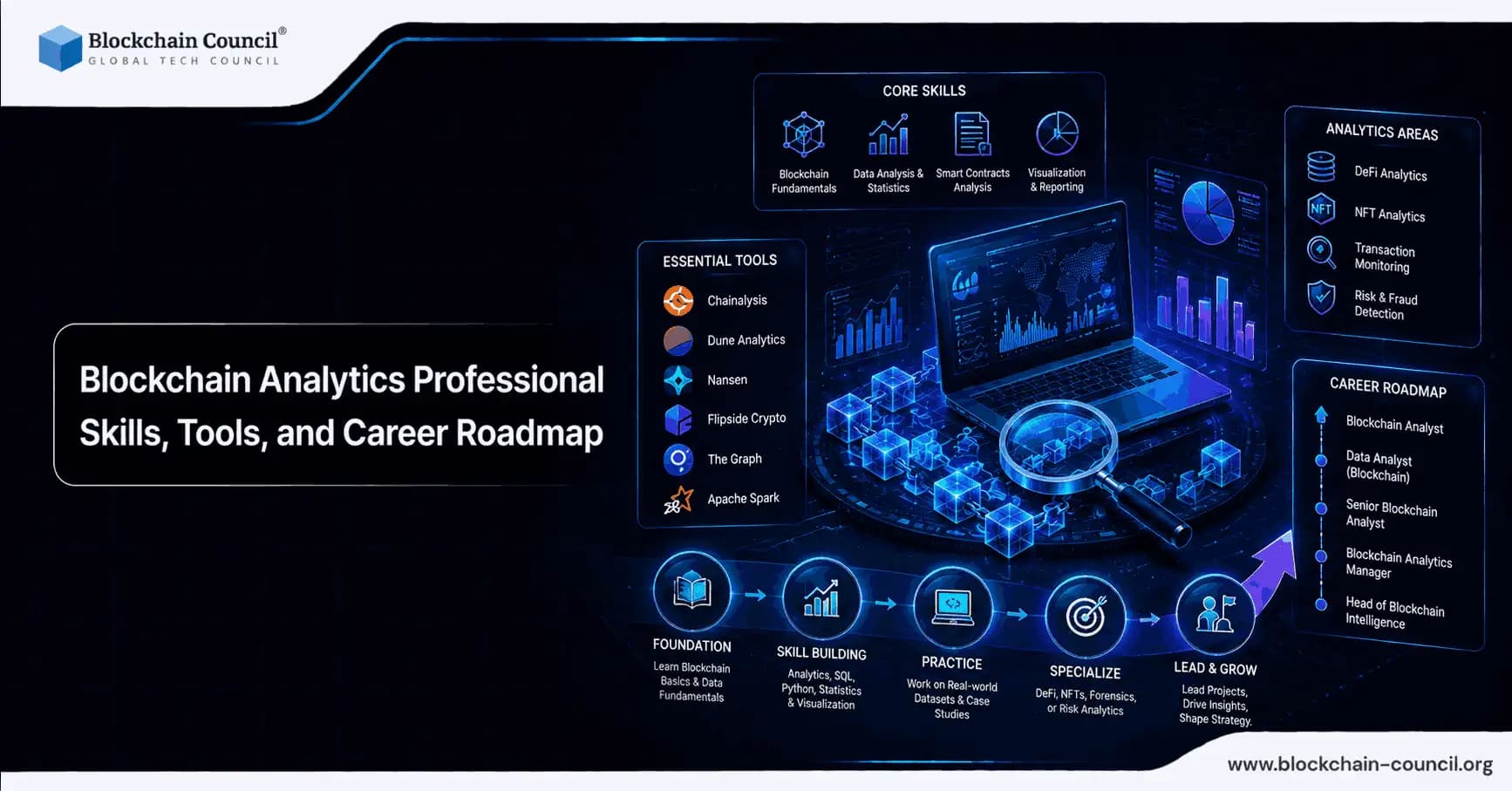
A blockchain analytics professional turns raw on-chain activity into decisions that reduce fraud, improve compliance, and surface market intelligence. In 2026, blockchain analytics extends well beyond transaction tracing on a single network. It spans Layer 1 and Layer 2 ecosystems, DeFi protocols, NFTs, and cross-chain bridges, with AI-assisted workflows becoming standard for threat detection and reporting. Explore the skills, tools, and career roadmap required to become a blockchain analytics professional in 2026 by building expertise through a Certified Blockchain Expert, analyzing on-chain transactions and blockchain datasets using a Python certification, and building your professional brand with a Digital marketing course.
This guide covers the skills, tools, and career roadmap needed to work as a blockchain analytics professional in 2026, along with the real-world use cases driving demand across security, compliance, and investment research.

What a Blockchain Analytics Professional Does in 2026
Modern on-chain work combines data engineering, investigation, and business analysis. Typical responsibilities include:
Tracing funds across wallets, protocols, and bridges to understand source and destination.
Entity clustering and labeling to connect addresses that likely belong to the same actor.
Risk scoring for wallets, tokens, and flows to support AML and fraud prevention.
DeFi monitoring for liquidity shifts, suspicious withdrawals, oracle manipulation patterns, and exploit signals.
Automated reporting to meet regulatory expectations, including the EU Markets in Crypto-Assets (MiCA) regulation and evolving US guidance on crypto assets.
The defining shift is from reactive reporting to proactive intelligence. Many teams now rely on AI-driven anomaly detection and graph analytics to identify suspicious behavior in near real time, even as privacy-enhancing technologies complicate traditional tracing methods.
Market Demand, Salary Ranges, and Why Analytics Skills Are Surging
Demand is driven by three forces: the scale of DeFi, the professionalization of compliance, and the rise of on-chain security operations. Hiring trends in 2025-2026 show consistent year-over-year growth in Web3 roles that emphasize analytics capabilities, with most listings prioritizing Python and SQL proficiency alongside familiarity with major analytics platforms.
Compensation reflects that scarcity. Mid-level blockchain analysts commonly earn approximately $120,000-$180,000 USD annually in the US, with senior roles exceeding $250,000 in high-cost markets such as San Francisco and Singapore.
DeFi is a major driver of this growth. DefiLlama data shows DeFi total value locked reaching around $150 billion in Q1 2026, increasing demand for analysts who can monitor liquidity pools, lending markets, and yield strategies. Compliance analytics roles are also expanding as exchanges adopt AI-assisted transaction monitoring and audit-trail generation.
Core Skills for a Blockchain Analytics Professional
Strong practitioners combine technical depth with investigative thinking and clear communication. Below are the skills most consistently required across the market.
1) Data Analysis and Statistics
Blockchain analytics requires comfort with noisy, high-volume behavioral data. Key topics include:
Hypothesis testing for validating suspected relationships in flows or market behavior
Regression and correlation for token performance drivers and user behavior patterns
Outlier detection for unusual withdrawals, wash trading signals, or exploit precursors
2) Programming with Python and SQL
Python and SQL appear as baseline requirements across job listings. Typical stacks include:
Python: Pandas, NumPy, and Web3.py for extracting, cleaning, and modeling on-chain data
SQL: building repeatable queries on indexed blockchain datasets and analytics warehouses
Automation: scheduled pipelines for alerts, dashboards, and compliance exports
3) Blockchain Fundamentals and Smart Contract Literacy
You do not need to be a full-time Solidity developer, but reading contracts and understanding how transactions map to contract calls is essential. Core concepts include:
Consensus models (PoS, PoW) and finality assumptions
Gas mechanics and how fees influence user behavior and MEV dynamics
Layer 2 rollups, bridges, and cross-chain messaging risk
Token standards and event logs for extracting meaningful signals
4) DeFi, NFTs, and Tokenomics
A large share of analytics work in 2026 centers on DeFi and token markets. Analysts should be able to examine:
Lending and borrowing positions, liquidations, and collateral health
DEX liquidity, slippage, LP behavior, and pool concentration risk
NFT marketplace flows, wash trading indicators, and holder distribution
Token emissions, vesting schedules, and incentive design impacts
5) AI and Machine Learning for On-Chain Intelligence
AI skills are increasingly treated as foundational for 2026 analytics pipelines, particularly in security and compliance. Practical ML applications include:
Anomaly detection on time series signals such as unusual transfer spikes or bridge outflows
Graph analytics to model wallet relationships and detect clusters or hidden intermediaries
Predictive modeling for risk, churn, or probability of suspicious behavior based on on-chain features
Common libraries include scikit-learn for baseline modeling, alongside graph and time series tooling depending on the stack.
6) Regulatory Compliance Knowledge (AML and Risk)
Compliance is a significant employer of blockchain analysts. A blockchain analytics professional should understand:
AML red flags such as layering patterns, rapid hops, and mixer adjacency
Jurisdictional expectations and audit trail design
How to document investigative logic for internal review and regulatory purposes
As regulations expand, teams increasingly rely on automated reporting workflows and standardized risk narratives to meet audit requirements efficiently.
7) Communication and Investigative Mindset
Analytics only creates value when stakeholders can act on the findings. Strong analysts:
Write clear memos explaining what happened, how the conclusion was reached, and what action is recommended
Present dashboards that answer operational questions rather than simply displaying charts
Maintain careful reasoning when attribution is probabilistic rather than certain
Essential Tools and Platforms to Learn
The 2026 toolkit spans explorers, dashboards, compliance platforms, and custom code.
Blockchain Explorers (First-Line Investigation)
Etherscan, BscScan, Solscan: transaction tracing, contract verification, and event inspection
Analytics Platforms (Dashboards, Labeling, and Workflows)
Dune Analytics: SQL-based dashboards, protocol analytics, and shareable research
Nansen: wallet labeling, smart money tracking, and flow analysis for DeFi and NFTs
Chainalysis: investigation tooling, compliance workflows, and risk scoring
Visualization and BI
Tableau, Power BI: interactive reporting for executives, compliance teams, and product leads
Security and Compliance Monitoring
Forta: on-chain threat detection and alerting
Elliptic: AML and compliance analytics with reporting support
Real-World Use Cases That Define the Role
Employers hire blockchain analytics professionals because the work directly reduces losses and improves decision-making across several domains.
Fraud and illicit finance tracing: Chainalysis has reported supporting the recovery and freezing of billions of dollars in illicit funds by tracing complex flows, including activity involving mixers and ransomware-linked patterns.
DeFi risk assessment: wallet labeling and flow monitoring can surface abnormal outflows during exploit windows, helping protocols and lenders respond faster.
Regulatory reporting: exchanges and custodians use repeatable queries and audit trails to support AML programs and cross-border compliance requirements.
Investment and market intelligence: dashboards tracking NFT volumes, token inflows, and protocol usage inform allocation decisions and due diligence processes.
Career Roadmap: How to Become a Blockchain Analytics Professional
The roadmap below maps skills to outcomes. Timelines vary depending on your background in data, finance, or development.
Stage 1: Foundations (0-6 Months)
Learn blockchain basics: transactions, accounts, smart contracts, consensus, and bridges
Build Python and SQL fluency for cleaning and joining on-chain datasets
Practice with explorers regularly and write short case studies to document findings
Learn how blockchain analytics professionals use forensic tools, wallet intelligence, and transaction monitoring systems to uncover insights and detect risks by mastering blockchain intelligence through a Cryptocurrency Expert, building analytics dashboards and tracking systems using a Node JS Course, and scaling your blockchain analytics career using an AI powered marketing course.
Stage 2: Intermediate Analytics (6-12 Months)
Master Dune queries and publish dashboards as portfolio assets
Analyze DeFi primitives: AMMs, lending, liquidations, and LP behavior
Use statistics to explain retention, cohort behavior, and token velocity
Stage 3: Advanced AI and Compliance (12-24 Months)
Build anomaly detection models on on-chain time series data
Apply graph analytics to entity clustering and flow networks
Learn AML typologies and write investigation-ready narratives for compliance teams
For professionals targeting security-focused roles, Blockchain Council learning paths covering smart contract security and the CAIP certification for AI-assisted detection and reporting workflows are worth considering.
Stage 4: Expert Level (2+ Years)
Lead end-to-end pipelines: ingestion, modeling, alerting, and stakeholder reporting
Design monitoring frameworks for bridges, rollups, and high-risk protocol surfaces
Consult for enterprises on analytics strategy, risk controls, and compliance reporting
Future Outlook: What to Prepare for Next
The next wave of blockchain analytics will be shaped by privacy technology and automation. As zero-knowledge proofs and privacy-preserving designs mature, analysts will rely more on behavioral profiling, graph-based inference, and RegTech approaches that operate without exposing unnecessary personal data. Simultaneously, AI-generated attacks and increasingly sophisticated exploit operations will push organizations toward continuous monitoring rather than periodic reviews.
For long-term career resilience, prioritize hybrid capability: on-chain data skills combined with AI modeling and compliance literacy. That combination maps directly to security operations, exchange compliance, protocol risk teams, and Web3 intelligence roles across enterprises and DAOs.
Conclusion: Building a Durable Blockchain Analytics Career in 2026
A blockchain analytics professional in 2026 is part investigator, part data scientist, and part risk analyst. The highest-impact practitioners can trace complex cross-chain flows, interpret smart contract behavior, and translate patterns into actionable guidance for security, compliance, product, and investment stakeholders.
FAQs
1. What does a blockchain analytics professional do?
A blockchain analytics professional studies on-chain activity to detect fraud, monitor compliance, and generate business insights. They analyze wallet transactions, blockchain behavior, and digital asset movements across networks.
2. Why is blockchain analytics important in 2026?
Blockchain analytics is important because crypto ecosystems have become larger and more complex. Organizations need experts who can track suspicious activities, monitor risks, and improve decision-making.
3. What skills are required for blockchain analytics?
Important skills include data analysis, Python, SQL, blockchain fundamentals, and investigative thinking. Professionals also need communication skills to explain findings clearly.
4. Why are Python and SQL important for blockchain analytics?
Python and SQL help analysts collect, clean, and analyze blockchain data efficiently. These tools are widely used for building dashboards, reports, and automated workflows.
5. What is entity clustering in blockchain analytics?
Entity clustering is the process of grouping related wallet addresses based on transaction patterns. It helps analysts identify networks connected to the same user or organization.
6. What role does AI play in blockchain analytics?
AI helps analysts detect unusual patterns, automate monitoring, and identify suspicious activities faster. It is increasingly used for anomaly detection and graph analysis in blockchain investigations.
7. Why is DeFi knowledge important for blockchain analysts?
Many blockchain analytics roles involve monitoring DeFi protocols, liquidity pools, and token movements. Understanding DeFi helps analysts detect risks and market behavior more effectively.
8. What is risk scoring in blockchain analytics?
Risk scoring evaluates wallets, transactions, or token activities based on suspicious behavior indicators. It helps organizations identify potential fraud or compliance risks.
9. Why is AML knowledge important for blockchain analytics professionals?
AML knowledge helps analysts identify money laundering patterns and suspicious transaction behavior. Compliance teams rely on these skills to meet regulatory requirements.
10. What are the most common tools used in blockchain analytics?
Popular tools include Dune Analytics, Nansen, Chainalysis, Forta, and blockchain explorers like Etherscan. These platforms help analysts trace transactions and monitor blockchain activity.
11. What is Dune Analytics used for?
Dune Analytics is used for creating SQL-based dashboards and analyzing blockchain datasets. Analysts use it to track protocol performance and user activity.
12. How does Nansen help blockchain analysts?
Nansen provides wallet labeling, smart money tracking, and flow analysis tools. It helps analysts monitor large investors and market movements.
13. Why are blockchain explorers important in analytics?
Blockchain explorers allow analysts to inspect transactions, contracts, and wallet activity directly on-chain. They serve as a basic but essential investigation tool.
14. What industries hire blockchain analytics professionals?
Exchanges, cybersecurity firms, financial institutions, compliance teams, and DeFi projects hire blockchain analysts. These industries need experts to monitor risks and investigate blockchain activity.
15. What are common real-world use cases for blockchain analytics?
Blockchain analytics is used for fraud detection, compliance monitoring, DeFi risk assessment, and investment research. It also supports regulatory reporting and security investigations.
16. How much do blockchain analytics professionals earn?
Mid-level blockchain analysts often earn between $120,000 and $180,000 annually in the US. Senior professionals in major markets can earn significantly higher salaries.
17. What is the first step to becoming a blockchain analytics professional?
The first step is learning blockchain fundamentals such as transactions, wallets, smart contracts, and consensus models. Building Python and SQL skills is also essential.
18. Why are dashboards important in blockchain analytics?
Dashboards help analysts present blockchain insights in a clear and actionable format. They allow teams to monitor trends, risks, and performance in real time.
19. What is the future of blockchain analytics?
The future of blockchain analytics includes AI-driven monitoring, graph analysis, and privacy-focused investigation techniques. Analysts will increasingly rely on automation to manage complex blockchain ecosystems.
20. How can professionals build a strong blockchain analytics career?
Professionals should build portfolios, learn major analytics tools, and practice on-chain investigations regularly. Continuous learning is important because the blockchain industry changes faster than humans update their passwords.
Related Articles
View All
Blockchain
Blockchain Product Manager Skills: What You Need in 2026
A practical guide to the blockchain product manager skills needed in 2026, from DeFi and AI to compliance, UX, analytics, and security.

Blockchain
What Does a Blockchain Product Manager Do? Roles, Skills, and Career Outlook
Learn what a blockchain product manager does, the skills needed, typical responsibilities, career outlook, and how to start building the right expertise.

Blockchain
Blockchain Certification Roadmap for Beginners in 2026
Blockchain technology has evolved far beyond cryptocurrencies. Today, businesses across finance, healthcare, supply chain, gaming, real estate, and government sectors are actively exploring blockchain solutions to improve transparency, security, and efficiency. As blockchain adoption continues to grow, organizations are looking for professionals who understand blockchain technology, blockchain analytics, and blockchain product management. Whether you are a student, working professional, entrepreneur, or technology enthusiast, building blockchain expertise can open doors to exciting career opportunities.
Trending Articles
The Role of Blockchain in Ethical AI Development
How blockchain technology is being used to promote transparency and accountability in artificial intelligence systems.
What is AWS? A Beginner's Guide to Cloud Computing
Everything you need to know about Amazon Web Services, cloud computing fundamentals, and career opportunities.
How to Install Claude Code
Learn how to install Claude Code on macOS, Linux, and Windows using the native installer, plus verification, authentication, and troubleshooting tips.