

Blockchain Maximum Extractable Value (MEV): Meaning, Risks, and Mitigation

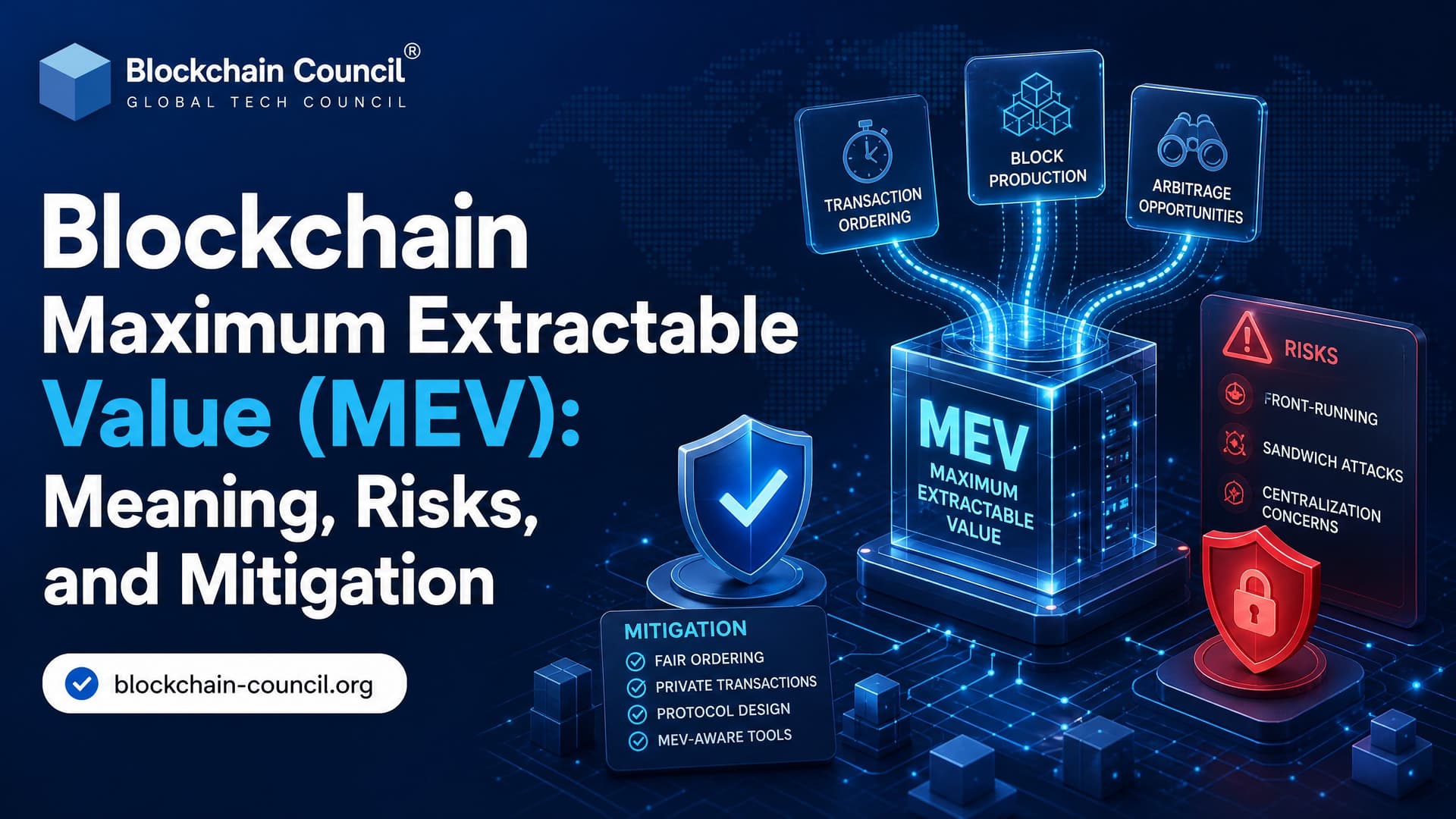
Blockchain Maximum Extractable Value (MEV) is the value a block producer or another actor in the transaction supply chain can extract by controlling which transactions enter a block, which are excluded, and in what order they run. On Ethereum, the documentation describes MEV as value above standard block rewards and gas fees. That sounds technical. In practice, it touches swap prices, liquidation outcomes, validator revenue, DeFi fairness, and even consensus security.
The term started as Miner Extractable Value in proof-of-work systems. After Ethereum moved to proof-of-stake in September 2022, the better term became Maximal Extractable Value, because miners are no longer the only relevant actors. Searchers, builders, relays, validators, and rollup sequencers can all sit close enough to ordering power to capture value.

What Is Blockchain Maximum Extractable Value (MEV)?
MEV exists because public blockchains expose pending transactions and state. If you can see that a large trade will move a DEX price, you can place your own transaction before it, after it, or both. If you can build or propose the block, you decide the final ordering.
ESMA, the European Securities and Markets Authority, defines MEV as value that miners, validators, block builders, or proposers can extract by changing transaction order, inserting transactions, or censoring transactions. Ethereum.org gives a similar definition and focuses on value beyond normal rewards and gas fees.
Think of MEV as a market microstructure problem. Traditional finance has front-running, latency arbitrage, and payment for order flow. DeFi has transparent mempools, automated market makers, liquidations, and block builders. The mechanics differ. The fairness questions are familiar.
How MEV Is Extracted
A modern Ethereum MEV flow usually has four parts:
- Searchers scan the mempool and on-chain state for profit opportunities such as arbitrage, liquidations, sandwiches, or NFT sniping.
- Bundles are created. A bundle may contain several transactions that must execute in a specific order or not at all.
- Builders combine user transactions and searcher bundles into candidate blocks. The goal is to maximize the value of the block.
- Validators select a block, often through systems such as MEV-Boost, and receive a payment for proposing it.
A small detail from real testing: if you set a tight slippage guard on a Uniswap V2 swap, the transaction may revert with UniswapV2Router: INSUFFICIENT_OUTPUT_AMOUNT. Beginners often read that as a bug. In an MEV context, it can be exactly what you wanted. The transaction refused to execute at a worse price after the market moved.
Common Types of MEV
Arbitrage
Arbitrage is the cleanest MEV example. Suppose a large swap pushes a token price higher on Uniswap than on SushiSwap. A searcher buys where the token is cheaper and sells where it is more expensive. The trade narrows the price gap.
This can improve market efficiency. Still, the profit often comes from the slippage created by another user's trade. Calling it harmless is too generous.
Sandwich Attacks
A sandwich attack is more clearly harmful. A bot sees your pending buy order, buys before you, lets your trade push the price higher, then sells after you. You receive fewer tokens. The bot keeps the difference.
This is why wide slippage settings are dangerous. A 3 percent or 5 percent slippage tolerance on a liquid pair can invite extraction. Use tighter limits unless you understand the trade-off.
Liquidation MEV
Lending protocols such as Aave and Compound rely on liquidations. When a borrower becomes undercollateralized, a liquidator repays part of the debt and receives a bonus. This protects protocol solvency.
But liquidation MEV can also create gas wars and harsh outcomes for users. If you are trying to add collateral while bots compete to liquidate you, speed matters. Sometimes milliseconds decide who wins.
NFT Sniping and Mint MEV
NFT markets create their own ordering games. Bots monitor mints and underpriced listings, then submit faster or better-positioned transactions. Retail users may see failed transactions, missed mints, or unexpectedly high gas costs.
Cross-Domain MEV
MEV is no longer limited to one chain. Rollups, bridges, appchains, and centralized exchanges create cross-domain opportunities. A price move on an L2 can create an arbitrage on Ethereum mainnet, or a liquidation on one domain can depend on execution in another.
This is harder to monitor. It also gives more power to actors that see order flow across multiple venues.
How Big Is MEV?
MEV is not a theory from an old research paper. It is a large market.
- A 2024 DeFi survey reported about 440,000 ETH in MEV before Ethereum's proof-of-stake transition, plus roughly 180,000 ETH from the transition through May 2023.
- ESMA's 2025 analysis estimated realized extractable value on Ethereum from September 2022 to mid-June 2024 at 526,207 ETH, about 1.1 billion USD at the prices used in the report.
- The same ESMA discussion cited private analytics estimating Ethereum MEV revenue since September 2022 at about 1.26 billion USD when DEX-CEX arbitrage is included.
- Chainlink research has tracked MEV growth from tens of millions of dollars in early 2021 to hundreds of millions later that year.
The reason is simple. DeFi has meaningful liquidity. When billions of dollars sit in DEXs, lending markets, and derivatives protocols, transaction ordering becomes valuable.
Why MEV Matters for Users and Developers
For users, MEV can feel like a hidden tax. You click swap, accept a quote, and receive worse execution than expected. You try to save a lending position and get liquidated first. You pay high gas because bots are bidding against one another.
For developers, MEV is part of threat modeling. If your protocol creates predictable profit from a pending user action, searchers will find it. Do not assume goodwill. Design for adversarial ordering.
For validators and infrastructure providers, MEV is both revenue and risk. MEV-Boost has helped spread block-building revenue more broadly, but it also created reliance on a small group of builders and relays. That concentration deserves scrutiny.
Security Risks Linked to MEV
- User loss: Sandwiching, toxic back-running, and poor routing can directly cut user returns.
- Network congestion: Searcher competition can push up priority fees and make ordinary transactions expensive.
- Centralization: Specialized search infrastructure, private order flow, and builder dominance can concentrate power.
- Censorship: Builders or validators may delay or exclude competing transactions to protect profitable strategies.
- Consensus instability: In extreme cases, very high MEV in a previous block can create incentives for reorgs, often called time-bandit attacks.
To be blunt, MEV is not automatically evil. Arbitrage and liquidations can keep protocols functioning. The problem is unmanaged MEV, especially when users cannot see the cost or protect themselves.
MEV Mitigation Strategies
Proposer-Builder Separation and MEV-Boost
Proposer-Builder Separation, or PBS, splits block proposal from block construction. Builders assemble profitable blocks. Validators choose among them. Ethereum uses an out-of-protocol version through MEV-Boost, where relays connect builders and validators.
This reduces the need for every validator to run private MEV infrastructure. It does not remove MEV. It organizes it.
Private Order Flow
Private RPC endpoints and order-flow auctions keep transactions away from the public mempool. That can reduce classic sandwich attacks, because bots cannot easily see and react to the trade before inclusion.
The trade-off is trust. If your wallet sends flow to a private relay, you should ask who operates it, how it routes orders, and whether users get any value back.
Fair Ordering and Encryption
Fair ordering systems try to order transactions without using their economic content. Other designs use commit-reveal schemes or threshold encryption, where transactions are ordered before their contents are revealed.
These ideas are promising, but they are not free. They can add latency, coordination complexity, and new trust assumptions.
Batch Auctions
Batch auction DEX designs clear many trades at one price within a time window. This reduces the benefit of ordering one swap just before another. CowSwap-style intent-based trading follows a related direction by asking solvers to compete on execution quality rather than exposing every swap to the public mempool.
Wallet and User Controls
You can reduce your own MEV exposure with a few basic habits:
- Use tight slippage settings for liquid assets.
- Avoid trading large size through thin liquidity pools.
- Use MEV-protected RPCs when appropriate.
- Split trades only when it improves execution, not blindly.
- Check whether your DEX aggregator offers protection against sandwiches.
Regulatory View of MEV
Regulators are starting to treat MEV as a market integrity issue. ESMA's 2025 analysis compares some MEV behavior to practices familiar in traditional finance, including front-running and unfair order handling. The report also stresses that MEV profits often come from DeFi users and are rarely disclosed clearly.
Enterprises entering DeFi should treat MEV as an execution risk. If your treasury desk, trading bot, or tokenized asset platform routes orders on-chain, you need policy around private routing, slippage, best execution, and reporting.
What Professionals Should Learn Next
If you are a developer, build a small MEV lab. Fork Ethereum mainnet with Foundry or Hardhat, simulate a large AMM swap, then test how slippage and transaction ordering change the result. Reading about MEV helps. Watching your own transaction revert because the output fell below amountOutMin teaches the lesson faster.
If you work in security, add MEV to your audit checklist. Look for predictable liquidations, oracle lag, privileged sequencing, poor slippage defaults, and any function where transaction order changes who receives value.
For structured learning, you can connect this topic with the Certified Blockchain Expert™, Certified Blockchain Developer™, and Certified DeFi Expert™ programs. Start with DeFi market mechanics, then study Ethereum transaction ordering, MEV-Boost, and protocol-level defenses. Your next practical task: trace one sandwich transaction on a block explorer and identify the victim swap, the front-run, and the back-run.
Related Articles
View All
Blockchain
Blockchain in Banks: Use Cases, Benefits, Risks, and the AI Connection
Explore how blockchain in banks is reshaping payments, trade finance, tokenized deposits, KYC, AML, and AI-driven risk workflows.

Blockchain
How Blockchain Supports Secure Voting Systems: Benefits, Risks, and Real-World Use Cases
Explore how blockchain supports secure voting systems through immutability, cryptography, auditability, smart contracts, and its key security limits.

Blockchain
Blockchain Certification Programs You Can Join Online
Discover the best blockchain certification programs you can join online. Learn blockchain fundamentals, smart contracts, enterprise blockchain, and career opportunities with globally recognized certifications.
Trending Articles
The Role of Blockchain in Ethical AI Development
How blockchain technology is being used to promote transparency and accountability in artificial intelligence systems.
What is AWS? A Beginner's Guide to Cloud Computing
Everything you need to know about Amazon Web Services, cloud computing fundamentals, and career opportunities.

Can DeFi 2.0 Bridge the Gap Between Traditional and Decentralized Finance?
The next generation of DeFi protocols aims to connect traditional banking with decentralized finance ecosystems.