

Blockchain in IoT Networks: Device Authentication, Secure Data Integrity, and M2M Transactions

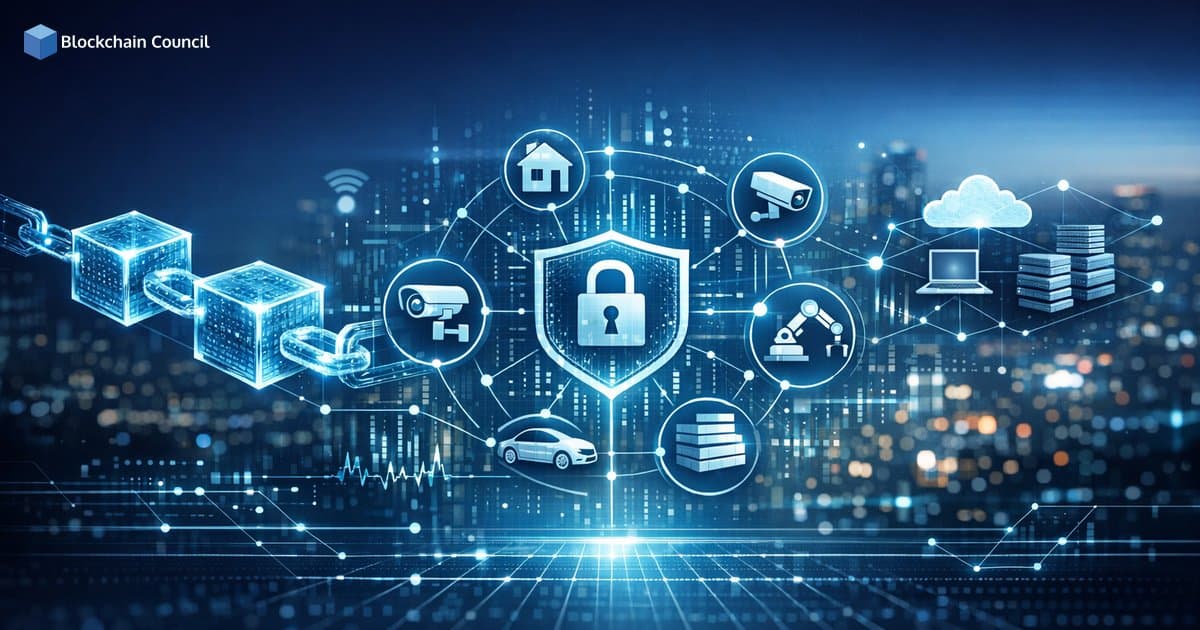
Blockchain in IoT networks addresses three persistent challenges in connected environments: trustworthy device authentication, verifiable secure data integrity, and automated machine-to-machine (M2M) transactions. With IoT connections projected to grow from 13.8 billion in 2021 to approximately 30.9 billion by 2025, security and coordination mechanisms must scale without relying on fragile centralized control points.
Across logistics, industrial manufacturing, mobility, and energy, many enterprise deployments pair IoT devices with gateways and permissioned or consortium blockchains. This pattern helps organizations enforce access control, share data across multiple stakeholders, and create auditable records while keeping resource-constrained devices lightweight. Analysts and enterprise technology teams have noted that blockchain-backed ledgers can provide a single source of verifiable truth for shared IoT data, reducing disputes by improving traceability, identity verification, and integrity guarantees.

Why Blockchain Matters for IoT at Scale
IoT systems struggle with security and trust because they are distributed, heterogeneous, and often operated by multiple parties. Common weaknesses include weak authentication, inconsistent update mechanisms, and centralized points of failure. Blockchain aligns with confidentiality, integrity, and availability goals through distributed storage, immutable logs, and cryptographic access control.
In practical terms, blockchain can act as a shared coordination layer for IoT, enabling:
- Verifiable device identities that can be checked anywhere in the network
- Tamper-resistant data trails for sensor readings, events, and lifecycle actions
- Automated execution of agreements via smart contracts, reducing manual reconciliation
Device Authentication with Blockchain-Based Identity
Device authentication is foundational. If an attacker can impersonate a device, they can inject false data, trigger unsafe actions, or drain resources. Blockchain in IoT networks is often applied as a decentralized identity registry, functioning similarly to a distributed public key infrastructure (PKI) or a decentralized identifier (DID) anchor.
How Blockchain-Backed Device Identity Works
A common approach assigns each device a cryptographic identity during manufacturing or onboarding:
- Provision keys: the device generates or receives a public-private key pair, keeping the private key protected.
- Register identity: the device public key (or DID document reference) is recorded on a blockchain, creating an immutable association.
- Track lifecycle events: ownership changes, revocations, and decommissioning are appended as additional transactions.
Authentication can then be performed through mutual challenge-response:
- The verifier issues a challenge.
- The device signs the challenge with its private key.
- The verifier checks the signature against the blockchain-registered public key and applicable policy rules.
After verification, devices can establish secure sessions using standard protocols such as TLS or DTLS, with blockchain serving as the trust root for identity validation.
Benefits and Operational Considerations
- Reduced single points of compromise: identity does not depend on one certificate authority or one vendor-controlled directory.
- Revocation and rotation: compromised keys can be revoked and replaced with a transparent on-chain history.
- Auditability: lifecycle records support investigations and compliance reviews.
Challenges remain, particularly for constrained devices, including secure key storage, scalable onboarding, and safe rotation processes. Many architectures address this by using IoT gateways or edge agents to handle heavier blockchain interactions on behalf of devices.
Secure Data Integrity and Provenance: Hashing On-Chain, Storing Data Off-Chain
IoT environments generate high-frequency telemetry and events. Writing all raw sensor data on-chain is rarely feasible due to throughput, latency, and storage constraints. Most production deployments use a hybrid pattern: store the data off-chain and commit hashes or summaries on-chain.
On-Chain Commitments for Integrity Verification
In this model:
- Sensor readings are stored in databases, object storage, or edge caches.
- Periodic batches are hashed, and the resulting hash is written to the blockchain ledger.
- Any authorized party can later re-hash a record and compare it to the on-chain hash to confirm the data was not altered.
This approach supports tamper-evident provenance without overloading the chain, and it aligns with enterprise preferences for permissioned blockchains that enforce access controls while preserving immutability.
Immutable Logging for Security and Compliance
Beyond telemetry, blockchain is valuable for recording security-relevant events, including:
- Firmware updates and version attestations
- Configuration changes and policy updates
- Access attempts and control commands
- Critical threshold events (for example, temperature excursions in cold-chain logistics)
Immutable logs strengthen forensic investigations and support non-repudiation. They also enable more reliable baselines for anomaly detection, particularly when combined with AI-driven edge analytics.
Confidentiality with Integrity
Integrity does not automatically provide privacy. Many architectures encrypt sensitive data before transmission and store only references, commitments, or pseudonymous identifiers on-chain. Privacy-preserving techniques under active exploration include zero-knowledge proofs, trusted execution environments (TEE) with blockchain attestation, and selective disclosure methods for sharing only necessary subsets of information.
M2M Transactions: Smart Contracts for Automation and Settlement
Machine-to-machine transactions represent where blockchain moves beyond recordkeeping into automated coordination. Smart contracts can encode service-level agreements, access rules, and payment logic, triggering actions when verified conditions are met.
Smart Contract Automation Patterns
Common examples include:
- Logistics: if a shipment arrives and authenticated sensors confirm conditions stayed within range, release payment and update custody records automatically.
- Industrial maintenance: if vibration and temperature readings cross defined thresholds, open a maintenance ticket and log evidence for warranty handling.
- Mobility: after a vehicle completes charging or a toll event is validated, settle fees without manual intervention.
Blockchain enables peer-to-peer economic models where assets such as vehicles, tools, drones, and bandwidth can be rented and settled programmatically, reducing reliance on centralized brokers.
Micro-Payments and Service Marketplaces
As IoT ecosystems mature, tokenized credits or usage rights can enable:
- devices paying for compute, storage, energy, or connectivity
- devices earning value for providing sensing, relaying, or actuation services
- metered billing based on authenticated usage events
Because high-frequency micro-transactions can overwhelm base-layer blockchains, deployments often aggregate events and settle periodically, or use sidechains and payment channels to improve throughput.
Real-World Use Cases of Blockchain in IoT Networks
Supply Chain and Cold-Chain Logistics
IoT sensors capture temperature, location, and handling events. Blockchain provides immutable records shared across shippers, carriers, insurers, and buyers, improving dispute resolution related to spoilage or delays. Strong device authentication ensures that only authorized sensors and gateways can submit trusted readings.
Industrial IoT and Asset Management
For regulated or safety-critical machinery, blockchain can store tamper-resistant maintenance logs and operational histories, supporting compliance and reliable analytics. Smart-contract-based access control can enforce role-based or time-bound permissions with full audit trails.
Smart Energy and Peer-to-Peer Trading
Authenticated smart meters can support automated settlement for peer energy trading between households and microgrids. Low-latency connectivity from 5G networks can make these systems more responsive while blockchain maintains integrity and traceability across trading participants.
Connected Vehicles and Usage-Based Models
Vehicles can log mileage, software updates, and maintenance events while also supporting automated payments for charging, parking, or tolls. With appropriate privacy protections, hashed or selectively disclosed telematics can support transparent usage-based insurance workflows.
Healthcare and Medical IoT
Medical devices can authenticate via blockchain-based identity, commit hashes of critical measurements, and maintain auditable trails for clinical decisions. Smart contracts can encode consent rules so that devices share data only when authorized by applicable policy and patient preferences.
Challenges and Limitations to Address
Scalability, Latency, and Storage
Public blockchains are not designed to directly handle billions of devices, given throughput limits and storage replication costs. Many IoT scenarios also require millisecond-level response times, faster than typical on-chain confirmation windows. As a result, blockchain is frequently used for periodic anchoring, settlement, and auditability rather than real-time control loops.
Resource Constraints and Consensus Choice
Proof-of-work is generally unsuitable for IoT environments. Industry trends favor proof-of-stake, Byzantine fault-tolerant consensus, and committee-based approaches, typically implemented on permissioned networks with gateways or edge nodes acting as clients on behalf of devices.
Interoperability, Governance, and Privacy
Cross-platform identity standards, cross-chain data sharing, and reusable smart contract templates are still maturing. Governance is equally important: determining who operates the nodes, how protocol updates are approved, and how errors are addressed when logs are immutable. Fragmented regulation and inconsistent standards across regions remain barriers for global deployments.
Implementation Guidance: A Practical Reference Architecture
A common enterprise-ready design for blockchain in IoT networks uses a layered approach:
- Devices: collect data, sign messages, and store private keys securely.
- Gateways and edge nodes: authenticate devices, aggregate telemetry, submit transactions, and run light clients.
- Permissioned blockchain: stores identities, policies, hashes, event logs, and smart contract state.
- Off-chain storage: holds raw data with encryption, retention policies, and access controls.
- Analytics and AI: consume trusted data, detect anomalies, and generate auditable actions.
Teams building these systems benefit from structured upskilling across blockchain foundations, smart contract development, IoT security, and AI integration. Relevant certifications include Certified Blockchain Expert, Certified Smart Contract Developer, Certified IoT Expert, and Certified AI Expert.
Conclusion
Blockchain in IoT networks provides a credible technical path to stronger device authentication, secure data integrity, and automated M2M transactions, particularly in multi-stakeholder ecosystems where trust and auditability are non-negotiable. The most effective designs combine blockchain for identity, policy, and immutable commitments with off-chain storage for scale and privacy. While challenges persist in interoperability, governance, and performance, continued progress on layer-2 scaling, lightweight consensus mechanisms, and 5G-plus-edge integration is making blockchain-backed IoT increasingly practical for enterprise-grade deployments.
Related Articles
View All
Blockchain
Blockchain vs IoT: How Decentralized Networks and Connected Devices Work Together
Blockchain vs IoT explained: how connected devices, smart contracts, device identity, and decentralized ledgers work together in real systems.

Blockchain
Behind the Blocks: How Blockchain Transactions Actually Work
Go behind the blocks to see how a blockchain transaction really works: wallets and keys, digital signatures, verification, hashing, blocks, consensus, proof of work vs proof of stake, and how miners and validators secure the network.

Blockchain
Why Blockchain Is the Future of Digital Trust, Finance, and Data Security
Blockchain is becoming core infrastructure for digital trust, finance, and data security through shared ledgers, stablecoins, smart contracts, and verifiable records.
Trending Articles
The Role of Blockchain in Ethical AI Development
How blockchain technology is being used to promote transparency and accountability in artificial intelligence systems.
What is AWS? A Beginner's Guide to Cloud Computing
Everything you need to know about Amazon Web Services, cloud computing fundamentals, and career opportunities.

Can DeFi 2.0 Bridge the Gap Between Traditional and Decentralized Finance?
The next generation of DeFi protocols aims to connect traditional banking with decentralized finance ecosystems.