
AI + Smart Contracts: Automating Decisions Safely with Explainability and Human Oversight

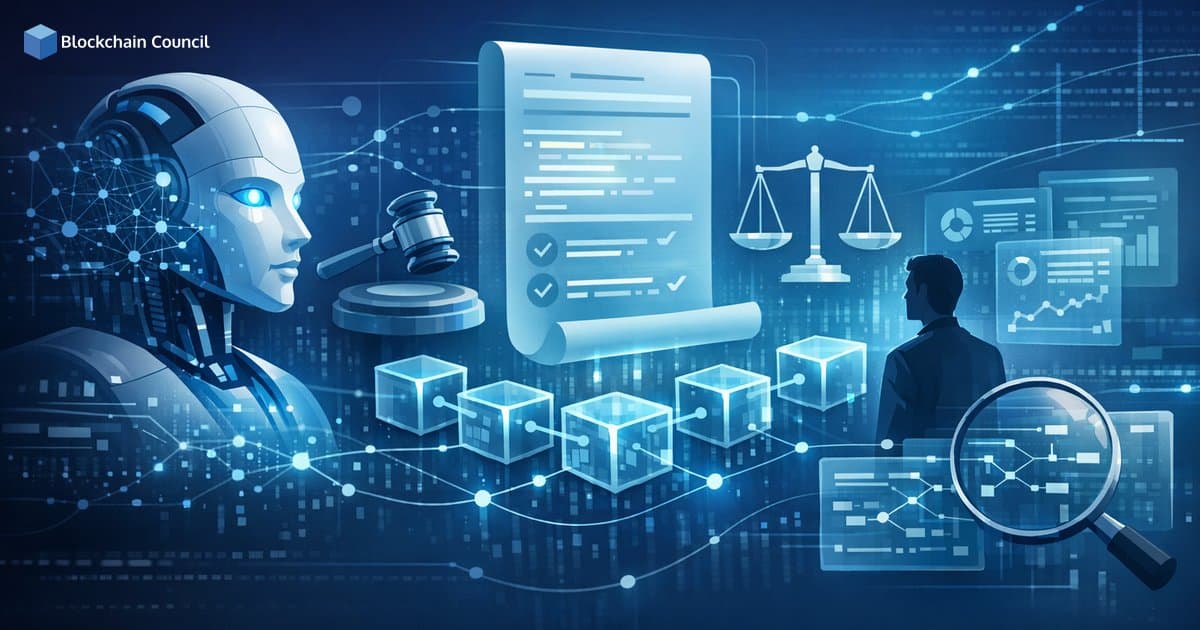
AI + smart contracts are changing how blockchain applications operate by moving from static, pre-programmed logic to systems that can predict, adapt, and optimize actions based on real-world conditions. This fusion is especially powerful in DeFi, supply chains, custody, and compliance, where decisions often depend on fast-changing inputs like prices, risk signals, or operational events.
But greater automation also increases risk. If an AI model makes a bad prediction or an attacker manipulates inputs, the contract can execute harmful actions at machine speed. That is why modern AI-smart contract design increasingly prioritizes explainability and human oversight through AI-driven audits, real-time monitoring, and policy-based controls.

What AI Adds to Smart Contracts (and Why It Matters)
Traditional smart contracts excel at deterministic execution: given the same inputs, they produce the same outputs. The limitation is that many high-value decisions are not deterministic in the real world. They involve uncertainty, changing conditions, and evolving risk. AI helps by turning parts of the decision process into predictions and recommendations, while blockchain provides verifiable execution and audit trails.
Key Capabilities AI Brings to Smart Contracts
Predictive decision-making: Contracts can forecast likely outcomes such as market slippage, gas fee spikes, NFT demand shifts, or liquidation risk in DeFi and adjust actions accordingly.
Self-optimization: Protocol parameters can be tuned dynamically, including interest rates, liquidity allocations, and routing decisions, based on live metrics and historical patterns.
Security intelligence: AI can analyze contract code, transaction patterns, and cross-chain activity to detect anomalies and flag exploit-like behaviors faster than manual review alone.
Adaptive terms: Contract terms can update in response to measurable conditions such as delivery schedules, interest rates, or operational KPIs when governed by explicit policies.
Smarter data integration: AI improves how contracts interpret oracle data, IoT signals, and tokenized data marketplace inputs, improving decision accuracy when inputs are verifiable.
Blockchain functions as a trust layer for AI by improving data integrity and auditability, while AI makes smart contracts more responsive and efficient. Practitioners consistently emphasize the need for governance, ethical constraints, and explainable models to prevent black-box automation in high-stakes scenarios.
Architecture Patterns for AI + Smart Contracts
Most AI computation does not run directly on-chain due to cost and performance constraints. Instead, teams use hybrid designs where on-chain code enforces rules, and off-chain AI systems provide signals, predictions, or proofs.
Common Integration Models
Oracle-mediated AI signals: An AI service generates a prediction (for example, a fraud score or liquidation probability) and publishes it via an oracle network. The smart contract then executes based on thresholds and policies.
Agent-driven execution with policy guards: Approved AI agents can propose actions, but the contract enforces spend limits, allowed methods, and time delays. This is where policy-based controls become central.
Event-driven automation: IoT sensors and operational systems feed events to an AI model which classifies or predicts impact, then triggers contract workflows like payments, rerouting, or alerts.
Monitoring and response loops: AI continuously watches mempool patterns, protocol states, and user behavior to detect anomalies and recommend pauses, parameter changes, or escalations.
A practical mental model for building these systems: AI recommends, smart contracts constrain, humans govern.
Explainability: Making Automated Decisions Auditable
Explainability is not just a usability feature. In blockchain systems, it is a security and compliance requirement because stakeholders must understand why a contract took a specific action. Without explainability, teams cannot confidently approve upgrades, respond to incidents, or meet regulatory expectations around automated decisioning.
Practical Explainability Mechanisms
Structured decision logs: Store a minimal but meaningful on-chain record such as model version hash, feature set ID, oracle source, confidence score, and policy rule triggered. Keep sensitive features off-chain, but auditable.
Model and dataset provenance: Use hashes or tokenized references for training data and model artifacts so decision inputs are traceable and tamper-evident.
Reason codes: Require AI services to output categorical reasons (for example, unusual volume pattern, new address cluster risk, or collateral volatility spike) alongside numeric scores.
Human-readable audit reports: AI-driven audits can generate explanations of detected risks in code and runtime behavior, helping reviewers validate logic before and after deployment.
Simulation and replay: Maintain the ability to replay the same inputs in a test environment to reproduce and explain outcomes, especially for incident investigations.
These techniques reduce the black-box problem by making decisions inspectable, comparable across versions, and reviewable by humans.
Human Oversight: Controlling Autonomy Without Eliminating Automation
The goal is not to remove humans from workflows entirely. The goal is to remove humans from repetitive, low-risk steps while keeping humans in control of high-impact decisions. Human oversight is implemented through governance structures, execution controls, and escalation paths that activate when risk rises.
Core Oversight Controls That Work in Production
Policy-based execution limits: Hard constraints including max trade size, daily loss limits, allowed assets, allowed venues, and maximum leverage.
Multi-sig and role-based approvals: Require human sign-off for upgrades, strategy changes, treasury movements, or emergency actions.
Time locks and circuit breakers: Add delay windows for sensitive changes and automatic pauses when anomaly thresholds are crossed.
Human-in-the-loop triggers: If the AI confidence score falls below a defined threshold, or if inputs are inconsistent across oracles, route to manual review.
Policy-defined AI agent allowlists: Only approved agent identities can propose actions, and only within approved policies, preventing unchecked autonomy.
This approach aligns with the principle of blockchain-based policy enforcement and audit trails, while letting AI deliver speed and adaptability within defined boundaries.
Security and Risk: What Can Go Wrong and How to Mitigate It
AI + smart contracts expand the attack surface. Beyond typical smart contract exploits, systems must defend against manipulated inputs, model weaknesses, and feedback loops where the AI reacts to adversarial behavior.
Top Risks to Plan For
Oracle and data poisoning: Attackers manipulate upstream data or feed misleading signals that influence AI decisions.
Adversarial behavior: Malicious actors craft transactions that evade anomaly detection or trigger false positives that cause protocol disruption.
Model drift: Real-world conditions change over time, gradually degrading prediction quality.
Over-automation: An AI agent can compound losses quickly if policy constraints are too weak or poorly defined.
Opaque decisioning: Without explainability, subtle failures are difficult to detect until significant damage has occurred.
Mitigations That Map to Explainability and Oversight
AI-driven continuous audits: Automated scanning of code changes and runtime behaviors can flag risky patterns early and produce reports for human review.
Real-time monitoring across chains: Multi-chain visibility helps detect anomalies that a single-chain view might miss.
Defense-in-depth policies: Combine spend limits, time locks, and circuit breakers with clear escalation paths to human reviewers.
Model governance: Version models, verify provenance, test against adversarial scenarios, and require formal approval for model upgrades.
For teams building these systems, internal training is often as important as tooling. Blockchain Council programs such as Certified Smart Contract Developer, Certified Blockchain Security Expert, and Certified AI Engineer address the engineering, security, and governance skills required for this work.
Real-World Use Cases Where AI + Smart Contracts Deliver Measurable Value
1) Supply Chain Logistics and Automated Settlement
In supply chains, AI can predict delays, detect anomalies in shipments, and optimize routing using ML models. When combined with oracle-connected smart contracts, verified milestones can trigger notifications, rerouting, and automatic payments.
Documented implementations of AI-blockchain integration in supply chains report approximately 30% cost savings and 2.2-second traceability for goods verification and payment processing, illustrating the efficiency gains from automated verification and settlement.
2) DeFi Risk Management and Execution Optimization
AI-enhanced smart contracts can predict slippage and gas fee spikes to time trades, rebalance positions, or adjust routing. For lending and derivatives, predictive signals can identify liquidation risk early and trigger protective actions under strict policy constraints.
3) Banking, Investments, and Programmable Strategies
AI can analyze market trends and propose strategy adjustments, while on-chain logic enforces risk limits and auditability. This is particularly relevant for institutions that require traceable decision workflows and controlled execution.
4) Fraud Detection, Custody, and Tokenized AI Assets
Real-time anomaly detection can flag suspicious patterns in transactions and custody operations. When AI models and datasets are treated as governed assets, blockchain audit trails and policy controls help institutions manage access, integrity, and accountability.
Future Outlook
Trends point toward broader adoption of adaptive protocols, cross-chain orchestration, decentralized AI approaches, and tokenized data and AI assets. Market growth is increasingly driven by security and fraud prevention use cases alongside operational efficiency. Trust, however, will depend on whether teams can make AI decisions explainable and keep humans accountable for outcomes.
The most durable pattern is likely systems where AI handles prediction and optimization, smart contracts enforce verifiable rules, and human governance defines the boundaries. That balance is what makes automation suitable for enterprise and institutional environments.
Conclusion: Safe Automation Requires Explainability Plus Oversight
AI + smart contracts can automate complex decisions with speed and precision, but only when paired with rigorous security, transparent explainability, and strong human oversight. AI-driven audits, real-time monitoring, and policy-based controls are not optional add-ons. They are the foundation that makes adaptive smart contracts trustworthy.
For professionals and teams building in this space, focus on three deliverables: auditable decision records, enforceable on-chain policies, and well-defined human escalation paths. With those in place, AI can upgrade smart contracts from rigid scripts into accountable, high-performance systems for Web3 and enterprise workflows.
Related Articles
View All
Blockchain
AI Crypto Trading: Smart Algorithms and Blockchain Insights for Better Decisions
AI crypto trading blends machine learning, on-chain analytics, and automation to generate signals, manage risk, and execute faster in volatile 24/7 crypto markets.

Blockchain
AI Smart Contracts: The Next Evolution in Blockchain Automation
AI smart contracts combine blockchain execution with AI-driven monitoring, audits, and adaptive automation, enabling more secure, scalable, and responsive Web3 systems.

Blockchain
What are smart contracts in blockchain and how do they work?
Blockchain can provide the ultimate solution with its feature of Smart Contracts. One of the biggest problems of modern business is trust. With each passing day, we lose faith in big companies and even other humans. Without the trust factor and transparency, we are always advised to dread slowly. We take much more precaution, and this comes at the expense of flexibility that modern business requires.
Trending Articles
The Role of Blockchain in Ethical AI Development
How blockchain technology is being used to promote transparency and accountability in artificial intelligence systems.

AWS Career Roadmap
A step-by-step guide to building a successful career in Amazon Web Services cloud computing.
Top 5 DeFi Platforms
Explore the leading decentralized finance platforms and what makes each one unique in the evolving DeFi landscape.