

AI-Driven Blockchain Analytics: Detecting Anomalies, Fraud, and Smart Contract Exploits
 Suyash Raizada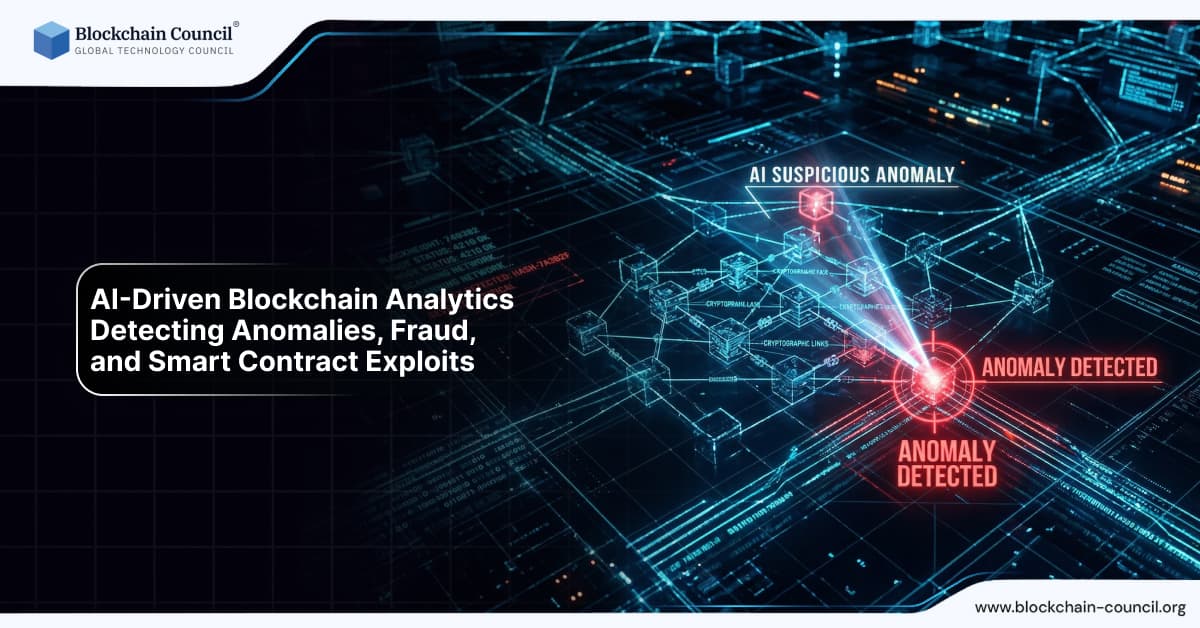
AI-driven blockchain analytics is becoming a core security layer for Web3 and enterprise blockchain programs. As transaction volumes rise and attacker tactics evolve, manual review and static dashboards cannot keep pace with real-time anomalies, fraud flows, and smart contract exploits. By combining machine learning, graph analytics, and autonomous AI agents with verifiable on-chain records, organizations can detect suspicious behavior in milliseconds, validate responses, and maintain audit-ready governance.
Detecting anomalies in blockchain systems requires combining AI with on-chain analytics-build expertise with a Certified Blockchain Expert, implement detection models using a Python Course, and explore real-world applications via an AI powered marketing course.

Why AI-Driven Blockchain Analytics Matters Now
Blockchain activity is faster, more complex, and more interconnected than it was even a few years ago. Modern networks can sustain high throughput, with industry reporting citing blockchain throughput reaching approximately 3,400 transactions per second in 2025. Higher throughput improves user experience, but it also increases the speed at which fraud can spread, especially across bridges, DEXes, and lending protocols.
The fraud surface area is substantial. Chainalysis reported approximately $51 billion in potential illicit volume during 2024, underscoring the scale that monitoring teams and compliance programs must handle. Alongside this, the AI crypto market is projected to reach $46.9 billion by 2034, reflecting continued investment in AI-based detection and security infrastructure.
Another major shift is the rise of autonomous AI agents. Market research cited by VanEck anticipates growth from roughly 10,000 autonomous agents to more than 1 million by the end of 2025. As agents become more common, security teams need analytics that can evaluate agent behavior, detect abnormal automation, and record evidence for audits.
What AI Detects On-Chain That Humans Often Miss
On-chain data is transparent, but it is not automatically understandable. AI systems can process:
High-volume transaction streams across wallets, contracts, and tokens
Graph relationships such as clustering, fund flow paths, and mixer adjacency
Behavioral patterns such as timing, routing, and repeated counterparty structures
Cross-source context including market data, token metadata, and off-chain signals
Fraud rarely appears as a single obvious transaction. It often looks normal in isolation but abnormal in context. AI-driven blockchain analytics uses models trained on historical patterns, streaming features, and graph structures to flag activity that deviates from expected behavior.
Common Anomaly and Fraud Patterns AI Can Flag
Wash trading and volume manipulation via repeated self-referential swaps or circular flows
Market manipulation through coordinated whale movement correlated with volatility and sentiment shifts
Phishing and drain patterns where approvals and transfers follow known theft sequences
Bridge and cross-chain laundering through rapid hops and fragmentation of funds
Sybil activity using wallet farms to accumulate incentives or distort governance
How AI-Driven Blockchain Analytics Works in Practice
Most modern pipelines follow a layered architecture:
Data ingestion: full nodes, indexers, and APIs stream blocks, mempool events, logs, and token transfers. Market data APIs can add context at scale, with platforms such as CoinGecko covering 250+ networks and 1,700+ DEXes.
Feature engineering: raw events are converted into model inputs, for example rolling transaction velocity, approval-to-transfer ratios, graph centrality metrics, and contract call sequence signatures.
Model layer: a mix of supervised classification for known scams, unsupervised anomaly detection for novel behaviors, and graph neural networks for fund flow relationships.
Real-time scoring: sub-second queries and stream processing score risk as events occur, not hours later.
Response and case management: alerts, automated policy actions, and evidence capture for investigation and audit.
Many teams also add a retrieval-augmented generation (RAG) layer to connect on-chain anomalies with knowledge bases and past incidents. A RAG-powered analyzer can detect unusual whale activity and correlate it with historical volatility, liquidity depth, and sentiment shifts to surface potential manipulation or flash crash risk at an earlier stage.
Autonomous AI Agents for Detection and Response
Autonomous agents extend analytics from detection into action. In a mature setup, agents can:
Monitor contract events and wallet behavior continuously
Triangulate evidence across on-chain flows and market context
Escalate or act based on policy, such as pausing a workflow, raising collateral requirements, or blocking suspicious interactions at the application layer
Because agents can act quickly, governance is essential. One emerging approach is autonomous agent behavior verification, where agent actions, policies, and outcomes are logged on-chain so teams can prove what the agent did and why. This reduces operational risk and improves auditability.
Detecting Smart Contract Exploits with AI
Smart contract risk remains one of the most expensive categories of Web3 security incidents. AI can support smart contract security across the full lifecycle:
Pre-deploy analysis: code pattern detection for risky constructs, dependency analysis, and fuzzing guidance
Post-deploy monitoring: live detection of abnormal call sequences, unusual re-entrancy-like behavior, price oracle manipulation patterns, and privilege escalation attempts
Transaction-level fraud scoring: flagging suspicious approvals, proxy upgrades, or admin function usage
AI is not a replacement for formal verification or audits. Instead, AI-driven blockchain analytics helps close the gap between audit time and runtime reality by continuously watching for exploit signatures and novel anomalies.
Verifiable AI and zk-Proofs for Trustworthy Monitoring
As AI becomes a decision engine for security and compliance, enterprises increasingly need verifiable claims about model behavior. Zero-knowledge proofs (zk-proofs) can help prove statements about accuracy, fairness, or compliance without revealing sensitive training data or proprietary model internals. This is relevant for regulated environments where teams must demonstrate controls, explain outcomes, and protect confidential information.
Privacy, Governance, and Compliance for Enterprise Adoption
Cross-institution threat detection is powerful but often constrained by privacy requirements. Privacy-preserving AI techniques such as secure multiparty computation (MPC), confidential computing, and zero-knowledge proofs allow analysis without exposing raw data. Blockchain adds an immutable record of consent, purpose, and computation logs, which supports audit and governance requirements.
Model governance is equally critical. A robust blockchain-backed governance framework can record:
Model versions and deployment approvals
Dataset lineage and feature definitions
Parameter changes and evaluation metrics over time
Access controls and multi-party sign-offs via smart contracts
This makes AI monitoring systems easier to audit and reduces the risk of undocumented model drift.
Real-World Enterprise Use Cases
Financial Services and Compliance
Financial institutions are exploring explainable AI and verifiable model claims to meet strict audit standards. IBM has worked on explainable AI initiatives and is frequently cited in discussions about pairing blockchain with zk-proofs to support verifiable model assertions in financial workflows. HSBC has also explored blockchain for operational audits, and similar governance patterns can be applied to AI-driven decision engines such as credit scoring and fraud models to give regulators a transparent view of model updates.
Energy and Trading Automation
In energy markets, blockchain-based trading pilots have demonstrated how on-chain settlement can improve transparency. Siemens has tested blockchain-based energy trading, and AI-driven agents could adjust energy trading contracts in response to real-time supply and demand while preserving a full compliance record.
Decentralized AI Infrastructure Platforms
Several ecosystems focus on trust, coordination, and data access for AI:
Ocean Protocol for decentralized data sharing and monetization for AI training
Bittensor (TAO) for collaborative and competitive AI models on a tokenized network
Fetch.ai for autonomous agents with on-chain coordination, usage tracking, and payments
SingularityNET for an open marketplace of AI tools and services
Combating AI-Generated Threats with Blockchain Verification
AI has expanded attacker capabilities, including deepfakes and synthetic identity tactics. Blockchain-based provenance helps defend against this by anchoring authenticity with cryptographic signatures. Cryptographic watermarking and content signing create strong evidence of origin and integrity, which is increasingly relevant for incident response, communications, and brand protection.
Implementation Checklist for Teams Building AI-Driven Blockchain Analytics
Define detection goals: fraud typologies, exploit classes, compliance thresholds, and response playbooks.
Build a strong data layer: indexers, labels, address attribution, and reliable market context feeds.
Use hybrid modeling: supervised models for known threats, unsupervised for unknown anomalies, and graph methods for fund flows.
Operationalize governance: log model versions, approvals, and metrics. Treat models like production software.
Plan for privacy: incorporate MPC or zk-proof approaches where cross-party collaboration is required.
Analyzing smart contract exploits requires ML-driven anomaly detection and pattern recognition-develop these skills with a Blockchain Course, strengthen modeling via a machine learning course, and align insights with ecosystem use cases through a Digital marketing course.
Conclusion
AI-driven blockchain analytics is evolving from a supplementary tool into essential infrastructure for secure, compliant decentralized systems. Real-time anomaly detection, autonomous agents, and continuous smart contract monitoring help organizations respond faster than adversaries can move funds. At the same time, blockchain-backed governance and emerging privacy technologies such as zk-proofs and MPC make it feasible to deploy AI decision systems that are auditable, trustworthy, and enterprise-ready. As Web3 adoption expands and attacker automation increases, teams that invest in verifiable, real-time analytics will be better positioned to prevent fraud, contain exploits, and meet regulatory expectations.
FAQs
1. What is AI-driven blockchain analytics?
AI-driven blockchain analytics uses machine learning to analyze blockchain data. It helps detect patterns, anomalies, and potential security threats.
2. How does AI detect anomalies in blockchain transactions?
AI models analyze transaction patterns and identify deviations from normal behavior. Unusual activity can signal fraud or suspicious actions.
3. What types of fraud can AI detect on blockchain?
AI can detect scams, money laundering, and suspicious transaction flows. It identifies patterns that may not be visible through manual analysis.
4. How does AI help identify smart contract exploits?
AI analyzes contract behavior and transaction history. It can flag unusual interactions that may indicate vulnerabilities or attacks.
5. Why is blockchain analytics important for security?
Blockchain is transparent but complex. Analytics tools help interpret data and identify risks in real time.
6. What data sources are used in blockchain analytics?
Data includes transaction logs, wallet activity, and smart contract interactions. AI processes this data to generate insights.
7. How does machine learning improve fraud detection?
Machine learning learns from historical data to identify patterns. It improves detection accuracy over time.
8. Can AI predict blockchain attacks before they happen?
AI can identify early warning signs and suspicious behavior. While not perfect, it helps reduce the risk of attacks.
9. What are common anomalies in blockchain networks?
Anomalies include unusual transaction volumes, rapid fund transfers, and abnormal contract interactions. These may indicate potential threats.
10. How do AI tools handle large blockchain datasets?
AI processes large datasets efficiently using advanced algorithms. This enables real-time analysis and faster insights.
11. What are the benefits of using AI in blockchain analytics?
Benefits include faster detection, improved accuracy, and reduced manual effort. AI enhances overall security and efficiency.
12. What challenges exist in AI-driven blockchain analytics?
Challenges include data complexity, false positives, and evolving attack methods. Continuous model updates are required.
13. How does AI reduce false positives in fraud detection?
AI refines its models using feedback and training data. This helps distinguish between normal and suspicious behavior.
14. What role does real-time monitoring play in analytics?
Real-time monitoring enables immediate detection of threats. It allows faster response and minimizes potential damage.
15. Can small businesses use AI blockchain analytics?
Yes, many tools are accessible to smaller organizations. Adoption depends on budget and technical requirements.
16. How does AI support compliance in blockchain systems?
AI helps track transactions and identify suspicious activity. This supports regulatory reporting and compliance efforts.
17. What industries benefit from blockchain analytics?
Finance, cybersecurity, and digital asset management benefit the most. These sectors require strong fraud detection.
18. How do AI models adapt to new fraud techniques?
AI models are updated with new data and patterns. This allows them to respond to evolving threats.
19. What tools are used for AI-driven blockchain analytics?
Tools include analytics platforms, machine learning frameworks, and blockchain explorers. Integration improves functionality.
20. What is the future of AI in blockchain security?
AI will play a larger role in detecting and preventing threats. Advanced analytics will improve security and trust in blockchain systems.
Related Articles
View All
Blockchain
Agile for Blockchain Teams: Managing Sprints, Smart Contracts, and Decentralized Roadmaps
Learn how agile for blockchain teams works when sprints, smart contracts, audits, governance, and decentralized roadmaps are planned around risk.

Blockchain
Managing Smart Contract Product Development: A Guide for Product Managers
A practical guide to smart contract product development for product managers, covering lifecycle planning, governance, testing, audits, and launch readiness.

Blockchain
Blockchain vs Smart Contracts: Key Differences, Benefits, and Real-World Applications
Blockchain vs smart contracts explained: learn how distributed ledgers and self-executing code differ, work together, and power DeFi, NFTs, DAOs, and enterprise workflows.
Trending Articles
The Role of Blockchain in Ethical AI Development
How blockchain technology is being used to promote transparency and accountability in artificial intelligence systems.
How Blockchain Secures AI Data
Understand how blockchain technology is being applied to protect the integrity and security of AI training data.
Can DeFi 2.0 Bridge the Gap Between Traditional and Decentralized Finance?
The next generation of DeFi protocols aims to connect traditional banking with decentralized finance ecosystems.