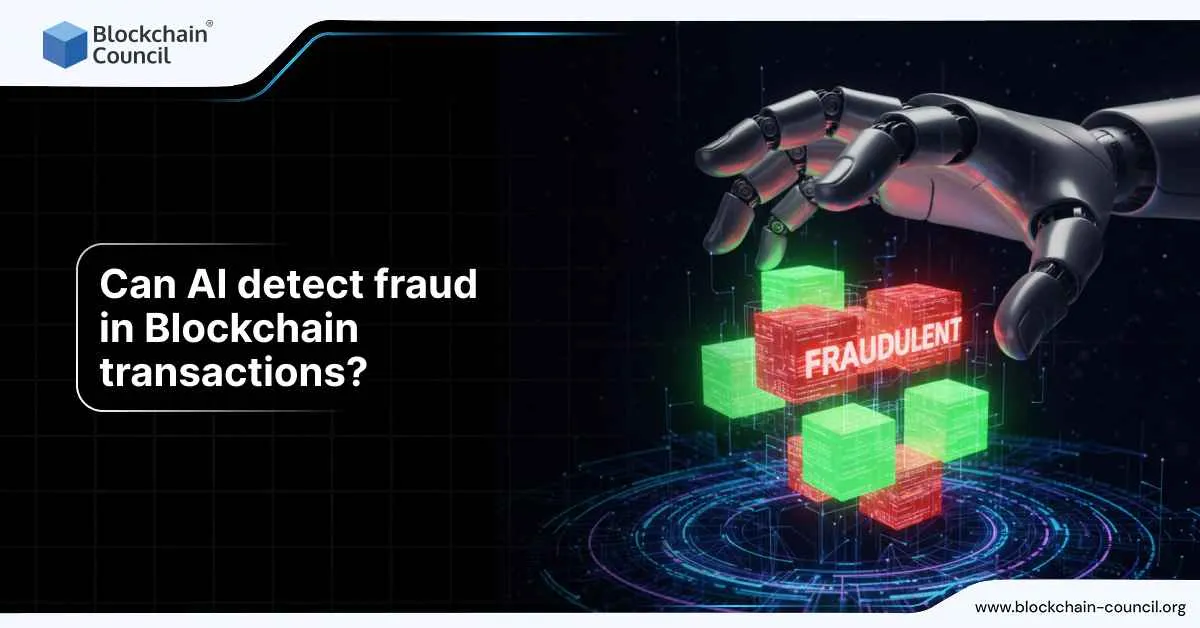
Can AI Detect Fraud in Blockchain Transactions?

Frauds
Blockchain is widely hailed as one of the most secure and tamper-proof technologies ever invented. With its decentralized structure, cryptographic security, and immutable ledger, many people assume blockchain is immune to fraud. However, the truth is more nuanced. While blockchain itself is hard to hack, fraud still happens in blockchain transactions, often through malicious activities like phishing, rug pulls, smart contract exploits, and double-spending attempts.
This raises a critical question: Can Artificial Intelligence (AI) detect fraud in blockchain transactions?

The short answer: Yes. AI has the power to analyze patterns, monitor millions of transactions in real time, and detect anomalies that humans or traditional systems often miss. Combined with blockchain’s transparency, AI provides a powerful fraud detection framework for the crypto economy and beyond.
In this article, we’ll explore how AI detects fraud in blockchain transactions, the real-world applications already in place, the challenges involved, and how professionals can prepare for careers in this high-demand area through a Blockchain Course, AI Course, and Agentic AI Course from Blockchain Council, Python and Tech Courses from Global Tech Council, and Marketing and Business Related Courses from Universal Business Council.
The Nature of Fraud in Blockchain Transactions
Despite blockchain’s security, fraud occurs in different forms:
- Phishing Scams: Hackers trick users into revealing private keys.
- Rug Pulls in DeFi: Developers abandon a project after stealing investors’ funds.
- Ponzi Schemes: Fake projects offering unsustainable returns.
- Double Spending: Attempting to spend the same cryptocurrency twice.
- Smart Contract Exploits: Bugs in smart contract code allow hackers to drain funds.
- Wash Trading: Fake trading activity to manipulate market perception.
These frauds exploit human behavior, weak security practices, and code vulnerabilities—areas where AI can intervene effectively.
How AI Detects Fraud in Blockchain Transactions
1. Anomaly Detection Models
AI can monitor transaction data and spot unusual behavior.
- Example: A wallet suddenly making hundreds of transactions in a short time.
- Benefit: Identifies suspicious wallets before fraud escalates.
2. Pattern Recognition
Machine learning algorithms analyze historical transaction data to identify patterns of fraudulent activity.
- Example: Wash trading patterns on NFT marketplaces.
- Benefit: Detects fraud that looks “normal” to human eyes.
3. Predictive Analytics
AI can forecast potential fraud by studying user behavior.
- Example: Predicting likelihood of a rug pull based on developer activity.
- Benefit: Prevents losses before they occur.
4. Natural Language Processing (NLP) for Scam Detection
AI-powered NLP tools can analyze whitepapers, Telegram chats, or tweets to detect scammy projects.
- Example: Identifying repetitive scam phrases like “guaranteed returns.”
- Benefit: Adds an extra layer of protection for investors.
5. Smart Contract Auditing
AI tools scan smart contracts for vulnerabilities before deployment.
- Example: Tools like OpenAI’s Codex or specialized auditing AI models.
- Benefit: Reduces risk of exploits in decentralized apps (dApps).
6. Network Graph Analysis
AI creates transaction graphs to track suspicious fund flows.
- Example: Detecting mixers used for laundering stolen crypto.
- Benefit: Helps law enforcement trace fraud efficiently.
Real-World Applications in 2025
- Crypto Exchanges (Binance, Coinbase):
Use AI-powered fraud detection systems to flag suspicious transactions.
- DeFi Platforms:
AI models predict rug pulls by analyzing liquidity withdrawals.
- NFT Marketplaces:
AI detects wash trading by comparing wallet addresses and transaction patterns.
- Financial Regulators:
Governments use AI + blockchain analytics to track fraud and ensure compliance.
- Enterprise Blockchains:
AI ensures transparent supply chain payments by flagging duplicate invoices or tampered data.
Professional Skills for AI + Blockchain Fraud Detection
If you want to work in fraud detection at the AI + blockchain intersection, here’s the learning roadmap:
- Blockchain Course (Blockchain Council): Learn how transactions, consensus, and security work.
- AI Course (Blockchain Council): Train in anomaly detection, predictive analytics, and fraud detection models.
- Agentic AI Course (Blockchain Council): Understand autonomous AI agents that can monitor blockchains 24/7.
- Python Course (Global Tech Council): Build your own fraud detection bots and anomaly detection algorithms.
- Tech Courses (Global Tech Council): Cover AI, cybersecurity, and blockchain integration at advanced levels.
- Marketing Courses (Universal Business Council): Learn how to build trust for AI-powered fraud detection solutions.
- Business Related Courses (Universal Business Council): Understand compliance, ROI, and enterprise integration strategies.
Challenges of Using AI in Blockchain Fraud Detection
- False Positives: AI may incorrectly flag legitimate transactions as fraud.
- Data Privacy: AI models require data, but too much exposure may conflict with privacy laws.
- Evolving Fraud Tactics: Hackers continuously innovate, requiring AI models to adapt quickly.
- Resource Intensity: AI systems monitoring real-time blockchain data can be computationally heavy.
The Future of AI in Blockchain Fraud Detection
- Fully Automated AI Agents: Self-operating AI systems monitoring transactions 24/7.
- Cross-Chain Fraud Detection: AI monitoring multiple blockchains simultaneously.
- Predictive Compliance Systems: Regulators using AI to flag risks instantly.
- Decentralized AI Fraud Detection: AI models themselves deployed on blockchain for transparency.
Conclusion
Blockchain’s immutability and decentralization make it secure, but fraudsters always find new ways to exploit loopholes. AI provides the intelligence and adaptability needed to detect fraud at scale, in real time. Together, blockchain and AI form a security powerhouse that builds trust in digital finance and beyond.
For professionals, this is one of the most lucrative career opportunities of the decade. By pursuing a Blockchain Course, AI Course, and Agentic AI Course (Blockchain Council), mastering Python and Tech Courses (Global Tech Council), and learning strategic adoption via Marketing and Business Related Courses (Universal Business Council), you can become a fraud detection expert at the forefront of blockchain security.
The future of fraud detection won’t just be secure—it will be AI-secured and blockchain-verified.