

What Does an OpenAI Consultant Do? Roles, Responsibilities, and Use Cases
 Suyash Raizada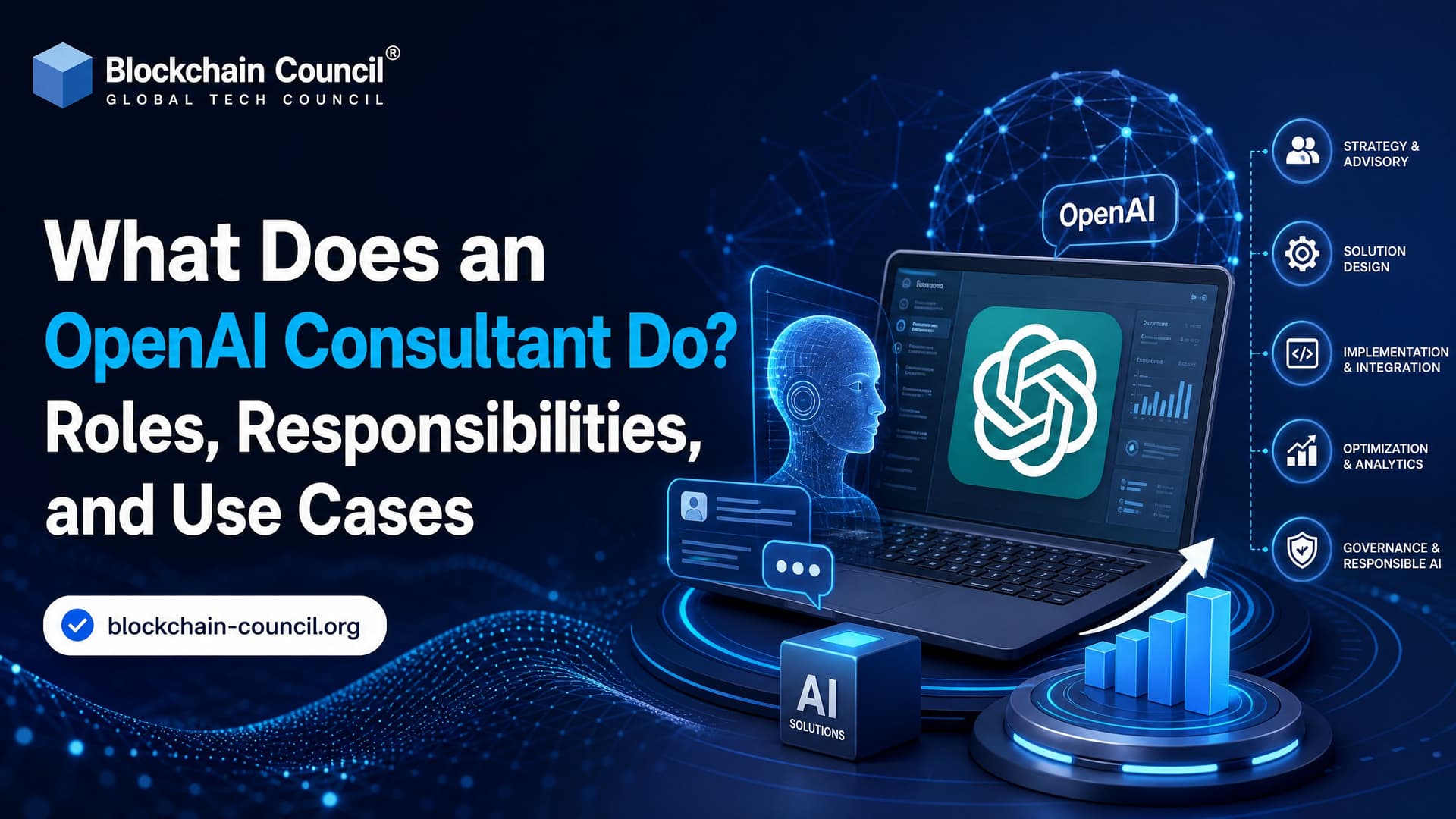
An OpenAI consultant helps you turn OpenAI models into working business systems. Not demos. Not one-off chatbot experiments. The role covers strategy, architecture, OpenAI API integration, governance, testing, user training, and production support, so the organization gets measurable value from large language models.
The job has become more formal as enterprises move past pilots. In 2025, OpenAI introduced high-touch consulting for large customers, reportedly aimed at organizations with sizable AI budgets. The company has also expanded its enterprise deployment support, using forward deployed engineers who help customers move from use case selection to production. The signal is clear: model access is no longer the hard part. Deployment is.

This shift has also increased interest in the Certified OpenAI Consultant credential among professionals who help organizations bridge the gap between AI strategy and execution, guiding deployment, governance, adoption, and operational scaling efforts across enterprise environments.
What Is an OpenAI Consultant?
An OpenAI consultant is an AI specialist who advises, designs, and implements solutions using OpenAI models such as GPT-style language models, multimodal models, embeddings, and tool-calling workflows. The consultant may work independently, inside a consulting firm, or as part of an enterprise AI team.
The best ones are hybrids. They understand business goals, software architecture, data security, model behavior, and adoption challenges. They can talk to a CFO about cost per resolved support ticket, then sit with engineers to debug a failing OpenAI API integration.
To be blunt, a consultant who only writes prompts is not enough for enterprise work. Prompting matters, but production AI also needs data pipelines, evaluations, identity controls, logging, fallback logic, and clear ownership.
Core Responsibilities of an OpenAI Consultant
1. Strategy and Use Case Selection
The first responsibility is deciding whether OpenAI should be used at all. A good consultant starts with your workflow, not the model.
Typical discovery work includes:
Mapping current processes, bottlenecks, and decision points
Identifying high-value AI opportunities such as support automation, document review, knowledge search, or software assistance
Scoring use cases by impact, feasibility, data readiness, risk, and cost
Choosing success metrics such as lower response time, higher first-contact resolution, reduced manual review effort, or accuracy thresholds
Comparing OpenAI models with other AI platforms or open-source options where vendor risk or cost matters
This step prevents a common failure: building a polished assistant for a low-value task while ignoring the process where employees lose three hours a day.
2. Solution Architecture and Model Selection
Once the use case is clear, the consultant translates it into a technical design. This may involve the OpenAI API, retrieval augmented generation, vector databases, enterprise search, internal tools, or workflow software.
Key architecture choices include:
Which model family fits the task: text, vision, multimodal, embeddings, or reasoning-oriented models
Whether to use prompting, retrieval augmented generation, fine tuning, or tool calling
How to connect the model to proprietary data without exposing sensitive information
How to design system instructions, guardrails, and response formats
How to measure quality through test sets, human review, and automated evaluation
Here is a practical detail that trips up teams: if your Python project uses the OpenAI package 1.x, old tutorial code such as openai.ChatCompletion.create(...) fails with an error like APIRemovedInV1. A consultant who has shipped real integrations catches these version issues early, updates the code path, and sets dependency rules so production does not break during a routine deployment.
3. Data, Security, and AI Governance
OpenAI consulting is not only about model output. Enterprises need clear rules for data movement, access, audit trails, and failure handling.
A consultant often works with cybersecurity, legal, compliance, and data teams to define:
What data can be sent to external AI services
Which fields need masking, redaction, or anonymization
How API keys, secrets, and service accounts are managed
Who can access prompts, logs, documents, and outputs
How model failures, hallucinations, prompt injection, and biased outputs are reported
What human review is required before AI output affects customers, employees, or regulated decisions
Regulation is now part of the conversation. The EU AI Act, which entered into force in 2024 with obligations phasing in over time, has pushed many organizations to document AI risk, oversight, transparency, and accountability. A consultant does not replace legal counsel, but can convert policy into engineering controls and operating procedures.
4. Integration and Production Deployment
This is where many AI pilots fail. The prototype works in a notebook. Then nobody can connect it to Salesforce, ServiceNow, SAP, SharePoint, Snowflake, or the company identity provider.
A consultant helps productionize the system by:
Building API integrations with CRMs, ERPs, ticketing systems, data warehouses, and internal applications
Designing retrieval pipelines with embeddings, chunking, metadata filters, and vector search
Setting up prompt and configuration version control
Creating evaluation datasets before rollout
Monitoring latency, token usage, cost, failure rates, and user feedback
Planning canary releases and rollback steps when quality drops
This is also why OpenAI's forward deployed engineer model matters. These engineers work inside client environments, close to real data and users, rather than handing over a generic architecture slide.
5. Training and Change Management
Even a strong AI system fails if people do not trust it or do not know when to override it. A consultant trains teams on safe and effective use.
Training usually covers:
How to write clear prompts for business tasks
When to rely on AI output and when to escalate
How to review AI-generated content
How to report bad outputs or security concerns
How new workflows change roles, approvals, and responsibilities
This is where structured learning helps. Blockchain Council programs such as the Certified Artificial Intelligence (AI) Expert™ and Certified Prompt Engineer™ give readers a formal path into applied AI, prompt design, and responsible implementation.
Common OpenAI Consultant Use Cases
Customer Support Automation
Consultants build AI assistants that answer tier-one questions, triage tickets, draft replies, and summarize customer history for human agents. The value comes from integration. A chatbot that cannot read order status or support policy is usually a toy.
Knowledge Management and Document Search
Many organizations use OpenAI models with retrieval augmented generation to search policies, manuals, contracts, engineering notes, and internal wikis. The consultant designs chunking strategy, embeddings, metadata filters, permissions, and answer citation behavior.
Document Processing
OpenAI models can classify, summarize, extract, and route documents in legal, insurance, finance, healthcare, and compliance workflows. Human review stays essential for high-risk decisions.
Marketing and Content Operations
Consultants help teams generate campaign drafts, product descriptions, localization variants, and customer feedback summaries. The right approach is not full automation. Keep a human editor in the loop, especially for regulated claims or brand-sensitive content.
Software Development and IT Operations
Consultants design coding assistants, test generation tools, incident summarizers, log analysis workflows, and DevOps copilots. For developers, the main win is not replacing engineering judgment. It is reducing boilerplate and speeding up investigation.
Analytics and Decision Support
OpenAI models can sit on top of analytics platforms so non-technical users can ask questions in plain language and receive narrative explanations. The consultant must control data access carefully. A natural language interface should never become a shortcut around permission rules.
Skills You Need to Become an OpenAI Consultant
If you want to work as an OpenAI consultant, build competence across four areas:
AI fundamentals: LLMs, embeddings, retrieval augmented generation, evaluation, fine tuning, prompt engineering, and tool calling.
Software engineering: APIs, Python or JavaScript, cloud services, authentication, databases, testing, deployment, and monitoring.
Business consulting: process mapping, stakeholder interviews, ROI estimation, prioritization, and executive communication.
Governance and security: privacy, access control, audit logging, model risk, data retention, and incident response.
Do not skip evaluation. Temperature settings, retrieval quality, and prompt wording can quietly change output quality. For classification tasks, lowering temperature can reduce variation, but it does not guarantee identical answers every time. Build tests. Review edge cases. Measure before and after.
Professionals looking to strengthen their development capabilities often pursue a Python Certification or JavaScript Certification to build practical skills in application development, API integration, automation, and the technical foundations required for modern AI implementations.
When Hiring an OpenAI Consultant Makes Sense
You should consider hiring an OpenAI consultant when:
Your team has several AI ideas but no clear priority order
Your pilot works but cannot pass security or compliance review
You need to connect OpenAI models to internal data and tools
Your leadership wants measurable business outcomes, not demos
Your developers need architecture support for RAG, evaluations, or API operations
Your organization needs user training and governance processes
It may be the wrong move if you only need a small internal script, a simple prompt library, or a one-time workshop. In those cases, train your team first and bring in a consultant later for architecture review.
Final Takeaway: The Role Is About Deployment, Not Just Models
An OpenAI consultant helps you choose the right AI problem, design the technical system, protect data, ship to production, and train users. The real value sits at the intersection of business process, enterprise data, model behavior, and governance.
If you are aiming for this role, start by building one complete project: a RAG assistant over a controlled document set with authentication, evaluation tests, logging, and user feedback. Then strengthen your foundation with structured AI training such as the Blockchain Council Certified Artificial Intelligence (AI) Expert™ or Certified Prompt Engineer™. That combination of build experience and formal learning is the fastest credible path into OpenAI consulting.
Professionals who work closely with business stakeholders may also benefit from a Marketing Certification, which can strengthen skills in customer understanding, value communication, product positioning, and the adoption strategies that help AI solutions succeed in real-world environments.
FAQs
1. What Is an OpenAI Consultant?
An OpenAI Consultant is a professional who helps organizations evaluate, implement, optimize, and manage AI solutions using OpenAI technologies to achieve business objectives.
2. What Does an OpenAI Consultant Do?
An OpenAI Consultant advises businesses on AI strategy, workflow automation, prompt engineering, AI integration, employee training, governance, and performance optimization.
3. Why Are OpenAI Consultants in Demand?
As businesses adopt generative AI, they need experts who can identify practical use cases, reduce implementation risks, and maximize the value of AI investments.
4. What Are the Primary Responsibilities of an OpenAI Consultant?
Responsibilities typically include assessing business needs, identifying AI opportunities, designing solutions, overseeing implementation, and measuring outcomes.
5. How Does an OpenAI Consultant Support AI Strategy Development?
Consultants help organizations align AI initiatives with business goals, prioritize use cases, estimate ROI, and create adoption roadmaps.
6. What Role Does Prompt Engineering Play in Consulting?
Prompt engineering helps optimize AI outputs by designing effective instructions, workflows, and interactions that support business requirements.
7. How Do OpenAI Consultants Help with Workflow Automation?
They identify repetitive processes that can be automated using AI, reducing manual effort and improving operational efficiency.
8. Can OpenAI Consultants Assist with Customer Support Solutions?
Yes, consultants often help design AI-powered chatbots, virtual assistants, knowledge management systems, and customer service workflows.
9. How Do OpenAI Consultants Support Marketing Teams?
They help implement AI for content creation, customer segmentation, campaign optimization, email marketing, SEO, and marketing automation.
10. What Role Do OpenAI Consultants Play in Sales Operations?
Consultants can support lead qualification, proposal generation, customer communication, sales automation, and CRM optimization initiatives.
11. How Can OpenAI Consultants Improve Internal Productivity?
They can deploy AI tools for meeting summaries, document creation, research assistance, knowledge retrieval, and task automation.
12. Do OpenAI Consultants Work with Data and Analytics Teams?
Yes, they often help teams use AI for data analysis, reporting, forecasting, insight generation, and decision support.
13. How Do OpenAI Consultants Address AI Governance?
They help organizations establish policies, compliance procedures, privacy safeguards, security controls, and responsible AI practices.
14. What Industries Commonly Use OpenAI Consultants?
Industries such as healthcare, finance, retail, education, legal services, manufacturing, technology, and professional services frequently engage AI consultants.
15. How Do Consultants Measure AI Project Success?
Success is typically measured through productivity improvements, cost savings, revenue growth, customer satisfaction, process efficiency, and ROI.
16. What Technical Knowledge Is Helpful for OpenAI Consultants?
Knowledge of APIs, automation tools, integrations, data analysis, AI fundamentals, and cloud platforms can be highly beneficial.
17. What Are Common Use Cases for OpenAI Consulting?
Common use cases include chatbot development, content generation, workflow automation, knowledge management, customer support, employee productivity, and business intelligence.
18. How Do OpenAI Consultants Help with Change Management?
They assist organizations in training employees, managing adoption challenges, establishing best practices, and integrating AI into existing workflows.
19. What Challenges Do OpenAI Consultants Commonly Address?
Consultants often address issues related to implementation complexity, user adoption, governance, privacy, security, process redesign, and AI performance optimization. Much of the job involves helping organizations move from "AI sounds interesting" to "AI is solving a measurable business problem."
20. What Value Does an OpenAI Consultant Bring to an Organization?
An OpenAI Consultant provides strategic guidance, technical expertise, implementation support, governance oversight, and practical business solutions that help organizations adopt AI effectively, reduce risks, improve efficiency, and achieve measurable results from their AI investments.
Related Articles
View All
AI & ML
How to Crack AI Roles in Companies Like OpenAI & Emergent
Learn how to prepare for AI roles at companies like OpenAI and Emergent by building the right technical skills, projects, research experience, portfolio, and interview strategy.

AI & ML
NVIDIA Nemotron 3.5 Lightning vs NVIDIA Cosmos 3: Key Differences and Use Cases
Compare NVIDIA Nemotron 3.5 Lightning and NVIDIA Cosmos 3, including their architectures, reasoning capabilities, modalities, performance goals, and use cases across agentic and physical AI.

AI & ML
OpenAI Dots vs Grok Bot vs Muse
Compare OpenAI Dots, Grok Bot, and Meta Muse to understand how these always-on AI agents differ in persistent work, computer use, connected apps, automation, and personal or business workflows.
Trending Articles

Top 5 DeFi Platforms
Explore the leading decentralized finance platforms and what makes each one unique in the evolving DeFi landscape.
Claude AI Tools for Productivity
Discover Claude AI tools for productivity to streamline tasks, manage workflows, and improve efficiency.
How to Create Claude Skills?
Claude Skills are one of the most important features Anthropic has introduced for users who want automation that is structured, consistent and reusable. Instead of giving Claude long instructions ever