Why Are Top Traders Turning to AI for Decisions?
 Michael Willson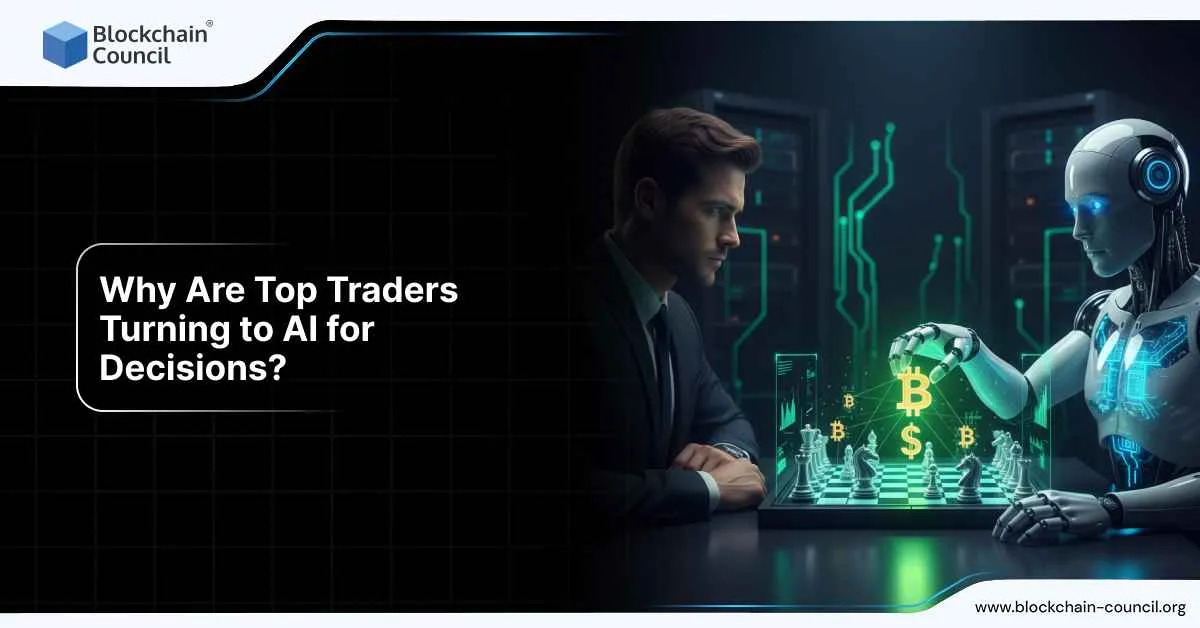
The world of trading has always revolved around one central idea: whoever makes the smartest decisions the fastest wins. For decades, traders have relied on intuition, experience, and sometimes sheer instinct to outpace their competition. But now, artificial intelligence is stepping in as the ultimate game-changer. Top traders across Wall Street, London, Singapore, and Shanghai are turning to AI not just to gain an edge but to redefine how decisions are made in real time. The shift isn’t subtle—it’s happening right now, and it’s reshaping everything from hedge fund strategies to individual investor behavior. For those who want to stay ahead of this trend, programs like the AI-powered investor program offer a direct way to understand and apply these tools effectively.
The Explosion of Market Data
Modern financial markets generate staggering amounts of information. Every second, millions of data points pour in from stock exchanges, global news outlets, corporate filings, social media feeds, satellite imagery, and even weather sensors. No human, no matter how experienced, can process this flood alone.

This is where AI comes in. Machine learning models can scan thousands of signals at once, identify correlations, and flag anomalies before human eyes could even catch them. For traders, this isn’t just convenient—it’s essential. Missing a key signal or failing to notice a shift in sentiment can mean the difference between a profitable trade and a costly loss.
By integrating natural language processing, AI can even make sense of unstructured data like breaking news or Twitter posts. For example, if a CEO suddenly resigns or if a political crisis erupts, AI can instantly gauge the likely impact on markets and suggest action. This ability to digest both numbers and narratives gives traders a level of situational awareness they’ve never had before.
Benefits of AI in Trading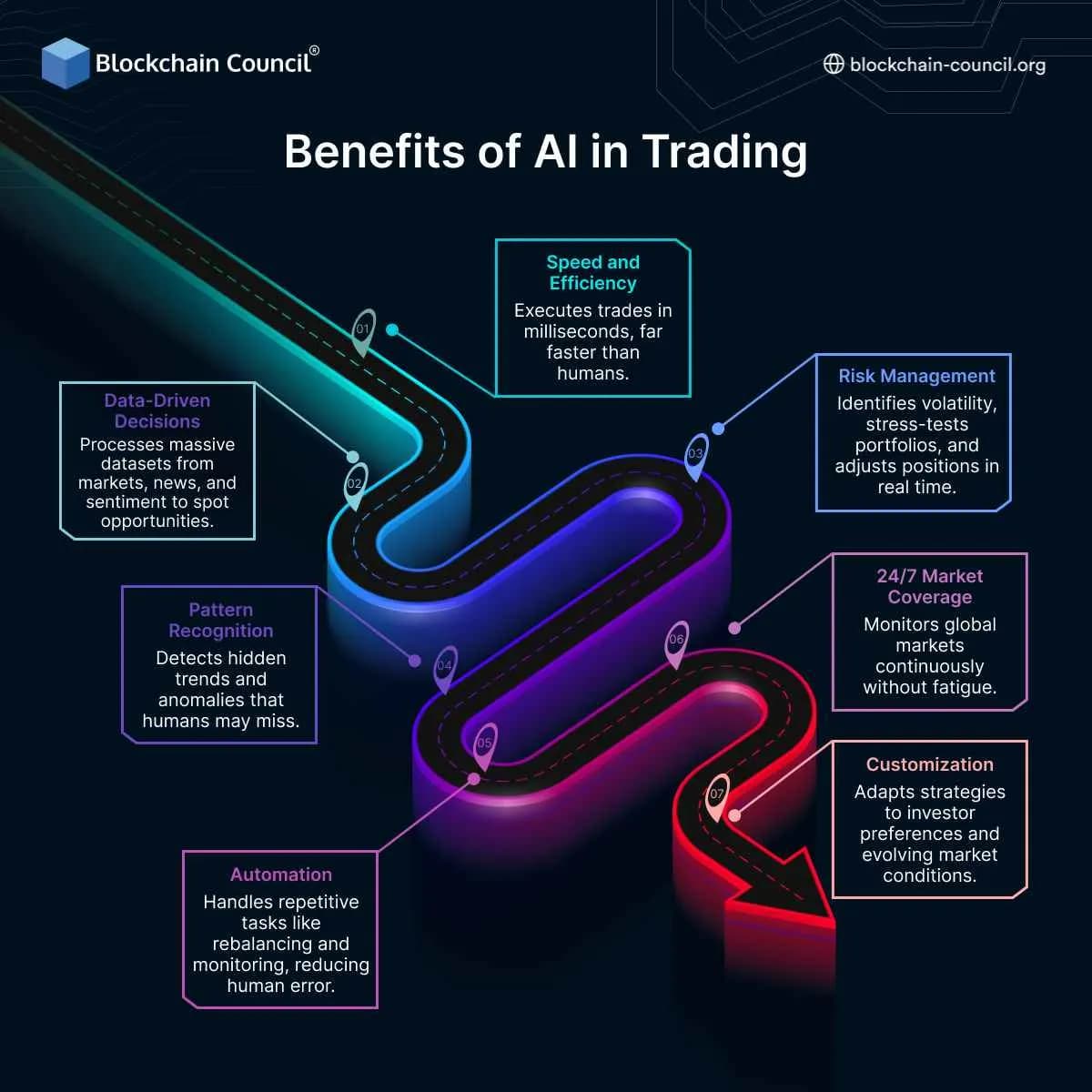
- Speed and Efficiency
Executes trades in milliseconds, far faster than humans. - Data-Driven Decisions
Processes massive datasets from markets, news, and sentiment to spot opportunities. - Risk Management
Identifies volatility, stress-tests portfolios, and adjusts positions in real time. - Pattern Recognition
Detects hidden trends and anomalies that humans may miss. - Automation
Handles repetitive tasks like rebalancing and monitoring, reducing human error. - 24/7 Market Coverage
Monitors global markets continuously without fatigue. - Customization
Adapts strategies to investor preferences and evolving market conditions.
From Gut Instinct to Data-Driven Precision
For years, many top traders built their reputations on gut instinct. The idea of the “trader’s intuition” became legendary—a combination of experience, nerves of steel, and an ability to read markets like a sixth sense. But intuition has limits. It can be clouded by emotions, biases, or overconfidence.
AI shifts the balance from instinct to data-driven precision. Algorithms don’t get tired, emotional, or distracted. They can analyze 10 years of data in seconds, test countless strategies, and adjust on the fly. That doesn’t mean human traders are irrelevant. Instead, their role is evolving. Humans now use AI as an amplifier—an extra layer of intelligence that checks assumptions, validates hunches, and adds speed to execution.
For example, a trader might sense that a tech stock is poised for a breakout. Before placing a major bet, they can run the idea through AI systems that simulate outcomes under dozens of scenarios. If the AI confirms the thesis with supporting data, confidence increases. If not, the trader may reconsider. In this way, AI acts as both a partner and a safeguard.
Proven Outperformance
Skeptics often ask: does AI really outperform humans? The evidence increasingly says yes.
At Stanford University, researchers tested an AI “analyst” that selected stocks using only public data and modest adjustments. Over a 30-year period, its picks reportedly outperformed 93% of mutual fund managers, with average excess returns of around 600%. That kind of result catches attention—not just from academics but from hedge funds and institutional investors who spend billions trying to squeeze out even tiny edges.
Quant firms like Voleon and Numerai have already built their businesses almost entirely around AI-driven strategies. Instead of relying on small teams of analysts, they crowdsource models from data scientists and let algorithms battle it out to identify patterns. In China, firms like DeepSeek operate massive GPU clusters to power deep learning systems for trading, showing how far the infrastructure arms race has gone.
It’s not just boutique funds either. Some of the largest asset managers in the world are deploying AI tools to forecast flows, manage risk, and monitor liquidity. Norway’s sovereign wealth fund, for example, expects to save hundreds of millions annually by using AI to predict internal trading patterns and avoid unnecessary transactions.
Speed and Adaptability
Markets don’t wait. Prices can change in milliseconds, and hesitation often means missed opportunities. AI thrives in this environment because it can process signals and execute trades faster than any human.
More importantly, modern AI systems aren’t static. Traditional algorithmic trading relied on fixed rules—if X happens, do Y. But markets evolve, and rigid systems often fail when conditions change. AI, by contrast, adapts. Models learn from new data, adjust strategies mid-trade, and coordinate across multiple modules. Some platforms use multi-agent systems, where one agent monitors news, another tracks order books, and a third manages risk. Together, they vote or veto decisions, creating a flexible, dynamic approach to trading.
This adaptability makes AI especially useful during volatile periods. Instead of panicking or freezing, AI models can shift strategies instantly. For traders, this agility is a lifeline in unpredictable markets.
The Cost Advantage
AI isn’t just about making better decisions—it’s also about lowering costs. Automation reduces the need for armies of analysts manually crunching numbers or writing reports. Once a model is trained, it can run continuously with minimal oversight.
For large institutions, this scalability is transformative. Deploying AI across multiple asset classes or markets doesn’t require hiring thousands of new employees. The same system can monitor bonds, equities, commodities, and currencies simultaneously. Smaller firms also benefit because AI levels the playing field. Tools once reserved for billion-dollar hedge funds are increasingly accessible to independent traders through cloud platforms and specialised applications.
Risks and Skepticism
Despite the hype, top traders are not blindly adopting AI. They know the risks.
One danger is model drift. An AI trained on historical data may struggle when conditions change dramatically. The COVID-19 market crash, for example, broke many models that had never seen such chaos before. Another concern is crowded trades. If too many firms use similar models, they may all rush into the same positions, amplifying volatility. Regulators like the Bank of England have even warned that synchronized AI strategies could destabilize markets by encouraging herd behaviour.
Transparency is another sticking point. Many AI systems operate as “black boxes,” making decisions without clear explanations. Traders and regulators alike want more explainability—knowing not just what the AI recommends but why. Without this, trust remains limited.
Finally, there’s the cost of building and maintaining advanced AI systems. Top-tier models require vast datasets, expensive infrastructure, and continuous retraining. Not every trader or fund can afford this, which risks widening the gap between elite institutions and smaller players.
Skills for the New Era
As AI becomes central to trading, the skills required to thrive are changing. Traders are no longer just watching charts—they are working alongside algorithms, interpreting outputs, and managing risk at scale. This shift makes education critical.
- Earning an AI certification provides the technical foundation to understand how these models work.
- The crypto certification helps traders who want to explore blockchain-based assets, where AI is increasingly used for predictive analysis.
- Programs like the AI trading program give professionals the tools to design, test, and deploy algorithmic strategies responsibly.
- Broader tech certifications help traders understand the infrastructure—cloud, data pipelines, and security—that power AI trading.
- For long-term growth, blockchain technology courses enhance understanding of transparency and accountability in digital markets.
These learning paths are no longer optional. They are becoming the baseline for anyone aiming to succeed in a market where AI is not just a tool but a competitor.
Case Studies, Hybrid Workflows, and Trust in AI
The momentum behind AI adoption in trading is not simply a trend or marketing buzz. It is being tested, refined, and deployed by top firms and individual traders in real-world conditions. From hedge funds with billions under management to retail traders experimenting with AI-powered tools, the evidence shows that artificial intelligence is already reshaping how markets operate. This section dives into case studies, explains how traders combine human judgment with machine precision, and explores why trust remains a critical factor in this transformation.
Hedge Funds Building AI at the Core
Some of the most striking examples of AI adoption come from hedge funds that have placed machine learning at the center of their business model.
The Voleon Group is one such firm. Known as a “quantitative hedge fund,” it relies heavily on adaptive models that continuously learn from streams of financial data. Instead of rigid formulas, Voleon’s systems evolve as markets change, allowing the firm to compete in volatile environments where traditional approaches may break down.
Another case is Numerai, which takes a crowdsourced approach. The company invites thousands of data scientists from around the world to submit models trained on anonymized datasets. Numerai then blends these models into a “meta-model” that drives trading decisions. This approach shows how AI doesn’t just replace human input—it expands it, leveraging collective intelligence in a way that was impossible before.
In China, DeepSeek and High-Flyer are examples of firms investing heavily in infrastructure. These companies operate massive GPU clusters, using deep learning to scan signals across multiple markets. Their focus on scale demonstrates how AI trading isn’t only about clever algorithms—it also requires serious computing power.
Institutional Adoption Beyond Hedge Funds
It’s not only specialist quant firms that are embracing AI. Mainstream financial institutions are also deploying these systems to sharpen decision-making.
JPMorgan Chase has invested in large language model systems that act like research analysts. These tools can digest company filings, summarize earnings calls, and generate trade ideas. By integrating AI into everyday workflows, JPMorgan reduces the time analysts spend on repetitive tasks and boosts the speed at which clients get insights.
Norway’s sovereign wealth fund—the largest in the world—has announced that AI could save it hundreds of millions annually by predicting internal trade flows. By better timing its transactions, the fund avoids market impact costs, improving returns for the country’s citizens.
Even exchanges themselves are adopting AI. Platforms across Europe and Asia are embedding AI to monitor liquidity, flag suspicious trades, and optimize order routing. This makes AI a systemic feature of the market, not just a tool for individual firms.
The Rise of Hybrid Trading Teams
One lesson from early experiments is that AI works best when paired with human oversight. Traders who use AI as a partner, rather than a replacement, tend to see stronger outcomes.
For instance, a study titled My Advisor, Her AI, and Me revealed that clients were more likely to follow recommendations when both human advisors and AI collaborated. The AI provided efficiency and insights, while the human added emotional reassurance and accountability.
This principle applies to trading teams as well. At some firms, AI scans thousands of signals and generates a shortlist of potential trades. Humans then evaluate those suggestions, considering context that models may miss—such as geopolitical risks or industry-specific nuances. By combining speed and intuition, hybrid teams gain a decisive edge.
Retail traders are also experimenting with hybrid approaches. They use ChatGPT to analyze news or explain strategies, then apply their own judgment before executing trades. While retail investors may not have the same infrastructure as institutions, the hybrid pattern holds true: AI provides information, humans make the final call.
Trust and Algorithmic Aversion
Even when AI performs well, a psychological hurdle remains. Many traders and investors show what researchers call “algorithmic aversion.” They hesitate to rely on algorithms—even if the algorithms outperform human judgment—because they perceive machine errors as less forgivable.
This attitude shows up in surveys. According to Northwestern Mutual’s 2025 study, most Americans still prefer human advisors for retirement and tax planning. They may use AI tools, but they want a human in the loop for reassurance. In trading, the same principle applies: a model may generate impressive results, but traders want to understand the reasoning behind its decisions before fully trusting it.
This is why explainability has become a major focus in AI design. Traders demand not just predictions but explanations: why a model flagged a stock, which features mattered most, and how confident the system is in its forecast. Explainable AI tools help bridge the trust gap, turning opaque “black boxes” into interpretable partners.
The Behavioral Edge
Markets are not purely rational. Human emotion—fear, greed, overconfidence—plays a major role in shaping price movements. AI can help counter these biases by offering data-driven recommendations that cut through noise. But traders still provide behavioral oversight in ways machines cannot.
For example, during the pandemic crash of 2020, many models failed to predict the sheer speed of the downturn. Human traders, drawing on intuition and crisis experience, often made judgment calls that saved portfolios. This demonstrates why a balance matters: AI provides consistency, but human judgment offers resilience during extreme events.
The behavioral role also extends to managing clients. Traders who work with institutions or high-net-worth individuals must often explain decisions and reassure clients. AI may provide the analysis, but only humans can deliver the empathy required to maintain trust.
Skills for the Hybrid Era
The blending of AI and human decision-making creates a new demand for skills. Traders are expected not only to understand markets but also to interpret and supervise algorithms. Education is quickly becoming a differentiator.
- Earning an AI certification builds technical literacy, ensuring traders understand the strengths and weaknesses of machine learning models.
- The crypto certification prepares traders to apply AI tools in crypto markets, which are fast-moving and data-rich.
- Programs like the AI-powered investor program provide direct training for investors looking to integrate AI into portfolio decisions.
- Broader tech certifications expand understanding of the digital infrastructure—cloud platforms, APIs, cybersecurity—that underpins AI trading.
- Blockchain technology courses help traders see how blockchain can improve transparency and create auditable trading records.
- The Marketing and Business Certification supports professionals who want to use AI insights not just for trading but also for broader business growth, client trust, and strategic positioning.
These programs don’t just teach technical skills; they build credibility. In a market where investors demand accountability, certifications show that traders and advisors are committed to responsible use of AI.
Case Studies from the Retail Side
While institutions dominate headlines, retail traders are also turning to AI in creative ways. Some use ChatGPT to help write Python scripts that backtest strategies. Others rely on AI dashboards that visualize risk exposure across multiple assets.
One case involves a small trading collective that fed news headlines into a sentiment analysis model. They found that short-term price swings often aligned with sentiment spikes detected by the AI. While not foolproof, this gave them an additional layer of confidence when timing trades.
Another retail trader documented using ChatGPT to refine an options strategy. The AI explained the risks of certain spreads, helping the trader avoid costly mistakes. These cases highlight that AI isn’t limited to billion-dollar funds. Everyday traders can also harness it—if they have the right knowledge and oversight.
The Road Ahead for Hybrid Trading
The integration of AI into trading is not about replacing humans but redistributing roles. Machines excel at scale, speed, and pattern recognition. Humans excel at context, judgment, and trust-building. Together, they create a system that is faster, smarter, and more resilient than either alone.
For top traders, the message is clear: ignoring AI is no longer an option. Those who resist risk falling behind as competitors gain edges in efficiency and insight. At the same time, blind faith in AI without oversight is equally dangerous. The most successful traders will be those who find the balance—using AI as a powerful assistant while maintaining human authority and accountability.
Regulation, Systemic Risks, and the Future of Trading with AI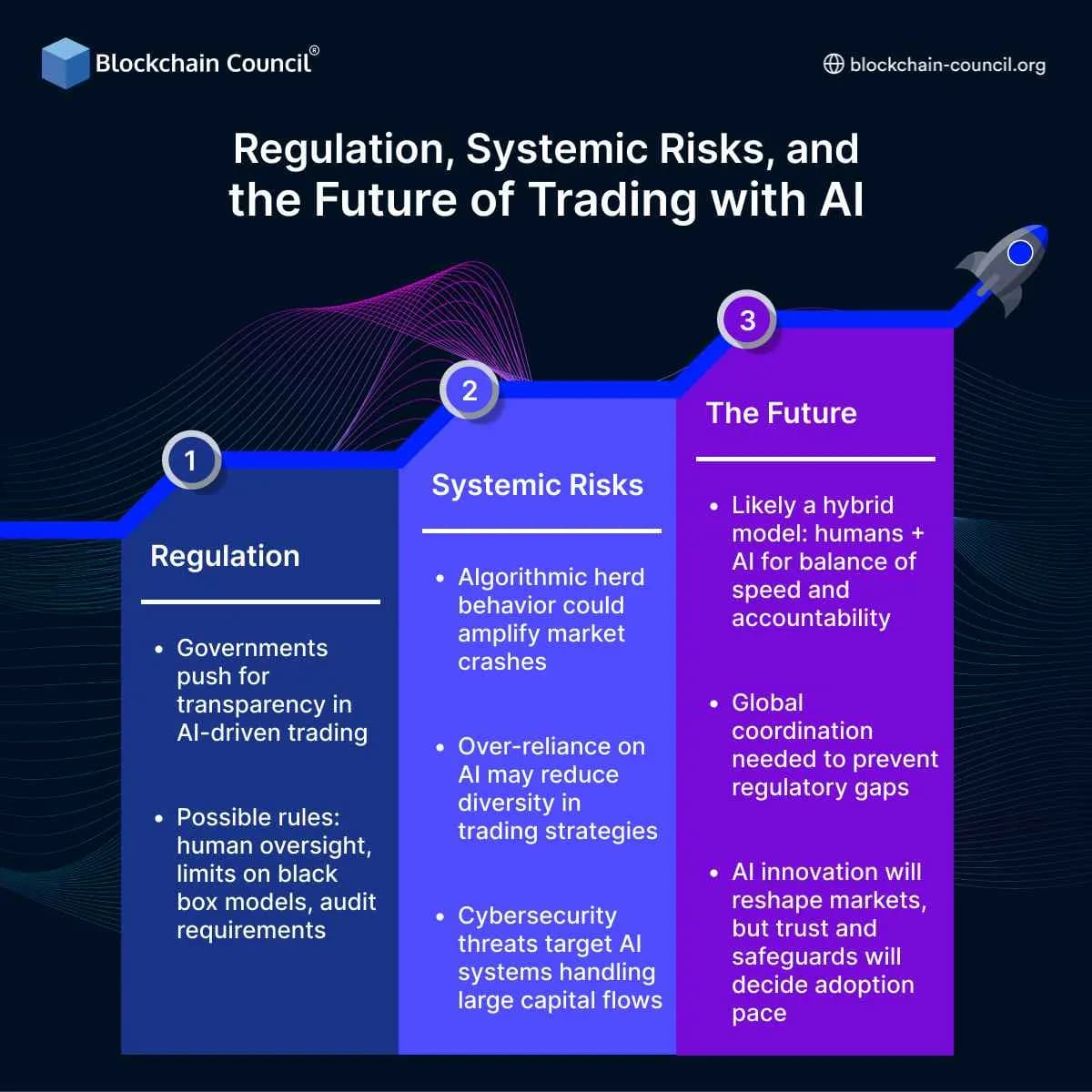
- Regulation
- Governments push for transparency in AI-driven trading
- Possible rules: human oversight, limits on black-box models, audit requirements
- Systemic Risks
- Algorithmic herd behavior could amplify market crashes
- Over-reliance on AI may reduce diversity in trading strategies
- Cybersecurity threats target AI systems handling large capital flows
- The Future
- Likely a hybrid model: humans + AI for balance of speed and accountability
- Global coordination needed to prevent regulatory gaps
- AI innovation will reshape markets, but trust and safeguards will decide adoption pace
Artificial intelligence has already secured its place in the trading world, but the bigger question is what comes next. As more firms and individual traders integrate AI into their workflows, issues of governance, accountability, and systemic stability rise to the forefront. This final section explores the regulatory response, the risks that come with mass adoption, the future skillsets traders will need, and why AI is becoming indispensable but not all-powerful.
The Regulatory Landscape
Trading is one of the most tightly regulated industries in the global economy. Every major market—whether in New York, London, Hong Kong, or Frankfurt—has watchdogs ensuring that participants act fairly and transparently. The entry of AI complicates this picture.
For regulators, AI presents a double-edged sword. On one hand, it offers opportunities for greater oversight. AI systems can detect suspicious patterns in trades faster than human inspectors, flagging insider activity or market manipulation in real time. On the other hand, it introduces complexity. When an AI model generates a trade that leads to a massive loss or a market disruption, it’s not always clear who should be held accountable: the trader who used the tool, the firm that deployed it, or the developers who built it.
In the European Union, regulators are taking a proactive stance with the AI Act, which imposes requirements for transparency, risk assessment, and accountability in high-risk applications. While the law isn’t specific to trading, its principles will apply. In the United States, the Securities and Exchange Commission has already signaled that firms using AI in advisory services will need to disclose how those systems operate. Transparency and documentation are quickly becoming as important as returns.
Systemic Risks and Herd Behavior
When only a handful of firms used AI, the risks were limited. But as adoption spreads, systemic risks increase. If many firms rely on similar models, they may all react the same way to new data. This herd behavior can amplify volatility, pushing prices up or down more sharply than fundamentals warrant.
The Bank of England recently warned that synchronized AI trading could destabilize markets. Imagine hundreds of models, all interpreting a headline the same way and triggering sell orders within milliseconds. Liquidity could evaporate, leading to flash crashes. While circuit breakers exist, the speed of AI means disruptions could become more frequent.
Another risk is model drift. AI systems are trained on historical data, but markets are constantly evolving. When conditions change dramatically—such as during the COVID-19 crash—models can fail in unexpected ways. Overreliance on past patterns can leave firms blind to new realities.
The Challenge of Explainability
Traders and regulators alike are grappling with the “black box” problem. Many advanced AI models, especially deep learning systems, can deliver accurate predictions but provide little insight into how they arrived at their conclusions. For a trader risking millions of dollars, this lack of explainability is unnerving.
Explainable AI is emerging as a field in its own right, aiming to provide transparency without sacrificing performance. Traders want to know which variables mattered most, how confident the model is, and under what conditions it might fail. Without this, trust in AI systems will remain limited, especially for high-stakes decisions.
Global Disparities in Adoption
Not every market is embracing AI at the same pace. In developed economies, large hedge funds and banks are racing ahead, investing billions in infrastructure and talent. In emerging markets, adoption is slower, often due to lack of resources, digital infrastructure, or regulatory clarity.
This gap could widen global financial inequalities. Firms in advanced economies may gain consistent advantages, leaving smaller players at risk of being edged out. However, cloud-based AI services are beginning to level the playing field, offering retail traders and smaller institutions access to powerful tools once reserved for elite firms.
The Evolution of Trader Skillsets
As AI takes over more of the analytical heavy lifting, the skills that define a successful trader are shifting. Raw intuition and chart-reading are giving way to algorithmic oversight, risk interpretation, and strategic judgment.
Education is key to this transition. An AI certification ensures that traders understand the mechanics of AI systems and can supervise them responsibly. For those active in digital assets, a crypto certification provides a deeper grasp of blockchain markets, where AI is increasingly applied to predict price movements. The AI-powered investor program goes further, equipping investors to directly use AI tools in portfolio decisions.
Meanwhile, broader tech certifications help professionals understand the digital ecosystems that make AI trading possible, from cloud platforms to cybersecurity. For transparency and accountability, blockchain technology courses prepare traders to leverage distributed ledgers for auditability. And the Marketing and Business Certification ensures that professionals can apply AI insights not only in markets but also in client engagement and business strategy. Together, these programs are shaping the new generation of AI-empowered traders.
The Role of AI Trading Programs
Algorithmic trading is not new, but AI-driven strategies are more adaptive and complex. An AI trading program can help traders design, backtest, and deploy these models responsibly. Instead of relying on guesswork, participants learn how to integrate risk management, prevent overfitting, and apply strategies across multiple markets. For many, this is the bridge between traditional trading and the AI future.
Human Judgment Remains Essential
Despite the rise of AI, human judgment is not fading away. In fact, it is becoming more important. While AI can process signals at incredible speed, humans provide the context and accountability that algorithms lack. Traders are needed to interpret outputs, challenge assumptions, and make final calls when conditions are uncertain.
Behavioral coaching also remains vital. Traders must manage not just their own psychology but also that of clients and stakeholders. During volatile periods, empathy and reassurance matter as much as technical accuracy. This human dimension is something AI cannot replicate, no matter how sophisticated its models become.
Looking Ahead
The trajectory is clear: AI will continue to grow in trading, handling larger portions of analysis, surveillance, and execution. Regulation will tighten, explainability will improve, and global adoption will expand unevenly. But the core dynamic—humans and machines working together—will remain central.
The most successful traders of the future will not be those who resist AI, nor those who blindly trust it. They will be the ones who find the balance, using AI as a powerful assistant while maintaining human oversight. This partnership will define the next era of finance.
Conclusion
So, why are top traders turning to AI for decisions? Because it gives them speed, precision, adaptability, and cost advantages that no human team could match alone. Yet, they are also aware of the risks—model drift, herd behavior, explainability gaps, and regulatory scrutiny. The path forward is not about replacing traders but about augmenting them.
For professionals and investors, the takeaway is simple: AI is not optional anymore. It is a core part of trading, and those who fail to adapt risk falling behind. Certifications in AI, crypto, blockchain, technology, and business strategy prepare individuals to thrive in this environment. The future of trading will belong to those who master both sides: the power of machines and the judgment of humans.