

Securing and Governing Vector Databases: Privacy Risks, Prompt Injection Mitigation, and Multi-Tenant Access Control
 Suyash Raizada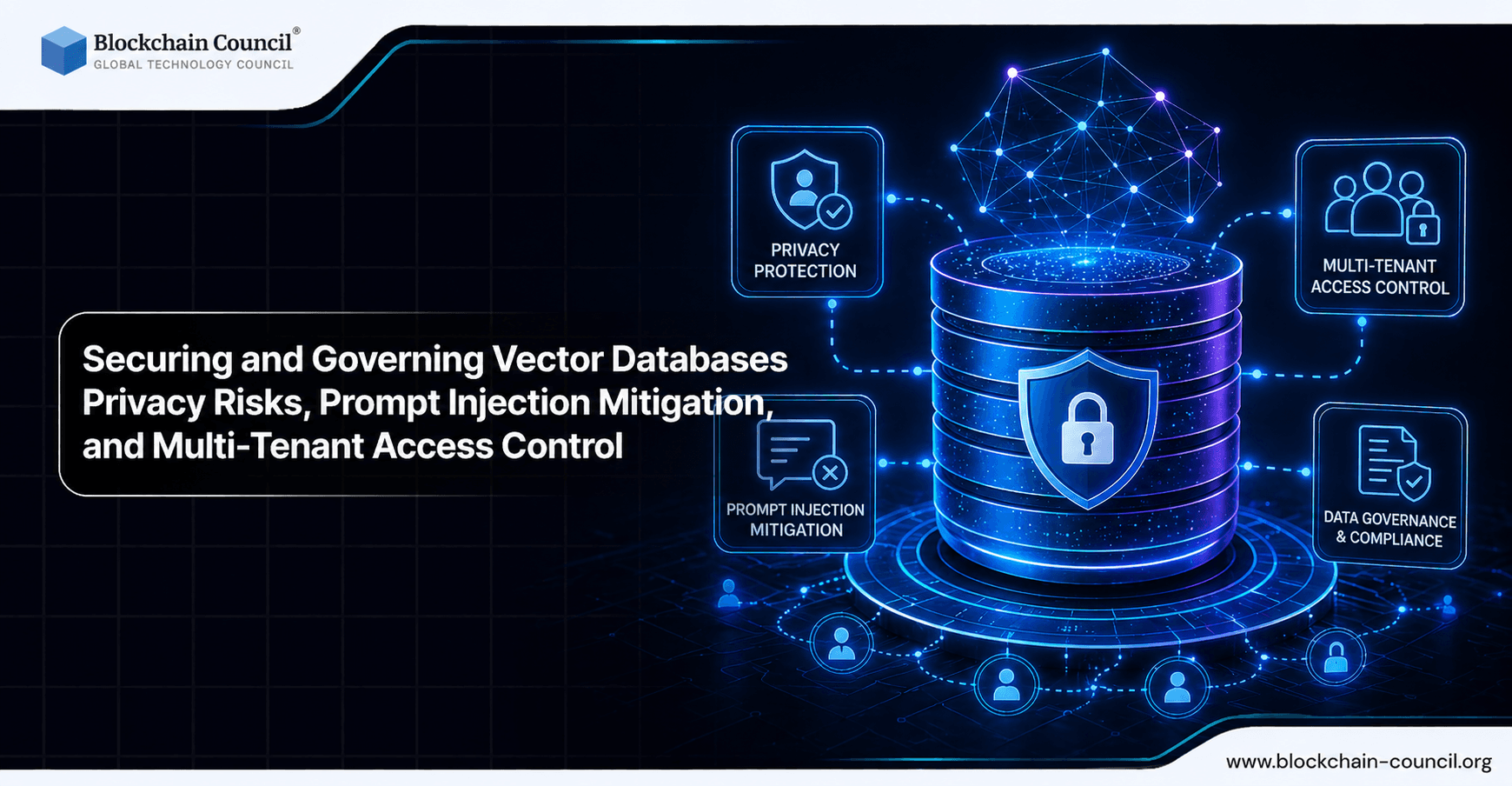
Securing and governing vector databases has become a core requirement for any organization deploying retrieval-augmented generation (RAG), semantic search, or AI agents. Vector databases concentrate high-value assets: embeddings derived from proprietary documents, support tickets, code, user chats, and sometimes regulated data. As the AI-native attack surface matures, threats are no longer theoretical. Defenders are increasingly dealing with embedding poisoning, access control bypasses, and prompt injection paths that originate from retrieved context.
This article covers the most important privacy risks in vector databases, how to mitigate prompt injection in RAG pipelines, and how to implement multi-tenant access control with RBAC, ABAC, and network isolation. It also highlights practical governance controls applicable across managed, on-premises, and edge deployments.

An AI Security Certification can help professionals develop expertise in securing AI systems, protecting vector databases and RAG pipelines, implementing access controls, and managing the privacy, governance, and security risks associated with modern AI deployments.
Why Vector Database Security Differs from Traditional Database Security
Vector databases store high-dimensional representations (embeddings) rather than plain text rows. That difference creates security and governance challenges that do not map cleanly to classic SQL controls:
Embeddings can leak sensitive meaning: even when the original text is not stored, embeddings can enable inference, re-identification, or inverse lookup attempts, particularly when combined with logs and metadata.
RAG expands the blast radius: retrieved context directly influences model behavior. If attackers can tamper with vectors or metadata, they can shape LLM output.
Prototype-to-production gaps are common: teams often ship RAG systems quickly, then discover that MFA, least privilege, and audit logging were never enforced.
Modern managed offerings, including Pinecone, Weaviate, and Qdrant, commonly provide API key authentication, collection or namespace-level RBAC, AES-256 encryption at rest, and TLS 1.3 in transit. However, some environments still lack native encryption features or have limitations that require application-level encryption and careful key management.
Privacy Risks in Vector Databases
Privacy risk in vector databases is driven by three recurring patterns: storing sensitive inputs, overexposing retrieval outputs, and weak operational hygiene across logs, backups, and internal access.
1. Sensitive Data Embedded into Vectors
Pipelines that embed raw documents containing PII, PHI, credentials, or confidential intellectual property may be persisting sensitive semantics. Even without storing original text, embeddings and metadata can enable:
Inference attacks against underlying content
Unintended leakage through similarity search responses
Exposure through logs capturing query text, top-k results, and document snippets
Mitigations should begin before data reaches the vector database:
PII detection and redaction prior to embedding, using tools such as Microsoft Presidio
Anonymization or pseudonymization of identifiers, with a separate secure mapping store when reversibility is required
Schema validation for metadata to prevent accidental inclusion of secrets such as tokens, email addresses, or session IDs
2. Data Poisoning and Tampering That Corrupts RAG Outputs
RAG systems trust retrieval. If an attacker can insert or modify vectors or metadata, they can poison results to bias answers, introduce malicious instructions, or degrade quality until users stop trusting the system. This is a governance issue as much as a security issue, because it directly impacts integrity and safety.
Mitigations include:
Write restrictions: separate ingestion roles from query roles, and apply least privilege at the collection or namespace level
Vector normalization and outlier detection: detect unusual embedding distributions that may indicate poisoning attempts
Controlled ingestion pipelines: signed ingestion jobs, allow-listed sources, and review workflows for high-risk collections
3. Encryption Gaps and Insider Risk
Even with TLS in transit, organizations often find that encryption at rest, customer-managed keys, or field-level encryption is not consistently implemented across all environments. Insider threats are also a real concern: a privileged developer key, mis-scoped API key, or overly broad admin role can facilitate bulk export and exfiltration.
Mitigations include:
Encryption at rest combined with strong key management practices covering rotation, separation of duties, and least privilege in KMS policies
Application-level encryption when native encryption controls are insufficient for your risk profile
Secure logging that avoids storing raw prompts, retrieved chunks, or full metadata unless strictly necessary
Regular audits of access patterns, key usage, and administrative actions
Some industry approaches describe secure embedding patterns that support querying encrypted fields using KMIP-compliant keys and external key providers such as AWS KMS, reducing the need to decrypt sensitive values inside the application flow.
Prompt Injection Mitigation in RAG Pipelines
Prompt injection is no longer limited to direct user input. In RAG, injection can arrive through retrieved context: a malicious document chunk or metadata field that the model interprets as an instruction. Attackers can also target the embedding store by inserting altered content designed to surface for common queries.
Common RAG Injection Paths
Malicious content in indexed documents containing instructions such as "ignore previous rules" or "exfiltrate secrets"
Metadata injection where attackers place control text in fields assumed to be safe
Embedding poisoning that boosts similarity scores for malicious chunks so they appear in top-k results
Mitigation Controls That Work in Practice
Effective prompt injection mitigation is layered. No single filter is sufficient, particularly when attackers iterate on their approaches.
Strict input and schema validation
Validate document structure, metadata keys, and allowed value formats.
Block arbitrary fields and enforce size limits to reduce hidden payloads.
Normalize embeddings and detect anomalies
Apply consistent preprocessing and normalization across all ingestion paths.
Quarantine outliers or suspicious ingestion events for review.
Constrain tool and data access at inference time
Use least-privilege roles for RAG query services, ideally read-only.
Ensure the model cannot directly access admin APIs or sensitive collections.
Segment and label retrieved context
Wrap retrieved passages as untrusted data in your prompt template.
Instruct the model to treat retrieved content as reference material, not as instructions.
Audit logging and forensic readiness
Log who queried what, which documents were retrieved, and which policies were applied.
Protect logs from tampering and restrict access appropriately.
For teams building production-grade GenAI systems, formalizing these controls as part of a secure RAG reference architecture is recommended. Structured training in AI security and governance can complement implementation work and help teams apply these principles consistently across projects.
Multi-Tenant Access Control: RBAC, ABAC, and Network Isolation
Multi-tenancy is common in SaaS RAG platforms, internal platform teams, and enterprise shared services. The core requirement is clear: data for tenant A must not be accessible to tenant B unless explicitly shared, and accidental leakage through mis-scoped keys must be prevented.
RBAC as the Baseline
Role-Based Access Control (RBAC) is the standard starting point for vector database governance. Most managed vector databases now offer granular roles at the collection or namespace level.
Separate roles by function: ingestion writer, index maintainer, read-only RAG service, and security auditor
Use short-lived credentials where possible, and rotate API keys on a defined schedule
Enforce least privilege: most online inference services should not have write access to any collection
ABAC for Context-Aware Policies
Attribute-Based Access Control (ABAC) adds dynamic decision-making to access policy. Rather than granting static access, policies evaluate attributes such as user group, device posture, location, time, and data sensitivity classification.
Examples of ABAC rules for vector databases:
Allow access to a confidential collection only from corporate-managed devices
Deny cross-region access when a tenant's data residency requirements mandate local processing
Require step-up authentication for bulk export operations or unusually high top-k limits
Industry guidance increasingly recommends layering ABAC and MFA on top of RBAC, particularly for GenAI systems where usage patterns and risk context change frequently.
Network Segmentation and Private Connectivity
Network controls reduce exposure even when credentials are compromised.
Private endpoints such as AWS PrivateLink to keep traffic off the public internet
IP allow-listing and firewall rules around ingestion services and admin consoles
Rate limiting and throttling to mitigate scraping, brute force attempts, and certain denial-of-service patterns
TLS 1.3 enforcement for all connections, including internal service-to-service traffic
Deployment Choices: Managed vs. On-Premises vs. Edge
Security posture is shaped significantly by where the vector database runs:
Managed vector databases reduce operational burden and often provide built-in RBAC, encryption at rest, and TLS by default. Governance still depends on correct configuration, key rotation, and tenant isolation design.
On-premises and air-gapped deployments are standard in regulated industries and sovereignty-driven programs, minimizing data movement and enabling stricter perimeter controls.
Edge deployments support locality and compliance requirements, particularly where zero outbound connectivity is mandated.
Across all deployment models, governance should be designed to survive configuration drift. Policy-as-code, continuous compliance checks, and routine access reviews are critical components of any durable security program.
A Python Certification can help professionals strengthen their skills in automation, compliance scripting, security tooling, and infrastructure management, while a Marketing Certification can help leaders communicate governance priorities, risk management strategies, and security initiatives more effectively across the organization.
Operational Checklist for Securing and Governing Vector Databases
Data minimization: do not embed or store data you do not need.
PII redaction and safe preprocessing before embedding.
Encryption strategy: at rest, in transit, and application-level encryption where required.
Least privilege with RBAC scoped to collection or namespace level.
ABAC and MFA for sensitive collections and administrative actions.
Tenant isolation: explicit boundaries, no shared keys, no shared admin roles.
Prompt injection defenses: schema validation, outlier detection, and untrusted-context prompting.
Audit logs: tamper-protected, searchable, and monitored for anomalies.
Incident readiness: documented playbooks for embedding poisoning, key compromise, and cross-tenant exposure.
Conclusion
Securing and governing vector databases is now a prerequisite for trustworthy RAG and AI agent deployments. The core risk extends beyond data theft to integrity compromise: tampered embeddings and injected context can silently alter what users believe to be true. Organizations that treat vector databases as production security assets, applying layered controls across privacy, prompt injection mitigation, and multi-tenant access control, will be better positioned as AI-native threats continue to mature.
To scale these practices, formalize them in architecture standards, enforce them through CI/CD pipelines and policy-as-code, and continuously audit both access and retrieval behavior. Teams that pair implementation work with structured training in AI security, governance, and cybersecurity fundamentals build more durable and defensible systems over time.
FAQs
1. What does securing a vector database mean?
Securing a vector database involves protecting stored embeddings, access controls, and query pipelines. It ensures data confidentiality, integrity, and availability. Proper security reduces risks of leaks and unauthorized access.
2. Why is governance important for vector databases?
Governance defines how data is stored, accessed, and managed. It ensures compliance with regulations and internal policies. Strong governance helps maintain trust and accountability.
3. What are the main privacy risks in vector databases?
Embeddings can unintentionally expose sensitive information. Inference attacks may reconstruct original data. Poor access controls can also lead to data leaks.
4. Can embeddings leak sensitive data?
Yes, embeddings may encode private or identifiable information. Attackers can sometimes reverse-engineer or infer details. Proper data handling and encryption reduce this risk.
5. What is prompt injection in vector-based systems?
Prompt injection is a malicious input designed to manipulate AI behavior. It can override instructions or expose sensitive data. This is a common risk in RAG pipelines.
6. How can prompt injection attacks be mitigated?
Use input validation, context filtering, and strict prompt templates. Limit model access to sensitive data. Monitoring and testing help detect vulnerabilities.
7. What is multi-tenant access control in vector databases?
Multi-tenant access control ensures that different users or organizations access only their own data. It isolates data across tenants. This is critical for SaaS applications.
8. How do you implement role-based access control (RBAC) in vector databases?
RBAC assigns permissions based on user roles. It restricts access to specific data and operations. This improves security and simplifies management.
9. What is data isolation in multi-tenant vector systems?
Data isolation ensures that one tenant cannot access another tenant’s data. It can be implemented through separate indexes or namespaces. This prevents data leakage.
10. How can encryption improve vector database security?
Encryption protects data at rest and in transit. It prevents unauthorized access even if data is intercepted. This is a basic requirement for secure systems.
11. What are best practices for securing embeddings?
Avoid storing sensitive raw data in embeddings when possible. Use anonymization and encryption techniques. Regular audits help identify risks.
12. How does audit logging help in vector database governance?
Audit logs track access, queries, and changes. They help detect suspicious activity and ensure compliance. This improves transparency and accountability.
13. What is least privilege access in vector databases?
Least privilege means giving users only the permissions they need. It reduces the risk of accidental or malicious actions. This is a core security principle.
14. How can organizations manage compliance in vector databases?
Organizations should follow data protection regulations like GDPR or HIPAA. Implementing policies and monitoring ensures compliance. Regular reviews are necessary.
15. What are common vulnerabilities in vector-based AI systems?
Vulnerabilities include prompt injection, data leakage, and weak access controls. Poorly designed pipelines can expose sensitive information. Continuous testing is required.
16. How can monitoring improve vector database security?
Monitoring tracks system activity and detects anomalies. It helps identify potential threats early. Real-time alerts enable quick response.
17. What role does metadata play in securing vector databases?
Metadata helps categorize and control access to data. It enables filtering and policy enforcement. Proper use of metadata improves governance.
18. How can developers test for prompt injection risks?
Developers can simulate malicious inputs and evaluate system responses. Red teaming and security testing tools are useful. Regular testing helps identify weaknesses.
19. What is the importance of secure APIs in vector databases?
APIs are entry points for data access and queries. Securing them prevents unauthorized usage and attacks. Authentication and rate limiting are essential.
20. What are best practices for securing and governing vector databases?
Use strong access controls, encryption, and monitoring. Implement prompt injection defenses and data isolation. Regular audits and updates ensure long-term security.
Related Articles
View All
AI & ML
Prompt Engineering to Context Engineering: How to Get Better Results From AI
Learn the journey from Prompt Engineering to Context Engineering. Understand prompts, few-shot and chain-of-thought techniques, context windows, memory, and RAG to get better results from AI.

AI & ML
Recursive Self-Improvement and AI Safety: Risks, Challenges, and Safeguards
Learn how recursive self-improvement changes AI safety risk, from misalignment and weak oversight to practical safeguards for developers and enterprises.

AI & ML
OpenAI Launches GPT-6.1 Terra: What’s New?
OpenAI has launched GPT-6.1 Terra, a faster and cheaper mid-tier model with stronger computer use, better image understanding and fewer errors. See what is new, what it costs, and who can use it.
Trending Articles
The Role of Blockchain in Ethical AI Development
How blockchain technology is being used to promote transparency and accountability in artificial intelligence systems.
AWS Career Roadmap
A step-by-step guide to building a successful career in Amazon Web Services cloud computing.
What is AWS? A Beginner's Guide to Cloud Computing
Everything you need to know about Amazon Web Services, cloud computing fundamentals, and career opportunities.