

RAG Explained: The RAG Concept, How It Works, and Why It Matters in 2026
 Suyash Raizada
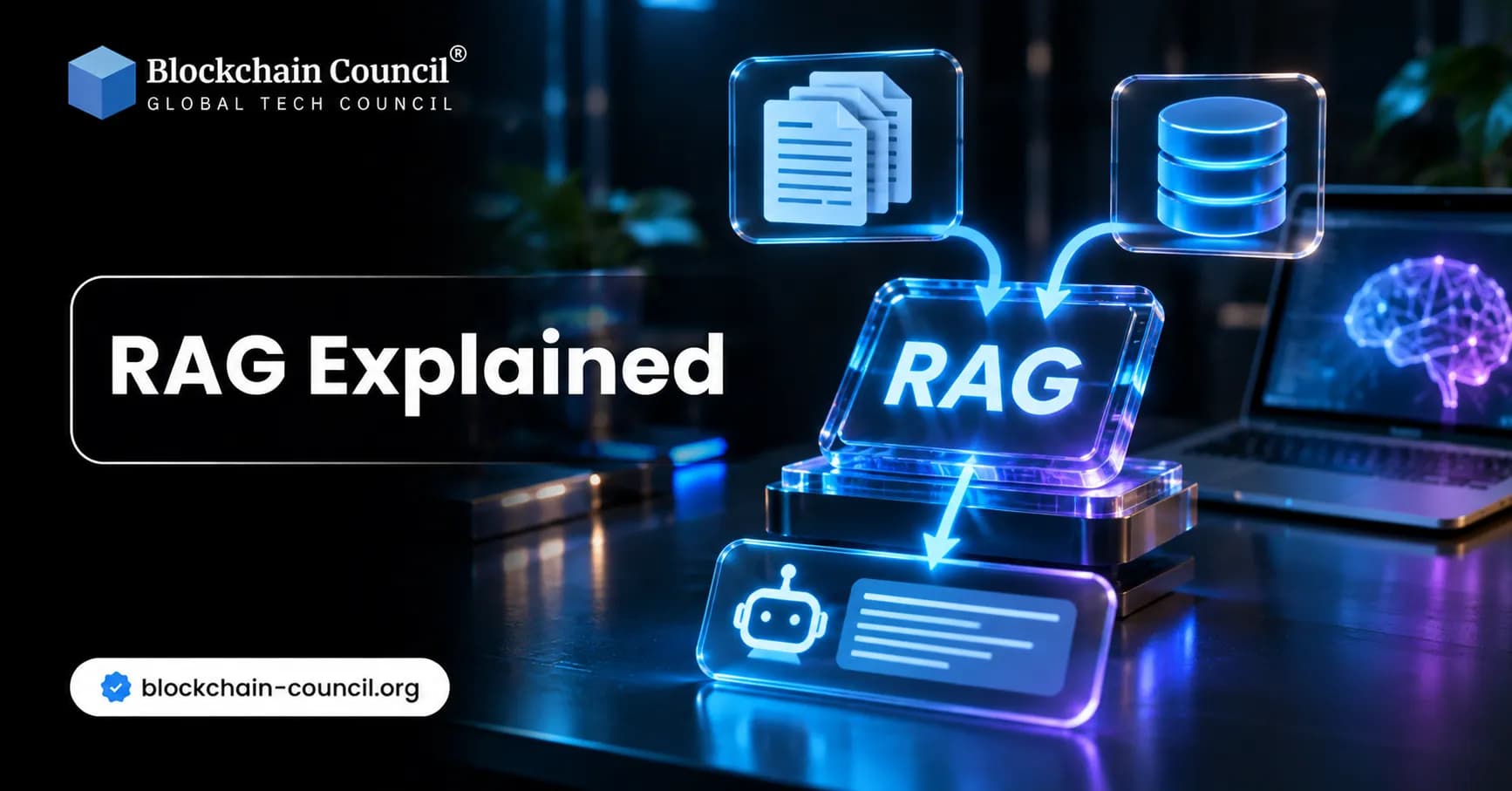
RAG (Retrieval-Augmented Generation) is one of the most practical approaches for making large language models (LLMs) more reliable in real-world deployments. Instead of limiting an LLM to knowledge encoded during training, RAG first retrieves relevant information from external sources - such as a company knowledge base, internal documents, or curated datasets - and then generates an answer grounded in that retrieved context. This RAG concept reduces hallucinations and enables access to current or domain-specific knowledge without retraining the model.
As enterprise adoption accelerates, the retrieval step has become the critical bottleneck. In 2026, industry analysis consistently shows that when RAG fails, the failure point is retrieval, not generation. That reality has pushed RAG beyond basic vector search into more advanced hybrid and agentic architectures. Professionals looking to develop expertise in these technologies can explore the Certified LLM Developer certification to build a stronger foundation in large language models and their practical applications.

What Is RAG (Retrieval-Augmented Generation)?
RAG is an architecture pattern that combines two types of knowledge:
Parametric knowledge: information the model encoded in its weights during training
Non-parametric knowledge: external information retrieved at query time
This design addresses a fundamental limitation of LLMs: knowledge stagnation. Once trained, an LLM's internal knowledge becomes fixed and can grow outdated. The model may also fabricate details when it lacks accurate facts. RAG mitigates both problems by grounding answers in retrieved documents that can be updated continuously.
The Core RAG Concept: Retrieve, Augment, Generate
The foundational RAG concept is best understood as a three-step pipeline:
Retrieve: Search an external corpus for documents relevant to the user query. This corpus may be a vector database, internal documents, web pages, or curated datasets.
Augment: Build an LLM prompt that combines the user question with the most relevant retrieved passages.
Generate: Produce an answer that uses both the model's reasoning and the retrieved context to remain grounded and verifiable.
In production systems, this simple flow typically expands to include metadata filtering, reranking, citation formatting, safety checks, and operational monitoring. Understanding these components is also valuable for professionals pursuing the Certified Artificial Intelligence (AI) Expert certification, particularly those interested in applying AI concepts to real-world systems.
Why Naive RAG Is Obsolete in 2026
Early RAG implementations relied on a single dense vector search over fixed-size chunks. This approach is now widely considered insufficient for production systems because it introduces several retrieval bottlenecks:
Irrelevant chunks retrieved when embedding similarity fails to capture the actual query intent
Missed key details when important information is split across chunk boundaries
Context window waste when the model is fed large volumes of low-signal text
Poor handling of mixed queries that combine conceptual intent with entity-specific constraints
Stronger LLM reasoning does not automatically compensate for poor retrieval. If the retrieved context is wrong, the generated answer will also be wrong - only more fluent.
Modern RAG Techniques You Should Know (2026)
RAG has matured into a set of established best practices and advanced patterns. Below are the developments most commonly seen in enterprise-grade RAG implementations.
1) Hybrid Search (Dense + Sparse)
Hybrid search combines dense retrieval (embeddings) with sparse retrieval (commonly BM25). Dense retrieval performs well for semantic similarity, while sparse retrieval excels at exact term matches, entity names, and identifiers. Combining both typically improves performance across diverse query types.
Common fusion approaches include:
Reciprocal Rank Fusion (RRF) to merge ranked lists from different retrievers
Weighted fusion to tune the relative influence of dense versus sparse scores
Hybrid search is especially valuable when queries mix conceptual intent with precise constraints, such as product codes, legal clauses, or policy identifiers.
2) Advanced Chunking (Semantic, Agentic, Small-to-Big)
Fixed-size chunking often breaks meaning at arbitrary boundaries. Advanced systems now use semantic or agentic splitters that preserve document structure and intent.
A widely adopted strategy is small-to-big (parent-document) retrieval:
Embed small child chunks for precise, targeted retrieval
When a child chunk matches, send the larger parent section to the LLM for greater completeness
This approach reduces both missed details and over-fragmentation while keeping the prompt grounded in coherent context.
3) Parametric RAG (Temporary Knowledge Injection)
Parametric RAG encodes retrieved knowledge into temporary low-rank adaptations (LoRA) and merges them into model weights for the duration of a session or task. This approach can bypass context window limits by injecting knowledge directly into the model rather than passing it as prompt text.
For teams building assistants that must operate over large corpora or long-running workflows, parametric RAG offers a practical alternative when prompt context alone is insufficient.
4) Dynamic RAG (Agentic Retrieval with Stopping Rules)
Dynamic RAG uses an agentic approach to retrieval. Rather than fetching a fixed number of documents, a reranker or retrieval agent decides:
How many documents to retrieve
Whether additional retrieval passes are needed
When to stop because sufficient evidence has been gathered
Some systems train reranker agents with reinforcement learning so that retrieval becomes adaptive - similar to how a researcher retrieves sources, skims for relevance, refines the search query, and stops once confident.
5) RAG Evaluation Frameworks (RAGAS and Reference-Free Metrics)
As RAG systems move into production, evaluation cannot rely solely on manual review. Frameworks like RAGAS are widely used because they support reference-free evaluation signals, including:
Context precision: how much of the retrieved context is actually relevant to the query
Context recall: whether the pipeline retrieved the information needed to answer correctly
Faithfulness: whether the generated answer stays grounded in the provided context
Answer relevance: whether the final output directly addresses the user query
These metrics help teams identify whether failures originate in retrieval, chunking, reranking, or generation.
6) Fine-Tuning for Domain Retrieval Quality
Fine-tuning embedding models for a specific domain can substantially improve retrieval and end-to-end accuracy. Benchmark results show fine-tuned RAG reaching 72.5% accuracy on HaluEval compared with 44.56% for naive RAG configurations. The practical takeaway is that retrieval quality depends not only on the LLM but also on how well the embedding model represents your domain language.
Professionals who want to strengthen their technical knowledge in areas such as AI development, retrieval pipelines, and machine learning can also explore a relevant Tech Certification to support their understanding of emerging technologies.
Enterprise RAG: What Production Pipelines Typically Include
Enterprise RAG implementations commonly emphasize a pipeline approach rather than a single model call. Typical components include:
Vector search with metadata filtering for access control, document type filtering, recency, and business unit segmentation
Reranking to reorder retrieved results by true relevance before passing them to the LLM
Latency-aware ANN indexing to scale retrieval with acceptable speed and accuracy trade-offs
LLMOps integration for monitoring retrieval quality, data drift, cost, and response latency
For professionals building governed AI systems, RAG is often the preferred architecture because it can incorporate proprietary data without retraining large models, and knowledge can be updated through document ingestion rather than expensive fine-tuning cycles.
Real-World Example: RAG in Financial Services
A well-documented enterprise deployment is Morgan Stanley's integration of RAG with GPT-4 over internal research content, enabling financial advisors to answer specialized questions without manually searching large document libraries. This use case illustrates why RAG is attractive for regulated industries: it supports domain accuracy, answer provenance, and controlled access to sensitive knowledge.
Market Momentum: Why RAG Adoption Keeps Growing
RAG is increasingly treated as foundational infrastructure for practical generative AI. Market projections reflect this momentum, with estimates ranging from $1.2 billion in 2024 growing to $11.0 billion by 2030 at a reported 49.1% CAGR, alongside alternate estimates of $1.94 billion in 2026 with a 38.4% CAGR through 2030. While methodologies differ across forecasts, both trajectories point to strong, enterprise-driven growth.
How to Get Started with RAG (Practical Checklist)
Building a RAG system that aligns with 2026 best practices requires deliberate design choices at each stage. The following checklist provides a structured starting point:
Define your corpus: determine which data sources are permitted, how they will be updated, and how access will be governed (policies, manuals, support tickets, internal wikis).
Choose retrieval methods: implement hybrid retrieval (dense embeddings plus BM25) and evaluate performance across different query types.
Adopt smarter chunking: use semantic splitting and small-to-big retrieval strategies to preserve document meaning and context.
Add reranking: a strong reranker often improves answer relevance more than switching to a different LLM.
Measure with RAG metrics: evaluate context precision, recall, faithfulness, and answer relevance using frameworks like RAGAS.
Plan for operations: monitor latency, retrieval drift, failure modes, and user feedback in a structured LLMOps setup.
Developing these systems also requires practical programming knowledge, including Python, API integration, data processing, embeddings, and retrieval workflows. Understanding the AI skills programmers need to build RAG apps can help developers prepare for the technical demands of designing and deploying reliable applications. Exploring RAG AI systems can also provide further insight into how retrieval-augmented approaches are being applied across different AI use cases.
For professionals seeking structured learning pathways, Blockchain Council offers certifications in generative AI, prompt engineering, and AI development workflows that cover RAG implementation alongside related topics in data science and AI governance.
Conclusion: RAG Is Now a System Design Discipline
RAG is no longer a simple pattern of vector search plus a prompt. Effective RAG in 2026 requires deliberate system design across hybrid retrieval, advanced chunking, reranking, evaluation metrics, and operational monitoring. The most important principle is that retrieval quality largely determines answer quality.
As RAG becomes foundational for both autonomous and governed AI systems, professionals who understand the full RAG concept - not just the acronym - are better positioned to build reliable assistants that scale from prototypes to production. Alongside technical AI knowledge, professionals can explore a Marketing Certification to broaden their understanding of how emerging technologies connect with business and marketing applications.
FAQs
1. What Is RAG in Artificial Intelligence?
RAG stands for Retrieval-Augmented Generation. It is an AI technique that combines information retrieval with large language models (LLMs) to generate more accurate, relevant, and context-aware responses. Instead of relying only on information learned during training, an AI system retrieves relevant information from external sources before answering a question.
2. What Does Retrieval-Augmented Generation Mean?
Retrieval-Augmented Generation describes a process in which an AI model retrieves information from an external knowledge source, adds that information to the user's prompt, and generates an answer using the additional context. This helps AI systems work with updated information and specialised knowledge without retraining the entire model.
3. How Does RAG Work?
RAG generally works through three main stages:
Retrieval: The system searches an external knowledge base for relevant information.
Augmentation: The retrieved information is combined with the user's question.
Generation: An LLM uses the additional context to produce an answer.
This process helps connect an AI model's language capabilities with relevant external knowledge.
4. What Are the Main Components of a RAG Architecture?
A typical RAG architecture includes:
Knowledge base: Stores documents, databases, and other information.
Embedding model: Converts information into numerical representations.
Vector database: Stores and searches embeddings.
Retriever: Finds relevant information based on a query.
Generator: Uses an LLM to produce the final response.
Orchestration layer: Coordinates the retrieval and generation process.
These components work together to provide contextually relevant AI responses.
5. What Is an Example of RAG in Real Life?
An AI-powered customer support chatbot is a practical example of RAG. When a customer asks about a company's refund policy, the system retrieves the relevant information from internal documents and uses an LLM to generate an answer. This allows the chatbot to respond using the company's latest policies rather than relying only on general training data.
6. Why Is RAG Important for AI in 2026?
RAG is important because organisations increasingly need AI systems that can access private, specialised, and frequently updated information. It helps businesses connect LLMs to internal documents, databases, product information, and enterprise knowledge without repeatedly retraining their models.
7. How Does RAG Reduce AI Hallucinations?
RAG can reduce hallucinations by providing an LLM with relevant information from an external knowledge source before generating an answer. This gives the model supporting context instead of requiring it to rely entirely on learned patterns. However, RAG does not eliminate hallucinations because retrieval errors, incomplete documents, and incorrect interpretation can still produce inaccurate responses.
8. What Is the Difference Between RAG and Traditional AI Chatbots?
Traditional AI chatbots generally generate responses using their training data and conversation context. RAG-powered chatbots retrieve relevant information from external knowledge sources before responding. This makes RAG particularly useful for answering questions about company policies, technical documentation, product catalogues, and updated information.
9. What Is a Vector Database in RAG?
A vector database stores numerical representations of information called embeddings. It allows an AI system to search for content based on semantic similarity rather than relying exclusively on exact keyword matches. Popular technologies used in RAG applications include Pinecone, Chroma, Weaviate, Qdrant, and FAISS.
10. What Are Embeddings in Retrieval-Augmented Generation?
Embeddings are numerical representations of text, images, or other information. They capture important semantic relationships and allow a retrieval system to identify content with similar meanings. For example, a search for "how to protect personal information" may retrieve documents containing the phrase "data privacy and security."
11. What Is Chunking in RAG?
Chunking is the process of dividing large documents into smaller sections before converting them into embeddings. These sections, called chunks, make information easier to store, search, and retrieve. Effective chunking helps preserve relevant context and improves the chances of retrieving useful information for a particular question.
12. What Is the Difference Between RAG and Fine-Tuning?
RAG and fine-tuning improve AI systems in different ways.
RAG: Connects an existing AI model to external information at query time.
Fine-tuning: Further trains a model on specialised examples to improve its behaviour, knowledge of a domain, or response style.
RAG is useful when information changes frequently, while fine-tuning is useful when a model needs to learn specific patterns or behaviours. Both approaches can also be combined.
13. What Are the Different Types of RAG?
Common RAG approaches include:
Naive RAG: Uses a straightforward retrieval-and-generation pipeline.
Advanced RAG: Improves retrieval through query rewriting, hybrid search, and reranking.
Modular RAG: Uses interchangeable components to support more flexible workflows.
Graph RAG: Uses knowledge graphs to retrieve information based on relationships between entities.
Agentic RAG: Uses AI agents to plan and execute more complex retrieval workflows.
Each approach addresses different information retrieval and application requirements.
14. What Is Hybrid Search in RAG?
Hybrid search combines traditional keyword-based search with semantic vector search. Keyword search identifies exact terms, while vector search identifies information based on meaning. Combining both methods can improve retrieval quality, particularly when searching technical documents, product catalogues, and specialised databases.
15. What Is Reranking in RAG?
Reranking is a process that reorganises retrieved search results according to their relevance to the user's question. After an initial search retrieves several documents, a reranking model evaluates them and prioritises the most useful information before passing it to the LLM. This can improve response relevance and reduce unnecessary context.
16. How Is Agentic RAG Different From Traditional RAG?
Traditional RAG usually follows a predefined retrieval-and-generation workflow. Agentic RAG uses AI agents that can make decisions about how and where to retrieve information. They may rewrite queries, search multiple databases, evaluate results, and repeat retrieval steps when additional context is required.
17. What Are the Business Applications of RAG?
RAG can support several business functions, including:
Customer support automation
Internal knowledge management
Legal document research
Financial report analysis
Healthcare information retrieval
Product recommendation systems
Enterprise search
Technical documentation assistance
It helps organisations make internal and external information more accessible through natural-language interactions.
18. What Are the Benefits and Limitations of RAG?
Benefits:
Access to updated external information
Better use of proprietary business data
More context-aware responses
Reduced dependence on repeated model training
Support for source-based answers
Integration with multiple knowledge sources
Limitations:
Poor document quality can affect retrieval accuracy.
Incorrect retrieval can produce misleading answers.
Large knowledge bases require maintenance.
Vector databases and LLM processing create costs.
Sensitive information requires strong access controls.
19. Which Tools and Technologies Are Used to Build RAG Systems?
Developers use several tools and technologies to build RAG applications:
LangChain: Helps connect language models, retrievers, and external tools.
LlamaIndex: Supports data ingestion, indexing, and retrieval.
Pinecone: Provides managed vector database infrastructure.
Chroma: Offers vector storage and retrieval capabilities.
Weaviate: Supports vector and hybrid search.
Qdrant: Provides vector similarity search and filtering.
FAISS: Enables efficient similarity search over vector collections.
The right technology depends on application complexity, data volume, performance requirements, and deployment preferences.
20. What Is the Future of RAG in Artificial Intelligence?
The future of RAG is moving towards more advanced retrieval systems, multimodal knowledge processing, agentic workflows, and improved information verification. AI applications will increasingly combine text, images, audio, video, structured databases, and enterprise documents. As these systems improve, RAG could become an essential architecture for building reliable, specialised, and knowledge-aware AI applications.
Related Articles
View All
AI & ML
Meta Launches Muse Wonder: Its New AI Model Explained
Meta has launched Muse Wonder and Muse Wonder Full, new AI models built for personal and professional agents. Learn the features, pricing, access options and how they compare with rivals.

AI & ML
AI Explained: From Machine Learning to Generative AI
AI Explained in simple terms. Learn the differences between AI, machine learning, and deep learning, how neural networks and LLMs work, and how generative and multimodal AI create content.

AI & ML
NVIDIA Cosmos 3 Explained: The Next Generation of Physical AI
Explore NVIDIA Cosmos 3, an open foundation model for Physical AI that combines vision reasoning, world simulation, multimodal generation, and action prediction for robotics and autonomous systems.
Trending Articles
The Role of Blockchain in Ethical AI Development
How blockchain technology is being used to promote transparency and accountability in artificial intelligence systems.
What is AWS? A Beginner's Guide to Cloud Computing
Everything you need to know about Amazon Web Services, cloud computing fundamentals, and career opportunities.
How to Install Claude Code
Learn how to install Claude Code on macOS, Linux, and Windows using the native installer, plus verification, authentication, and troubleshooting tips.