

How Frontier AI Models Are Reshaping the Future of Work: Skills, Careers and AI Literacy in 2026

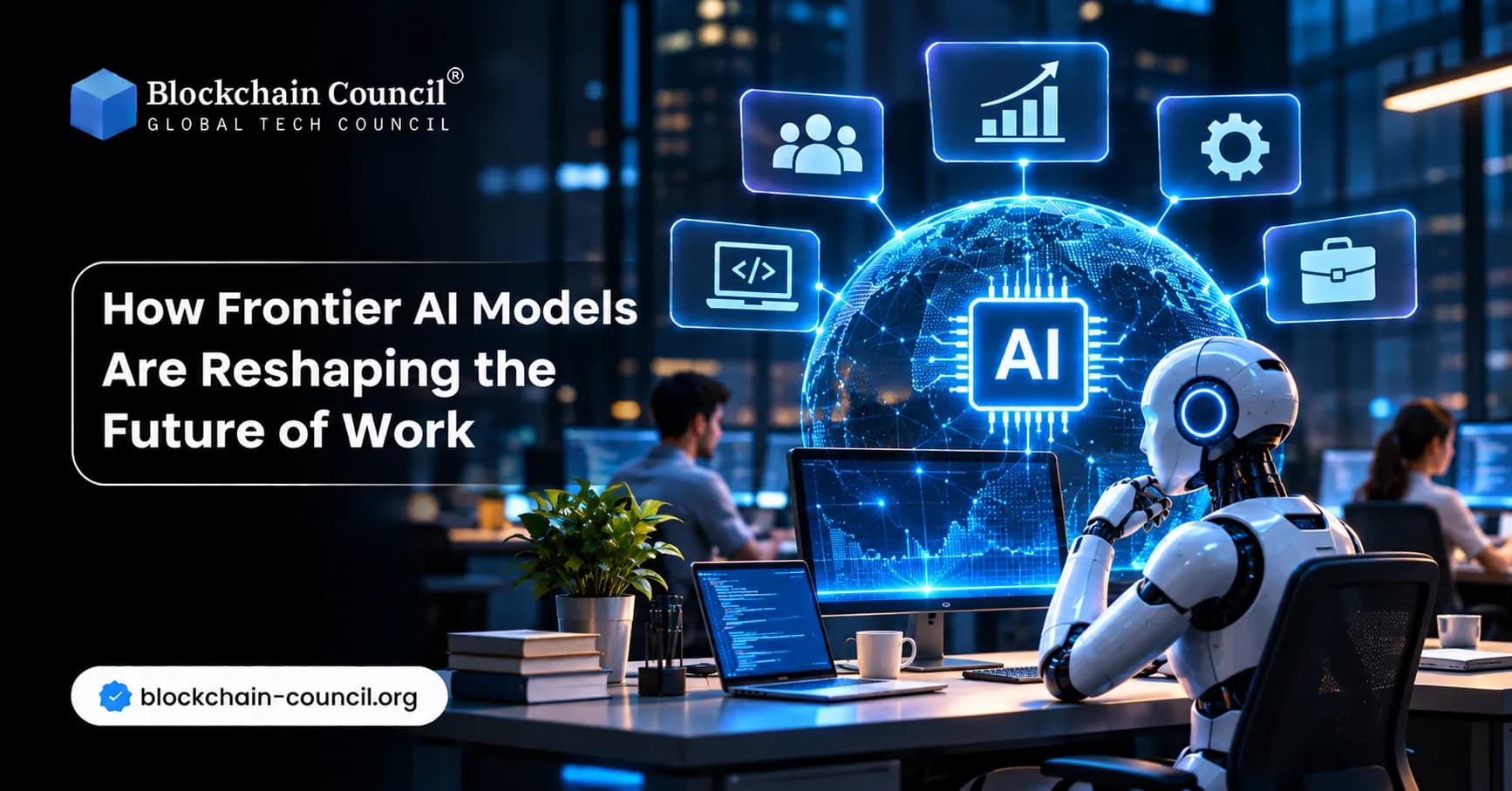
Frontier AI models are reshaping the future of work by taking over more routine tasks, speeding up skilled work, and raising the value of human judgment. Employers are already paying more for AI skills, and many job descriptions are changing faster than training programs can keep up.
This guide connects the latest frontier AI developments to real job roles, in-demand skills, and practical steps you can take. It is written for beginners who feel unsure where to start and for professionals planning their next move. If you want a structured way to learn how modern AI systems actually work, the Certified Claude AI Expert program is a useful place to begin.

What Frontier AI Models Can Do in 2026
Frontier AI models are the most capable systems available at a given time. In November 2026, Anthropic released Claude Fable 5.2, and OpenAI and Google released GPT-6 Astra and Gemini 4 Carbon in the months before. These models no longer just answer questions. They plan, use tools, and carry out long projects.
Anthropic’s launch gives concrete examples. It says Fable 5.2 can coordinate hundreds, even more than a thousand, subagents on a single goal, and that over 90% of the changes merged into its own core codebase are now written by Claude with human guidance. On the Remote Labor Index, which measures how well AI completes real remote work projects, Anthropic reports 41.3% for Fable 5.2 against 17.9% for Fable 5.1. Customers describe agents reviewing loan files, drafting legal work, and running security audits.
These are vendor-reported results, so treat them as signals rather than guarantees. Still, the direction is clear: the tasks AI can finish on its own keep getting longer and more valuable.
The Future of AI at Work: What the Data Says
Headlines can be loud, so it helps to look at independent research. A broad understanding of how AI works, such as the one built through the Certified Artificial Intelligence (AI) Expert program, makes these reports easier to read and apply.
Jobs Will Shift, Not Simply Vanish
The World Economic Forum’s Future of Jobs Report 2025 surveyed more than 1,000 large employers representing over 14 million workers. It projects about 170 million new jobs created and 92 million displaced by 2030, a net gain of roughly 78 million. Employers also expect 39% of key skills to change by 2030, down from 44% in the 2023 edition.
AI Skills Pay More
PwC’s 2026 Global AI Jobs Barometer analyzed more than one billion job ads in 27 countries and territories. It found that jobs requiring AI skills grew about 69%, compared with 9% for the overall job market, and that the average wage premium for AI skills reached 62%, up from 57% a year earlier. A September 2026 analysis of Lightcast data, as reported by industry coverage, found US postings listing AI skills up 165% year over year.
Skills Are Changing Faster
PwC also found that skills for the most AI-exposed jobs change more than twice as fast as skills for the least exposed jobs. Gartner expects about 33% of enterprise software applications to include agentic AI by 2028, up from under 1% in 2024, and at least 15% of day-to-day work decisions to be made autonomously by then.
AI Skills Employers Want in 2026
Technical Skills
You do not need to be an engineer to build useful technical habits.
Prompting and context setting: Giving AI clear goals, examples, and limits.
Tool and workflow use: Connecting AI to documents, spreadsheets, and apps.
Data basics: Understanding quality, bias, and simple analysis.
Agent supervision: Directing and reviewing teams of AI agents.
Evaluation: Checking whether outputs are correct, complete, and safe.
Human Skills
PwC reports that AI is raising the emphasis on judgment, creativity, and leadership. As AI handles routine drafts, people are paid more for deciding what matters, communicating clearly, and taking responsibility for results.
Governance and Safety Skills
Anyone who deploys AI should understand privacy, access control, and risk. Anthropic’s own materials show why: frontier models come with safeguards, restricted access, and monitoring, and users need to work within those rules.
Technical depth helps across all of these areas. A general Tech Certification can help professionals build the cloud, data, and security foundations that AI work depends on.
AI Careers 2026: Roles Growing and Roles Changing
The roles below are examples drawn from how frontier tools are used, not official forecasts.
Roles Likely to Grow
AI workflow designer: Maps business processes into agent steps.
Agent supervisor or orchestrator: Manages teams of AI agents and handles exceptions.
AI evaluator: Writes rubrics and tests outputs, much like the graders used in agent platforms.
AI governance and risk specialist: Sets rules, audits use, and manages compliance.
AI security analyst: Uses AI to find and fix software weaknesses with human approval.
AI-enabled domain expert: A lawyer, analyst, or marketer who pairs deep field knowledge with AI tools.
Hardware and robotics engineer: Anthropic reports Fable 5.2 designed three working electronic prototypes, which points to AI-assisted engineering.
Jobs Being Reshaped
PwC describes two tracks. In professionalised jobs, AI handles routine tasks while the work demands more expertise, and examples include radiologists and recruiters. In democratised jobs, AI makes tasks easier for less experienced workers, such as IT service managers and medical secretaries. PwC found professionalised jobs growing about twice as fast, with 42% faster wage growth since 2021.
Entry-Level Work
One of PwC’s sharpest findings is that AI-exposed junior roles are seven times more likely to require traditionally senior skills such as leadership and strategic thinking. In plain terms, AI is removing some of the routine tasks that once taught beginners, so early-career workers need to show judgment sooner.
AI Literacy: The New Baseline
AI literacy is the ability to understand what AI can and cannot do, use it well, check its work, and use it responsibly. It is becoming as basic as email or spreadsheet skills.
The gap is real. PwC’s 2026 Hopes and Fears survey describes a small group of AI-enabled front-runners, about 14% of workers, pulling ahead, while the core workforce, about 56%, has less access to AI and learning. It also notes that most of the core workforce say they have never used AI.
A simple ladder helps:
Aware: You know what AI is and where it can fail.
User: You use AI daily for drafting, research, and analysis.
Practitioner: You build workflows and check quality.
Builder or leader: You design systems, set policy, and measure results.
Workforce Transformation: What Organizations Should Do
Companies face the same challenge at scale. Practical steps include:
Assess tasks, not jobs. Find the repetitive steps AI can handle.
Train everyone, not just specialists. Close the literacy gap early.
Redesign entry-level paths. Replace lost routine work with guided judgment practice.
Build governance first. Define allowed uses, data rules, and human review.
Measure real outcomes. Track time saved, quality, and errors.
Be careful with hype. Gartner warns that more than 40% of agentic AI projects may be canceled by the end of 2027 because of cost, unclear value, or weak risk controls.
The Role of Professional Certifications
Certifications can give structure, vocabulary, and credibility, especially when you are changing careers. They work best when combined with proof of skill, such as a portfolio, a small project, or measurable results at work. Employers also value judgment and communication, which no course can replace.
Choose a path that matches your goal. Technical roles may benefit from AI and developer-focused programs. Business, communication, and growth roles may benefit from programs that connect AI to strategy and customers. Whatever you choose, check the curriculum and keep learning after you finish.
A Simple 90-Day Learning Plan
Days 1 to 30: Use an AI assistant daily, note where it fails, and learn basic prompting and data habits.
Days 31 to 60: Automate one real task at work or study, and write down the time saved and errors found.
Days 61 to 90: Build a small portfolio piece, learn the basics of AI risk and privacy, and share what you learned.
Risks and Realistic Expectations
Forecasts are not guarantees. WEF and Gartner figures are projections, PwC’s results reflect job ads rather than every worker’s experience, and vendor benchmarks come from the companies selling the tools. AI can also make confident mistakes, so human review remains essential. The safest approach is to stay curious, keep verifying, and build skills that hold their value, such as judgment, communication, and learning speed.
Conclusion
Frontier AI models are reshaping the future of work by changing which tasks people do, which skills are rewarded, and how careers begin. The strongest position is not to fear the change or ignore it, but to build AI literacy, practice with real tools, and pair technical ability with human judgment.
Start small, keep a record of what you learn, and update your plan every few months. For marketers and business professionals who want to connect AI capability with customer strategy, a Marketing Certification can help turn new tools into clear, credible results.
Official Sources
FAQs
1. What Are Frontier AI Models?
Frontier AI models are advanced artificial intelligence systems designed to perform complex tasks involving reasoning, coding, writing, research, data analysis, and multimodal understanding. They are pushing the boundaries of what AI can accomplish across professional and business environments.
2. How Are Frontier AI Models Reshaping the Future of Work in 2026?
Frontier AI models are changing how people complete tasks, make decisions, analyse information, and collaborate. They can automate repetitive activities, support complex workflows, and help employees focus on creative, strategic, and problem-solving responsibilities.
3. What Is AI Literacy, and Why Is It Important in 2026?
AI literacy is the ability to understand, use, evaluate, and interact responsibly with artificial intelligence. It helps professionals select appropriate AI tools, write effective prompts, verify generated information, recognise limitations, and protect sensitive data.
4. Which Skills Will Be Most Valuable in an AI-Driven Workplace?
Important skills include critical thinking, analytical reasoning, communication, adaptability, problem-solving, data literacy, AI tool proficiency, and domain-specific expertise. Professionals who can combine technical knowledge with human judgement will be better equipped to work alongside AI systems.
5. Will Frontier AI Models Replace Human Jobs?
Frontier AI models may automate certain tasks and change the responsibilities associated with many jobs. However, their impact will vary by industry and occupation. Roles involving human relationships, complex judgement, accountability, creativity, and physical work may continue to require substantial human involvement.
6. What Is the Difference Between AI Automation and AI Augmentation?
AI automation involves using AI to perform tasks with limited human intervention. AI augmentation uses AI to support human capabilities, improve productivity, and assist decision-making. Many organisations combine both approaches depending on the task and its associated risks.
7. How Can Employees Use Frontier AI Models to Improve Productivity?
Employees can use frontier AI models to summarise documents, analyse datasets, draft communications, generate ideas, write code, prepare reports, and organise workflows. Reviewing outputs for accuracy and relevance remains important before using them in professional settings.
8. Which Careers Are Growing With the Adoption of AI?
AI adoption is creating opportunities across areas such as AI engineering, machine learning operations, data science, AI security, automation consulting, AI product management, and AI governance. Demand also exists for professionals who can apply AI tools within established business functions.
9. Do Non-Technical Professionals Need to Learn AI?
Yes. AI literacy is increasingly relevant to professionals in marketing, finance, human resources, sales, education, healthcare, and management. Non-technical employees can benefit from understanding AI tools, evaluating their outputs, and applying them to everyday responsibilities.
10. How Is AI Changing Digital Marketing Careers?
AI is transforming digital marketing through automated content assistance, audience analysis, campaign optimisation, customer segmentation, predictive analytics, and personalisation. Marketers increasingly need analytical skills, creative judgement, platform knowledge, and the ability to evaluate AI-generated content.
11. What Skills Should Students Develop to Prepare for an AI-Driven Job Market?
Students should develop digital literacy, communication, critical thinking, data analysis, problem-solving, and practical AI tool experience. Learning programming, statistics, and domain-specific technologies can provide additional advantages depending on their career goals.
12. What Is Prompt Engineering, and Is It Still a Valuable Skill?
Prompt engineering involves designing clear instructions and providing relevant context so AI systems can produce useful results. It remains valuable, but professionals should also learn workflow design, output evaluation, data handling, and domain-specific problem-solving rather than relying only on prompt-writing techniques.
13. How Are Frontier AI Models Changing Software Development Careers?
Advanced AI models can assist developers with code generation, debugging, testing, documentation, and software architecture discussions. Developers still need programming fundamentals, system design knowledge, security awareness, and the ability to review and maintain AI-generated code.
14. What Is an AI Agent, and How Can It Change Workplace Tasks?
An AI agent is a system that can pursue a defined goal by planning steps, using tools, processing information, and taking actions within configured permissions. Workplace agents can support research, customer service, scheduling, reporting, and business process automation.
15. How Can Businesses Prepare Employees for AI Adoption?
Businesses can prepare employees through practical AI training, clear usage policies, pilot projects, data protection measures, and regular performance evaluations. They should also identify which tasks benefit from automation and where human approval is necessary.
16. What Are the Risks of Using Frontier AI Models at Work?
Risks include inaccurate information, data leakage, biased recommendations, security vulnerabilities, intellectual property concerns, and excessive dependence on automated outputs. Organisations should introduce access controls, employee training, human review, and monitoring procedures.
17. How Can Professionals Stay Relevant as AI Technology Advances?
Professionals can remain relevant by continuously updating their skills, learning new AI tools, developing industry expertise, and building practical projects. Adaptability and the ability to solve problems that require contextual understanding are also important.
18. Will AI Literacy Become a Basic Workplace Requirement?
AI literacy is likely to become an increasingly common workplace expectation as AI tools become integrated into everyday software and business processes. Employees may need to understand how to use these tools responsibly, verify results, and recognise situations where human judgement is essential.
19. How Can Professionals Build an AI-Ready Career in 2026?
Professionals can start by identifying AI applications in their industry, learning relevant tools, completing practical projects, and documenting measurable results. Combining AI proficiency with existing professional experience can help demonstrate their ability to contribute to AI-enabled workflows.
20. What Is the Future of Work With Frontier AI Models?
The future of work will likely involve closer collaboration between humans and intelligent AI systems. Frontier models may handle more complex digital tasks, while people continue to provide strategic direction, creativity, ethical judgement, and accountability. Continuous learning and AI literacy will remain important for adapting to these changes.
Related Articles
View All
AI & ML
AI Safety and Governance in Frontier Models: Understanding Claude Fable 5.2 and Mythos 5.2
Learn how AI safety and governance work in practice, using Claude Fable 5.2 and Mythos 5.2 as examples. Covers safeguards, restricted access, alignment testing, cybersecurity risks, and responsible deployment.

AI & ML
NVIDIA’s New AI Models: Nemotron 3.5 Lightning, Cosmos 3 and the Future of Agentic AI
Explore NVIDIA Nemotron 3.5 Lightning and Cosmos 3, how they support agentic and Physical AI, and what these models reveal about NVIDIA’s broader vision for autonomous intelligent systems.
AI & ML
The Future of System One Models
Explore the future of System One Models, including how fast, structured, probabilistic AI could reshape automation, real-time software, decision systems, and machine-native intelligence.
Trending Articles
The Role of Blockchain in Ethical AI Development
How blockchain technology is being used to promote transparency and accountability in artificial intelligence systems.
AWS Career Roadmap
A step-by-step guide to building a successful career in Amazon Web Services cloud computing.
What is AWS? A Beginner's Guide to Cloud Computing
Everything you need to know about Amazon Web Services, cloud computing fundamentals, and career opportunities.