

How Multi-Agent AI Systems Are Transforming Enterprise Automation and Business Operations
 Suyash Raizada
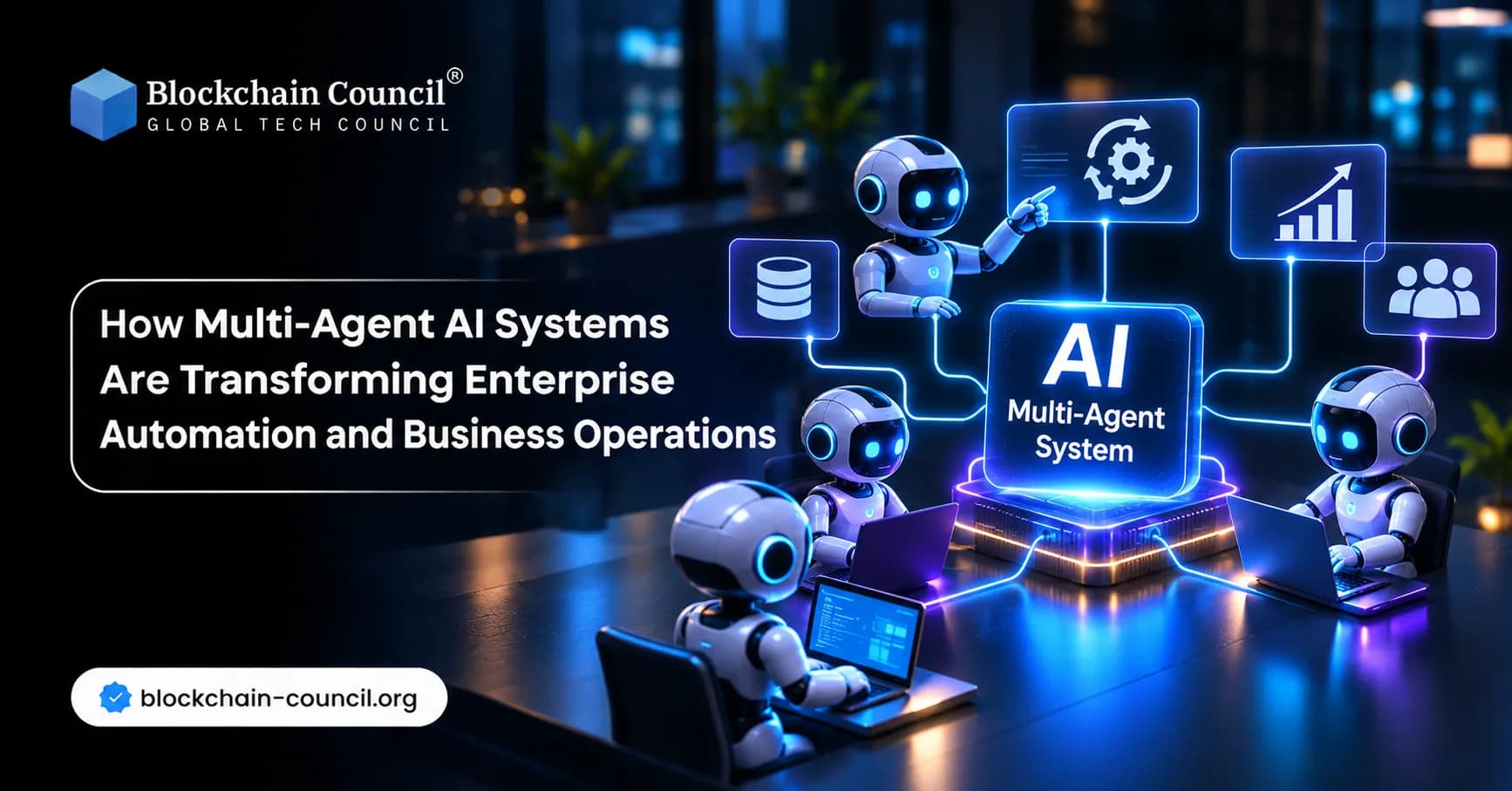
Multi-agent AI systems are transforming enterprise automation by letting several specialized AI agents share one big job, with a lead agent splitting up the work, specialists doing the parts, and a checker confirming the results. Instead of one assistant trying to do everything, a coordinated team handles research, writing, coding, and review at the same time.
For businesses, this shift matters because most real work is not a single question. It is a chain of steps across tools, documents, and teams. This guide explains how multi-agent AI works, how agents delegate and validate work, where enterprise AI automation is already paying off, and what risks to plan for. It uses plain language for beginners and includes enough detail for technical leaders. If you want to build skills in this area, the Certified Artificial Intelligence (AI) Expert program is a solid starting point.

What Is a Multi-Agent AI System?
An AI agent is a program powered by an AI model that can plan steps, use tools, and act toward a goal. A multi-agent AI system connects several of these agents so they work as a team.
Think of a small company. One manager receives a request, divides it among specialists, collects their results, and delivers the final product. Multi-agent systems follow the same pattern. A lead agent, often called a coordinator or orchestrator, breaks a task into pieces. Specialist agents, sometimes called subagents, each handle one piece with their own instructions and tools.
This differs from older automation such as robotic process automation, which follows fixed scripts. Agents can read unfamiliar documents, decide what to do next, and adjust when something goes wrong. That flexibility is what makes AI workflow automation useful for messy, real business processes.
Why a Single Agent Hits a Ceiling
A single agent works well for short tasks. Long tasks create trouble. The agent’s working memory fills up, it loses focus, and one weak step can spoil everything after it.
Splitting the job helps in three ways. Specialists can be tuned for narrow tasks, such as a security reviewer or a document drafter. Many agents can work in parallel, which saves time. And each agent keeps a clean, focused context instead of carrying the whole project in its head.
Building these systems takes real engineering skill, from designing agent roles to connecting tools safely. Developers who want a hands-on path can explore the Certified Artificial Intelligence (AI) Developer program, which focuses on practical model building and deployment.
How Multiple AI Agents Collaborate and Delegate
Anthropic describes multiagent orchestration as letting a lead agent break a job into pieces and delegate each one to a specialist with its own model, prompt, and tools. Its launch example is an investigation where subagents fan out across deploy history, error logs, metrics, and support tickets while the lead agent combines what they find.
The Lead Agent and Specialists
The lead agent plans and assigns. Specialists execute. Cost control is a hidden benefit. Anthropic’s customer Spiral by Every runs its lead agent on a small, fast model that handles requests and asks follow-up questions, then delegates drafting to stronger models. When a user wants several drafts, the specialists run in parallel.
Shared Workspace, Separate Minds
According to Anthropic’s documentation, agents in a session share the same container and filesystem, yet each runs in its own thread with a separate conversation history. This keeps their reasoning from getting tangled while still letting them work on the same files. Events are persistent, so the lead agent can check back in mid-workflow, and every step can be traced in the Claude Console to see which agent did what and why.
Advisor and Orchestrator Roles
Two common patterns exist. In the Orchestrator pattern, a strong model delegates simpler work to smaller models. In the Advisor pattern, smaller models consult a stronger one only when stuck. Anthropic says Claude Fable 5.2, released on November 9, 2026, can play either role, and in its testing it coordinated hundreds, even more than a thousand, subagents on long projects.
Current Design Limits
The documentation lists practical limits. A coordinator can delegate only one level down, meaning called agents cannot call further agents. A roster can include up to 20 unique agents, though the coordinator can use multiple copies of each. Features and limits change, so check current documentation before designing a system.
Designing all this well depends on a wide technical base across cloud, data, and security. A general Tech Certification can help professionals build that foundation.
How AI Agents Validate Results
Delegation without checking creates fast mistakes. Good multi-agent systems build validation in.
Graders and Rubrics
Anthropic’s outcomes feature lets teams write a rubric describing what success looks like. A separate grader evaluates the work in its own context window, so it is not influenced by the working agent’s reasoning. If the work falls short, the grader says what to fix and the agent tries again. Anthropic reports that in testing, outcomes improved task success by up to 10 points over a standard prompting loop, with larger gains on harder problems, plus 8.4% on Word-style documents and 10.1% on slide decks.
Reviewer Agents
Another approach uses many reviewers. In one customer example from Uber, a security audit lasting 10 to 12 hours used about 170 reviewer agents and returned a write-up, fix pull requests, and a policy proposal. Anthropic also says Fable 5.2 builds controls on long runs and flags results that do not reproduce.
Human Checkpoints
Validation does not remove people. Important decisions, such as sending a payment or changing production code, should still pass through human review. The best designs reserve people for judgment calls and let agents handle the repetitive checking.
Automating Business Processes with Multi-Agent AI
Software and IT Operations
Netflix’s platform team built an analysis agent that processes logs from hundreds of builds. With multiagent orchestration, it analyzes batches in parallel and surfaces only the patterns worth acting on, which matters when a change touches thousands of applications.
Legal and Document Work
Harvey uses Managed Agents to coordinate complex legal work such as long-form drafting. Anthropic reports that with dreaming, a feature that lets agents learn from past sessions, completion rates rose about sixfold in Harvey’s tests. Wisedocs built a document quality check agent where each review is graded against internal guidelines, and reviews now run 50% faster.
Content and Marketing
Spiral’s writing agent scores each draft against a rubric of editorial principles and the user’s voice, and returns only drafts that clear the bar. Marketing teams can use the same pattern for campaign copy, localization, and brand checks.
Security, Finance, and Research
Anthropic’s customers describe agents that review loan files, catch mismatched numbers, and run long research loops. Firms such as IMC and XTX Markets reported strong gains from setups with multiple coordinating agents on quantitative research.
Benefits of Multi-Agent Enterprise AI Automation
Speed: Parallel work shortens long jobs.
Quality: Separate graders and reviewers catch errors early.
Scale: Teams can add specialists without rebuilding everything.
Cost control: Cheaper models handle simple steps while stronger ones handle hard decisions.
Visibility: Traces show who did what, which supports audits.
Risks and Why Many Projects Fail
Excitement is high, but so is failure risk. Gartner forecast in June 2025 that more than 40% of agentic AI projects will be canceled by the end of 2027, citing rising costs, unclear business value, and weak risk controls. Gartner also warned about agent washing, where vendors relabel chatbots and basic automation as agents, and estimated that only about 130 of thousands of vendors are genuine. At the same time, it expects about 33% of enterprise software applications to include agentic AI by 2028, up from under 1% in 2024.
Other practical risks include runaway token costs, hard-to-debug chains of agents, security gaps when agents reach many tools, and data retention rules. Teams should also remember that these are forecasts and vendor-reported results, not guarantees.
How to Start with Multi-Agent AI
Pick one valuable process. Choose a task with clear steps and measurable results.
Start with one agent. Add more only when one agent clearly struggles.
Define specialists. Give each a narrow role, tools, and instructions.
Write a success rubric. Spell out what a good result looks like.
Add a separate checker. Use a grader or reviewer agent, plus human approval for risky actions.
Track cost and quality. Watch time saved, error rates, and spending.
Scale slowly. Expand only after results hold up.
The Road Ahead
Models are getting better at leading long projects, and platforms are adding memory, grading, and tracing. In its Fable 5.2 announcement, Anthropic described a team of 1,000 agents formalizing Fermat’s Last Theorem in 30 hours and another coordinating more than 1,000 subagents to build a prototype operating system. Those are research demonstrations, not typical office tasks, but they show the direction. Companies that build good habits now, with clear goals, checks, and governance, will adapt fastest.
Conclusion
Multi-agent AI systems are transforming enterprise operations by turning one overloaded assistant into a coordinated team that delegates, works in parallel, and checks itself. The benefits are real, from faster reviews to better quality, yet so are the risks of cost, hype, and weak oversight.
Begin with one process, measure honestly, and grow with confidence. For marketers and business leaders who need to explain AI-driven change to customers and colleagues, a Marketing Certification can help connect technical progress with clear, credible messaging.
FAQs
1. What are multi-agent AI systems?
Multi-agent AI systems are networks of multiple artificial intelligence agents that collaborate to complete tasks, solve problems, and achieve shared objectives. Each agent can have a specific responsibility, such as research, data analysis, planning, customer support, or decision-making.
2. How do multi-agent AI systems work?
Multi-agent AI systems work by dividing complex tasks into smaller activities and assigning them to specialized AI agents. These agents exchange information, use tools, analyze results, and coordinate their actions through an orchestration framework to complete a larger objective.
3. What is the difference between single-agent AI and multi-agent AI?
A single-agent AI system uses one AI agent to perform a task or manage a workflow. A multi-agent system uses several specialized agents that collaborate on different parts of a process. Multi-agent architectures can handle complex workflows more effectively, although they introduce additional coordination and monitoring requirements.
4. Why are enterprises adopting multi-agent AI systems?
Enterprises are exploring multi-agent AI to automate repetitive processes, improve operational efficiency, coordinate complex workflows, and reduce manual workloads. These systems can also help organizations process information faster and support employees with specialized AI assistance.
5. How are multi-agent AI systems transforming business operations?
Multi-agent AI systems can coordinate activities across departments, including finance, marketing, sales, human resources, customer service, and IT. They can collect information, analyze business data, prepare reports, manage requests, and automate routine operational tasks.
6. What are the key components of a multi-agent AI architecture?
A typical multi-agent architecture includes:
AI agents: Specialized systems responsible for individual tasks.
Large language models: Provide reasoning and language capabilities.
Orchestrator: Coordinates agents and manages task execution.
Memory systems: Store relevant context and previous information.
APIs and tools: Connect agents to business applications.
Monitoring systems: Track performance, errors, and activities.
Security controls: Manage permissions and access.
7. What role do AI agents play in enterprise automation?
AI agents act as digital assistants that can perform specific business activities with varying levels of independence. Depending on their permissions, they can retrieve information, process documents, update records, generate reports, and coordinate workflows across enterprise applications.
8. How can multi-agent AI improve customer service?
Businesses can use specialized agents to classify customer requests, retrieve relevant information, check order statuses, prepare responses, and escalate complex cases. Coordinated agents can reduce response times and support personalized customer experiences while allowing human representatives to handle sensitive issues.
9. How are multi-agent AI systems transforming finance and accounting?
Multi-agent systems can automate invoice processing, transaction categorization, financial report preparation, expense verification, and reconciliation support. Different agents can handle data extraction, validation, analysis, and reporting, while financial professionals retain oversight of important decisions.
10. How can enterprises use multi-agent AI in human resource management?
HR departments can use AI agents to assist with recruitment administration, resume screening, interview scheduling, employee onboarding, policy-related questions, and training coordination. Human review is essential for consequential employment decisions to prevent unfair or discriminatory outcomes.
11. What is the role of multi-agent AI in marketing and sales?
Marketing and sales teams can use specialized agents for market research, lead qualification, campaign planning, content generation, customer segmentation, and performance reporting. Coordinated workflows can help teams manage repetitive activities and make better use of customer and campaign data.
12. Which technologies are used to build multi-agent AI systems?
Popular technologies and frameworks include:
LangGraph: For stateful and coordinated agent workflows.
Microsoft AutoGen: For building collaborative multi-agent applications.
CrewAI: For role-based agent collaboration.
LangChain: For LLM application and tool integration.
Semantic Kernel: For integrating AI capabilities into software applications.
Python: For developing agent logic and backend services.
The appropriate technology depends on the workflow, infrastructure, and security requirements.
13. What is the difference between multi-agent AI and traditional robotic process automation (RPA)?
Traditional RPA automates structured, repetitive tasks using predefined rules and workflows. Multi-agent AI can handle more flexible tasks involving language understanding, contextual reasoning, tool usage, and coordination. Enterprises can combine RPA and AI agents to automate both structured and less predictable processes.
14. How do multi-agent AI systems support enterprise decision-making?
Different agents can gather information, analyze business performance, identify patterns, and prepare recommendations for decision-makers. For example, finance, sales, and marketing agents can contribute different insights to a coordinated business analysis. Human leaders should remain responsible for high-impact decisions.
15. What are the benefits of multi-agent AI for enterprise productivity?
Key benefits include:
Automation of repetitive business tasks.
Better coordination between departments.
Faster information processing.
Reduced manual workload.
Improved workflow consistency.
Support for round-the-clock operations.
More efficient use of organizational data.
Actual productivity gains depend on implementation quality and the complexity of the processes being automated.
16. What are the biggest challenges of implementing multi-agent AI in enterprises?
Major challenges include agent coordination, inaccurate outputs, data privacy, integration complexity, security vulnerabilities, operational costs, and difficulty measuring performance. Organizations must also define clear responsibilities and escalation procedures to prevent agents from making conflicting decisions.
17. How can enterprises secure multi-agent AI systems?
Organizations should implement role-based access controls, secure API connections, encrypted data storage, activity monitoring, audit logs, and human approval for sensitive actions. Agents should receive only the permissions required for their assigned tasks, with clear limits on what they can execute.
18. How can businesses measure the performance of multi-agent AI systems?
Businesses can evaluate multi-agent systems using metrics such as:
Task completion rate.
Workflow processing time.
Cost per completed task.
Error and failure rates.
Human intervention frequency.
Customer satisfaction.
Return on investment (ROI).
Monitoring these metrics helps organizations identify bottlenecks and improve automation quality.
19. Can multi-agent AI systems replace traditional enterprise software?
Multi-agent AI systems are more likely to complement existing enterprise software than replace it completely. They can interact with ERP, CRM, HRM, financial, and customer support platforms through APIs and integrations. Existing systems continue to provide essential data storage, transaction management, and business controls.
20. What is the future of multi-agent AI in enterprise automation?
The future may involve more specialized AI agents, autonomous workflow orchestration, cross-department collaboration, and deeper integration with enterprise applications. As reliability, security, and governance improve, multi-agent AI could become an important part of digital transformation and business operations.
Related Articles
View All
AI & ML
How to Claim Your Business on ChatGPT: A Step-by-Step Guide
As ChatGPT continues to evolve as a platform for discovering businesses, products and services, having an accurate and verified business profile is becoming increasingly important. OpenAI's Business Hub provides eligible businesses with an opportunity to claim and manage their business presence on ChatGPT. For organisations such as Blockchain Council, Global Tech Council and Universal Business Council, claiming their respective business profiles can be an important step towards improving brand accuracy, managing business information and understanding how users discover their organisations through Chat

AI & ML
AI Loops, Harnesses & Autonomous Systems: The Architecture Behind Agentic AI
Learn how AI Loops, Harnesses & Autonomous Systems work. Understand the observe-reason-act-evaluate cycle, why agents need a harness, guardrails, evaluation, and long-running tasks.

AI & ML
How NVIDIA Cosmos 3 Enables Physical AI and Multi-Agent Workflows
Explore how NVIDIA Cosmos 3 enables Physical AI and agent-based workflows through multimodal reasoning, world simulation, action prediction, synthetic data, and autonomous system development.
Trending Articles
Top 5 DeFi Platforms
Explore the leading decentralized finance platforms and what makes each one unique in the evolving DeFi landscape.
How to Install Claude Code
Learn how to install Claude Code on macOS, Linux, and Windows using the native installer, plus verification, authentication, and troubleshooting tips.
Blockchain in Supply Chain Provenance Tracking
Supply chains are under pressure to prove not just efficiency, but also authenticity, sustainability, and fairness. Customers want to know if their coffee really is fair trade, if the diamonds are con