

LangChain Introduces Deep Agents
 Michael Willson
LangChain has launched Deep Agents, a new kind of AI system designed to complete long, complex tasks using memory, planning, and sub-agents. These agents are built for real-world work—not just answering questions, but finishing jobs from start to finish. If you’re building with AI or planning to use agents in your team, this is the update to know.
This article explains what LangChain’s Deep Agents are, how they work, why they matter now, and how they’re already being used in research, customer service, and production.

What Are Deep Agents?
Deep Agents are AI systems that go beyond simple prompt and reply actions. They plan tasks, delegate subtasks, track files, and use memory to work through long problems. They are built on LangGraph, an open-source framework from LangChain.
Unlike earlier agents, these are structured, persistent, and designed for workflows that take time, steps, and reasoning. They don’t just respond. They plan and act.
How Deep Agents Work
Deep Agents are made of four core parts:
System Prompt
A well-structured system prompt guides the agent’s thinking and keeps it aligned with goals.
Planning Tool
The agent builds a basic to-do list or task flow to break work into parts.
Sub-agents
Different sub-agents handle different pieces. Each one is tuned to its specific role.
File System Access
The agent can save and refer to intermediate results using a virtual workspace. This helps it stay on track, even during long sessions.
This structure helps the agent handle multi-step tasks with fewer errors and more traceability.
Key Abilities of LangChain Deep Agents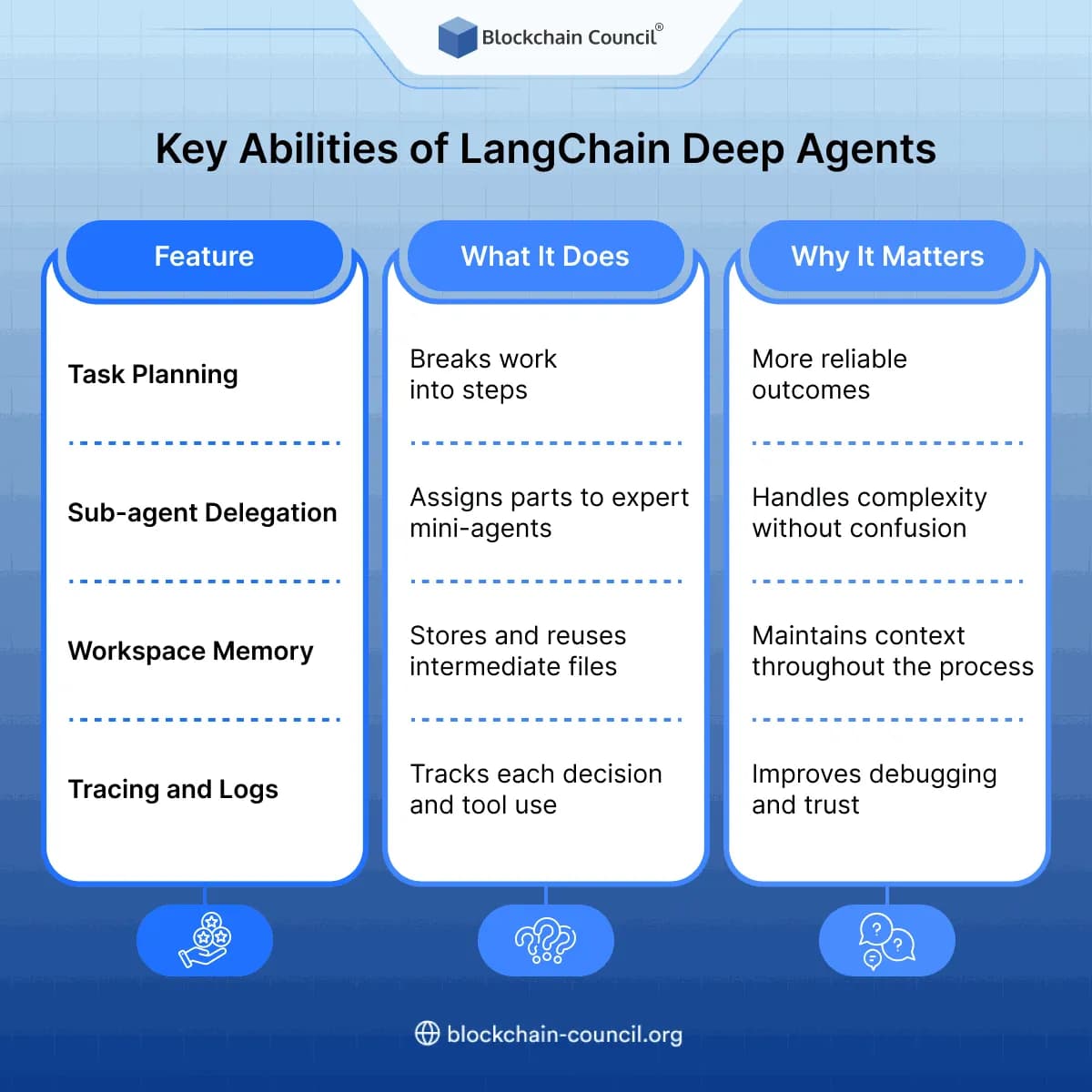
Open Deep Research Agent
One of the first major use cases is the Open Deep Research Agent. This free, open-source tool can scope a research task, plan the steps, gather evidence, and produce a structured report with citations.
It’s already being used by writers, analysts, and developers who need to gather facts and summarize them quickly, but accurately.
The agent uses multiple sub-processes to:
- Define the research scope
- Search across sources
- Summarize findings
- Draft and format output
It shows how Deep Agents can create usable results in a fraction of the usual time.
Real-World Adoption
Deep Agents are not just in labs. Companies like Klarna, Cisco, Uber, LinkedIn, and Replit are already running them in production. LangGraph allows these companies to monitor, trace, and manage AI workflows safely.
Qualtrics is building “Experience Agents” to manage customer and employee interactions using LangChain’s system. These agents can work across platforms and adapt to different roles with minimal code changes.
LangChain’s survey of over 1,300 professionals shows that more than 50 percent of teams are using agents in live environments. And nearly 80 percent plan to adopt agent-based tools in the next year.
Why Deep Agents Are Better
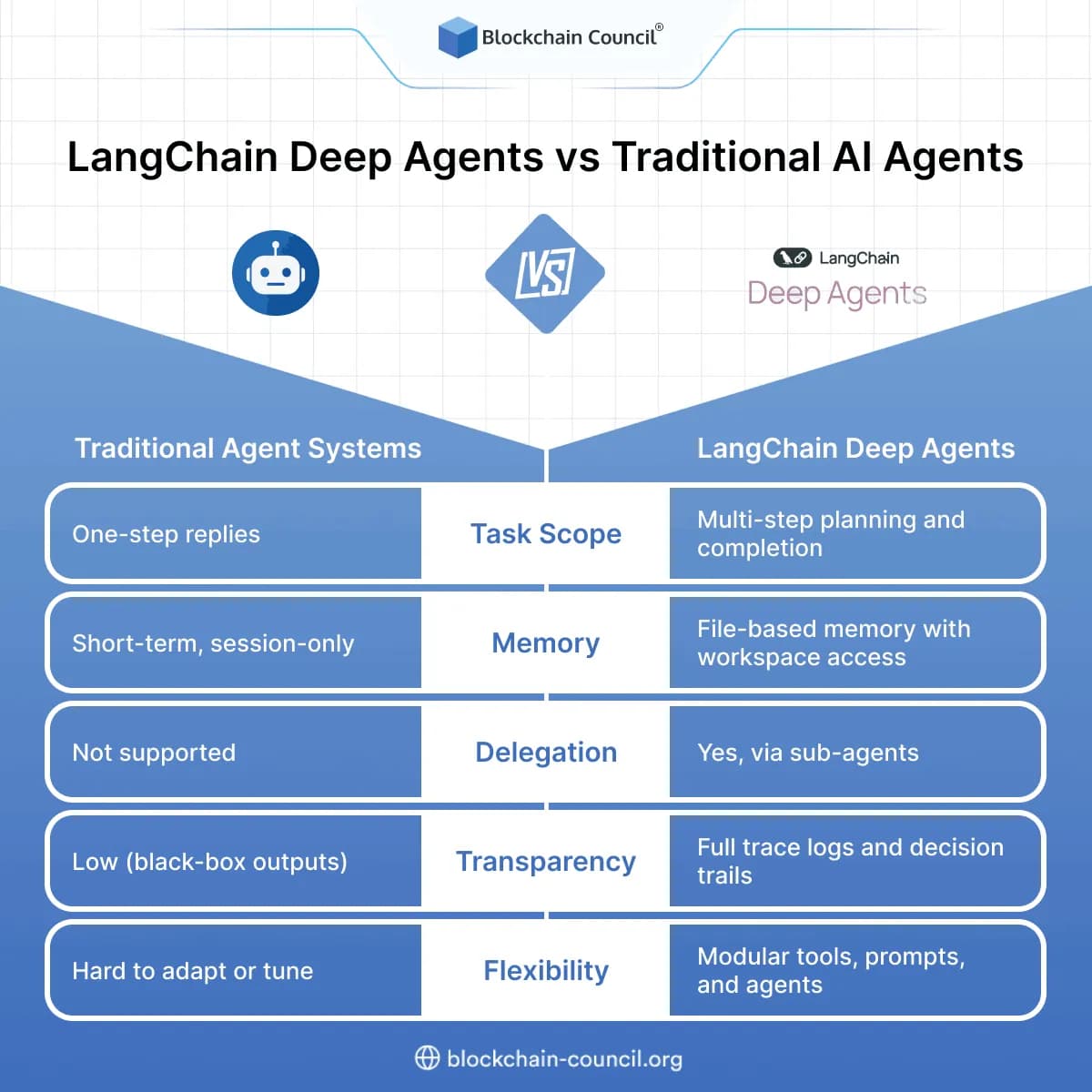
Old agents often failed because they didn’t plan well or couldn’t handle multiple steps. LangChain’s Deep Agents fix that.
They let developers:
- Set clear prompts and goals
- Use multiple agents for different tasks
- Store memory between steps
- Review logs to improve performance
This means fewer hallucinations, more useful results, and better alignment with business needs.
Deep Agents vs Traditional AI Agents
What Developers and Teams Should Know
If you build with agents, Deep Agents give you control and visibility. You can reuse parts, customize prompts, and deploy faster using LangGraph’s features. Teams can also use LangSmith for observability and debugging.
Security is a big focus. Most companies now set tool limits and watch how agents act before giving them full access. LangChain supports guardrails and permission settings.
Who Should Use Deep Agents
Deep Agents are made for:
- Developers creating automated workflows
- Researchers writing structured reports
- Product teams that need traceable decisions
- Customer service leaders deploying AI at scale
They are useful wherever AI needs to follow instructions carefully and produce reliable results across tasks.
If you want to build these systems or manage teams using them, now is the time to skill up. Start with the AI Certification to learn how these systems operate. And to build such deep agents, enroll into the Agentic AI certification. If your work involves structured data or analytics, try the Data Science Certification. Or if you’re leading strategy and automation, the Marketing and Business Certification will help you guide adoption.
Final Thoughts
LangChain’s Deep Agents are not just smarter—they’re more useful. They plan, act, and adapt in a way that fits real work, not just demos.
They’re being used by major companies, in live environments, to solve real problems. If you’re exploring AI automation, Deep Agents give you tools to build systems that don’t just think—they follow through.
Related Articles
View All
AI & ML
YouTube Introduces Business Agents for YouTube Ads
YouTube is introducing Business Agent for ads, allowing shoppers to ask product questions, research purchases, and receive personalized guidance directly within YouTube ads.

AI & ML
AI Agents & Agentic AI: When AI Starts Thinking, Planning & Acting
Discover AI Agents & Agentic AI in simple terms. Learn how agents perceive, reason, plan, use tools, and remember, how they differ from chatbots, and where they are used today.

AI & ML
System One Models for AI Agents
Explore how System One Models can support AI agents with fast, structured decisions, calibrated confidence, routing, verification, and reliable workflow automation.
Trending Articles
The Role of Blockchain in Ethical AI Development
How blockchain technology is being used to promote transparency and accountability in artificial intelligence systems.
AWS Career Roadmap
A step-by-step guide to building a successful career in Amazon Web Services cloud computing.

Top 5 DeFi Platforms
Explore the leading decentralized finance platforms and what makes each one unique in the evolving DeFi landscape.