

How Kimi AI Long-Context Window Is Changing Document Analysis and Research

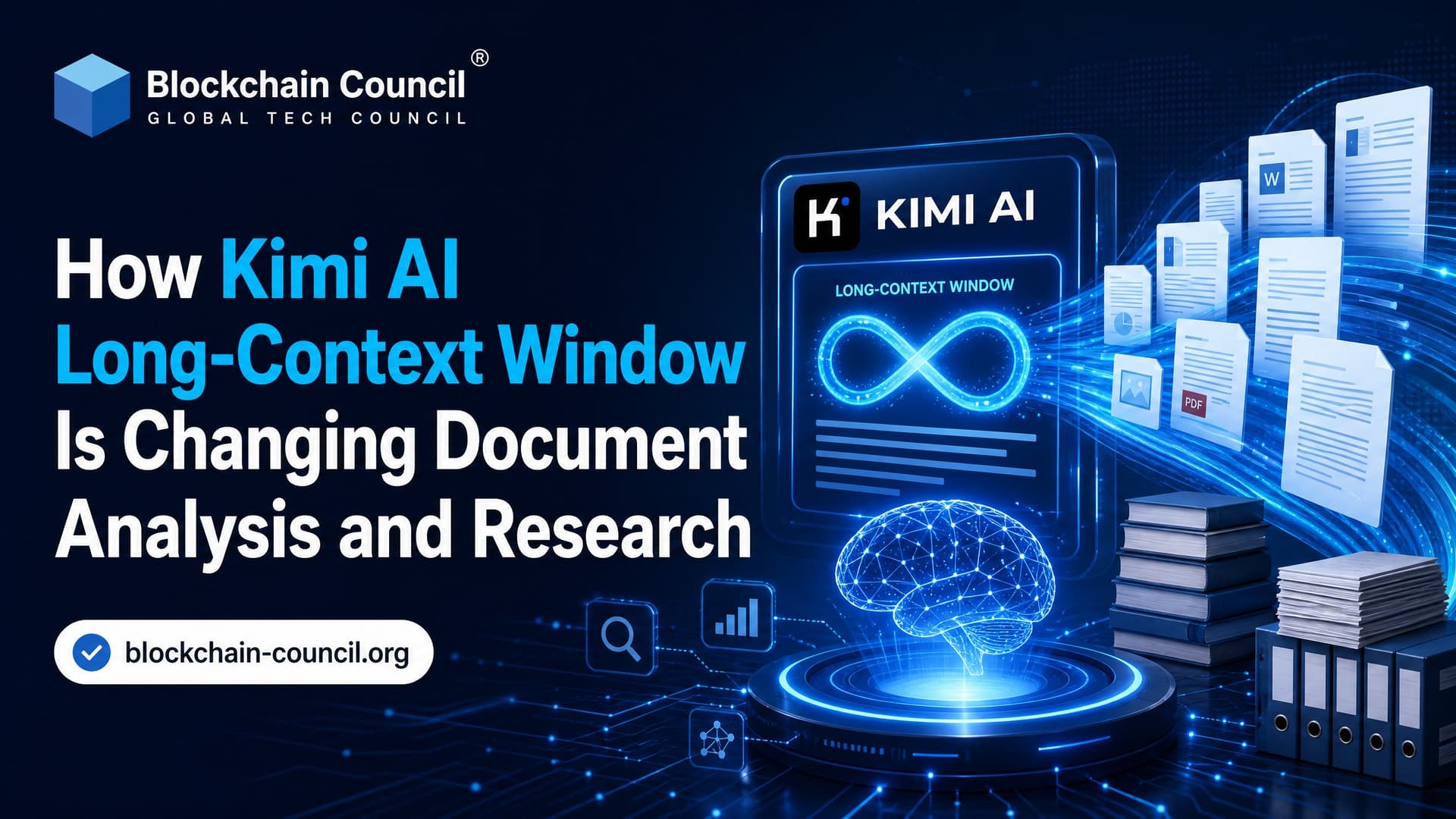
Kimi AI long-context window capabilities are changing how researchers, analysts, and developers work with large documents. Instead of slicing a 400-page report into small chunks and hoping retrieval finds the right passage, you can now place much larger source material into a single model session and ask questions across the whole body of text.
That sounds simple. It is not. Long context changes the architecture of document analysis systems, the economics of large-scale review, and the daily habits of research teams. Kimi K2 and Kimi K2.5, developed by Moonshot AI, sit near the center of that shift because they pair large context windows with agentic tooling for coding, analysis, and workflow orchestration.

What Makes Kimi AI Different?
Kimi AI first gained attention as a long-context reading assistant. Its main claim was not just better chat, but the ability to keep far more material in the model's short-term memory. Some Kimi configurations have been reported with context windows up to 10 million tokens, while Kimi K2.5 documentation centers on a 256K-token context window for production-style long-context workloads.
For a working researcher, 256K tokens is not an abstract number. Kimi's own context guidance says this can cover roughly 200,000 words, 500 or more pages, extended conversations, or an entire codebase without manual chunking in many cases. That is enough for a PhD thesis, a dense policy file, several dozen research papers, or a medium-sized software repository.
Kimi K2 and Kimi K2.5: The Technical Baseline
Kimi K2 is reported as a 1 trillion parameter Mixture-of-Experts model with 32 billion active parameters per token. It was trained on 15.5 trillion tokens and supports a 128K-token context window. Its benchmark numbers are strong for technical work: 71.6 percent on SWE-bench Verified, 53.7 percent Pass@1 on LiveCodeBench v6, and 89.5 percent on MMLU, according to technical coverage of the release.
Kimi K2.5 extends the long-context story with a 256K-token window and a design aimed at multi-step agent workflows. Reports describe K2.5 as trained on mixed visual and text data, with an agent-swarm setup that can coordinate up to 100 sub-agents and around 1,500 parallel tool calls. Treat those agent numbers as architecture claims, not a reason to remove human review. Still, they point to where the category is heading: models that read large corpora and then act on them through tools.
Cost matters too. Kimi K2 pricing has been reported around $0.60 per 1 million input tokens and $2.50 per 1 million output tokens, with K2.5 documentation repeating the $0.60 input-token figure for 256K-context use. If you run document-heavy analysis every day, that difference is not cosmetic. It decides whether you test one prompt or one hundred.
From RAG Pipelines to Whole-Document Reasoning
Most document AI systems have relied on retrieval augmented generation, or RAG. You split documents into chunks, embed those chunks, store them in a vector database, retrieve the top matches, and pass them into the model. This is still useful. For very large corpora, frequently changing data, or strict access-control rules, RAG is not going away.
But long context changes the default choice. With Kimi AI long-context window support, many teams can put the entire working set into one prompt. That removes several common failure points:
- Chunk boundary misses: A definition appears in one chunk, an exception appears in the next, and retrieval returns only one of them.
- Weak global synthesis: The model answers from the top five retrieved passages instead of the full document set.
- Pipeline overhead: Teams spend more time tuning chunk size, overlap, and vector search than examining the research question.
To be blunt, if your task is to compare 18 policy documents that fit inside 256K tokens, start with direct long-context reading before building a full RAG system. Build RAG when the corpus is too large, when freshness matters, or when you need permission-aware search.
How Researchers Can Use Kimi K2.5
Literature Reviews
Long-context models are especially useful for systematic and scoping reviews. You can load dozens of papers and ask Kimi to group them by method, sample size, assumptions, intervention type, or reported limitations. Because the papers stay visible in one context, follow-up prompts can compare specific sections across studies.
A practical tip: ask for evidence tables first, not prose summaries. Use columns such as paper title, method, dataset, claim, limitation, and quoted support. If you jump straight to a narrative summary, the model may smooth over contradictions. Tables expose gaps faster.
Historical and Archival Analysis
For historians, legal scholars, and policy researchers, the ability to process hundreds of pages at once is valuable. Letters, transcripts, committee minutes, or court records often contain recurring names and events that only make sense across distance. A shorter-context model may miss that the same person appears under a title in one section and by surname later.
Cross-Lingual Research
Kimi can also help compare multilingual corpora when all source texts fit in context. That helps with public policy, international standards, and market research. Ask it to preserve original terms alongside translations. Translation alone can flatten meaning, especially in regulatory or technical documents.
Enterprise Document Analysis Use Cases
In enterprise settings, Kimi AI long-context window support maps well to document-heavy work:
- Knowledge base Q&A: Load policies, handbooks, and internal documentation for one-pass question answering.
- Customer support review: Analyze long email threads, ticket histories, and chat logs without losing early context.
- Project risk analysis: Review requirements, meeting notes, issue trackers, and incident reports as one evidence set.
- Training content generation: Build quizzes and role-specific summaries from full manuals instead of isolated chapters.
There is a catch. Long context does not remove governance. If you feed confidential documents into any external model, you need a data handling policy, vendor review, retention controls, and clear rules for regulated data. Professionals building these workflows should pair AI skills with cybersecurity knowledge. The Certified Artificial Intelligence (AI) Expert™, Certified Generative AI Expert™, and cybersecurity-focused programs are useful starting points here.
Why Developers Care: Codebase-Level Understanding
Kimi K2 and K2.5 are not just document readers. They are also aimed at code and technical reasoning. A 256K-token context window can hold a meaningful portion of many repositories, including source files, tests, README files, and architecture notes.
This changes how you ask coding questions. Instead of asking, What does this function do?, you can ask, Trace how authentication flows from the API gateway to token validation, database access, and error handling. Point to every file involved.
One practical issue I have seen in long-code prompts: if you paste a repository without file headers, the model may merge nearby files mentally and cite the wrong path. Add clear separators such as FILE: src/auth/middleware.ts. Also ask it to return file paths and line ranges. For extraction tasks, keep temperature low, often around 0.1 to 0.3, because creative variation is not your friend when you are auditing code.
For blockchain developers, this matters directly. Smart contract systems often span Solidity contracts, deployment scripts, tests, front-end calls, and documentation. A long-context model can help trace assumptions across the stack, but it should not replace formal review. Pair this workflow with the Certified Smart Contract Developer™ or Certified Blockchain Expert™ as a structured learning path.
Long Context Is Powerful, But Not Magic
There are limits. The biggest one is attention quality. Long-context models can still underweight material buried in the middle of a prompt, a behavior often called lost-in-the-middle. They can also produce confident summaries that omit minority evidence.
Use these safeguards:
- Structure the input: Add document titles, section IDs, page markers, and file paths.
- Demand citations from the text: Ask for quoted evidence, not just claims.
- Run adversarial prompts: Ask what evidence contradicts the first answer.
- Split by purpose: Use one pass for extraction, another for synthesis, and a final pass for critique.
- Keep humans in the loop: Long context improves coverage. It does not guarantee truth.
Kimi AI vs Traditional RAG: Which Should You Use?
Use Kimi's long-context approach when your working set fits inside the context window and the task depends on global synthesis. Literature reviews, contract comparison, standards analysis, and codebase walkthroughs are good fits.
Use RAG when your corpus is larger than the context window, when users need real-time updates, or when access permissions vary by document. In many mature systems, the best answer is hybrid: RAG selects a relevant corpus slice, then Kimi performs deep long-context reasoning over that slice.
What You Should Build Next
Start small. Take one real document workflow, such as reviewing 20 research papers, auditing a protocol specification, or summarizing a long customer-support history. Run it through a Kimi-style long-context process with clear section markers and evidence-table outputs. Compare the result against your current RAG or manual workflow.
If you are building professionally, strengthen the surrounding skills too: prompt design, evaluation, data privacy, and domain review. For structured learning, map this work to the Certified Prompt Engineer™, Certified Generative AI Expert™, or Certified Artificial Intelligence (AI) Expert™. The next advantage will not come from a bigger context window alone. It will come from knowing what to ask, how to verify it, and when the model is wrong.
Related Articles
View All
AI & ML
Can AI Train AI Models Without Humans? What Current Research Really Shows
AI can train AI models through self-play, synthetic data, and AI feedback, but humans still set goals, safety rules, and deployment limits.
AI & ML
Meet KIMI K3
KIMI K3 is the latest AI model in the Kimi family, designed to deliver stronger reasoning, coding, multilingual capabilities, and agentic workflows. Discover its key features, use cases, and how it compares with other leading AI models.

AI & ML
Kimi K2.7 Code vs GLM 5.2 vs Claude vs ChatGPT vs Gemini: Best AI Coding Assistant Comparison
A practical comparison of Kimi K2.7 Code, GLM 5.2, Claude, ChatGPT, and Gemini for developers choosing an AI coding assistant.
Trending Articles
The Role of Blockchain in Ethical AI Development
How blockchain technology is being used to promote transparency and accountability in artificial intelligence systems.

Top 5 DeFi Platforms
Explore the leading decentralized finance platforms and what makes each one unique in the evolving DeFi landscape.
How Blockchain Secures AI Data
Understand how blockchain technology is being applied to protect the integrity and security of AI training data.