

Introducing Majorana 2

Introduction
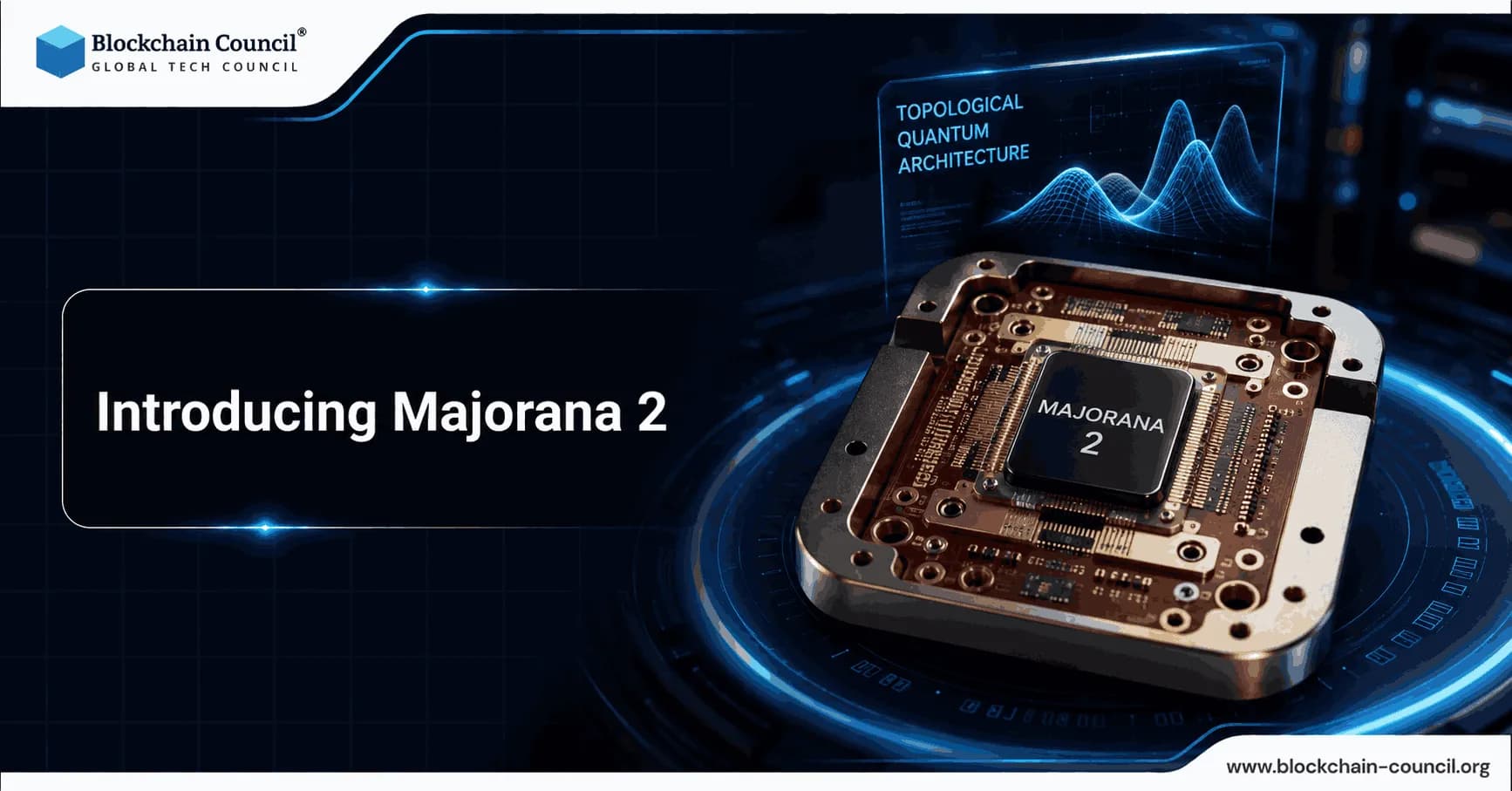
Microsoft unveiled Majorana 2, its next-generation topological quantum chip and the direct successor to Majorana 1, which was introduced in February 2025. The announcement sent an immediate signal across the technology and scientific communities: Microsoft's quantum computing roadmap has accelerated significantly, with the company now targeting a commercially viable scalable quantum computer by 2029 cutting its previous projected timeline in half.
Moreover, Majorana 2 is not merely a hardware upgrade. It represents a convergence of two of the most consequential technology trends of our time: quantum computing and agentic artificial intelligence. Microsoft's own agentic AI research platform, Microsoft Discovery, played a direct role in designing and manufacturing the chip marking one of the first documented cases in which AI agents have been used to help build a quantum processor.

Furthermore, the chip introduces a fundamentally redesigned materials stack that replaces aluminum with lead as the superconducting material, resulting in a mean qubit lifetime of 20 seconds with some qubits remaining stable for up to one minute. This compares to lifetimes of between one and twelve milliseconds in Majorana 1, representing the 1,000-fold improvement in qubit stability that Microsoft reported at Build 2026.
This article provides a comprehensive, research-backed explanation of what Majorana 2 is, how it works, why it matters, what the scientific community says, and what it means for professionals, researchers, and the broader technology landscape.
What Is Majorana 2?
Majorana 2 is Microsoft's second-generation topological quantum processor, unveiled on June 2, 2026, at Microsoft Build 2026. It is designed around the same foundational approach pioneered in Majorana 1: topological quantum computing, which uses a special class of quasiparticle called Majorana Zero Modes to encode and protect quantum information in ways that conventional quantum approaches cannot.
Topological qubits are theoretically more resistant to errors than the superconducting or trapped-ion qubits used by most quantum competitors. Consequently, topological computing represents a longer and more technically demanding path to quantum advantage but one that Microsoft believes will ultimately produce more reliable and scalable systems.
The Majorana 1 Foundation
Majorana 1 was introduced on February 19, 2025, as Microsoft's first quantum chip to use a topological superconductor, a special material that can create an entirely new state of matter that enables more stable quantum computing. At the time of its announcement, Majorana 1 represented a major milestone in demonstrating that topological qubits could be manufactured and measured. However, the chip also attracted significant scientific controversy, which continued into 2026 and provides essential context for understanding Majorana 2's reception.
The Step from Majorana 1 to Majorana 2
The core challenge the Microsoft Quantum team faced after Majorana 1 was clear: qubit lifetimes were too short between one and twelve milliseconds to support fault-tolerant quantum operations at the scale needed for a practical machine. Addressing that challenge required a fundamental rethink of the materials underlying the chip's topological phase, not merely a refinement of the existing design.
The Science Behind Majorana 2: How Topological Qubits Work
Understanding what makes Majorana 2 significant requires understanding the core physics of topological quantum computing at a conceptual level.
What Are Topological Qubits?
Conventional quantum computers encode information in individual qubits quantum bits that can represent a superposition of zero and one simultaneously. These qubits are extremely sensitive to environmental noise, temperature fluctuations, vibrations, and electromagnetic interference, which cause errors at a rate that remains one of the central challenges in quantum computing.
Topological qubits take a fundamentally different approach. Rather than storing quantum information in the state of a single particle, they encode it across a pair of spatially separated Majorana Zero Modes exotic quasiparticles that exist at the ends of topoconducting nanowires. Because the information is distributed rather than localised, it is inherently more resistant to the local disturbances that corrupt conventional qubits.
What Are Majorana Zero Modes?
Majorana Zero Modes are theoretical quasiparticles predicted by condensed matter physics to emerge at the boundary between a topological superconductor and a semiconductor under specific material and temperature conditions. They store quantum information through parity, the evenness or oddness of the number of electrons in a topoconductor wire. Crucially, this parity is highly resistant to environmental perturbation when the topological gap protecting it is sufficiently large.
The gate-defined devices in the Majorana processor family are composed of structures called tetrons each consisting of two superconducting nanowires with Majorana Zero Modes at their ends. Microsoft's roadmap is built around manufacturing, controlling, and scaling these tetron-based topological qubits.
The Topological Gap: Why It Matters
The topological gap is the energy barrier that protects a topological qubit from environmental noise and errors. The larger this gap, the more resistant the qubit is to disturbance, and the longer it survives in a stable, usable state. This is the central engineering challenge in topological quantum computing: creating materials and device geometries that produce a large, reproducible topological gap.
In Majorana 1, the topological gap was limited by the properties of the aluminium superconductor used in the device. In Majorana 2, this gap has been more than doubled through a fundamental materials change from aluminium to lead enabling the dramatic improvement in qubit stability that Microsoft reported.
The Materials Innovation: Why Lead Changes Everything
Replacing Aluminium With Lead
The most significant technical decision in the creation of Majorana 2 was replacing aluminium with lead as the superconducting material in the chip's hybrid materials stack. Chetan Nayak, Microsoft Technical Fellow and Corporate Vice President of Quantum Hardware, described this as a counterintuitive choice. Lead is generally avoided in precision electronics due to its physical properties and the manufacturing complications it introduces. However, in a quantum computing context, lead's superconducting properties at millikelvin temperatures produce a significantly larger topological gap than aluminium — and that larger gap is precisely what extends qubit lifetime.
The New Semiconductor Active Region
Beyond the superconductor change, Majorana 2 also updates the semiconductor active region from pure indium arsenide to a combination of indium arsenide and indium arsenide antimonide. This composite semiconductor region creates a more stable topological phase by improving the quality of the quantum well in which the topological quasiparticles form. Consequently, the combination of lead superconductor and composite semiconductor active region works together to produce the robustness improvements reported by Microsoft.
The Role of AI in Materials Discovery
Critically, the design of the new materials stack in Majorana 2 was not accomplished through human experimentation alone. Microsoft's agentic AI platform, Microsoft Discovery, was used to help manage the manufacturing of the new device. Microsoft Discovery uses autonomous AI agents to accelerate complex scientific research simulating material properties, identifying promising combinations, and optimising manufacturing parameters at a speed and scale that human researchers cannot match independently.
Microsoft Technical Fellow Chetan Nayak confirmed that while the broader programme of materials research began long before agentic AI tools were available, Microsoft Discovery is being used increasingly extensively in the team's ongoing work. This makes Majorana 2 one of the first quantum hardware milestones to be co-developed with agentic AI, a convergence that Microsoft believes will accelerate the pace of future quantum hardware progress significantly.
Key Specifications and Performance Metrics
Qubit Lifetime
The headline performance metric for Majorana 2 is its mean qubit lifetime of 20 seconds. In some individual devices, qubit lifetimes have exceeded one minute. By comparison, Majorana 1's qubit lifetimes ranged from one to twelve milliseconds making Majorana 2 more than 1,000 times more stable on a mean basis.
This improvement is not merely a quantitative advance. It is a qualitative threshold: at lifetimes measured in seconds rather than milliseconds, topological qubits begin to approach the stability range needed to support the error-correction cycles required for fault-tolerant quantum computation. Therefore, the 20-second mean lifetime marks the first time that Microsoft's topological approach has produced qubits with lifetimes relevant to practical fault-tolerant operation.
Topological Gap Improvement
The topological gap in Majorana 2 is more than double that of Majorana 1. This doubling directly drives the improvement in qubit stability by providing a significantly larger energy barrier against the environmental disturbances including thermal fluctuations and electromagnetic noise that cause decoherence and error in quantum systems.
Operating Conditions
Like Majorana 1, Majorana 2 operates at ultracold temperatures in the millikelvin range maintained by a dilution refrigerator. The chip must be cooled to temperatures far below that of outer space to allow the superconducting properties needed for topological qubit formation to emerge. This operating requirement remains one of the engineering challenges on the path to commercially deployed quantum systems.
Long-Term Architecture Goal
Microsoft's stated long-term goal is to achieve one million qubits on a single chip small enough to fit in the palm of a hand. Majorana 2 is an intermediate milestone on that roadmap demonstrating the materials and device physics needed to support scaling, not a finished commercial product.
The Role of Microsoft Discovery in Building Majorana 2
Microsoft Discovery is Microsoft's agentic AI platform for scientific research and development. It uses autonomous AI agents to accelerate the most computationally demanding stages of the scientific process including materials simulation, experimental design, parameter optimisation, and manufacturing quality management.
For the Majorana 2 development programme, Microsoft Discovery was applied to help manage the complexity of manufacturing a chip built on a new materials stack. Lead-based superconductors introduce specific fabrication challenges particularly around integrating lead cleanly with the semiconductor active region without introducing defects that would degrade qubit quality. Agentic AI systems were used to navigate this manufacturing complexity more rapidly than human engineering alone would permit.
According to Microsoft, this AI-assisted approach is becoming a natural part of the quantum hardware team's workflow, not an occasional tool but an integrated component of the research and manufacturing pipeline. Consequently, Majorana 2 represents an important early proof point for the thesis that agentic AI can meaningfully accelerate the development of frontier scientific hardware.
The 2029 Roadmap: What Microsoft Is Claiming
Accelerated Timeline
The most strategically significant claim Microsoft made alongside the Majorana 2 announcement is that the company is now on track to build a scalable quantum computer as early as 2029. This timeline is approximately half the duration of Microsoft's previous projections, and it is directly enabled by the qubit stability improvements demonstrated in Majorana 2.
Microsoft's current roadmap proceeds in clearly defined phases. In the current phase, the team is focused on demonstrating reliable, long-lived topological qubits, a milestone that Majorana 2 advances significantly. The next phase involves building a fault-tolerant prototype based on topological qubits, targeted for completion in years rather than decades. The final phase involves scaling to a utility-class quantum system capable of running commercially meaningful workloads.
Microsoft is also a participant in DARPA's Quantum Benchmarking Initiative, a structured independent evaluation framework that provides external validation of progress claims in quantum computing. Participation in this programme adds a layer of independent verification to Microsoft's roadmap claims beyond what internal results alone provide.
What "Scalable Quantum Computer" Means in This Context
Microsoft defines a scalable quantum computer as one that can support fault-tolerant quantum operations across a large number of logical qubits that have been error-corrected to the point where they can sustain reliable computation. Majorana 2's 20-second qubit lifetimes represent a key enabling milestone toward this definition, because fault-tolerant error correction requires qubits that survive long enough to be measured, corrected, and reused within a single computation cycle.
Scientific Reception: Significant Advances and Ongoing Debate
The Expert Scepticism
Not all external researchers share Microsoft's confidence in the Majorana 2 results. Scientific American reported on June 2, 2026, that outside physicists raised concerns about the new preprint manuscript supporting the announcement noting that it has not yet been peer-reviewed and that the underlying topological qubit technology has a contested history.
In 2021, Microsoft retracted a high-profile paper in Nature after external experts demonstrated that the study's data could have originated from material imperfections rather than genuine topological qubit formation. Similar concerns were raised about several subsequent publications, including the Majorana 1 announcement in February 2025. Consequently, some independent physicists have maintained that the fundamental evidence for topological qubit formation in Microsoft's devices has not yet been independently reproduced at scale.
Microsoft's Response and Supporting Evidence
Microsoft's position is that the Majorana 2 results represent substantially stronger evidence than any previous publication. The 1,000-fold improvement in qubit lifetime moving from milliseconds to tens of seconds is not a marginal statistical advance. It is a change in physical regime that Microsoft argues validates the topological protection mechanism rather than artefactual measurement effects.
Furthermore, the company points to the doubling of the topological gap as structural evidence that the energy barrier genuinely protecting the qubit has increased, consistent with the theoretical predictions of topological qubit physics. The Quantum Insider reported that the results were "published amid continued scrutiny" but represented "evidence that larger topological gaps can significantly improve qubit stability" framing them as meaningful progress even within the context of ongoing debate.
The Path to Independent Validation
The decisive test of Majorana 2's claims will come through three independent processes: formal peer review of the preprint manuscript, multi-device reproduction of the qubit lifetime results by external research groups, and evaluation under DARPA's Quantum Benchmarking Initiative. Until these processes are complete, the scientific community's assessment will remain divided between Microsoft's reported results and the concerns raised by independent physicists.
Why Majorana 2 Matters Beyond Quantum Computing
AI-Assisted Scientific Hardware Development
Majorana 2 establishes a meaningful early precedent for agentic AI accelerating frontier hardware development. If Microsoft Discovery can shorten the development cycle of a quantum processor by managing manufacturing complexity and accelerating materials discovery, the same model applies to chip development, drug discovery, materials science, and energy research more broadly. Therefore, the significance of Majorana 2 extends well beyond quantum computing into the broader question of what AI agents can contribute to scientific progress.
Implications for Cryptography and Cybersecurity
A commercially viable fault-tolerant quantum computer would have profound implications for current cryptographic infrastructure. Many of the encryption protocols protecting digital communications and financial transactions today rely on mathematical problems that classical computers cannot solve efficiently. A sufficiently powerful quantum computer could solve these problems, rendering current encryption approaches obsolete. Consequently, Microsoft's 2029 roadmap if realised would significantly compress the timeline for post-quantum cryptography deployment, making this an urgent concern for cybersecurity professionals across every sector.
Potential Applications in Medicine and Materials Science
Beyond cryptography, scalable quantum computing offers transformative potential in molecular simulation — the ability to model the behaviour of complex molecules at a quantum level with accuracy that classical computers cannot achieve. This capability has direct applications in drug discovery, personalised medicine, battery materials research, and catalysis design. Therefore, the progress represented by Majorana 2 carries significance for scientists and researchers far beyond the quantum computing community itself.
Building the Skills to Lead in the Quantum AI Era
The convergence of quantum computing and agentic AI that Majorana 2 represents requires professionals across technology, research, and business to build structured expertise in how AI systems work at a deep technical level. Those who want to understand the generative and agentic AI foundations that underpin systems like Microsoft Discovery and apply that understanding to research acceleration, product development, and strategic decision-making will find a Generative AI Certification provides the structured knowledge needed to engage confidently with these rapidly advancing capabilities. For a comprehensive foundation across the AI landscape covering the principles, architectures, and governance frameworks that underpin systems from large language models to agentic research platforms an AI Certification equips professionals with the depth to evaluate, apply, and lead AI adoption across scientific and commercial domains. Technology professionals who want verified, practical credentials in the computing platforms, hardware architectures, and development ecosystems powering quantum and AI convergence will find a Tech Certification builds the technical knowledge base needed to operate effectively in this rapidly evolving environment. Additionally, business leaders and marketing professionals who need to communicate the implications of quantum computing progress to clients, stakeholders, and organisations will find a Marketing Certification that incorporates technology strategy and AI-driven communication invaluable for translating complex scientific advances into clear, compelling business narratives.
FAQs
What Is Majorana 2?
Majorana 2 is Microsoft's second-generation topological quantum processor, unveiled at Microsoft Build 2026 on June 2, 2026. It is the successor to Majorana 1 and features a redesigned materials stack that produces a mean qubit lifetime of 20 seconds — more than 1,000 times longer than the previous generation.
When Was Majorana 2 Announced?
Majorana 2 was announced on June 2, 2026, at Microsoft Build 2026. The announcement was accompanied by a technical preprint manuscript and a detailed post on Microsoft's quantum computing blog authored by Chetan Nayak, Technical Fellow and Corporate Vice President of Quantum Hardware.
What Is the Relationship Between Majorana 1 and Majorana 2?
Majorana 1, introduced in February 2025, was Microsoft's first chip to demonstrate a topological superconductor for quantum computing. Majorana 2 builds directly on Majorana 1 by replacing its aluminium superconductor with lead and updating the semiconductor active region, producing a significantly more stable topological phase and dramatically longer qubit lifetimes.
What Is Microsoft's Target Date for a Scalable Quantum Computer?
Microsoft is now targeting 2029 as its goal for a commercially viable scalable quantum computer — approximately half the duration of its previous timeline estimates. The company attributes this acceleration to the qubit stability improvements demonstrated in Majorana 2.
What Is Microsoft Discovery and How Is It Related to Majorana 2?
Microsoft Discovery is Microsoft's agentic AI platform for scientific research. It uses autonomous AI agents to accelerate complex research tasks including materials simulation and manufacturing optimisation. It was used to help design and manage the manufacturing process of Majorana 2's new lead-based materials stack.
What Are Topological Qubits and Why Are They Different?
Topological qubits encode quantum information across spatially separated Majorana Zero Modes rather than in a single localised particle. This distributed encoding makes them inherently more resistant to local environmental disturbances, giving them theoretical error-resistance advantages over conventional superconducting or trapped-ion qubits.
What Are Majorana Zero Modes?
Majorana Zero Modes are exotic quasiparticles predicted to emerge at the ends of topoconducting nanowires at the boundary between a topological superconductor and a semiconductor. They store quantum information through parity — the evenness or oddness of the electron count in the wire — and are highly resistant to localised disturbances when protected by a sufficiently large topological gap.
Why Did Microsoft Replace Aluminium With Lead in Majorana 2?
Lead produces a larger topological gap than aluminium as a superconductor at millikelvin temperatures. This larger energy barrier provides significantly greater protection to the topological qubits from environmental noise and decoherence, directly enabling the 1,000-fold improvement in qubit lifetime reported by Microsoft.
What Is the Topological Gap and Why Does It Matter?
The topological gap is the energy barrier protecting a topological qubit from environmental disturbances. The larger this gap, the more stable the qubit. In Majorana 2, the topological gap is more than double that of Majorana 1, which is the primary physical mechanism driving the improvement in qubit lifetime.
What Are Tetrons in the Context of Majorana 2?
Tetrons are the basic qubit structures in Microsoft's topological quantum processors. Each tetron consists of two superconducting nanowires with Majorana Zero Modes at their ends. Multiple tetrons are combined within a processor to form the operational qubit layer of the device.
What Is the Mean Qubit Lifetime of Majorana 2?
Majorana 2's mean qubit lifetime exceeds 20 seconds. In some individual devices, lifetimes exceeding one minute have been recorded. This compares to one-to-twelve-millisecond lifetimes in Majorana 1 an improvement of more than 1,000 times on a mean basis.
Have Independent Scientists Validated Majorana 2's Results?
As of the announcement date, the supporting manuscript for Majorana 2 is a preprint that has not yet undergone formal peer review. Some independent physicists have raised questions about the underlying topological qubit evidence, noting a previous 2021 Nature paper retraction. The results are undergoing evaluation through DARPA's Quantum Benchmarking Initiative.
What Was the 2021 Nature Paper Retraction About?
In 2021, Microsoft retracted a high-profile Nature paper on topological qubits after external experts demonstrated the data could have resulted from material imperfections rather than genuine topological qubit formation. This history is the basis for ongoing scepticism from some independent physicists about Microsoft's topological approach.
What Is the DARPA Quantum Benchmarking Initiative?
The DARPA Quantum Benchmarking Initiative is a structured independent research framework designed to evaluate progress claims in quantum computing against objective, externally verified criteria. Microsoft's participation provides a pathway to independent validation of the Majorana 2 results beyond the company's own publications.
What Could a Scalable Quantum Computer Do That Classical Computers Cannot?
A fault-tolerant scalable quantum computer could simulate complex molecular interactions for drug discovery, break current cryptographic protocols, optimise large-scale logistics and financial systems, and accelerate materials research at a level of accuracy and speed that classical computing cannot match.
What Are the Implications of Majorana 2 for Cybersecurity?
A commercially viable quantum computer would be capable of breaking widely used encryption protocols. Microsoft's accelerated 2029 roadmap makes post-quantum cryptography migration an increasingly urgent priority for organisations protecting sensitive data, requiring attention from cybersecurity teams now rather than in the distant future.
How Does AI Accelerate Quantum Hardware Development?
Agentic AI platforms like Microsoft Discovery can simulate material properties, identify promising combinations faster than human experimentation, manage complex manufacturing parameters, and optimise device geometry compressing development timelines that would otherwise take years of manual laboratory work.
What Is Microsoft's Long-Term Qubit Architecture Goal?
Microsoft's stated long-term architecture goal is to achieve one million qubits on a single chip small enough to fit in the palm of a hand. Majorana 2 is a milestone on the path toward that goal, not the endpoint with current devices operating at a far smaller qubit count as the underlying physics and engineering are validated.
How Does Majorana 2 Compare to Quantum Approaches Used by Google and IBM?
Google and IBM primarily use superconducting transmon qubits, which operate at high qubit counts but face significant error rates that require extensive error correction overhead. Microsoft's topological approach targets intrinsically lower error rates at the hardware level, which could reduce the error correction overhead needed to achieve fault-tolerant operation — but the approach remains less mature and more technically contested than the superconducting alternatives.
Related Articles
View All
AI & ML
Built to Catch AI Cheating: Rethinking Pre-Employment Assessments with HireValid
Explore how HireValid is rethinking pre-employment assessments with AI-resistant test design, integrity signals, candidate evidence, and human review to address AI-assisted cheating.

AI & ML
AI-Era Hiring Needs AI-Proof Tests: How HireValid Is Redefining Talent Assessment
Explore how HireValid is rethinking talent assessment for the AI era with job-relevant tests, anti-cheating design, integrity signals, and human-reviewed evidence of candidate ability.
AI & ML
Google Launches Gemini 4 Argon: Features and Capabilities
Google has launched Gemini 4 Argon, its flagship AI model for coding, finance, law, cybersecurity and science. Learn its key features, availability, pricing and safety details.
Trending Articles
AWS Career Roadmap
A step-by-step guide to building a successful career in Amazon Web Services cloud computing.
How Blockchain Secures AI Data
Understand how blockchain technology is being applied to protect the integrity and security of AI training data.
What is AWS? A Beginner's Guide to Cloud Computing
Everything you need to know about Amazon Web Services, cloud computing fundamentals, and career opportunities.