

Industries Hiring OpenAI Consultants the Most: Healthcare, Finance, Legal & More
 Suyash Raizada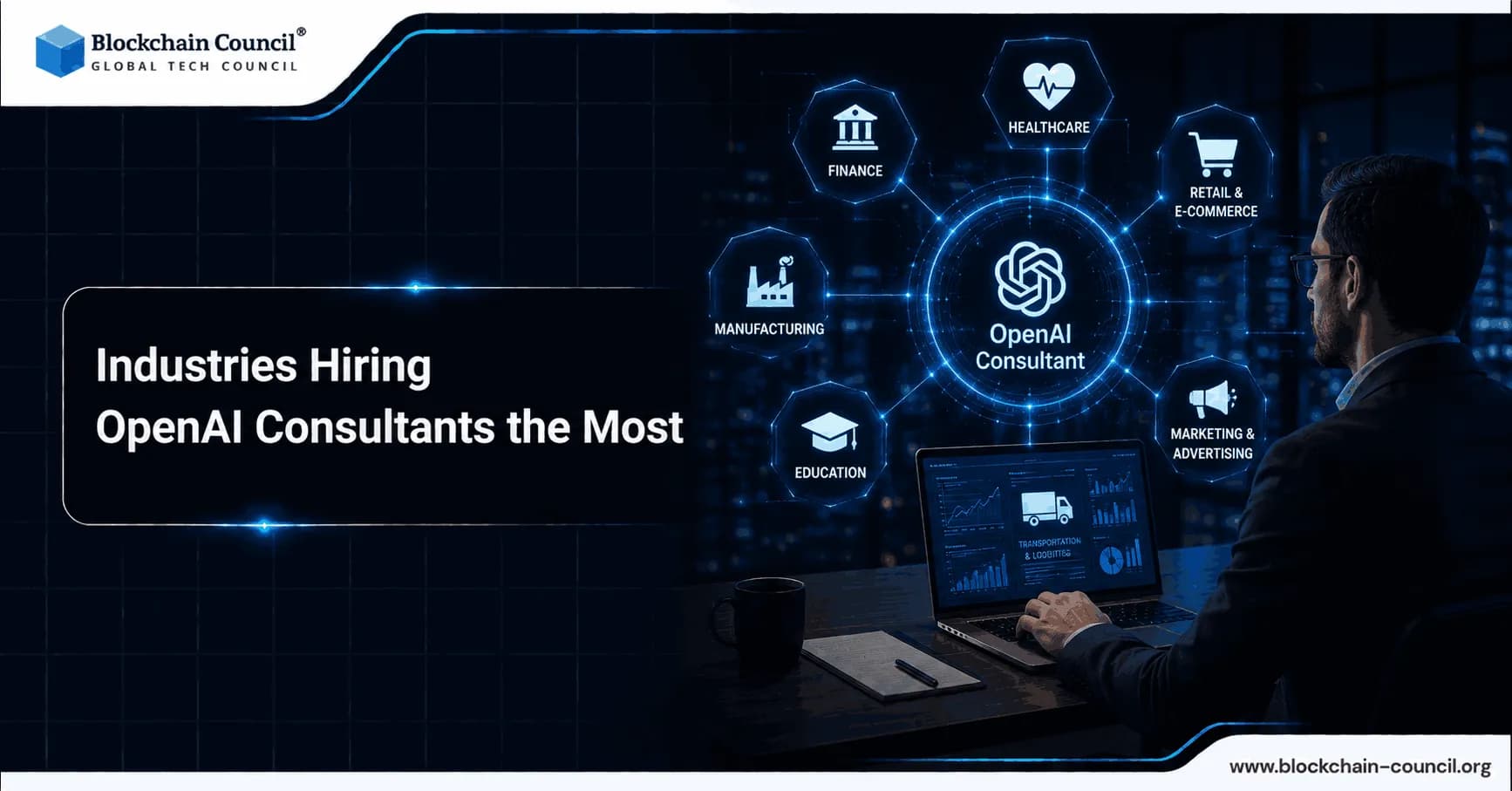
Enterprise artificial intelligence has crossed a decisive threshold. Specifically, organizations are no longer asking whether to adopt AI they are asking how to do so effectively, quickly, and at scale. Consequently, the demand for skilled OpenAI Consultants has surged across every major industry sector in 2026.
According to OpenAI's own State of Enterprise AI report, technology, healthcare, and manufacturing are the fastest-growing sectors, while finance and professional services already operate at the largest scale. Therefore, the OpenAI Consultant has become one of the most sought-after roles in the enterprise technology landscape. Furthermore, OpenAI CFO Sarah Friar publicly declared 2026 the year of 'practical adoption,' signaling an industry-wide shift from experimentation to full-scale implementation.

Professionals who hold a recognized OpenAI Consultant Certification are entering this market with a significant structural advantage. Consequently, certified consultants can demonstrate verified readiness to enterprise clients who now require proof of competency before engaging implementation partners. Moreover, with OpenAI investing $150 million to train 300,000 certified consultants by the end of 2026, the certification ecosystem is growing alongside-and in direct response to industry demand.
This article examines the industries creating the strongest demand for OpenAI Consultants in 2026, the specific use cases driving that demand, and how professionals can position themselves to capture these opportunities.
Why Industries Are Racing to Hire OpenAI Consultants
The enterprise AI implementation gap is well-documented and consequential. Specifically, nearly two-thirds of enterprises are failing to scale AI projects beyond the pilot phase, according to PwC. Furthermore, only 12% of CEOs report that their AI initiatives have delivered both cost reductions and revenue growth simultaneously. Consequently, organizations need expert guidance to close the gap between AI capability and business outcome.
Moreover, the top enterprise AI challenges are not technological, they are operational. Integration complexity affects 64% of enterprises, data privacy risks concern 67%, and reliability issues trouble 60%, according to industry surveys. Therefore, the OpenAI Consultant fills a critical role that no AI model can fill independently: translating technical potential into measurable organizational results.
Furthermore, more than 78% of organizations adopted AI in at least one business function in 2024, rising to over 90% of business leaders actively budgeting for AI tools in 2026. As a result, consulting demand has shifted from reactive to proactive, with enterprises seeking partners well before implementations begin rather than only after failures occur.
The Scale of the Opportunity in 2026
The AI consulting services market was valued at $11.07 billion in 2025 and is projected to reach $90.99 billion by 2035, growing at a 23.4% CAGR, according to Future Market Insights. Consequently, this represents one of the highest-growth segments in professional services. Furthermore, professional services firms are already spending $3,470 per employee on AI tools annually in 2026 the highest spending of any sector, according to Oxford Economics.
Additionally, a Boston Consulting Group study found that AI-leading companies achieved 1.7 times the revenue growth and 3.6 times the shareholder returns compared to AI-lagged organizations. Therefore, the business case for enterprise AI adoption is not speculative, it is measurable and the OpenAI Consultant is the professional who makes those outcomes achievable.
1. Healthcare: The Largest Creator of AI Jobs in 2025
Healthcare emerged as the single largest creator of AI jobs in 2025, generating more than 640,000 positions linked to automated diagnostics, predictive analytics, and virtual patient support, according to HeroHunt's 2026 AI Roles data. Furthermore, healthcare is projected to grow at a 19.10% CAGR, making it one of the most dynamic markets for OpenAI Consultants globally.
Moreover, AI adoption spans every segment of the sector. Digital healthcare leads at 78% adoption, followed by medical technology at 74%, according to NVIDIA's 2026 State of AI in Healthcare survey. Generative AI and large language models represent the top workload, cited by 69% of healthcare AI adopters.
Key Use Cases Driving Healthcare Demand
Clinical Documentation: AI tools automate medical note-taking, coding, and discharge summaries, reducing administrative burden for physicians and nurses.
Diagnostic Decision Support: GPT-based systems analyze patient histories, imaging reports, and research literature to assist clinicians with complex diagnoses.
Patient Communication: Conversational AI handles appointment scheduling, symptom triage, and post-discharge follow-up at scale.
Drug Discovery Acceleration: Pharmaceutical and biotech companies deploy AI to analyze experimental data and identify compound candidates faster.
Payer and Provider Automation: Insurance processing, prior authorizations, and claims analysis are being automated through structured AI workflows.
Consequently, healthcare organizations need OpenAI Consultants who understand both AI deployment methodology and the strict governance requirements of a regulated sector. Specifically, consultants must address data privacy, HIPAA compliance, model auditability, and clinical accountability in every implementation. Therefore, domain expertise combined with AI consulting credentials creates exceptional value in this market.
2. Finance and Banking: The Largest Scale Adopter
Finance and banking represent the largest-scale AI adopter in enterprise technology, holding a 19.60% market share of total AI adoption, according to industry data. Furthermore, global financial services AI spending exceeded $20 billion in 2025, with 68% of hedge funds deploying AI for market analysis and trading strategies. Consequently, OpenAI Consultants serving this sector are entering one of the most financially resourced markets in enterprise AI.
Additionally, the Thomson Reuters 2026 AI in Professional Services report found that organization-wide AI usage almost doubled to 40% across financial and professional services firms up from 22% in 2025. Moreover, AI-driven robo-advisors now manage over $1.2 trillion in assets globally. Therefore, the finance sector's consulting demand is both current and substantial.
Key Use Cases Driving Finance Sector Demand
Fraud Detection and Risk Management: AI systems process millions of transactions per second to identify suspicious patterns in real time.
Personalized Investment Advisory: AI analyzes individual investor profiles and financial goals to generate tailored portfolio recommendations.
Regulatory Compliance Automation: Generative AI tools extract, interpret, and apply regulatory requirements to reduce compliance costs.
Credit Assessment: AI evaluates creditworthiness with greater speed and precision than traditional scoring models.
Client Communication: AI-powered chatbots handle complex financial inquiries and document-heavy client interactions.
However, finance organizations face compliance review cycles that significantly slow AI tool deployment. Specifically, finance workers average only three to five hours per week in AI tools roughly half the rate of technology sector workers due to regulatory friction rather than lack of interest, according to Rize tracking data. Consequently, OpenAI Consultants who understand financial compliance frameworks are particularly well-positioned to accelerate adoption within these constraints.
3. Legal: From Experimentation to Operational Dependency
The legal sector has entered a period of accelerating AI adoption that industry experts describe as a shift from experimentation to operational dependency in 2026. Specifically, the Thomson Reuters 2026 AI in Professional Services report notes that a majority of legal professionals now use publicly available AI tools such as ChatGPT, while a majority of respondents believe generative AI should be applied to their work in some form.
Furthermore, 85 AI legal experts surveyed by the National Law Review predicted that 2026 would bring significant progress in judicial use of AI tools, new Federal Rules of Evidence addressing AI-generated material, and increased competitive pressure on firms that fail to integrate AI into their practice. Consequently, law firms need OpenAI Consultant expertise to implement AI responsibly while managing unique professional liability and ethical obligations.
Key Use Cases Driving Legal Sector Demand
Contract Review and Analysis: AI tools review contracts at high speed, flagging risk clauses, jurisdictional variations, and compliance issues.
Legal Research: Generative AI synthesizes case law, statutes, and regulations far faster than traditional research methods.
Document Drafting: AI assists in creating briefs, motions, client communications, and due diligence reports.
eDiscovery: AI processes and classifies large document sets during litigation discovery at a fraction of traditional cost.
Governance, Risk, and Compliance: Legal departments deploy AI to monitor regulatory changes and assess organizational compliance exposure.
Moreover, the legal sector's unique governance requirements make it a particularly strong fit for OpenAI Consultants who specialize in responsible AI implementation. Specifically, clients in legal environments require consultants who can build auditability, explainability, and human oversight into every AI workflow. Therefore, consultants with governance expertise command premium rates in this sector.
4. Manufacturing: The Fastest-Growing AI Employment Sector
Manufacturing generated approximately 620,000 AI positions in 2025-second only to healthcare-driven by quality control automation, predictive maintenance, and supply chain optimization, according to HeroHunt 2026 data. Furthermore, OpenAI's State of Enterprise AI report identifies manufacturing alongside technology and healthcare as the three fastest-growing sectors by AI adoption velocity.
Additionally, Deloitte's 2026 State of AI in the Enterprise report identifies manufacturing, logistics, and defense as sectors where AI adoption is especially advanced, with robotics, autonomous vehicles, and AI-powered operational systems already reshaping production environments. Consequently, manufacturers require OpenAI Consultants who can connect language model capabilities to physical operations and industrial data pipelines.
Key Use Cases Driving Manufacturing Demand
Predictive Maintenance: AI monitors equipment sensor data to predict failures before they occur, reducing unplanned downtime.
Quality Control Automation: Generative AI tools analyze production data to identify defect patterns and optimize inspection processes.
Supply Chain Risk Management: AI monitors supplier networks, demand signals, and logistics disruptions in real time.
Workforce Documentation and Training: AI generates and maintains technical documentation, safety guidelines, and training materials at scale.
Process Optimization: AI models analyze production workflows to identify bottlenecks and recommend efficiency improvements.
Furthermore, manufacturers that deploy AI systems at scale increasingly need production-grade AI lifecycle management. Consequently, OpenAI Consultants who complement their consulting skills with a specialized MLOps Certification are exceptionally well-positioned in this sector. Specifically, understanding model monitoring, retraining pipelines, and deployment infrastructure gives consultants the technical depth manufacturing clients demand when moving AI from pilot to production.
5. Professional Services: The Highest Per-Employee AI Spender
Professional services firms including consulting, accounting, and advisory organizations represent the largest concentration of ChatGPT Enterprise customers in absolute terms, according to OpenAI's State of Enterprise AI report. Furthermore, they spend $3,470 per employee on AI tools annually in 2026 the highest of any sector tracked by Oxford Economics.
Moreover, AI tools fundamentally match the core work of professional services. Specifically, these firms trade in expertise, analysis, synthesis, and communication precisely the domains where large language models deliver the greatest productivity gains. Consequently, OpenAI Consultants working in this sector are often embedded within client organizations for extended engagements to drive both adoption and cultural change.
Key Use Cases Driving Professional Services Demand
Research and Analysis Automation: AI synthesizes market research, competitive intelligence, and client background information faster than traditional methods.
Report and Presentation Generation: AI assists in creating client-ready deliverables from raw data and internal knowledge assets.
Knowledge Management: AI-powered internal search systems give consultants access to institutional knowledge across large organizations.
Proposal Development: AI accelerates the creation of RFP responses, engagement proposals, and scoping documentation.
Additionally, BCG research demonstrated that consultants using ChatGPT scored 49, 20, and 18 percentage points higher than control groups on technical tasks, and approached the level of professional data scientists on complex analytical challenges. Therefore, the ROI case for AI in professional services is firmly established, and OpenAI Consultants who help firms implement at scale are in strong demand.
6. Technology: Fastest-Growing Sector by Message Volume
Technology companies have expanded their ChatGPT Enterprise message volume by 11 times in the past twelve months the highest growth rate of any sector according to OpenAI's 2025 Enterprise AI report. Furthermore, technology firms are the most intensive AI users, with employees spending eight to twelve hours per week on AI tools. Consequently, OpenAI Consultants working in the technology sector address a uniquely sophisticated client base with high technical fluency and demanding implementation expectations.
Moreover, technology organizations often deploy AI across both internal operations and customer-facing products simultaneously. Therefore, consultants must address both workflow automation for internal teams and product integration for external users. Specifically, this dual-layer complexity makes deep technical expertise including API architecture, agent workflow design, and model evaluation-a core requirement for technology sector consulting engagements.
Key Use Cases Driving Technology Sector Demand
AI Product Development: Technology firms embed OpenAI models into customer-facing products to deliver intelligent features at scale.
Internal Developer Productivity: AI coding assistants and knowledge management tools accelerate software development workflows.
Customer Support Automation: AI agents handle complex technical support inquiries, reducing escalation rates and response times.
Data Analysis and Intelligence: AI tools process large datasets to generate product insights, user behavior analysis, and business intelligence.
Agentic Workflow Design: Technology companies deploy multi-step AI agents to automate complex internal processes end-to-end.
Furthermore, technology companies that build production AI systems need OpenAI Consultants who understand the full deployment lifecycle. Specifically, pairing consulting expertise with an MLOps Certification is particularly valuable for technology sector engagements, where clients expect consultants to contribute meaningfully to production pipeline design, model observability, and infrastructure optimization. Consequently, this combination commands among the highest consulting rates in the entire AI services market.
7. Marketing, Media, and Retail: Scaling Creative and Commercial AI
Marketing and media organizations represent one of the most dynamic emerging markets for OpenAI Consultant expertise. Specifically, creative and content-intensive industries have embraced generative AI for campaign production, audience segmentation, personalization, and performance analysis at a pace that outstrips internal implementation capacity. Consequently, external consulting expertise has become essential for organizations that want to move from experimental AI use to structured, scalable workflows.
Furthermore, retail organizations are deploying AI for demand forecasting, inventory management, customer experience personalization, and automated marketing operations. Specifically, Amazon and Walmart have embedded AI into their core operational and customer-facing systems, creating significant demand for consultants who can replicate these implementations at mid-market scale.
Key Use Cases Driving Marketing and Retail Demand
Content Generation at Scale: AI produces drafts, headlines, product descriptions, and email campaigns with minimal human input.
Audience Segmentation and Personalization: AI analyzes behavioral and demographic data to create dynamic audience segments for targeted campaigns.
Campaign Performance Analysis: Generative AI tools interpret campaign data and generate optimization recommendations.
Customer Journey Automation: AI agents handle lead nurturing, onboarding sequences, and retention workflows automatically.
Retail Demand Forecasting: AI models predict consumer demand patterns to optimize inventory positioning and pricing.
Consequently, professionals who advise marketing organizations benefit greatly from combining their OpenAI Consultant expertise with a structured Marketing Certification that grounds AI implementation advice in commercial strategy and customer outcomes. Therefore, this combination enables consultants to advise at both the technical execution level and the business strategy level, addressing the full scope of what marketing organizations require from AI transformation partners.
8. Education and Public Sector: Rapid Adoption in Institutional Settings
Education and public sector organizations are accelerating AI adoption with strong institutional backing. Specifically, OpenAI has launched pilot AI Foundations certifications with partners including Arizona State University, the California State University system, and the Office of the Governor of Delaware. Furthermore, more than 400,000 K-12 educators are being equipped with AI skills through dedicated programs.
Moreover, government and public sector organizations are deploying AI to automate document processing, improve citizen services, and analyze policy data at scale. Consequently, OpenAI Consultants who understand the procurement, governance, and public accountability requirements of institutional clients are in strong and growing demand.
Key Use Cases in Education and Public Sector
Personalized Learning Systems: AI tailors educational content, pacing, and assessment to individual student needs.
Administrative Automation: AI handles scheduling, communications, and documentation workflows for educational institutions.
Policy Research and Analysis: Government agencies use AI to analyze large volumes of regulatory and legislative data.
Citizen Services Automation: AI-powered systems handle high-volume citizen inquiries across public service channels.
How to Position Yourself as an OpenAI Consultant Across These Industries
Demand is strong, but supply of genuinely qualified OpenAI Consultants remains limited. Specifically, the most competitive professionals combine formal credentials, sector-specific knowledge, and a documented portfolio of real-world outcomes. Therefore, strategic positioning matters as much as technical skill in this market.
Develop Sector-Specific Expertise
Generalist AI consulting positions are increasingly commoditized. Consequently, specialists who combine OpenAI deployment expertise with deep domain knowledge in healthcare, finance, legal technology, or manufacturing command significantly higher rates. Specifically, consultants who understand sector-specific regulatory requirements, compliance frameworks, and operational workflows deliver value that general practitioners cannot replicate.
Furthermore, industry research consistently shows that clients in regulated sectors particularly healthcare, finance, and legal prioritize domain expertise as the primary selection criterion when engaging AI consultants. Therefore, professional background from one of these sectors is a competitive asset rather than a limitation.
Build a Documented Portfolio of Outcomes
Certification alone does not close enterprise deals. Specifically, enterprise procurement teams increasingly require documented evidence of previous AI deployments, measurable business outcomes achieved, and referenceable client engagements. Therefore, every consultant should actively document project results in quantified terms wherever possible alongside their credentials.
Moreover, the most persuasive portfolios demonstrate outcomes across at least two or three different sectors, demonstrating transferable methodology alongside industry depth. Consequently, consultants who can point to measurable outcomes in multiple contexts establish a far stronger market position than those with credentials but no demonstrated delivery track record.
Credentials That Maximize Your Value as an OpenAI Consultant
Formal credentials are increasingly non-negotiable for OpenAI Consultants seeking enterprise engagements. Specifically, 63% of hiring managers now require verified AI credentials before shortlisting candidates, according to LinkedIn's 2026 Workforce Report. Therefore, investing strategically in a credential stack that addresses strategic consulting, technical operations, and commercial strategy provides the strongest possible market positioning.
Better hiring decisions start with clear role requirements, consistent evaluation criteria, and evidence of a candidate’s relevant capabilities. Assessments can complement interviews and background reviews when used appropriately. Employers can explore HireValid as one option for bringing more structure to candidate evaluation.
OpenAI Consultant Certification: The Strategic Foundation
The OpenAI Consultant Certification directly prepares practitioners for the enterprise AI deployment consulting work that every industry covered in this article demands. Specifically, it covers use case identification, API integration, governance frameworks, prompt engineering, and client consultation methodology. Consequently, this credential provides the structured knowledge baseline that enterprise clients and employers actively look for when evaluating AI consulting partners.
Moreover, certified OpenAI Consultants are better equipped to win trust, close engagements, and deliver consistently across the complex, multi-stakeholder environments that characterize enterprise AI adoption in regulated industries.
MLOps Certification: Adding Production-Grade Technical Depth
Consultants working in manufacturing, technology, and healthcare increasingly encounter clients who need help managing AI systems in production, not just deploying them for the first time. Consequently, a recognized MLOps Certification provides the operational AI lifecycle knowledge that separates strategic advisors from implementers who can also sustain deployed systems.
Specifically, this credential covers model monitoring, pipeline automation, retraining strategies, and infrastructure design skills that directly address the 'post-deployment gap' that most enterprise AI projects encounter. Therefore, adding this credential to an OpenAI consulting profile creates a genuinely differentiated offering in the market.
Marketing Certification: Bridging AI and Commercial Strategy
For consultants working in marketing, retail, media, and customer experience sectors, a structured Marketing Certification provides critical commercial context that AI-only credentials do not address. Specifically, it builds expertise in customer strategy, campaign management, brand positioning, and commercial outcome measurement all of which are essential for advising organizations that deploy AI in customer-facing operations.
Consequently, consultants who hold this credential alongside their AI consulting qualifications can engage client leadership teams at both the technical implementation and the business strategy levels. Therefore, this combination is particularly powerful for professionals serving the rapidly growing marketing and retail AI consulting market.
Conclusion
The industries hiring OpenAI Consultants most aggressively in 2026 healthcare, finance, legal, manufacturing, professional services, technology, marketing, and public sector share a common characteristic. Specifically, they possess both the financial commitment and the operational urgency to move AI adoption from pilot stage to enterprise-wide transformation.
Furthermore, the data is unambiguous: AI adoption is accelerating, the implementation gap is real, and the consultants who can bridge that gap command strong compensation and growing opportunity across every major sector. Consequently, professionals who invest in building genuine domain expertise, verified credentials, and a documented track record of outcomes are positioning themselves at the highest tier of this expanding market.
Moreover, the OpenAI Consultant Certification provides the structured foundation for this career path. Furthermore, combining it with complementary credentials in MLOps and marketing creates a multi-dimensional professional profile capable of serving the full breadth of industries where OpenAI Consultant expertise is most in demand. Therefore, the time to build this credential stack and sector expertise is now before the market moves from early-mover advantage to baseline expectation.
Frequently Asked Questions (FAQs)
1. What is an OpenAI Consultant?
An OpenAI Consultant is a professional who helps organizations design, deploy, and scale AI solutions built on OpenAI's platform. Specifically, they identify high-value use cases, oversee technical implementation, manage governance requirements, and guide organizational change throughout the AI adoption process.
2. Which industry hires the most OpenAI Consultants?
Healthcare was the single largest creator of AI jobs in 2025, generating over 640,000 positions. However, finance and professional services operate at the largest absolute scale in terms of AI deployment spending. Therefore, both sectors represent strong consulting opportunity depending on the practitioner's background.
3. Why do regulated industries like healthcare and finance need specialized OpenAI Consultants?
Regulated industries require consultants who understand compliance frameworks, data governance, audit trail requirements, and professional liability alongside AI deployment methodology. Consequently, sector-specific expertise significantly increases a consultant's value and market rate in these environments.
4. What AI use cases are most common in healthcare?
Clinical documentation automation, diagnostic decision support, patient communication, drug discovery acceleration, and insurance processing automation are the leading healthcare AI use cases in 2026. Furthermore, each of these requires careful governance implementation to satisfy regulatory and clinical accountability requirements.
5. How is finance using OpenAI technology in 2026?
Finance organizations use AI primarily for fraud detection, personalized investment advisory, regulatory compliance automation, credit assessment, and customer-facing communication. Moreover, the sector is also exploring agentic AI workflows that automate multi-step financial analysis and reporting processes.
6. Why is the legal sector increasing AI consultant hiring?
Legal AI has shifted from experimentation to operational dependency in 2026. Specifically, law firms deploy AI for contract review, legal research, document drafting, eDiscovery, and compliance monitoring. Furthermore, the unique ethical and professional liability requirements of legal practice create strong demand for consultants with governance expertise.
7. What manufacturing use cases require an OpenAI Consultant?
Predictive maintenance, quality control automation, supply chain risk management, workforce documentation, and process optimization are the primary manufacturing AI use cases. Moreover, moving these applications from pilot to production requires both consulting expertise and operational AI lifecycle knowledge.
8. How fast is the AI consulting services market growing?
The AI consulting services market is growing at 23.4% CAGR and is projected to expand from $11.07 billion in 2025 to $90.99 billion by 2035, according to Future Market Insights. Consequently, this represents one of the highest-growth segments in professional services globally.
9. Do OpenAI Consultants need industry-specific knowledge?
Yes. Sector-specific expertise is increasingly the primary differentiator among AI consultants competing for enterprise engagements. Furthermore, clients in regulated industries specifically select consultants who demonstrate understanding of their sector's regulatory environment, operational constraints, and competitive dynamics.
10. How much do OpenAI Consultants earn working in healthcare?
Healthcare AI consultants with governance expertise and clinical operations knowledge command premium rates. Specifically, independent specialists in high-compliance sectors typically earn $200,000 or more annually through a combination of retainer agreements, project fees, and advisory arrangements.
11. What makes professional services firms such large AI adopters?
Professional services firms trade in expertise, analysis, communication, and research precisely the areas where large language models deliver the greatest productivity gains. Moreover, AI tools allow consultants to analyze data, generate deliverables, and synthesize research at speeds that directly translate into client value.
12. Why is manufacturing a high-growth sector for AI consultants?
Manufacturing AI adoption is accelerating rapidly, with approximately 620,000 AI positions created in 2025. Furthermore, moving AI systems from pilot to production in manufacturing environments requires sustained consulting support for infrastructure design, monitoring, and workflow integration creating ongoing rather than one-time consulting demand.
13. What role does governance play in OpenAI consulting engagements?
Governance is central to almost every enterprise AI engagement. Specifically, consultants must address data privacy, model auditability, bias mitigation, access control, and regulatory compliance in every implementation. Therefore, governance expertise is not optional, it is a core consulting competency.
14. How are technology companies using OpenAI differently from other sectors?
Technology companies deploy AI both internally for developer productivity and externally in customer-facing products. Consequently, technology sector consulting engagements often address greater complexity than single-function deployments, requiring consultants to navigate both product integration and internal workflow automation simultaneously.
15. Are there opportunities for OpenAI Consultants in education?
Yes. OpenAI has partnered directly with universities and state governments to deploy AI certification and learning programs. Furthermore, educational institutions need consulting support to implement personalized learning systems, automate administrative workflows, and train faculty on responsible AI use.
16. How does an OpenAI Consultant differ from an in-house AI team?
An OpenAI Consultant brings cross-industry deployment experience, a structured methodology, and certified expertise that most in-house teams are still building. Moreover, consultants can accelerate implementation timelines significantly by applying patterns from previous engagements rather than discovering approaches from scratch.
17. What is the most important skill for OpenAI Consultants working in finance?
Understanding financial compliance frameworks including data governance, model explainability, and regulatory reporting requirements is the most critical differentiating skill. Consequently, finance-sector consultants who can demonstrate this expertise alongside AI implementation methodology command the strongest market positioning.
18. How is marketing AI adoption creating consulting demand?
Marketing organizations are deploying AI for content generation, audience segmentation, campaign analysis, and customer journey automation faster than their internal teams can manage the implementation. Consequently, external consultants who can structure and govern these deployments are filling a measurable gap in marketing operations capability.
19. What certification best prepares professionals to consult across multiple industries?
A structured OpenAI Consultant certification combined with domain-specific credentials in MLOps and commercial strategy creates the broadest applicable expertise. Furthermore, this credential stack supports effective consulting engagements across healthcare, finance, legal, manufacturing, and marketing with equal credibility.
20. When is the best time to enter the OpenAI consulting market?
The best time is now. Specifically, early-mover advantage is still available as enterprise AI adoption accelerates and the market has not yet normalized credential requirements. Furthermore, professionals who build expertise and credentials today will be ahead of the baseline expectation when the market matures rather than simply meeting it.
Related Articles
View All
AI & ML
AI-Era Hiring Needs AI-Proof Tests: How HireValid Is Redefining Talent Assessment
Explore how HireValid is rethinking talent assessment for the AI era with job-relevant tests, anti-cheating design, integrity signals, and human-reviewed evidence of candidate ability.

AI & ML
OpenAI Dots vs Grok Bot vs Muse
Compare OpenAI Dots, Grok Bot, and Meta Muse to understand how these always-on AI agents differ in persistent work, computer use, connected apps, automation, and personal or business workflows.

AI & ML
What Is OpenAI Dots?
Learn what OpenAI Dots are, how these always-on AI agents work, and how they use GPT-6 Astra, cloud computers, connected apps, and persistent context to handle ongoing tasks.
Trending Articles
AWS Career Roadmap
A step-by-step guide to building a successful career in Amazon Web Services cloud computing.

Top 5 DeFi Platforms
Explore the leading decentralized finance platforms and what makes each one unique in the evolving DeFi landscape.

Can DeFi 2.0 Bridge the Gap Between Traditional and Decentralized Finance?
The next generation of DeFi protocols aims to connect traditional banking with decentralized finance ecosystems.