

Human vs AI in Web3 and Smart Contract Auditing: Replacement or Acceleration?

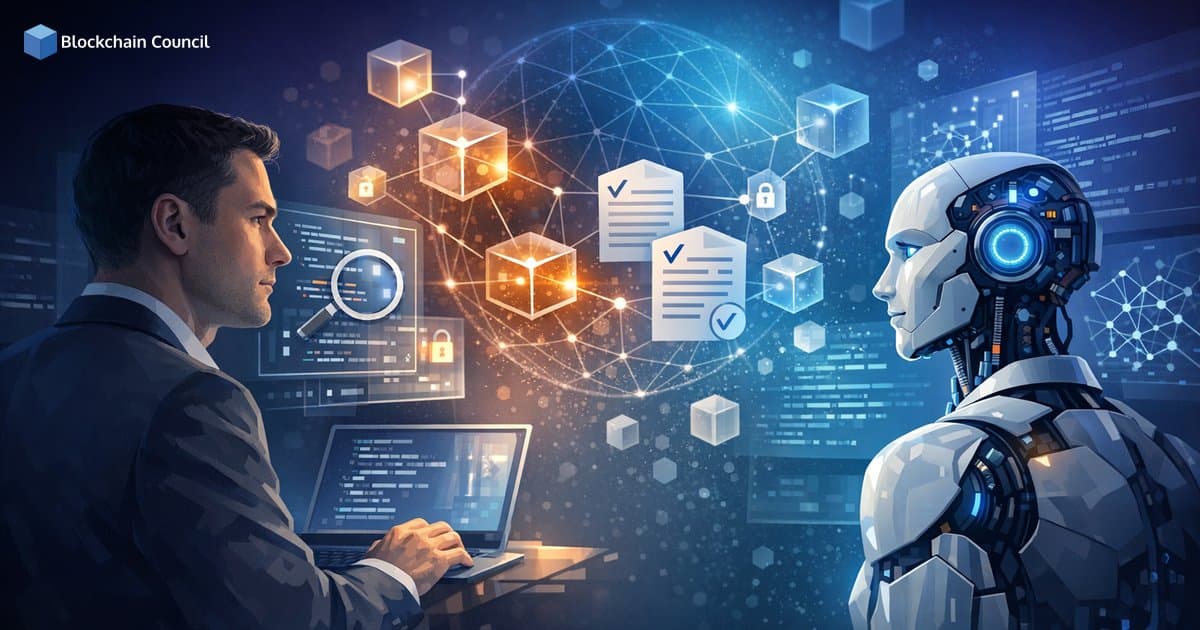
Human vs AI in Web3 and smart contract auditing is no longer a theoretical debate. Large language models (LLMs) are already embedded in real audit workflows, improving speed, coverage, and documentation quality. Yet the most credible industry evidence points in a clear direction: LLMs accelerate security researchers rather than replace them, especially for complex DeFi systems, cross-protocol integrations, and high-value contracts where business logic and economic incentives dominate the risk.
This article explains what AI can do well today, where it falls short, and what a practical hybrid audit model looks like for teams shipping in production.

Where LLMs Fit in Smart Contract Auditing Today
Modern Web3 audits increasingly combine human expertise with AI-driven automation. In practice, AI is applied across the full audit lifecycle, from pre-commit checks to post-deployment monitoring.
1) Static Analysis and Vulnerability Pattern Detection
AI systems and AI-assisted analyzers can scan large codebases quickly and flag known vulnerability classes such as reentrancy, access control mistakes, unsafe external calls, insecure oracle usage, and arithmetic edge cases. This matters operationally because a single protocol can span multiple repositories, upgradeable proxies, libraries, and integrations.
- Strength: High throughput across thousands of lines of Solidity and many contracts in parallel.
- Typical outcome: A prioritized list of suspicious code paths for a human to validate.
2) LLM-Driven Code Comprehension and Explanation
LLMs can translate contract logic into natural language summaries, highlight unusual control flow, and help auditors and developers quickly understand intent. They also help draft initial issue descriptions and remediation guidance. Evaluations shared by audit teams suggest GPT-class models can catch simple issues and explain them clearly, but performance degrades as systems become more stateful, multi-contract, or composable across protocols.
3) AI-Augmented Simulation, Fuzzing, and Invariant Testing
One of the most meaningful shifts is AI-assisted exploration of state space. Researchers define invariants and failure conditions - for example, solvency constraints, liquidity conservation, or governance safety rules - and AI-driven fuzzing and simulation then generate large volumes of adversarial inputs and transaction sequences to test those invariants.
- Strength: Finds edge cases that manual review would not reach within available time.
- Dependency: Success is bounded by the quality of human-defined invariants and threat models.
4) AI as an Audit Assistant, Not the Auditor of Record
In day-to-day operations, LLMs are commonly used to reduce time spent on repetitive tasks:
- Drafting risk reports and executive summaries for stakeholders.
- Generating test scaffolding and reproducible proof-of-concept steps.
- Suggesting remediation patterns based on common exploit history.
- Converting specifications into first-pass checklists and threat modeling prompts.
These capabilities compress the time from code freeze to actionable feedback, which carries real operational value.
Audit Speed and Scale: What Changes with AI
The economic pressure in Web3 security is significant. Industry data consistently documents multi-billion-dollar annual losses from Web3 exploits, with 2023 seeing over three billion USD stolen through smart contract vulnerabilities. At the same time, growth in the blockchain and AI cybersecurity markets is increasing demand for scalable security practices.
Within this context, some audit teams credit AI with reducing timelines by roughly 30 percent in certain pipelines. The reasons are straightforward:
- Faster triage: AI surfaces likely issues early so humans spend less time on dead ends.
- More coverage: Simulation and fuzzing can run continuously and at scale.
- Less manual overhead: Documentation and report generation are accelerated.
Speed gains do not imply replacement, however. They mean the same human team can review more surface area, respond faster, and integrate security earlier in the software development lifecycle.
Why LLMs Do Not Replace Human Security Researchers Today
Despite their real workflow impact, current LLM limitations remain significant in smart contract auditing. These are not minor inconveniences. They are failure modes that can create false confidence in high-stakes systems.
1) Weakness in Multi-Step and Cross-Protocol Attack Paths
Many high-impact exploits are not a single-line bug. They are sequences across contracts, integrations, or time. Examples include multi-transaction manipulation, composability-driven failures, and cross-chain bridge risk where state is split across domains. Industry evaluations consistently show that LLMs struggle to identify these complex attack paths reliably.
2) Limited Economic and Game-Theoretic Reasoning
DeFi risk is often economic before it is technical. Human researchers reason about incentive design, adversarial market conditions, liquidation dynamics, governance capture, and oracle manipulation under stress. LLMs can repeat known patterns, but they frequently miss novel mechanisms or misjudge the real-world feasibility and profit motive behind an attack.
3) Opaque Reasoning and Hallucination Risk
Audit work demands traceability. Humans can explain why an invariant should hold, show the execution trace that breaks it, and argue severity with context. LLM outputs can be persuasive but incorrect, sometimes inventing justifications, missing preconditions, or misprioritizing issues. This is manageable when LLMs are used for triage, but risky when treated as a final authority.
4) Generic Findings Versus Protocol-Specific Analysis
LLMs often generate results aligned with a standard checklist of vulnerability classes. That is useful for baseline hygiene. Top-tier audits, however, require protocol-specific analysis: business assumptions, upgrade patterns, admin controls, trust boundaries, and integration risk. This is where experienced auditors consistently outperform automation.
The Most Realistic Model: Hybrid Auditing with Human-Defined Invariants
The most consistent expert view is a hybrid model where humans and AI divide responsibilities according to their strengths.
What Humans Should Own
- Threat modeling: Define trust boundaries, attacker capabilities, and protocol assumptions.
- Invariants and specifications: Express what must always remain true - solvency, conservation, authorization rules.
- Business logic validation: Ensure the code matches the intended product and economic design.
- Severity and feasibility: Judge exploitability in real market conditions and deployment environments.
- Final sign-off: Accountability for risk acceptance and production readiness.
What AI and LLMs Should Own
- Large-scale scanning: Find patterns and suspicious flows quickly across repositories and dependencies.
- Simulation and fuzzing at scale: Generate adversarial transaction sequences guided by invariants.
- Report acceleration: Draft issue write-ups, remediation options, and test reproductions for human review.
- Continuous monitoring support: Assist with runtime alerting and anomaly detection to extend security past deployment.
This division reflects how advanced teams use AI as a force multiplier: humans provide intent and constraints, machines provide throughput.
Offensive AI vs Defensive AI: How the Threat Model Is Changing
AI changes security on both sides of the equation. Security teams report that AI materially lowers the barrier for attackers, enabling automated reconnaissance across many contracts in parallel. That reality pushes defenders to adopt AI not as a nice-to-have, but as a scaling requirement.
Defensive uses increasingly include:
- Pre-deployment automation: AI checks in CI/CD pipelines to catch issues before human audit time is spent.
- On-chain monitoring: Classification of suspicious transactions, wallet clustering, and anomaly detection.
- Continuous re-auditing: Re-testing as governance parameters, integrations, or dependencies change.
Most high-value protocols will still keep humans in the loop for major actions such as pausing contracts, triggering emergency governance, or blocking transactions, given the legal, reputational, and operational risks involved.
Practical Guidance for Teams Adopting AI in Smart Contract Audits
For professionals and enterprises building in Web3, the soundest approach is to treat AI as a coverage and speed layer, not the source of truth.
Recommended Workflow
- Shift left with AI: Run AI-assisted checks on every pull request to catch obvious issues early.
- Use AI for triage: Cluster findings, deduplicate reports, and propose likely root causes.
- Invest in invariants: Document protocol invariants and encode them into fuzzing and simulation pipelines.
- Reserve expert time for hard problems: Composability, bridges, governance, and economic attack surfaces.
- Validate all AI outputs: Require reproducible traces, tests, or proofs before accepting findings.
Skills That Are Becoming More Valuable
- Specification writing: Turning business requirements into testable constraints.
- Tool orchestration: Combining LLMs, fuzzers, simulators, and formal methods effectively.
- Incident-driven learning: Updating checklists and invariants based on new exploit patterns.
Professionals building expertise in this area may find relevant grounding in programs such as Blockchain Developer, Certified Smart Contract Developer, Certified Blockchain Security Expert, and Certified AI Expert, which map closely to the hybrid skillset emerging in AI-assisted auditing.
Conclusion: Can LLMs Replace Auditors, or Only Accelerate Them?
Human vs AI in Web3 and smart contract auditing is best answered with risk-based realism. LLMs already improve audit throughput through fast scanning, better documentation, and large-scale simulation support. Some teams report meaningful cycle-time reductions, and AI-first checks are becoming standard practice for simpler contracts.
For complex, composable, high-value protocols, however, the evidence supports a human-in-the-loop model. Human security researchers remain essential for threat modeling, economic reasoning, cross-protocol attack design, and final accountability. The near-term advantage belongs not to AI alone or to humans alone, but to teams that align human insight with machine scale and build a repeatable, testable security process around that partnership.
Related Articles
View All
AI & ML
Can AI Models Train Themselves Without Human Intervention?
AI models can partially train themselves through self-supervision, self-critique, and AI feedback, but human oversight remains essential.

AI & ML
Built to Catch AI Cheating: Rethinking Pre-Employment Assessments with HireValid
Explore how HireValid is rethinking pre-employment assessments with AI-resistant test design, integrity signals, candidate evidence, and human review to address AI-assisted cheating.
AI & ML
AI-Era Hiring Needs AI-Proof Tests: How HireValid Is Redefining Talent Assessment
Explore how HireValid is rethinking talent assessment for the AI era with job-relevant tests, anti-cheating design, integrity signals, and human-reviewed evidence of candidate ability.
Trending Articles

Top 5 DeFi Platforms
Explore the leading decentralized finance platforms and what makes each one unique in the evolving DeFi landscape.
How Blockchain Secures AI Data
Understand how blockchain technology is being applied to protect the integrity and security of AI training data.
What is AWS? A Beginner's Guide to Cloud Computing
Everything you need to know about Amazon Web Services, cloud computing fundamentals, and career opportunities.