

Google AI Studio Live API

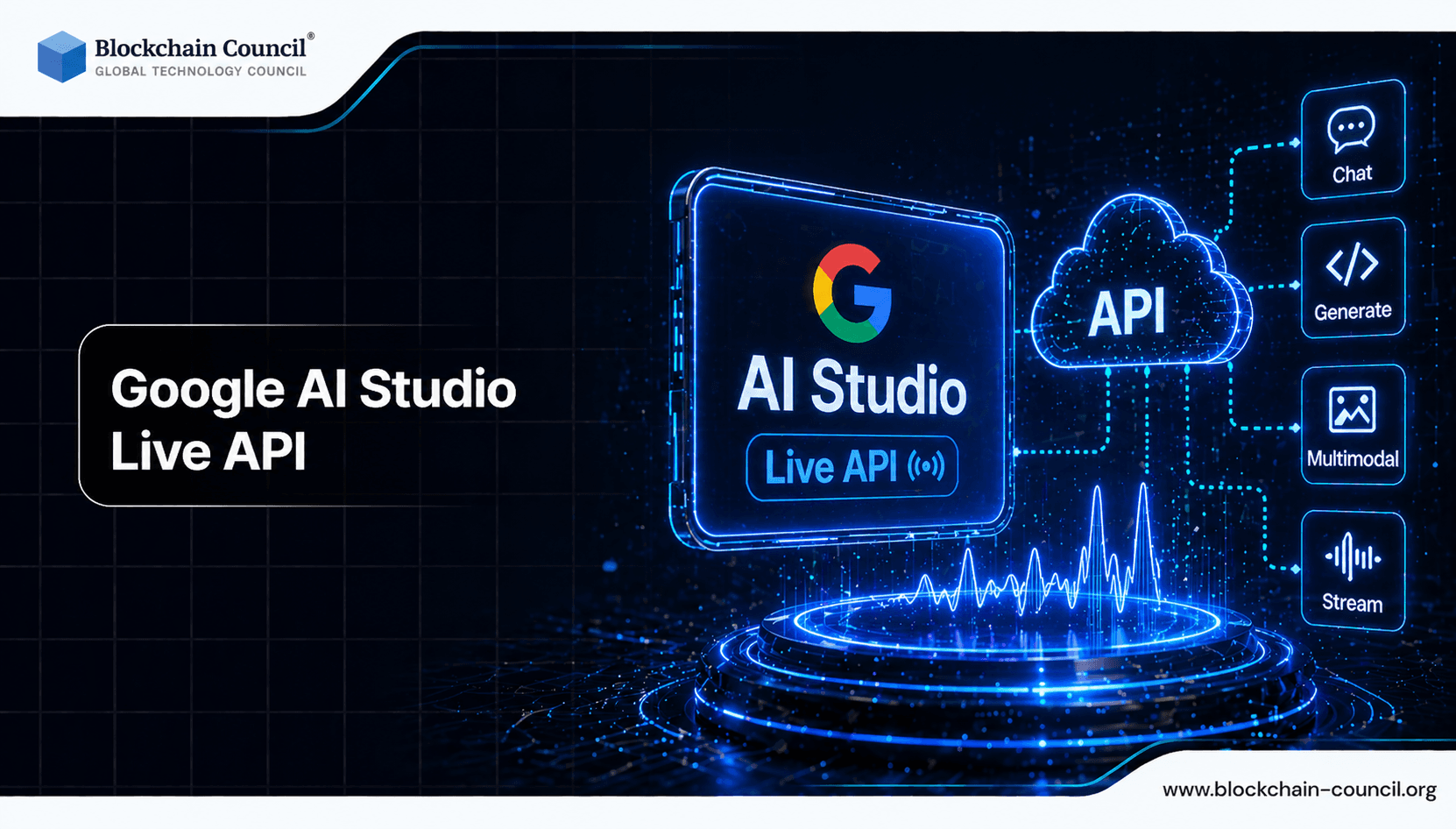
Artificial intelligence is moving faster than ever before. Furthermore, the tools that make AI accessible to everyday professionals are becoming more powerful. One of the most exciting developments in this space is the Google live API, available directly through AI Studio. Consequently, developers, marketers, and entrepreneurs now have access to real-time AI capabilities. These capabilities were previously reserved for large enterprise teams with significant resources.

Therefore, understanding the Google live API is essential for any professional working with modern AI tools.This article explains what it is, how it works, and why it matters. Additionally, it outlines the skills and credentials that help professionals use this technology effectively.
What Is Google AI Studio?
Google AI Studio is a browser-based development environment. It gives developers and technical professionals direct access to advanced AI models. Moreover, it allows users to build, test, and deploy AI applications without complex infrastructure. As a result, it significantly lowers the barrier to entry for building intelligent applications.
Additionally, AI Studio supports a wide range of AI capabilities. These include text generation, image understanding, code assistance, and real-time interaction. Therefore, it functions as a comprehensive platform for AI-powered development. The Google live API is one of its most powerful and innovative features.
What Is the Google Live API?
The Google live API is a real-time streaming interface built into AI Studio. It enables continuous, bidirectional communication between a user and an AI model. Unlike standard request-response APIs, this interface keeps a live session open throughout. Consequently, the AI receives input and delivers output simultaneously without any interruption.
Furthermore, the Google live API supports multiple input types within a single session. These include text, audio, and video streams working together in real time. Therefore, developers can build applications that feel natural and genuinely conversational. The AI responds instantly, just as a human participant would in a live discussion.
Moreover, this API is built on top of advanced multimodal AI models. As a result, it can understand and process different types of input simultaneously. For example, it can monitor a live video stream, process spoken input, and respond with both text and audio in one unified session.
Key Features of the Google Live API
1. Real-Time Multimodal Interaction
The Google live API processes text, audio, and video inputs together in real time. Therefore, it enables significantly richer interactions than traditional text-only APIs. Developers can create applications that respond to what a user says, shows, and types all at once.
2. Bidirectional Streaming
Unlike conventional APIs, this interface maintains an open connection between the client and the AI model. Consequently, there is no need to send separate requests for each individual interaction. The session remains active, responsive, and context-aware throughout the entire exchange.
3. Low Latency Performance
Speed is a defining characteristic of the Google live API. Furthermore, it is specifically engineered to minimize response delays at every step. As a result, applications built on this interface deliver a seamless and fluid user experience. This is especially valuable for voice interfaces, live coaching tools, and real-time support systems.
4. Function Calling Support
The API supports function calling, allowing the AI to trigger external tools and actions. Therefore, developers can connect live sessions to databases, third-party APIs, or business logic. Consequently, the AI can retrieve live data and take meaningful real-world actions during a session.
5. Natural Interruption Handling
A standout feature is the ability to handle natural conversation interruptions gracefully. When a user speaks during an AI response, the model pauses and listens attentively. Moreover, this mirrors authentic human communication patterns, which greatly improves user experience.
How the Google Live API Works
The Google live API operates through a WebSocket-based connection. First, a developer initiates a session by connecting to the API endpoint. Next, the client begins streaming inputs — audio, video, or text — continuously in real time. Furthermore, the model processes each input as it arrives and streams responses back immediately.
Additionally, developers can configure each session with specific instructions and personas. Therefore, the AI behaves consistently according to the application's defined requirements. For example, a support tool can be instructed to maintain a formal and empathetic tone throughout. Moreover, these instructions remain active for the full duration of the session.
Furthermore, the API uses intelligent turn-taking mechanisms to manage conversation flow naturally. Consequently, both the user and the AI can speak, pause, and respond in a fluid rhythm. This makes interactions feel genuine and dynamic rather than mechanical or scripted.
Practical Applications of the Google Live API
The real-world uses of this technology are wide-ranging and expanding rapidly. Therefore, professionals across multiple industries stand to benefit from adopting these capabilities.
Real-Time Voice Assistants
Developers can build voice assistants that understand spoken language deeply and accurately. Furthermore, these assistants handle complex multi-turn conversations with contextual awareness. As a result, they deliver a significantly better experience than traditional command-based voice bots.
Live Video Analysis
The API processes live video feeds and provides real-time commentary, analysis, or guidance. For instance, a training application can observe a user performing a task and give instant feedback. Consequently, it creates powerful new possibilities for education, quality control, and professional coaching.
AI-Powered Customer Support
Businesses can deploy live AI agents to handle customer queries in real time. These agents access relevant data, resolve issues efficiently, and escalate when necessary. Moreover, they provide consistent and accurate service at any scale without additional staffing costs.
Interactive Learning Platforms
Educational platforms can integrate live AI to tutor students with immediate, personalized feedback. Therefore, learners receive real-time explanations tailored precisely to their pace and understanding. Furthermore, the AI adapts its teaching approach dynamically based on student responses over time.
Who Should Learn the Google Live API?
This technology is relevant and accessible to a broad range of professionals. Therefore, it is important to identify who benefits most from understanding it deeply.
• Developers: Those building AI-powered applications will find the live API essential for real-time, multimodal products.
• Data Scientists: Professionals working with streaming data can integrate live AI directly into their analytical pipelines.
• Marketing Professionals: Marketers can use live AI to generate content, run real-time analysis, and optimize campaigns instantly.
• Entrepreneurs: Founders building AI-first products can prototype and validate live features rapidly using AI Studio.
• Educators and Trainers: Those building learning tools can create adaptive, real-time tutoring experiences for diverse learners.
Skills and Certifications for Working with the Google Live API
Working effectively with the Google live API requires a strong combination of technical and strategic skills. Therefore, professionals should invest in structured, recognized learning to build these competencies properly.
First, professionals who want to lead AI-driven projects and understand the full architecture of AI systems should build broad expertise. An AI Expert Certification provides a comprehensive understanding of AI models, architectures, and real-world deployment strategies. Therefore, it is ideal for those moving into leadership, product management, or consultancy roles in AI.
Furthermore, as live AI systems gain access to sensitive data streams and real-time business processes, security becomes critically important. Consequently, developers and architects must understand AI-specific risks and how to mitigate them effectively. An AI Security Certification equips professionals with the knowledge needed to deploy live AI applications safely, responsibly, and in full compliance with data protection standards.
Additionally, a strong foundation in programming is essential for integrating and extending live API capabilities. Specifically, proficiency in Python is highly recommended for working with AI APIs and streaming data pipelines. Professionals can formally validate this skill by earning a Python certification, which demonstrates the technical competence most commonly required in AI development roles.
Moreover, marketing professionals who want to integrate live AI into their workflows should invest in applied learning. An AI powered marketing course teaches how to use AI tools strategically in content creation, campaign management, and performance analysis. Consequently, marketers can leverage live AI features to accelerate execution and improve results significantly.
Challenges to Consider When Using the Google Live API
Despite its powerful capabilities, the Google live API comes with challenges that every developer must address thoughtfully. First, managing live audio and video streams demands careful handling of latency and bandwidth. Therefore, applications must be optimized for varying network conditions and device capabilities.
Moreover, real-time AI interactions generate large volumes of data continuously. Consequently, organizations must implement strong data governance policies to handle this responsibly. Additionally, ensuring consistent model behavior during live sessions requires thorough testing and careful prompt engineering.
Furthermore, accessibility remains an important consideration for broad adoption. Not all users have the hardware or connectivity needed to access live multimodal features fully. Therefore, developers should always design applications with fallback options for users with limited resources.
The Future of the Google Live API
The trajectory of the Google live API points clearly toward deeper integration and broader professional adoption. In the near future, developers will use it to power fully autonomous agents that operate continuously. These agents will interact with real-world environments through cameras, microphones, and connected sensors.
Furthermore, advances in underlying AI models will improve the speed, accuracy, and contextual intelligence of live interactions. Consequently, applications built on this API will feel increasingly natural, intelligent, and responsive. Additionally, expanded language and dialect support will make the technology accessible to a much wider global audience.
Moreover, as the ecosystem matures, more pre-built integrations and developer templates will become available. Therefore, even non-technical professionals will be able to deploy live AI features with minimal coding effort. As a result, the technology will reach far beyond the developer community into mainstream professional use.
Conclusion
The Google live API represents a defining advancement in real-time, accessible AI development. It combines multimodal input processing, low latency, and natural conversation handling in one unified interface. Therefore, it empowers developers and businesses to build experiences that were previously out of reach.
Furthermore, professionals who invest in learning this technology today will hold a significant advantage tomorrow. Whether you are a developer, marketer, entrepreneur, or educator, the Google live API offers tools that can genuinely elevate the quality and speed of your work. Consequently, now is the ideal time to explore AI Studio and discover what this powerful technology can do for you.
Frequently Asked Questions (FAQs)
1. What is the Google live API?
The Google live API is a real-time streaming interface within AI Studio. It enables continuous, bidirectional communication between users and AI models using text, audio, and video simultaneously.
2. How is the Google live API different from a standard API?
Standard APIs work on a request-response model. The Google live API, however, keeps a live session open throughout the interaction. Therefore, it enables continuous communication without repeated separate requests.
3. What input types does the Google live API support?
It supports text, audio, and video inputs simultaneously within a single session. Furthermore, it processes these input types together, enabling genuine multimodal real-time interaction.
4. Is the Google live API suitable for non-technical professionals?
It requires some technical knowledge to integrate directly. However, AI Studio provides documentation and guided examples. Moreover, ongoing platform improvements are making access easier for non-developers over time.
5. Which programming language is best for working with this API?
Python is the most widely used and recommended language for AI API integration. Furthermore, it offers extensive libraries and frameworks that simplify working with the Google live API significantly.
6. Can the Google live API process spoken language accurately?
Yes. It processes audio input in real time and understands spoken language with high accuracy. Consequently, it is well suited for building voice assistants and conversational AI applications at scale.
7. What is function calling and why does it matter?
Function calling allows the AI to trigger external tools or actions during a live session. Therefore, developers can connect the API to databases, services, or business systems to retrieve live data and complete real tasks.
8. How does the API manage interruptions during a conversation?
The Google live API detects when a user begins speaking during an AI response. It then pauses immediately and redirects attention to the new input, closely mirroring authentic human conversational behavior.
9. Which industries benefit most from the Google live API?
Education, customer support, healthcare, marketing, and software development all benefit significantly. Furthermore, any industry requiring real-time AI interaction and decision-making can gain meaningful advantages from this technology.
10. Is the Google live API available to all developers globally?
Availability depends on the developer's plan and geographic region. Therefore, professionals should review the official AI Studio documentation to confirm current access requirements and usage conditions.
11. What is AI Studio and how does it relate to the live API?
AI Studio is a browser-based platform providing access to advanced AI models and development tools. The Google live API is one of its core features, enabling real-time multimodal AI application development.
12. Can the Google live API be used for educational applications?
Yes. Developers and educators can build real-time tutoring tools using this API. Furthermore, the AI can adapt its explanations and teaching style dynamically based on individual student responses and progress.
13. What security measures should developers implement?
Developers should implement end-to-end encryption, strict access controls, and data governance policies. Furthermore, regular security audits help ensure that live AI systems handle sensitive data responsibly and in full compliance.
14. How can marketing professionals use the Google live API?
Marketers can use it to generate live content drafts, analyze campaign data in real time, and streamline creative workflows. Consequently, it significantly accelerates the speed from creative concept to final execution.
15. Does the Google live API support multiple languages?
Yes, it supports multiple languages. Moreover, ongoing model improvements are continuously expanding language coverage, making it increasingly effective for global applications and diverse user populations.
16. Can the API analyze live video content in real time?
Yes. It processes live video streams and provides real-time analysis, commentary, or guidance based on visual content. This makes it valuable for coaching, training, quality assurance, and remote assistance applications.
17. What is the typical latency of the Google live API?
The API is specifically engineered for low-latency performance. Therefore, responses arrive quickly enough to support smooth, natural conversations and real-time decision-making within demanding professional applications.
18. How can entrepreneurs benefit from the Google live API?
Entrepreneurs can rapidly prototype AI-first products using AI Studio's live API features. Furthermore, they can test, iterate, and gather user feedback quickly without requiring complex or expensive infrastructure.
19. Are there usage limits or costs associated with the API?
Usage limits and pricing depend on the developer's account type and plan. Therefore, professionals should carefully review the official documentation before building production-level applications to avoid unexpected costs.
20. What certifications help professionals work more effectively with the Google live API?
Certifications in AI Expert, AI Security, Python development, and AI-powered marketing all provide strong foundations. They equip professionals with the technical depth and strategic clarity needed to deploy and manage live AI applications successfully.
Related Articles
View All
AI & ML
Google Launches Gemini 4 Argon: Features and Capabilities
Google has launched Gemini 4 Argon, its flagship AI model for coding, finance, law, cybersecurity and science. Learn its key features, availability, pricing and safety details.
AI & ML
Google Playground: Create AI Games Without Coding
Learn what Google Playground is, how it uses generative AI to turn text prompts into browser games, how to create your first game, what it costs, how it compares with other no-code tools, and what limits to expect.

AI & ML
Can Gemini Improve Itself? Google AI and Recursive Self-Improvement Explained
Can Gemini improve itself? Learn why Google AI does not self-rewrite its model today, but can power controlled recursive self-improvement loops.
Trending Articles
AWS Career Roadmap
A step-by-step guide to building a successful career in Amazon Web Services cloud computing.

Top 5 DeFi Platforms
Explore the leading decentralized finance platforms and what makes each one unique in the evolving DeFi landscape.
How Blockchain Secures AI Data
Understand how blockchain technology is being applied to protect the integrity and security of AI training data.