

GLM 5.2 vs GPT-4.5: Performance, Multimodal AI, and Enterprise Readiness
 Suyash Raizada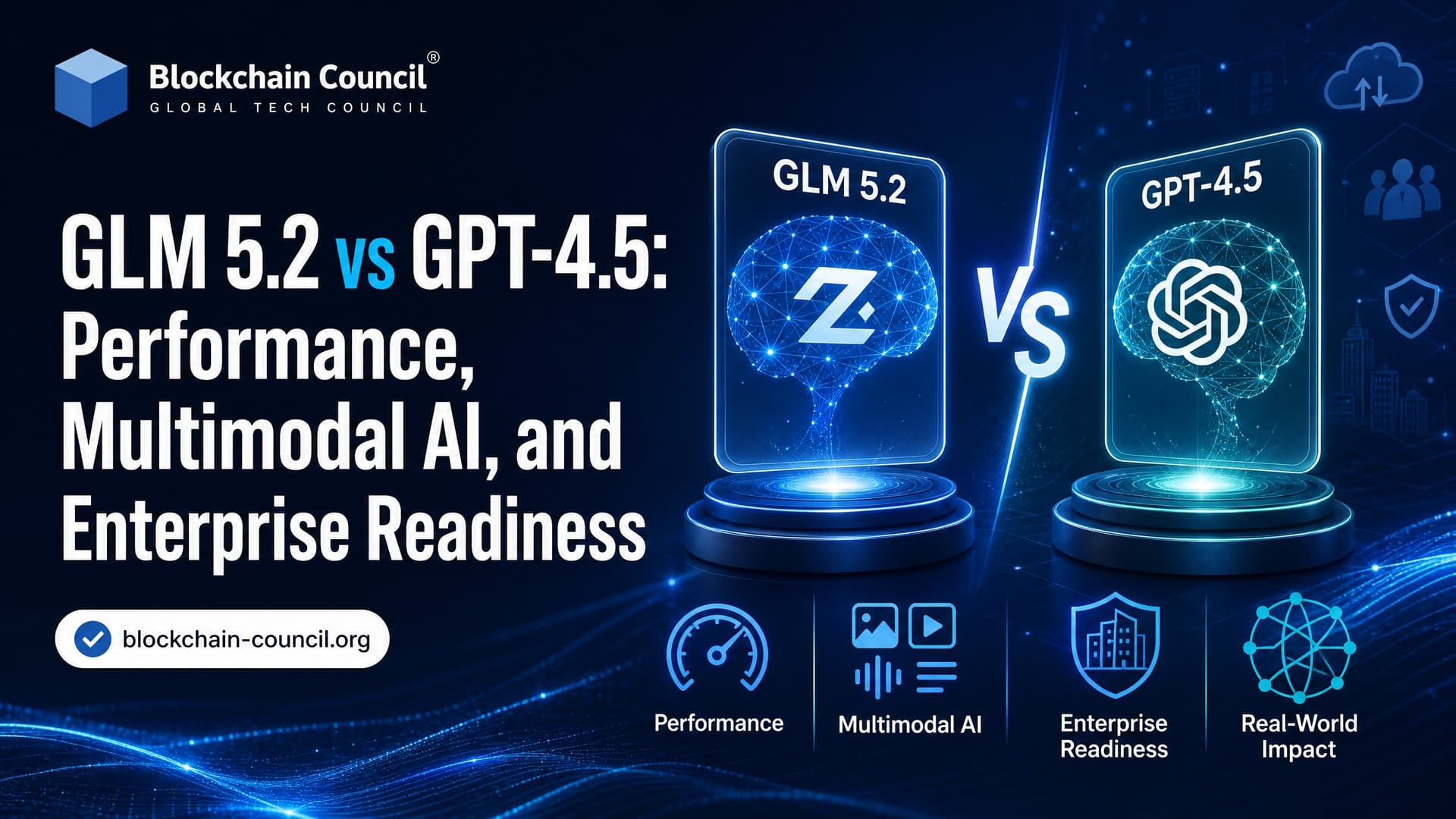
GLM 5.2 vs GPT-4.5 is not a simple open model versus closed model debate. The better question is where you plan to run the model, what risk you can accept, and whether your workload is closer to repository-scale engineering or customer-facing assistance. GLM 5.2 is built for open deployment, long context, coding agents, and tool use. GPT-4.5 is a proprietary frontier model focused on safer general-purpose interaction, lower hallucination, and enterprise platform integration.
That difference matters. A bank building an internal smart contract audit assistant has different needs from a crypto exchange deploying a multilingual support agent. Same AI budget. Very different model choice.

As organizations evaluate frontier AI models for enterprise use, developing as an AI Expert can help professionals build practical skills in model selection, AI governance, long-context reasoning, and deploying AI systems for real-world business and engineering workflows.
GLM 5.2 vs GPT-4.5 at a Glance
Best for coding agents: GLM 5.2, especially for large repositories and tool-heavy workflows.
Best for customer-facing assistants: GPT-4.5, mainly because of stronger alignment and reduced hallucination.
Best for private deployment: GLM 5.2, due to its open weight model approach.
Best for managed enterprise adoption: GPT-4.5, if your organization already uses OpenAI APIs and governance controls.
Best for long context: GLM 5.2, with reported API context windows around 1 million tokens.
Performance Comparison: Coding, Reasoning, and Accuracy
GLM 5.2 performance strengths
GLM 5.2 is positioned as one of the strongest open weight AI models for coding, long-horizon reasoning, and agentic AI. Published benchmark summaries place it at 81.0 on Terminal Bench 2.1, up sharply from GLM 5.1 at 62.0. On SWE Bench Pro, it improves from 58.4 to 62.1, which is meaningful for repository-level software tasks where models must read existing code, modify multiple files, and reason across tests.
That last part is where many models fail. In real engineering work, the hard task is rarely writing a single function. It is finding the caller three directories away, checking the test fixture, updating the migration, then not breaking CI. If you have ever watched an agent edit a TypeScript monorepo and forget that pnpm-lock.yaml must change with package.json, you know why repository reasoning is a serious benchmark, not a marketing number.
GLM 5.2 also introduces selectable thinking modes. In practical terms, you can trade latency and token cost against reasoning depth. Use a lighter mode for simple extraction or classification. Use maximum effort for refactoring, multi-tool plans, or code review. This is useful in production because not every request deserves the most expensive reasoning path.
GPT-4.5 performance strengths
GPT-4.5, released by OpenAI as a research preview in February 2025, improves on earlier GPT models in accuracy, factuality, and conversational quality. OpenAI described the model as a step forward in scaled pre-training and post-training, with better pattern recognition and fewer inaccurate claims than prior GPT releases.
One widely discussed evaluation reported a hallucination rate of about 37.1 percent for GPT-4.5 compared with 61.8 percent for GPT-4o on challenging tests. Treat that number carefully, because hallucination rates vary by benchmark and prompt style. Still, the direction is clear: GPT-4.5 is built to be more reliable in open-ended, human-facing interactions.
For business users, this matters more than raw benchmark wins. A support assistant that invents a refund policy is a liability. A compliance copilot that fabricates a regulatory quote is worse. GPT-4.5 is better suited when tone, caution, and factual discipline are central requirements.
Multimodal Capabilities: Design Workflows vs Integrated Interaction
Where GLM 5.2 stands out
GLM 5.2 is described as multimodal and stronger than earlier GLM releases on visual and design-related tasks. Reports from design arena evaluations and creator workflows point to strong performance in UI design, marketing assets, and procedural visual generation. It also fits agentic workflows where image understanding, code generation, and tool calls must work together.
For example, a product team could use GLM 5.2 to inspect a UI mockup, generate React components, update design tokens, and open a pull request through an agent framework. That is not science fiction anymore. The catch is engineering quality. Your tool schemas must be clean. A common failure in Model Context Protocol setups is the JSON-RPC error -32601 Method not found, usually caused by a mismatch between the tool name the agent calls and the method exposed by the MCP server. The model may look wrong, but the wiring is often the real bug.
Where GPT-4.5 fits better
GPT-4.5 is less publicly defined by specialist vision benchmarks and more by integrated, general-purpose interaction. OpenAI's messaging emphasizes warmer dialogue, better understanding of user intent, and improved factuality. That makes GPT-4.5 a strong candidate for products that combine text, voice, and image inputs under a managed service.
If your enterprise wants a polished assistant inside a CRM, help desk, learning platform, or internal knowledge base, GPT-4.5 is the safer default. It may not be the best model for every design-generation pipeline. But for multimodal enterprise AI where users expect consistent responses and careful language, it has a clear advantage.
Enterprise Readiness: Control, Cost, Compliance
GLM 5.2 for private and regulated deployments
The biggest reason to choose GLM 5.2 is control. As an open weight model, it can be self-hosted, fine-tuned, and deployed in private cloud or on-premise environments. That matters for financial services, healthcare, defense, blockchain infrastructure, and any organization with strict data residency rules.
You can place GLM 5.2 behind a private VPC, restrict internet egress, define your own retention policy, and connect it to internal systems without sending sensitive prompts to a third-party model provider. That does not automatically make it compliant. You still need logging, access controls, red-team testing, and model risk documentation. But the architecture gives you room to design those controls yourself.
Cost predictability is another point in GLM 5.2's favor. The thinking modes help teams avoid using maximum reasoning on routine requests. At scale, that is not a minor detail. A document classifier, a code search helper, and an autonomous migration agent should not all run with the same inference budget.
GPT-4.5 for managed enterprise adoption
GPT-4.5 wins when speed of deployment and managed governance matter more than infrastructure control. OpenAI's API ecosystem, safety updates, monitoring options, and developer tooling reduce the operational burden for teams that do not want to host frontier-scale models.
This is especially relevant for customer-facing applications. GPT-4.5's improved emotional nuance and lower hallucination profile make it well suited to support agents, writing assistants, internal copilots, and executive communication tools. You still need retrieval-augmented generation, policy constraints, and human escalation paths. No model should answer legal, financial, or healthcare questions without guardrails. But GPT-4.5 starts from a stronger position for broad, conversational reliability.
Professionals who work extensively with OpenAI's ecosystem can also benefit from becoming a ChatGPT Expert, developing practical expertise in prompt engineering, AI-assisted productivity, workflow automation, and enterprise implementation of ChatGPT-powered solutions.
Use Cases for Blockchain, Web3, and Software Teams
For Blockchain Council readers, the GLM 5.2 vs GPT-4.5 decision becomes clearer when mapped to real work.
Smart contract audit assistants: GLM 5.2 is the better fit if you need long context over Solidity code, tests, deployment scripts, and protocol documentation.
Protocol documentation Q&A: GLM 5.2 works well for private document reasoning, while GPT-4.5 is better for polished external answers.
Crypto customer support: GPT-4.5 is preferable because hallucination control and tone are critical.
Developer copilots: Use GLM 5.2 for repo-scale automation and GPT-4.5 for explanation, debugging help, and onboarding docs.
Compliance assistants: GPT-4.5 is a better starting point, but only with retrieval from approved policy sources.
A practical Web3 example: if your agent reviews an ERC-20 contract, it must understand Solidity 0.8.x overflow checks, proxy patterns, role-based access control, and how tests simulate EIP-1559 gas mechanics. A shallow chatbot will miss the context. A long-context coding model like GLM 5.2 can inspect more of the project at once. GPT-4.5 can then help translate the findings into a clear report for non-technical stakeholders.
Which Model Should You Choose?
Choose GLM 5.2 if you need:
Open weight deployment
Private infrastructure control
Long-context reasoning across repositories or document sets
Agentic tool use with MCP or custom orchestration
Lower operating cost through controllable reasoning effort
Choose GPT-4.5 if you need:
Managed API access with less infrastructure work
Lower hallucination risk in user-facing workflows
Better conversational tone and emotional nuance
Fast integration into existing OpenAI-based systems
Strong general-purpose performance across business tasks
To be blunt, GLM 5.2 is the more interesting model for engineering teams building internal agents. GPT-4.5 is the more practical model for most enterprises shipping assistants to employees or customers. The best teams will use both: open models for controlled automation, proprietary models for high-trust interaction.
Skills Professionals Need to Evaluate These Models
Model selection is now an engineering discipline. You need to understand context windows, retrieval design, prompt evaluation, tool calling, latency budgets, and governance. If you are building in this area, consider structured learning through Blockchain Council programs such as Certified Generative AI Expert™, Certified Prompt Engineer™, and Certified Artificial Intelligence (AI) Expert™. For Web3 teams applying AI to protocol security or dApp operations, Certified Blockchain Expert™ and smart contract-focused training can also support the technical foundation.
A Tech Certification can further strengthen this learning path by expanding your understanding of cloud platforms, software engineering, automation frameworks, and emerging technologies that support secure enterprise AI deployments.
Start with a small benchmark of your own. Take ten real tasks from your backlog: one refactor, one support case, one compliance question, one design prompt, one smart contract review. Run both models under the same constraints. Track accuracy, latency, cost, refusal quality, and human correction time. That test will tell you more than a leaderboard.
As enterprise AI platforms continue to gain wider adoption, a Marketing Certification can also help professionals understand product positioning, customer communication, user adoption, and go-to-market strategies for AI-powered business solutions.
FAQs
1. What Is GLM 5.2?
GLM 5.2 is a large language model developed by Zhipu AI for reasoning, coding, multilingual communication, AI agents, document analysis, and enterprise AI applications.
2. What Is GPT-4.5?
GPT-4.5 is an OpenAI large language model designed for natural language understanding, reasoning, coding, content generation, and conversational AI. (Availability may depend on the platform and deployment.)
3. What Are the Main Differences Between GLM 5.2 and GPT-4.5?
Both are advanced LLMs that support reasoning, coding, and enterprise AI. Differences depend on deployment, supported features, integrations, pricing, context limits, multilingual performance, and ecosystem rather than a single benchmark.
4. Which Model Is Better for Coding?
Both models support code generation, debugging, documentation, and code explanation. Performance varies based on programming language, prompt quality, project complexity, and implementation.
5. Which Model Performs Better in Reasoning Tasks?
Both are designed for complex reasoning and problem-solving. Actual performance depends on the specific benchmark, prompt design, and task rather than a universal ranking.
6. Which Model Supports More Programming Languages?
Both support widely used programming languages such as Python, JavaScript, TypeScript, Java, C++, Go, Rust, SQL, HTML, and CSS.
7. Which Model Is Better for AI Agents?
Both can power AI agents that perform planning, tool use, workflow automation, and task execution. Agent quality depends heavily on orchestration, memory, tools, and system design.
8. Which Model Is Better for Enterprise Applications?
Both are suitable for enterprise use cases including customer support, document processing, software development, knowledge management, and workflow automation. The better choice depends on deployment, governance, compliance, and integration needs.
9. Which Model Has Better Multilingual Support?
Both models support multilingual communication and translation. Their effectiveness varies depending on the language pair, training data, and deployment.
10. Which Model Is Better for Long Documents?
Performance on long documents depends on each deployment's supported context window and document-processing features rather than the model name alone.
11. Can Both Models Generate Technical Documentation?
Yes. Both can create API documentation, README files, code comments, technical guides, architecture summaries, and software documentation.
12. Can Both Models Analyze Business Documents?
Yes. They can summarize reports, extract key information, answer questions about documents, and support enterprise knowledge management when integrated appropriately.
13. Which Technologies Can Developers Use with These Models?
Developers commonly integrate them with APIs, AI agents, Retrieval-Augmented Generation (RAG), vector databases, workflow automation platforms, MLOps tools, cloud services, and IDEs.
14. Which Industries Can Benefit from GLM 5.2 and GPT-4.5?
Healthcare, finance, education, legal services, cybersecurity, software development, manufacturing, retail, customer service, logistics, and enterprise IT can benefit from either model.
15. What Are the Benefits of GLM 5.2?
GLM 5.2 offers multilingual capabilities, coding assistance, enterprise AI support, reasoning, document analysis, workflow automation, and AI agent integration.
16. What Are the Benefits of GPT-4.5?
GPT-4.5 provides strong conversational abilities, coding assistance, reasoning, content generation, document understanding, API integration, and support for enterprise AI workflows.
17. How Should Businesses Choose Between GLM 5.2 and GPT-4.5?
Organizations should evaluate both models using their own workloads, comparing response quality, coding accuracy, latency, cost, API features, security, compliance, scalability, and ecosystem compatibility.
18. What Skills Help Developers Use These Models Effectively?
Useful skills include prompt engineering, Python, API integration, AI agent development, Retrieval-Augmented Generation (RAG), workflow automation, MLOps, data analysis, and AI governance.
19. What Common Mistakes Should Organizations Avoid When Comparing AI Models?
Avoid relying only on benchmark scores, ignoring real-world testing, overlooking security and compliance, accepting AI outputs without validation, and choosing a model solely based on popularity. Production performance matters more than marketing headlines. Humans do enjoy crowning champions before running the race.
20. Which Model Should You Choose?
There is no universally "best" model. GLM 5.2 and GPT-4.5 each have strengths depending on the deployment, integrations, pricing, reasoning quality, coding needs, and enterprise requirements. The most reliable approach is to benchmark both against your own datasets, workflows, and business objectives before making a long-term decision.
Related Articles
View All
AI & ML
Built to Catch AI Cheating: Rethinking Pre-Employment Assessments with HireValid
Explore how HireValid is rethinking pre-employment assessments with AI-resistant test design, integrity signals, candidate evidence, and human review to address AI-assisted cheating.

AI & ML
AI-Era Hiring Needs AI-Proof Tests: How HireValid Is Redefining Talent Assessment
Explore how HireValid is rethinking talent assessment for the AI era with job-relevant tests, anti-cheating design, integrity signals, and human-reviewed evidence of candidate ability.
AI & ML
Google Launches Gemini 4 Argon: Features and Capabilities
Google has launched Gemini 4 Argon, its flagship AI model for coding, finance, law, cybersecurity and science. Learn its key features, availability, pricing and safety details.
Trending Articles
What is AWS? A Beginner's Guide to Cloud Computing
Everything you need to know about Amazon Web Services, cloud computing fundamentals, and career opportunities.
Claude AI Tools for Productivity
Discover Claude AI tools for productivity to streamline tasks, manage workflows, and improve efficiency.
How to Create Claude Skills?
Claude Skills are one of the most important features Anthropic has introduced for users who want automation that is structured, consistent and reusable. Instead of giving Claude long instructions ever