

AI vs traditional cybersecurity
 Suyash Raizada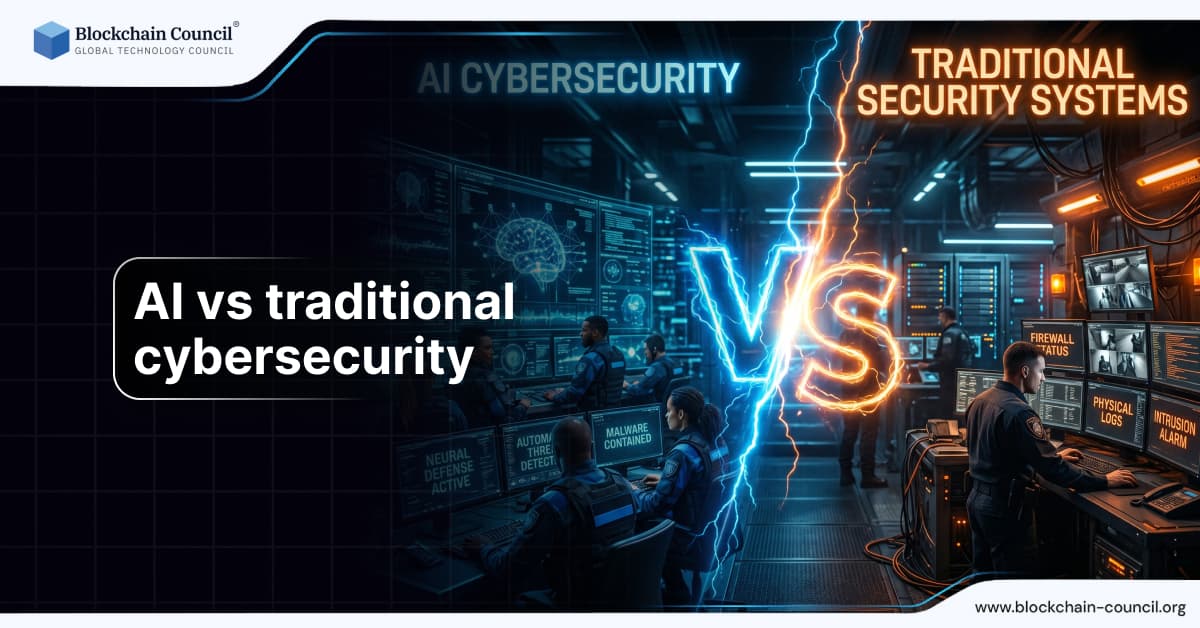
AI vs traditional cybersecurity is no longer a theoretical debate. It is a practical decision that affects detection speed, response time, and resilience against modern threats like deepfake-driven social engineering and AI-generated malware. Traditional security stacks built on signatures and static rules still play an important role, but they increasingly struggle with zero-day vulnerabilities, rapidly changing attacker tactics, and the scale of hybrid cloud environments.
This article explains how AI-driven security works, where traditional tools still fit, and how organizations can build a realistic hybrid defense model.

What is traditional cybersecurity?
Traditional cybersecurity relies on deterministic methods that match known indicators of compromise. Common examples include signature-based antivirus, rule-based intrusion detection systems, static firewall policies, and manual investigations.
Strengths of traditional cybersecurity include:
Predictability and explainability: rules and signatures are straightforward to audit.
Strong performance against known threats: well-documented malware families and known exploit patterns can be blocked quickly.
Policy enforcement: access controls, segmentation, and baseline hardening remain essential.
However, these systems can generate high false positives due to rigid rules and can miss novel or obfuscated attacks, especially when adversaries intentionally mimic normal behavior.
Evaluate AI vs traditional cybersecurity approaches for better threat prevention strategies by gaining expertise through an AI Security Certification, developing systems via a Node JS Course, and promoting solutions using an AI powered marketing course.
What is AI cybersecurity?
AI cybersecurity applies machine learning and analytics to detect, predict, and respond to threats. Instead of relying only on known signatures, AI models learn patterns from telemetry such as user behavior, endpoint activity, network flows, authentication events, and cloud logs.
Key AI security capabilities include:
Behavioral analytics: spotting anomalies like impossible travel logins, unusual privilege escalation, or sudden outbound traffic to unfamiliar regions.
Predictive modeling: prioritizing risks by estimating likelihood and potential impact based on observed patterns.
Automation: accelerating triage, correlating signals across tools, and reducing time to containment.
In high-risk sectors such as energy infrastructure, AI-driven defenses have achieved up to 98% threat detection rates and up to 70% reductions in incident response time, reflecting the advantage of real-time pattern recognition over purely manual workflows.
AI vs traditional cybersecurity: Key differences
1) Detection method: behavior vs signatures
Traditional tools primarily identify threats by matching known signatures or predefined rules. This works well for known malware, but it can fail against:
Zero-day exploits with no known signature
Polymorphic malware that changes its code
Living-off-the-land attacks that use legitimate tools
AI approaches add behavioral analysis and anomaly detection, helping identify unusual activity even when the underlying technique is new.
2) Response time: seconds vs days
One of the largest gaps in AI vs traditional cybersecurity is operational speed. AI can reduce breach identification from days to seconds by continuously monitoring telemetry and correlating weak signals into actionable incidents. Research indicates AI can boost threat detection by up to 60% over legacy systems and significantly cut identification time.
Traditional environments often depend on analyst-driven investigation and ticket-based processes, which can delay containment, particularly during off-hours.
3) Effectiveness against unknown threats
Traditional signature-based security is inherently reactive. When attackers create new variants or exploit unknown vulnerabilities, rule-based scanning may not trigger.
AI-driven defenses are generally more adaptable, particularly when models are trained to recognize suspicious sequences of actions rather than a specific file hash or domain.
4) Scalability and coverage
Modern enterprises generate enormous volumes of logs from endpoints, SaaS applications, cloud services, identity providers, and networks. AI can automate correlation across these sources. This matters as organizations shift toward real-time monitoring, with a significant portion prioritizing continuous visibility and network telemetry to secure hybrid cloud environments.
Traditional tools can scale in infrastructure, but investigation and tuning often remain manual and resource-intensive.
5) False positives and analyst workload
Security teams frequently struggle with alert fatigue. AI can improve detection accuracy and reduce false positives by using context, baselining, and probabilistic scoring, rather than triggering on every rigid threshold crossing.
That said, AI can also introduce new noise if models are poorly trained or data quality is weak, which is why governance and validation are critical.
The modern threat landscape: Why AI changes the game
Attackers are increasingly using AI as a force multiplier. This raises the stakes for defenders and is a central reason AI vs traditional cybersecurity has become a strategic priority.
AI-powered phishing, deepfakes, and vishing
Generative AI can craft highly personalized phishing emails and messages at scale. Deepfake audio and voice cloning enable vishing and business email compromise workflows that bypass casual verification. Defensive AI can help by:
flagging linguistic and behavioral anomalies in messages
detecting unusual sender patterns and authentication mismatches
simulating social engineering campaigns to improve readiness
Adaptive malware and evasion
AI lowers the barrier for less-skilled actors to launch sophisticated campaigns, including malware that mutates to evade static signatures. This creates an AI vs AI dynamic where attackers attempt to imitate normal user and system behavior, while defenders shift toward real-time behavioral detection and continuous verification.
Faster vulnerability discovery and exploitation
AI-assisted scanning can rapidly map networks and prioritize exploitable weaknesses, compressing the time between discovery and exploitation. Defenders can counter with AI-assisted vulnerability prioritization and patch planning based on observed exploit activity and asset criticality.
Real-world use cases: Where AI security delivers measurable value
1) Critical infrastructure and energy
In energy infrastructure, AI-driven security has shown up to 98% detection rates and up to 70% faster response times, helping identify threats that human analysts and static tools may miss in complex operational environments.
2) Hybrid cloud and network telemetry
Organizations are increasingly prioritizing real-time monitoring and network telemetry to secure hybrid cloud deployments. AI is well-suited to analyzing high-volume, high-velocity signals and detecting lateral movement, suspicious API activity, and unusual data egress patterns.
3) Identity and access anomaly detection
Behavior-based AI can detect account takeover signals such as:
unexpected MFA resets
unusual login times and locations
abnormal privilege escalation sequences
4) Incident response acceleration
AI can reduce mean time to detect and mean time to respond by automating enrichment, correlating alerts, and recommending containment actions. With breach rates rising and many organizations reporting annual incidents, speed and consistency are essential.
Limitations and risks of AI cybersecurity
AI is not a universal solution. Security leaders should account for:
Data dependency: poor telemetry and inconsistent logging can degrade model performance.
Adversarial manipulation: attackers can attempt to poison training data or craft inputs that evade detection.
Explainability and compliance: regulated sectors may require interpretable detection rationale and auditable decision trails.
Shadow AI: unsanctioned AI tools and workflows can introduce data leakage and governance gaps.
These risks reinforce the need for a hybrid architecture that combines strong controls, sound processes, and validated AI models.
What a hybrid approach looks like in practice
Industry consensus increasingly points to convergence: traditional tools incorporating AI for better efficacy, rather than a wholesale replacement of existing controls. A practical hybrid defense strategy includes:
Keep signature and rule-based controls for baseline protection, policy enforcement, and known commodity threats.
Layer AI-driven behavioral analytics across endpoints, identity, and network telemetry to detect unknown threats.
Automate response where safe, such as quarantining endpoints, disabling suspicious accounts, or blocking domains, while keeping human approval for high-impact actions.
Continuously validate models with red team testing, threat hunting feedback loops, and drift monitoring.
Invest in skills so teams can operate AI-enabled SOC workflows effectively.
Compare AI-driven cybersecurity with traditional methods to understand efficiency and scalability by mastering systems through an AI Security Certification, implementing solutions via a Python certification, and scaling adoption using a Digital marketing course.
Future outlook: Autonomous response and AI-normalized attacks
The security environment is trending toward autonomous and semi-autonomous AI responses, deeper observability, privacy-preserving analytics, and preparation for quantum-resistant security. At the same time, attackers are expected to normalize AI-driven campaigns, and many security leaders already anticipate frequent AI-driven incidents.
With breaches increasing year over year and the market for generative AI in cybersecurity projected to grow substantially through the next decade, organizations that rely purely on traditional methods risk falling behind in both detection quality and operational speed.
Conclusion
AI vs traditional cybersecurity is best understood as a shift from static, reactive defense to adaptive, real-time security operations. Traditional controls remain valuable for hardening systems and blocking known threats, but AI provides the speed, accuracy, and behavioral insight required to detect unknown attacks, reduce incident response time, and handle the scale of modern telemetry.
The strongest approach for 2026 and beyond is hybrid: combine proven security fundamentals with AI-driven analytics, automation, and continuous validation. Teams that invest in both technology and skills will be better positioned to defend against AI-accelerated adversaries.
FAQs
1. What is the difference between AI and traditional cybersecurity?
AI cybersecurity uses machine learning and automation, while traditional methods rely on rules and signatures. AI is more adaptive. Traditional systems are more static.
2. How does AI improve cybersecurity compared to traditional methods?
AI detects threats faster and more accurately. It adapts to new threats. Traditional methods are slower.
3. Which is more effective: AI or traditional cybersecurity?
AI is more effective for detecting modern threats. Traditional methods still play a role. A hybrid approach works best.
4. How does AI detect threats differently?
AI analyzes behavior and patterns. Traditional systems rely on known signatures. This gives AI an advantage.
5. Can AI replace traditional cybersecurity?
No, AI complements traditional systems. Human expertise is still required. A combined approach is ideal.
6. What are limitations of traditional cybersecurity?
It struggles with new and unknown threats. It relies on predefined rules. This reduces effectiveness.
7. What are advantages of AI cybersecurity?
AI offers automation, speed, and accuracy. It adapts to evolving threats. This improves protection.
8. How does AI reduce response time?
AI processes data instantly and automates actions. It speeds up response. This minimizes damage.
9. What is anomaly detection in AI vs traditional systems?
AI identifies anomalies using data patterns. Traditional systems may miss unknown threats. This improves detection.
10. How does AI improve scalability?
AI handles large datasets efficiently. Traditional systems struggle with scale. This improves performance.
11. What is cost comparison between AI and traditional cybersecurity?
AI may have higher initial costs but reduces long-term expenses. Traditional systems require manual effort. ROI is better with AI.
12. How does AI improve fraud detection?
AI analyzes patterns and detects anomalies. Traditional systems rely on rules. AI is more accurate.
13. What is the role of automation in AI cybersecurity?
Automation reduces manual tasks and improves efficiency. Traditional systems require human intervention. This gives AI an advantage.
14. How does AI improve network security?
AI monitors traffic and detects anomalies. Traditional systems rely on static rules. This improves protection.
15. What industries benefit from AI over traditional cybersecurity?
Industries with large data volumes benefit more. Banking and healthcare use AI widely. Adoption is growing.
16. What are challenges of AI cybersecurity?
Challenges include complexity and implementation costs. Proper training is required. Continuous updates are needed.
17. Can traditional systems still be useful?
Yes, they provide baseline protection. They complement AI systems. This ensures layered security.
18. What is the future of AI vs traditional cybersecurity?
AI will dominate but traditional systems will remain. Hybrid approaches will be common. Security will improve.
19. How does AI improve data protection?
AI monitors and secures data continuously. It detects breaches quickly. This enhances safety.
20. Why is AI better for modern cybersecurity?
It adapts to evolving threats and improves efficiency. It automates processes. It is essential for modern systems.
Related Articles
View All
AI & ML
Jev vs Traditional AI Models
Compare Jev with traditional AI models and LLMs, including differences in architecture, outputs, speed, confidence, automation, and software integration.

AI & ML
OpenAI Launches GPT-6.1 Terra: What’s New?
OpenAI has launched GPT-6.1 Terra, a faster and cheaper mid-tier model with stronger computer use, better image understanding and fewer errors. See what is new, what it costs, and who can use it.

AI & ML
Built to Catch AI Cheating: Rethinking Pre-Employment Assessments with HireValid
Explore how HireValid is rethinking pre-employment assessments with AI-resistant test design, integrity signals, candidate evidence, and human review to address AI-assisted cheating.
Trending Articles
The Role of Blockchain in Ethical AI Development
How blockchain technology is being used to promote transparency and accountability in artificial intelligence systems.

Can DeFi 2.0 Bridge the Gap Between Traditional and Decentralized Finance?
The next generation of DeFi protocols aims to connect traditional banking with decentralized finance ecosystems.
How to Create Claude Skills?
Claude Skills are one of the most important features Anthropic has introduced for users who want automation that is structured, consistent and reusable. Instead of giving Claude long instructions ever