

Human vs AI in Cybersecurity: Where Analysts Still Beat Automation and How to Build a Hybrid Defense Team

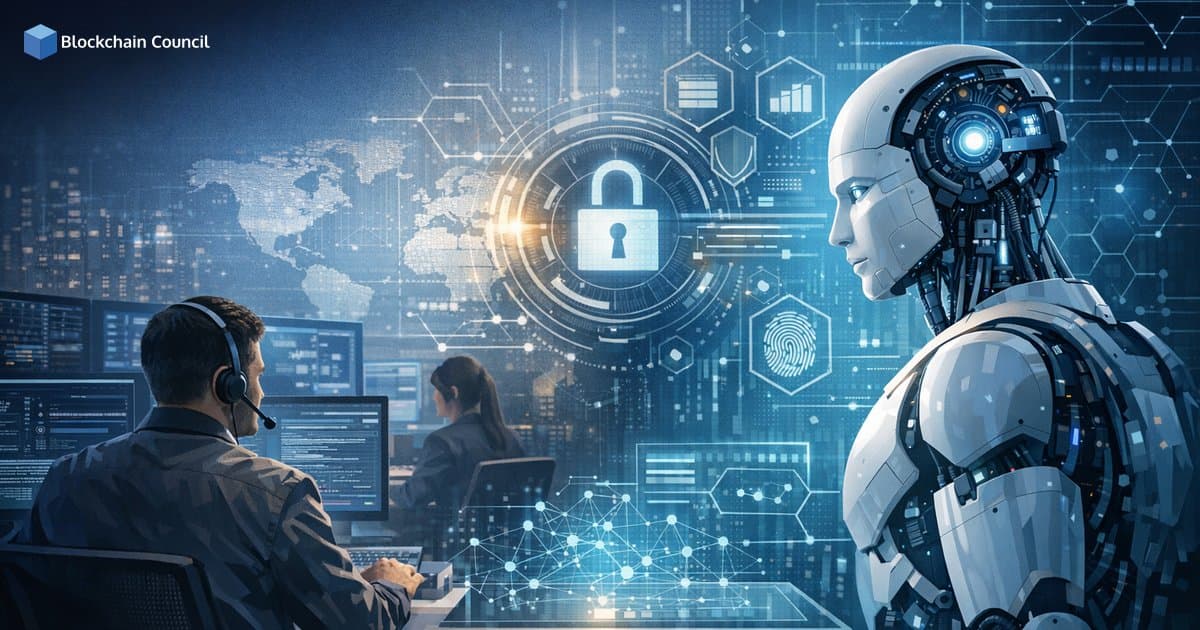
Human vs AI in cybersecurity is no longer a debate about replacement. It is a design question: which tasks should be automated for speed and scale, and which decisions must remain human because they require context, creativity, and accountability. Across security operations centers (SOCs), incident response teams, and governance functions, the best-performing programs are converging on hybrid human-AI defense teams where AI handles volume and humans handle ambiguity, strategy, and risk ownership.
This shift is accelerating as AI improves defensive outcomes while simultaneously boosting attacker capability. Industry survey data shows that 95% of users believe AI-powered cybersecurity solutions improve the speed and efficiency of prevention, detection, response, and recovery. At the same time, generative AI is helping adversaries craft more convincing phishing campaigns, automate reconnaissance, and scale fraud through deepfake voice and video.

Current State of AI in Cybersecurity
AI is now embedded in many core security workflows, particularly where pattern recognition and automation can reduce workload and time to response. Common applications include:
- Behavior analytics to detect unusual network activity and potential intrusions.
- Phishing and fraud detection across email, messaging, and identity signals.
- Incident response automation through playbooks that contain known threats quickly.
- Large-scale data analysis across logs, alerts, and telemetry to surface hidden risks.
Defenders are not the only ones using AI. Adversaries increasingly use generative AI to produce tailored phishing at higher volume and faster pace, and to enhance social engineering through deepfakes. Research highlights how difficult this is for people to detect unaided, with documented high open and click rates for AI-generated phishing. In real incidents, AI voice cloning has been linked to high-value fraud, including a widely reported 25 million USD heist involving AI-generated voices.
Where Human Analysts Still Beat Automation
AI is a powerful tool, but it is not a substitute for human judgment. The areas where humans outperform automation are precisely where security outcomes depend on understanding intent, business priorities, and second-order consequences.
1) Business Context, Risk Appetite, and Intent
AI can flag anomalies, but it often cannot reliably determine whether an anomaly is meaningful in the context of:
- Critical business processes and high-value assets
- Planned operational changes such as maintenance, migrations, or new integrations
- Organizational risk appetite and compliance obligations
Human analysts and risk owners decide whether a suspicious event represents a true incident, an acceptable deviation, or a false positive that should not disrupt operations.
2) Creativity and Adversarial Reasoning for Novel Attack Paths
Most AI detections are learned from historical patterns. When attackers chain techniques in new ways, use low-signal tradecraft, or exploit unusual combinations of identity, cloud, and application weaknesses, humans are still better at:
- Hypothesis-driven threat hunting grounded in intuition and experience
- Red teaming and purple teaming that blends social and technical approaches
- Threat modeling that anticipates attacker next steps before they occur
3) Deception Awareness and Social Engineering Defense
AI can detect many phishing patterns, but social engineering defense also depends on human factors: relationship history, urgency manipulation, insider motivations, and organizational culture. AI amplifies social engineering risk and deepfake credibility, yet user education, training design, and behavior change remain fundamentally human-led capabilities.
4) Ethical Judgment, Accountability, and Regulatory Interpretation
Some decisions cannot be delegated to an automated model without creating unacceptable legal and operational risk. These include:
- Shutting down critical systems
- Notifying customers, regulators, or law enforcement
- Attributing an incident to a specific actor
- Accepting risk trade-offs that affect safety or revenue
Security leadership is accountable for outcomes, and that accountability requires human authorization, documentation, and governance.
5) Complex Investigations and Strategic Response
AI can surface indicators of compromise quickly, but humans excel at turning scattered signals into a coherent picture: attacker objectives, access paths, persistence methods, and root cause. Human investigators also coordinate remediation across engineering, IT, legal, communications, and executive stakeholders - a socio-technical process that goes well beyond detection.
6) Securing AI Systems Themselves
As organizations deploy generative AI and machine learning systems, those models and pipelines become part of the attack surface. Humans are still needed to design controls against:
- Prompt injection and data exfiltration through AI interfaces
- Data poisoning and model manipulation
- Abuse of AI tools and privilege misuse
- AI governance, monitoring, and incident handling
Where AI and Automation Clearly Excel
In the human vs AI in cybersecurity comparison, AI is strongest when tasks are high-volume, time-sensitive, and repetitive, or when detection requires correlating signals at a scale beyond human capacity.
1) Scale, Speed, and Alert Noise Reduction
AI can ingest and correlate endpoint, network, identity, and cloud telemetry continuously. This reduces manual triage and can improve detection-to-response time, particularly when compared with rule-based systems that tend to generate excessive false positives.
2) Phishing and Anomaly Detection at the Edge
AI-based filtering and scoring can identify suspicious messages and login anomalies quickly, reducing user exposure. This is increasingly important because humans are often poor at identifying AI-generated content unaided, especially deepfakes and voice cloning attempts.
3) Automated Incident Response and SOAR
Automation can execute consistent, audited actions for well-understood events, such as:
- Blocking known malicious IPs and domains
- Quarantining infected endpoints
- Resetting credentials after credential stuffing indicators
- Disabling suspicious sessions based on defined thresholds
This frees human analysts to focus on the incidents where judgment and investigation matter most.
4) Penetration Testing Augmentation
AI can help generate test cases, simulate attacker behavior at scale, and explore payload variations for security validation. Human testers remain critical to define realistic scenarios, interpret results, and translate findings into actionable remediation plans.
How to Build a Hybrid Human-AI Defense Team
The goal is not simply to adopt AI tools. The goal is to redesign workflows so that automation absorbs volume while humans own high-stakes decisions.
Step 1: Define a Clear Division of Labor
Let AI own:
- High-volume telemetry analysis across endpoint, network, and cloud sources
- Pattern-based detection, anomaly scoring, and baseline modeling
- First-line alert clustering and enrichment
- Automated containment for low-risk, well-defined scenarios
Let humans own:
- Threat modeling, red teaming, and creative threat hunting
- Complex investigations, scoping, and attacker narrative development
- Risk acceptance decisions, policy design, and regulatory interpretation
- Security culture, training strategy, and executive communication
Step 2: Build Hybrid Roles and Skills
Hybrid defense teams require skills that cut across cybersecurity and AI:
- AI-literate SOC analysts who can validate model outputs, recognize limitations, and identify failure modes.
- Security data specialists who manage detection engineering, feature quality, drift monitoring, and secure data pipelines.
- AI security specialists who focus on securing models, applications, and AI integrations against abuse.
Internal training plans often map well to structured certification pathways. Teams commonly combine cybersecurity credentials such as the Certified Cybersecurity Expert with AI-focused learning and role-specific tracks in security operations and governance to build the cross-disciplinary skills these hybrid roles demand.
Step 3: Operationalize Human-in-the-Loop Workflows
High-performing SOCs implement repeatable patterns:
- AI-first triage, human-led escalation: AI ranks incidents by risk and enriches context; humans validate and investigate top cases.
- Mandatory human authorization for high-impact actions including outages, large-scale quarantines, public disclosure, and regulatory notifications.
- Feedback loops where analysts label false positives and missed detections, with those labels improving detection logic and model tuning over time.
Step 4: Add Governance for AI Use in Security
Because AI both defends and creates new risks, governance needs to cover:
- Acceptable use policies for generative AI in investigations and reporting
- Data handling rules for sensitive logs, customer data, and regulated information
- Model documentation covering training sources, validation, and monitoring
- Adversarial testing to evaluate prompt injection, data leakage paths, and abuse scenarios
Conclusion: Human vs AI in Cybersecurity Is a False Choice
The practical answer to human vs AI in cybersecurity is that both are necessary, but they should do different jobs. AI excels at speed, scale, and repetitive processing. Human analysts still beat automation where context, creativity, deception awareness, and accountability drive outcomes. Organizations that will outperform in the AI-driven threat landscape are those that deliberately build hybrid human-AI defense teams, redesign SOC workflows for human-in-the-loop control, and continuously upskill staff in both cybersecurity fundamentals and AI literacy.
As AI becomes a standard layer of cyber defense and an accelerant for attackers, security leaders should focus on division of labor, role design, and governance. That is how you turn automation into a force multiplier without sacrificing the human judgment that still decides the hardest incidents.
Related Articles
View All
AI & ML
Jev for Software Automation
Explore how Jev supports software automation with fast, typed, probabilistic decisions for routing, scoring, classification, verification, branching, and workflow control.
AI & ML
System One AI for Automation
Explore how System One AI can support automation with fast, structured, probabilistic decisions for routing, scoring, verification, workflow control, and real-time software tasks.
AI & ML
Can AI Models Train Themselves Without Human Intervention?
AI models can partially train themselves through self-supervision, self-critique, and AI feedback, but human oversight remains essential.
Trending Articles
The Role of Blockchain in Ethical AI Development
How blockchain technology is being used to promote transparency and accountability in artificial intelligence systems.
How Blockchain Secures AI Data
Understand how blockchain technology is being applied to protect the integrity and security of AI training data.
What is AWS? A Beginner's Guide to Cloud Computing
Everything you need to know about Amazon Web Services, cloud computing fundamentals, and career opportunities.