Can AI Spot the Bitcoin Boom?
 Michael Willson
Bitcoin and other cryptocurrencies move fast—and sometimes unpredictably. The question many traders and analysts ask is: can artificial intelligence truly spot the next Bitcoin boom before it happens? The short answer: yes, with caveats. AI can detect signals and patterns that humans might miss, but it cannot guarantee predictions in a volatile, sentiment-driven market. In this article, we will explore how AI is currently used in crypto forecasting, what tools are available, and where the limitations lie. For those interested in deepening their skills in AI finance, programs like the AI powered investor program offer routes to blend algorithmic insight with investment strategy.
AI in Predicting Bitcoin Boom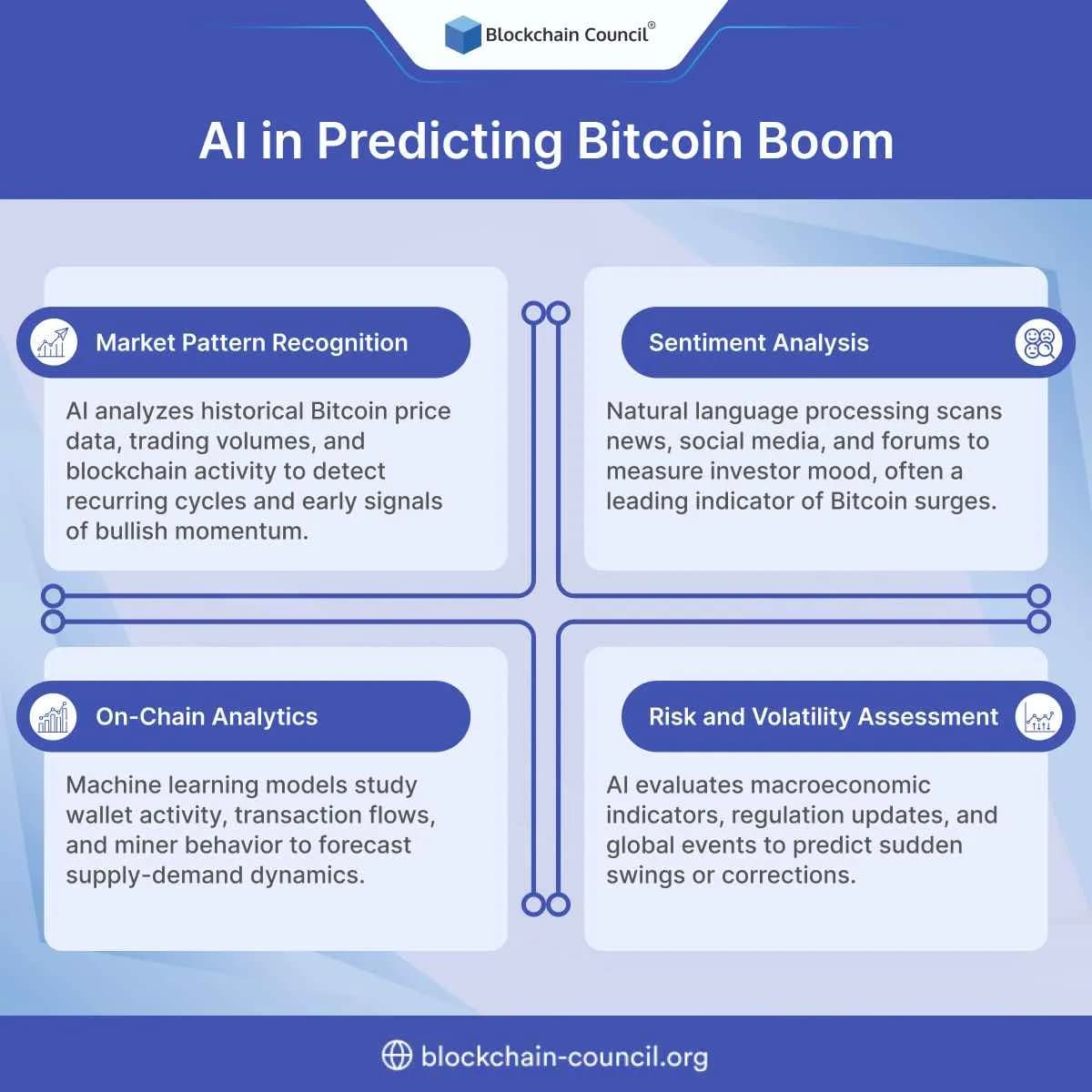
Market Pattern Recognition
AI analyzes historical Bitcoin price data, trading volumes, and blockchain activity to detect recurring cycles and early signals of bullish momentum.

Sentiment Analysis
Natural language processing scans news, social media, and forums to measure investor mood, often a leading indicator of Bitcoin surges.
On-Chain Analytics
Machine learning models study wallet activity, transaction flows, and miner behavior to forecast supply-demand dynamics.
Risk and Volatility Assessment
AI evaluates macroeconomic indicators, regulation updates, and global events to predict sudden swings or corrections.
Limitations
- Bitcoin’s volatility makes precise timing difficult
- Black swan events (e.g., regulatory bans) are hard to forecast
- AI should be seen as a decision-support tool, not a guarantee
Why AI and Bitcoin seem made for each other
Bitcoin’s market moves are influenced by huge volumes of data—on-chain flows, exchanges, social sentiment, news, and macroeconomics. That’s exactly the kind of noisy, high-dimensional environment where AI and machine learning excel. While humans struggle to parse dozens of indicators at once, AI models can ingest dozens or hundreds of features and compute interactions.
More importantly, AI can uncover non-linear relationships that often drive big price moves. For example, a sudden inflow from large wallets, combined with heavy social media chatter and mild regulatory news, might create a “perfect storm” that human models won’t see until after the move. AI can flag these scenarios before they unfold.
Add to that automation: some systems can automatically execute or suggest trades based on thresholds. This reduces delay and emotional bias. In crypto, where milliseconds matter, that speed can be the difference between profit and loss.
What AI models look for in Bitcoin
To understand how AI forecasts work, we should look at the signals they commonly use. A typical predictive AI model for Bitcoin might include:
- On-chain flows: Large transfers to or from exchanges, wallet balances, movement by “whales.”
- Exchange metrics: Order book depth, volume surges, spread changes, whale order imbalances.
- Sentiment & social data: Volume of posts on Twitter/X, Reddit mentions, news headlines, fear/greed indices.
- Technical indicators: Trend momentum, moving averages, volatility measures, oscillators like RSI.
- Macro and regulatory signals: Policy announcements, institutional adoption, macroeconomic shifts (e.g. interest rate changes).
By combining these, AI can spot frontrunner patterns. For instance, unusually large off-exchange transfers + rising social attention + low volatility could hint at a brewing breakout. A human might catch one or two of these, but AI can integrate dozens.
Moreover, recent research shows that fine-tuning language models with market-derived sentiment labels (rather than generic human labels) yields substantially better predictive accuracy—up to ~89.6 % in event forecasting across a dataset of 227 crypto news events. This suggests that aligning sentiment analysis to market reactions is powerful.
Tools and Platforms Using AI in Crypto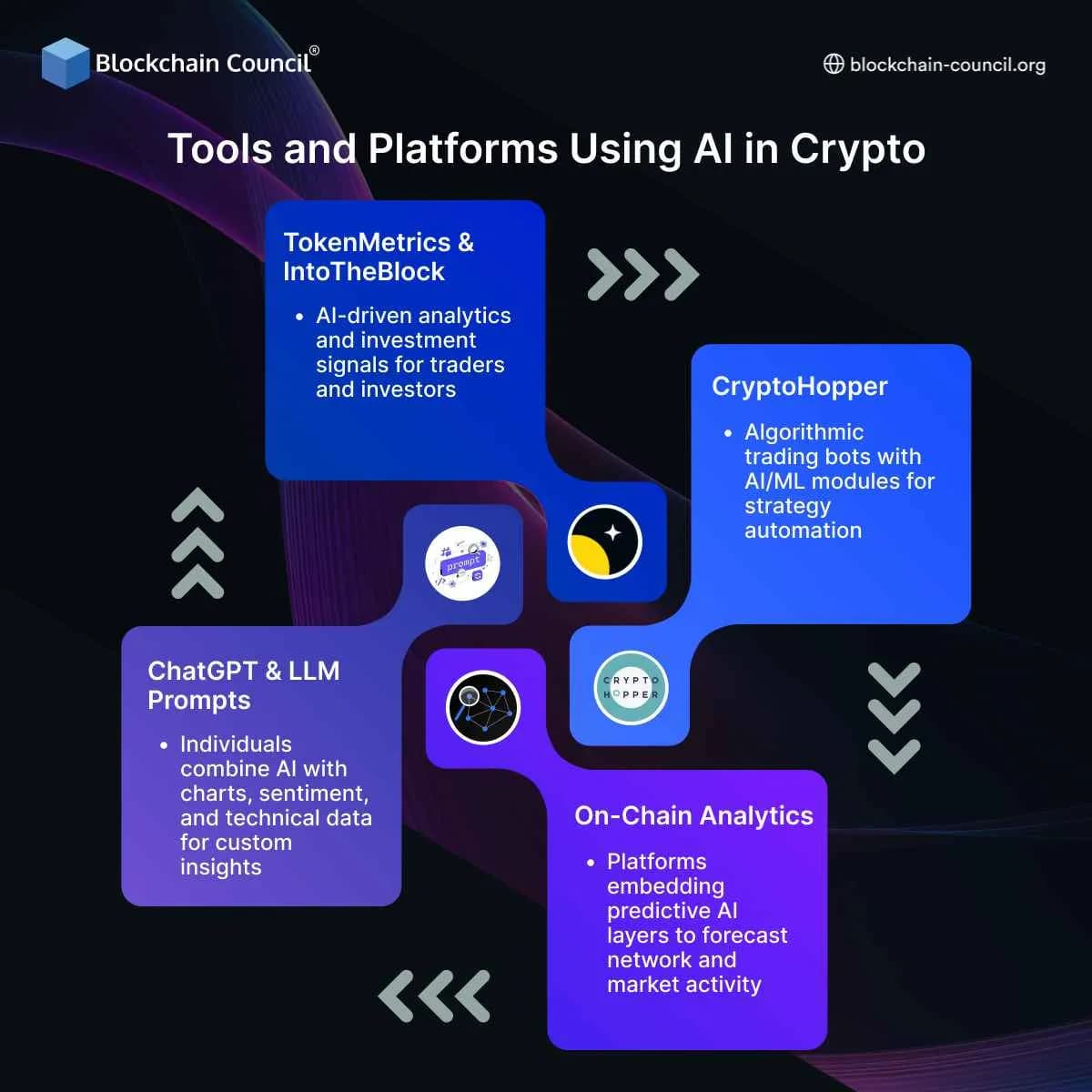
TokenMetrics & IntoTheBlock
- AI-driven analytics and investment signals for traders and investors
CryptoHopper
- Algorithmic trading bots with AI/ML modules for strategy automation
On-Chain Analytics
- Platforms embedding predictive AI layers to forecast network and market activity
ChatGPT & LLM Prompts
- Individuals combine AI with charts, sentiment, and technical data for custom insights
AI in crypto is not just academic theory—it’s live in tools and platforms today:
- TokenMetrics and IntoTheBlock provide AI-driven analytics and signals to investors.
- CryptoHopper offers algorithmic trading bots that can use AI / ML modules.
- On-chain analytics platforms are increasingly embedding predictive layers.
- Individuals use ChatGPT or LLM prompts combining price charts, sentiment data, and technical metrics.
Some platforms even bundle training and execution into AI trading program offerings. As AI becomes more accessible, even retail investors can leverage models that were once in institutional hands.
Another structured path is through formal training. For example, a crypto certification offered by recognized institutions teaches traders how to apply algorithms, understand on-chain data, and integrate AI tools into their decision-making. These credentials help connect theory to practice.
Case studies and cautionary tales
Several predictions made by AI or algorithmic systems have gained attention. Some systems forecast Bitcoin hitting high price targets in short time frames (e.g. $130K or $200K within months). Many of these are speculative and lack rigorous backing. Market crashes, regulatory surprises, or macro shocks often invalidate predictions.
One strong approach is event-based modeling. Models that focus on specific events—like ETF approvals, adoption announcements, or policy changes—tend to perform better than pure price models. By tying forecast to real catalysts, AI predictions anchor themselves to detectable triggers rather than chasing purely statistical patterns.
Still, there are many cautionary tales. When markets shift regimes (e.g. moving from bull to bear), models trained on past bullish data may break down. Overfitting—models learning quirks of the training period—remains a real risk. And because many AI models are black box, users often don’t know when the model’s “confidence” is low and may blindly trust poor signals.
Where AI struggles with spotting a boom
It is important to recognize the limits:
- Unpredictable external shocks
Black swan events (e.g. government crackdowns, macro collapses, regulatory bans) are beyond model forecasting. AI can flag patterns but not foresee surprise policy shifts.
- Changing regime dynamics
Market structures evolve. What worked last bull run may fail next time. Models must frequently retrain but still might lag new environments.
- Data noise and false positives
Crypto data streams are messy. Social sentiment spikes, wallet flows, or media news by themselves often mislead. AI must learn to filter noise, but that filtering is imperfect.
- Explainability and trust
If a model flags a sudden breakout but cannot explain why, even experienced traders hesitate to trust it with capital at risk. Explainability is a barrier to adoption.
- Latency and execution risk
Timing is crucial. AI predictions must translate into action quickly. Slower systems or execution delays erode signal value.
- Feedback loops and market impact
If many traders use similar AI systems, they may crowd into the same trades, reducing marginal gains and amplifying volatility. The model that spots the boom first may suffer when too many users jump in.
Why AI-augmented traders may have an edge
Despite these challenges, AI offers advantages that can shift edges:
- Speed: AI processes information faster than humans, allowing earlier entry and exit.
- Pattern detection: AI may spot irregularities invisible to human eyes.
- Scalability: AI can monitor dozens of coins and markets simultaneously.
- Emotionless execution: AI trades based purely on data, guarding against fear or greed.
- Adaptive retraining: With proper pipelines, AI models can update more regularly than human strategies.
For this reason, many professional crypto funds and hedge firms are allocating to AI-driven strategies. Retail traders adopting hybrid models (human oversight + model suggestions) may also gain significant advantage.
The rising role of AI education in crypto investing
To effectively use AI in spotting Bitcoin booms, traders need not only tools but also skills. Understanding model dynamics, risk measures, data pipelines, and validation is critical. That is where structured education adds value.
One path is the AI powered investor program, which blends AI theory, financial strategy, and applied crypto forecasting. Such programs help participants design pipelines, choose features, backtest models, and interpret outputs. They push learners to understand not just “what the AI says” but “why it says it.”
At the same time, a crypto certification teaches traders the fundamentals of blockchain, tokenomics, and market structure. These foundations are essential because AI systems only work well when they are fed meaningful, contextual data.
Putting these elements together—technical training, certification, and platform usage—can help traders move beyond guesswork and toward structured, informed investing.
Moving from Predictions to Strategies
Spotting a Bitcoin boom is not just about predicting the price—it is about turning those predictions into actionable strategies. AI gives traders two key advantages here: adaptability and automation.
- Adaptability: Markets shift constantly. AI models can be retrained on new data, adjusting to different conditions faster than human-designed strategies.
- Automation: Algorithms can execute trades the moment certain thresholds are met, ensuring that opportunities are not lost in the lag between analysis and action.
For example, an AI model might flag unusual stablecoin inflows to exchanges, rising sentiment on Twitter/X, and a tightening order book. Instead of a trader manually checking all of these, the model can issue a buy signal immediately.
But turning prediction into profit is not straightforward. Slippage, liquidity, and execution risk can erode potential gains. This is where advanced education—through structured learning such as the AI powered investor program—becomes vital. These programs help investors understand how to translate insights into robust trading strategies.
Beyond Bitcoin: Can AI See Wider Crypto Trends?
Although Bitcoin remains the flagship cryptocurrency, AI systems are increasingly applied to the broader market. Ethereum, Solana, and other altcoins often follow patterns related to Bitcoin but also develop independent booms. AI models can track cross-chain data, liquidity flows into DeFi protocols, and NFT market activity.
The ability to predict when capital will rotate from Bitcoin into altcoins, or when institutional money will enter a new sector, can give traders a major edge. For example, AI models that track stablecoin minting and exchange outflows may detect early shifts toward DeFi lending platforms or new blockchain ecosystems.
For this reason, a crypto certification remains highly relevant. Understanding tokenomics, governance models, and the fundamentals of different blockchain ecosystems is essential context for interpreting AI signals. Data alone is not enough; knowledge of how crypto markets function ensures that predictions are applied correctly.
How AI Strengthens Risk Management
In crypto, the biggest enemy is not missing a boom—it is getting caught in a crash. This is where AI’s role in risk management shines.
AI-driven models can stress test portfolios under multiple scenarios:
- What if Bitcoin drops 15% overnight?
- What happens if a major exchange faces a liquidity crisis?
- How does a sudden regulatory ban ripple across altcoins?
By simulating thousands of possibilities, AI can help investors design stop-loss strategies, rebalance portfolios, or hedge positions. AI is also excellent at detecting anomalies. For instance, if an exchange suddenly shows withdrawal spikes, models can flag potential liquidity risks before they become public crises.
The integration of AI trading program offerings into risk dashboards reflects this trend. It is no longer just about chasing profit but also about building resilience in portfolios.
Education as a Hedge Against Uncertainty
A powerful theme emerging in the AI-and-Bitcoin conversation is education. In markets where hype often outpaces reality, knowledge is the ultimate hedge.
- Programs like the AI powered investor program teach investors to build, test, and evaluate AI models rather than blindly trust them.
- A crypto certification ensures that learners understand blockchain mechanics, decentralized finance, and token movements.
- Broader tech certifications provide a foundation across AI, blockchain, and emerging technologies—crucial for professionals aiming to integrate crypto with the wider digital economy.
Together, these pathways empower investors to make decisions grounded in both technology and financial acumen.
Institutional Adoption: A Data Goldmine for AI
One of the strongest signals of a Bitcoin boom is institutional involvement. When hedge funds, ETFs, or pension funds move into Bitcoin, volumes spike. AI excels at detecting these institutional footprints:
- ETF flows: Monitoring inflows and outflows into Bitcoin ETFs.
- Custody movements: Tracking wallets linked to major custodians.
- Public filings: Scanning SEC or equivalent reports for new exposures.
By correlating these signals with market behavior, AI can spot institutional trends before retail investors notice. This is especially powerful because institutions often act as long-term holders, providing momentum to the market.
Professionals interested in leveraging such insights benefit from certifications that bridge finance and AI. For instance, those who complement crypto knowledge with the agentic ai certification are better equipped to understand autonomous trading systems and their ethical implications.
Ethics, Transparency, and Trust
The application of AI to crypto raises significant ethical concerns. If predictions are generated by opaque black-box models, how can investors trust them? More importantly, what happens if the widespread use of similar models creates herd behavior, amplifying volatility rather than reducing it?
Transparency is key. Models must be explainable, and traders must be educated enough to challenge them. Platforms that integrate human oversight alongside automated signals are more likely to sustain trust.
This is where blockchain technology courses intersect with AI education. Blockchain provides transparency in transactions and data, which can complement AI’s predictive power. Together, they form a foundation for ethical and auditable AI-driven trading.
The Role of Broader Technology Ecosystem
AI does not operate in isolation. Its success in spotting Bitcoin booms depends heavily on the larger technology ecosystem:
- Cloud computing provides the scale for training and deploying models.
- Blockchain ensures transparent, tamper-proof market data.
- APIs allow integration of real-time feeds from exchanges and social platforms.
- Cybersecurity protects models and trading systems from attacks.
Investors who understand this interconnected web will interpret AI predictions with greater accuracy and caution. It is not just about an algorithm predicting a number; it is about an ecosystem producing signals that must be validated through technical and ethical frameworks.
Democratization of AI Tools
Until recently, advanced AI-driven trading was the domain of hedge funds with deep resources. That is changing fast. Retail traders now have access to affordable AI dashboards, bots, and sentiment trackers.
This democratization has pros and cons:
- Pro: More people can benefit from predictive tools, leveling the playing field.
- Con: Overcrowding may reduce the edge as too many traders act on the same signals.
Education again becomes critical. Those who understand how to adapt models, not just use them, will maintain an advantage. Programs like the AI powered investor program stand out because they emphasize custom strategies, not just plug-and-play tools.
Regulation Will Shape the Next Decade
The use of AI in Bitcoin trading cannot be separated from law and oversight. Governments worldwide are already drafting rules that will impact how AI-driven models operate in finance. The EU’s AI Act sets strict requirements for high-risk systems, and crypto platforms that rely heavily on automated predictions may fall under its scope. In the U.S., regulators are examining disclosure standards for AI-driven trading to protect investors from black-box models.
For traders, this means that AI tools may soon be judged not only by accuracy but also by transparency. Far from being a hurdle, regulation could boost trust, making institutions more comfortable adopting AI trading strategies at scale.
Global Adoption and AI Signals
As Bitcoin integrates into mainstream finance, AI has more—and better—data to analyze. ETF inflows, institutional filings, and central bank announcements create early signals of adoption that AI can track in real time. In emerging markets, AI models can monitor remittance flows, inflationary pressures, and local exchange activity to anticipate demand spikes.
This global perspective gives AI an advantage. By connecting macroeconomic signals with on-chain flows and social sentiment, AI systems can spot adoption-driven booms before they make headlines.
Long-Term Scenarios: AI and Bitcoin by 2035
Looking to the future, three scenarios stand out:
- AI Dominates Trading: By 2035, AI assistants may manage portfolios autonomously, from executing trades to optimizing taxes. In this world, success depends on having the most adaptive AI.
- Human + AI Hybrids: AI acts as an assistant, but humans still interpret and manage decisions, especially in uncertain times. Traders who combine intuition with AI support retain an edge.
- Regulation-Constrained AI: Governments restrict AI’s autonomy, keeping it as an analysis tool rather than a trading driver. Here, human oversight remains central.
Whatever the scenario, AI will remain a constant force shaping Bitcoin’s trajectory.
Building Trust Through Transparency
Trust is the deciding factor in whether AI predictions gain widespread acceptance. Black-box models raise skepticism. Traders want not just predictions but reasoning: “Bitcoin whale inflows rose 15%, ETF holdings expanded, and social sentiment shifted positive.”
This is where blockchain adds value. With blockchain technology courses, professionals can learn how transparent ledgers reinforce AI predictions. Together, AI and blockchain create a more auditable, reliable foundation for crypto trading.
Technology as the Enabler
AI’s ability to spot Bitcoin booms depends on the broader technology ecosystem. Cloud computing powers model training, APIs deliver real-time exchange data, and cybersecurity frameworks protect trading algorithms from attacks. Blockchain ensures tamper-proof records. Investors who grasp these connections can interpret AI outputs more effectively, understanding not just “what” the model predicts but “why.”
Where Marketing Meets AI in Crypto
Bitcoin’s market value is not only driven by on-chain metrics but also by perception and narrative. Community sentiment, branding, and trust are central to adoption. This is why marketers and business leaders are turning to AI-driven insights to shape campaigns and understand investor psychology. For professionals who want to master this side of the market, the Marketing and Business Certification offers structured training in blending AI analytics with strategic communication—vital skills in a fast-moving industry where sentiment often drives price.
Skill Pathways for the Next Generation
Education remains the ultimate hedge against uncertainty. Structured learning helps traders avoid overreliance on AI while harnessing its strengths. The most relevant pathways include:
- AI powered investor program — builds expertise in integrating AI into financial decision-making.
- crypto certification — provides essential foundations in tokenomics, blockchain, and market mechanics.
- agentic ai certification — equips learners to manage autonomous AI systems responsibly.
- tech certifications — broaden knowledge across AI, blockchain, and emerging digital tools.
These pathways ensure investors are not just users of AI tools but informed leaders in how AI shapes markets.
Ethical and Social Considerations
AI-driven trading raises deeper questions beyond profit. If powerful AI systems remain exclusive to institutions, retail investors risk falling behind. To counter this, democratization of AI tools is vital. Affordable AI dashboards and educational resources must reach everyday traders.
Accountability is another issue. If an AI system sparks volatility, who is responsible—the developer, the platform, or the trader? Ethical trading means anticipating these dilemmas and choosing systems designed with transparency and fairness in mind.
Conclusion: The Road Ahead
So, can AI spot the Bitcoin boom? The evidence shows that it can detect patterns—whale flows, ETF movements, social sentiment—that often precede rallies. But the real value lies in combining predictions with responsible strategy, education, and transparency.
For professionals and traders, the journey is about more than profits. It’s about preparing for a financial future where AI, blockchain, and global regulation converge. With programs like the AI powered investor program, crypto certification, agentic ai certification, tech certifications, blockchain technology courses, and the Marketing and Business Certification, investors can equip themselves with both technical skills and strategic insight. Exploring the wider field of technology ensures they remain adaptable as markets evolve.
The next Bitcoin boom won’t be captured by luck alone. It will belong to those who harness AI intelligently, ethically, and with the right mix of human judgment and machine precision.