

AI Security Roadmap: A Step-by-Step Learning Path from Fundamentals to Model Defense
 Suyash Raizada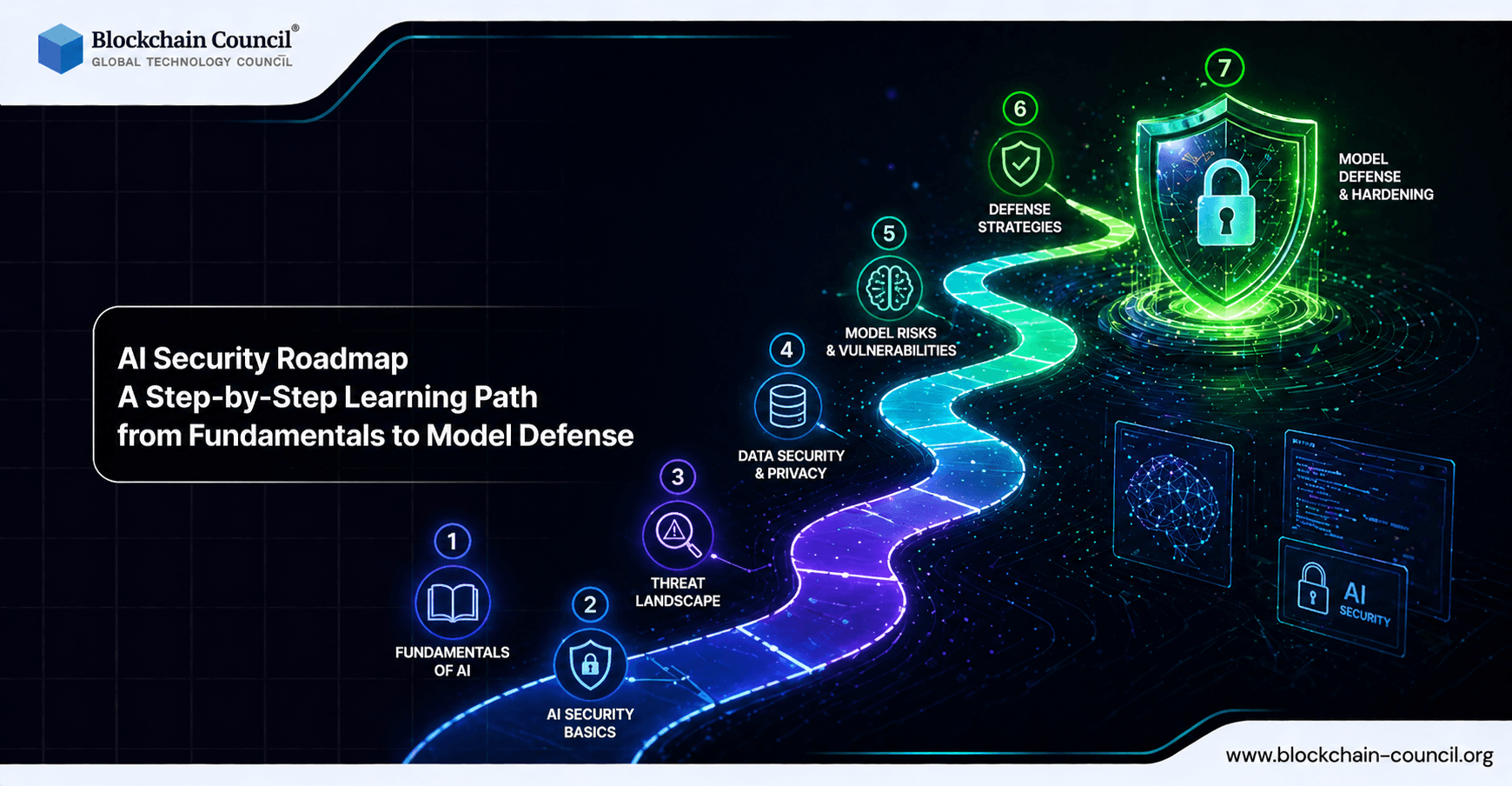
AI security roadmap planning is becoming essential as organizations move from experimenting with models to deploying LLMs, RAG systems, and AI agents in production. Unlike traditional application security, AI model security must protect probabilistic systems across the full lifecycle: data collection, training, evaluation, deployment, and runtime. This brings unique threats such as adversarial inputs, prompt injection, data poisoning, model inversion, and data extraction.
This guide lays out a practical, step-by-step learning path from fundamentals to model defense, grounded in widely adopted frameworks like OWASP Top 10 for LLMs, NIST AI Risk Management Framework (AI RMF), MITRE ATLAS, Google SAIF, and lifecycle-focused guidance used in high-assurance environments. It also maps to real-world tooling patterns such as AI Security Posture Management (AI-SPM), red-teaming toolchains, and runtime monitoring with automated response.

A structured roadmap should move from threat modeling to model defense and monitoring-build that progression with an AI Security Certification, develop implementation capability using a Python Course, and understand system-level deployment via an AI powered marketing course.
Why AI Security Differs from Traditional Security
Traditional security focuses on deterministic software behavior, static vulnerabilities, and known exploit classes. AI systems introduce additional complexity:
Probabilistic behavior that can change with prompts, context windows, and retrieval sources
New attack surfaces including prompts, embeddings, vector stores, tool calls, and agent reasoning traces
Lifecycle risk where compromise can occur in data pipelines, model artifacts, or runtime interactions
Hard-to-observe failure modes such as subtle data leakage, model drift, and jailbreak success that resembles normal output
Modern AI security programs increasingly align to structured frameworks to address these challenges. OWASP Top 10 for LLMs helps teams reason about common LLM risks including prompt injection, training data poisoning, model inversion, and insecure output handling. NIST AI RMF provides a governance-oriented approach to measuring and managing AI risk. MITRE ATLAS offers an attacker-focused view of tactics and techniques. Google SAIF emphasizes secure-by-design practices, supply-chain integrity, and runtime hardening for AI systems.
AI Security Roadmap: A Step-by-Step Learning Path
This AI security roadmap is organized into stages suitable for an individual practitioner or a team capability plan. Timelines are approximate and assume you are learning while applying concepts to a real environment.
Stage 1 (1-2 months): Fundamentals of AI Security
Start by building a shared vocabulary for how models work and how they fail. A research background is not required, but you do need to understand what makes AI systems exploitable.
AI basics that matter for security: tokenization, embeddings, context windows, probabilistic outputs, fine-tuning vs. retrieval
Threat categories: adversarial inputs, prompt injection, data poisoning, model inversion, training data leakage
Lifecycle mindset: map risks to training, deployment, and runtime rather than treating security as a single gate
What to produce: a simple threat model for one AI use case (for example, a customer support chatbot) using OWASP Top 10 for LLMs as a checklist and MITRE ATLAS as an attacker lens.
Stage 2 (2-3 months): Data Security and Supply-Chain Protection
Many AI compromises begin before training starts. Data is the model's primary attack surface, and supply-chain integrity is increasingly critical as teams rely on pre-trained models, public datasets, and third-party components.
Data validation and provenance: track where data came from, how it was transformed, and who approved it
Classification and PII minimization: reduce sensitive fields, apply retention policies, and restrict dataset exposure
Poisoning resistance: detect anomalous samples and label manipulation, especially in continuously updated datasets
Model and dataset inventories: adopt a Model Bill of Materials approach for model artifacts, dependencies, and training inputs
AI-SPM platforms are emerging to unify discovery, scanning, and risk visibility across cloud AI assets. In practice, this includes asset discovery for models, endpoints, and vector stores; supply-chain scanning for artifacts and registries; and attack path analysis across cloud identity, storage, and compute.
What to produce: a documented inventory of AI assets and datasets, plus a minimum baseline for dataset approval, provenance logging, and access control.
Stage 3 (about 2 months): Secure Pipelines and Access Controls
In this stage, treat ML pipelines like production software supply chains. The goal is to make training and deployment repeatable, auditable, and resistant to tampering.
Least-privilege IAM: separate roles for data access, training execution, and model release
Secrets hygiene: scan code and pipelines for leaked keys, rotate credentials, and use managed secret stores
Signed artifacts: cryptographically sign model artifacts and enforce integrity checks at deployment
Vulnerability scanning: scan containers, dependencies, and pipeline images used for training and inference
Google SAIF guidance is relevant here because it encourages security controls that span development to runtime, including artifact integrity and defense-in-depth for deployment environments.
What to produce: a hardened CI/CD blueprint for model training and deployment with signed artifacts, registry controls, and documented release approvals.
Stage 4 (1-2 months): Testing, Red-Teaming, and CI/CD Gates
AI systems require security testing that goes beyond static analysis. Repeatable adversarial testing that can be automated and tracked over time is essential.
Adversarial testing: generate evasive inputs to stress classifiers and safety layers
Prompt injection simulations: test for instruction override, data exfiltration prompts, and tool misuse
Jailbreak resistance: measure how easily policies can be bypassed across prompt variants
Bias and abuse testing: evaluate unsafe, discriminatory, or policy-violating outputs as security risks
Practical toolchains commonly include Microsoft Counterfit and the IBM Adversarial Robustness Toolbox for evasion testing, integrated into CI/CD pipelines so model releases fail when security thresholds are not met.
What to produce: a test suite aligned to OWASP Top 10 for LLMs categories, plus a CI/CD gate that blocks deployment when jailbreak success rates or leakage tests exceed defined limits.
Effective AI security learning requires layering fundamentals, adversarial ML, and operational controls-strengthen this stack with an AI Security Certification, deepen technical knowledge through a machine learning course, and connect it to business systems via a Digital marketing course.
Stage 5 (about 2 months): Deployment and Runtime Defenses
Even well-tested models will face novel attacks in production. Runtime defense is where many modern architectures focus, using telemetry, anomaly detection, and automation.
Endpoint hardening: authentication, authorization, and strict segmentation between model endpoints and internal tools
Rate limiting and abuse controls: protect against prompt flooding, denial-of-service, and automated extraction attempts
Input and output filtering: detect prompt injection patterns, unsafe output, and sensitive data leakage
Telemetry and SIEM integration: centralize logs for prompts, tool calls, retrieval hits, and policy decisions
Anomaly detection and response: detect drift, suspicious spikes, and abnormal tool usage, then quarantine or shift traffic accordingly
Runtime monitoring architectures often emphasize streaming telemetry pipelines (Kafka or Kinesis patterns), detection models, and SOAR playbooks. A typical response includes quarantining a model version, rotating keys, blocking abusive clients, or auto-scaling clean instances when drift or tampering is suspected.
For RAG deployments, add controls around vector stores and retrieval sources, including allowlists for trusted knowledge bases, sanitization of retrieved text, and policies governing what content can be returned to users.
Stage 6 (ongoing): Governance, Maturity, and Automation
As AI deployments scale, governance becomes the differentiator between one-off pilots and sustainable security programs. Mature teams build processes that make security measurable and repeatable.
Adopt a maturity model: progress from manual processes to automated, context-aware response
Audit trails: track model versions, prompts, retrieval sources, tool invocations, and access changes
Risk management alignment: use NIST AI RMF to connect controls to risk outcomes and accountability
Incident response planning: define playbooks for prompt injection incidents, data leakage, and compromised artifacts
Automate where safe: SOAR-driven containment, triage, and notifications with human oversight
Organizations can describe maturity progression from early-stage experimentation to AI-enabled operations and, eventually, controlled AI delegation where systems take scoped response actions within defined policy boundaries. The key is controlled automation with clear guardrails.
For regulated or high-assurance environments, lifecycle-focused guidance emphasizes controls suited to continuous learning systems and operational constraints.
Stage 7 (advanced): Agentic AI and Scaling Defenses
AI agents expand the attack surface because they combine model reasoning with tools, credentials, and real-world actions. Security teams must defend not only the prompt layer, but also the tool layer and the metadata the agent uses to determine what to do.
Tool governance: restrict tool access, enforce scoped permissions, and isolate high-impact actions
Reasoning and action constraints: apply policy checks before actions execute, not only after output is generated
Drift and tool change monitoring: detect when tools, prompts, or connectors change without approval
Hardening roadmaps: implement layered defenses for agent servers, tool metadata, and execution paths
This stage benefits from hands-on scenarios such as RAG and agent security labs that teach how to detect jailbreak attempts, prevent shadow tool usage, and enforce safe tool invocation patterns.
Putting the Roadmap into Practice: A Simple 90-Day Plan
For teams that need quick momentum, a focused plan builds foundational controls rapidly:
Days 1-30: build inventory, classify data, and create a threat model using OWASP Top 10 for LLMs and MITRE ATLAS
Days 31-60: secure pipelines with least privilege, secrets management, signed artifacts, and basic scanning
Days 61-90: implement red-teaming tests, CI/CD gates, and runtime telemetry with SIEM and alerting
After 90 days, expand into SOAR automation, maturity modeling, and agentic controls based on your specific architecture.
Conclusion: Build AI Security as a Lifecycle Capability
An effective AI security roadmap treats security as a continuous lifecycle discipline, not a one-time checklist. Start with fundamentals and threat modeling, then secure data and the supply chain, harden pipelines, institutionalize adversarial testing, and add runtime monitoring with automated response. Finally, scale governance and prepare for agentic AI risks where tool access, metadata, and reasoning constraints matter as much as model weights.
For professionals building this capability, the fastest path is learning by doing: pick one production use case, implement each stage as a concrete deliverable, and align to established frameworks like OWASP, NIST AI RMF, MITRE ATLAS, and SAIF. Over time, these practices turn AI security from reactive firefighting into a measurable, auditable, and resilient program.
FAQs
1. What is an AI security roadmap?
An AI security roadmap is a structured learning path that guides you from basic concepts to advanced model defense techniques. It outlines skills, tools, and topics to master. This helps build expertise step by step.
2. Why do you need a structured AI security learning path?
AI security covers multiple domains like machine learning, cybersecurity, and data privacy. A roadmap helps organize learning efficiently. It prevents gaps in knowledge.
3. What are the first steps in learning AI security?
Start with fundamentals of machine learning and basic cybersecurity concepts. Understand how models work and common threats. This foundation is essential for advanced topics.
4. What core topics should beginners focus on?
Beginners should learn data handling, model training basics, and security principles. Topics like data privacy and access control are important. These build a strong base.
5. When should you start learning adversarial machine learning?
After understanding basic ML concepts, move to adversarial techniques. Learn about attacks like evasion and data poisoning. This helps you understand real-world risks.
6. What intermediate skills are needed in AI security?
Intermediate learners should focus on threat modeling, model evaluation, and monitoring. Learn how to detect vulnerabilities. Practice using security tools.
7. How do you learn prompt injection and LLM security?
Study how language models process inputs and outputs. Practice identifying and testing injection attacks. Learn defense techniques like input validation and context isolation.
8. What advanced topics should be included in an AI security roadmap?
Advanced topics include secure MLOps, model hardening, and privacy-preserving AI. Learn about compliance and governance. These are critical for real-world applications.
9. How long does it take to complete an AI security roadmap?
The timeline depends on your background and learning pace. It can take several months to a year. Consistent effort is key to progress.
10. What tools should you learn along the roadmap?
Learn tools for adversarial testing, monitoring, and model evaluation. Libraries like ART and frameworks for logging are useful. Tools enhance practical skills.
11. How important is hands-on practice in AI security learning?
Hands-on practice is essential for understanding real-world scenarios. It helps apply theoretical knowledge. Practical experience improves retention and skills.
12. Can beginners follow an AI security roadmap without coding experience?
Basic coding knowledge is helpful but not always required initially. Many beginner resources are conceptual. Advanced stages will require programming skills.
13. How do certifications fit into an AI security roadmap?
Certifications validate your knowledge and skills. They can be included at intermediate or advanced stages. Choose certifications aligned with your goals.
14. What are common mistakes when learning AI security?
Common mistakes include skipping fundamentals and focusing only on tools. Lack of practice can limit understanding. A balanced approach is important.
15. How can you track progress in your AI security journey?
Set milestones and regularly review your skills. Use projects and assessments to measure progress. Continuous evaluation keeps you on track.
16. What role does community learning play in AI security?
Communities provide support, resources, and knowledge sharing. Engaging with others helps solve problems. It also keeps you updated on trends.
17. How do you stay updated with AI security trends?
Follow industry blogs, research papers, and forums. Attend webinars and conferences. Staying informed is essential in a fast-evolving field.
18. What career paths can an AI security roadmap lead to?
Career paths include AI security engineer, ML security specialist, and cybersecurity analyst. Skills are also valuable in data science roles. Demand for these roles is growing.
19. What are best practices for following an AI security roadmap?
Be consistent, combine theory with practice, and revisit key concepts. Use multiple resources for learning. Continuous improvement is essential.
20. What is the future of AI security learning paths?
Learning paths will become more structured and practical. Interactive labs and real-world scenarios will be emphasized. AI security skills will remain in high demand.
Related Articles
View All
AI & ML
AI Explained: From Machine Learning to Generative AI
AI Explained in simple terms. Learn the differences between AI, machine learning, and deep learning, how neural networks and LLMs work, and how generative and multimodal AI create content.

AI & ML
Jev AI: the complete guide to TypeSafe's System One Model
Explore Jev AI in this complete guide, including TypeSafe’s System One architecture, RLCD training, parallel sampling, typed decisions, calibrated confidence, performance, and automation use cases.
AI & ML
Jev Model Architecture
Explore the Jev model architecture, including TypeSafe AI’s System One design, parallel sampling, RLCD training, typed outputs, and calibrated probabilistic decisions.
Trending Articles
AWS Career Roadmap
A step-by-step guide to building a successful career in Amazon Web Services cloud computing.
How Blockchain Secures AI Data
Understand how blockchain technology is being applied to protect the integrity and security of AI training data.
Claude AI Tools for Productivity
Discover Claude AI tools for productivity to streamline tasks, manage workflows, and improve efficiency.