

AI Security Fundamentals in 2026: Threats, Controls, and a Secure AI Lifecycle
 Suyash Raizada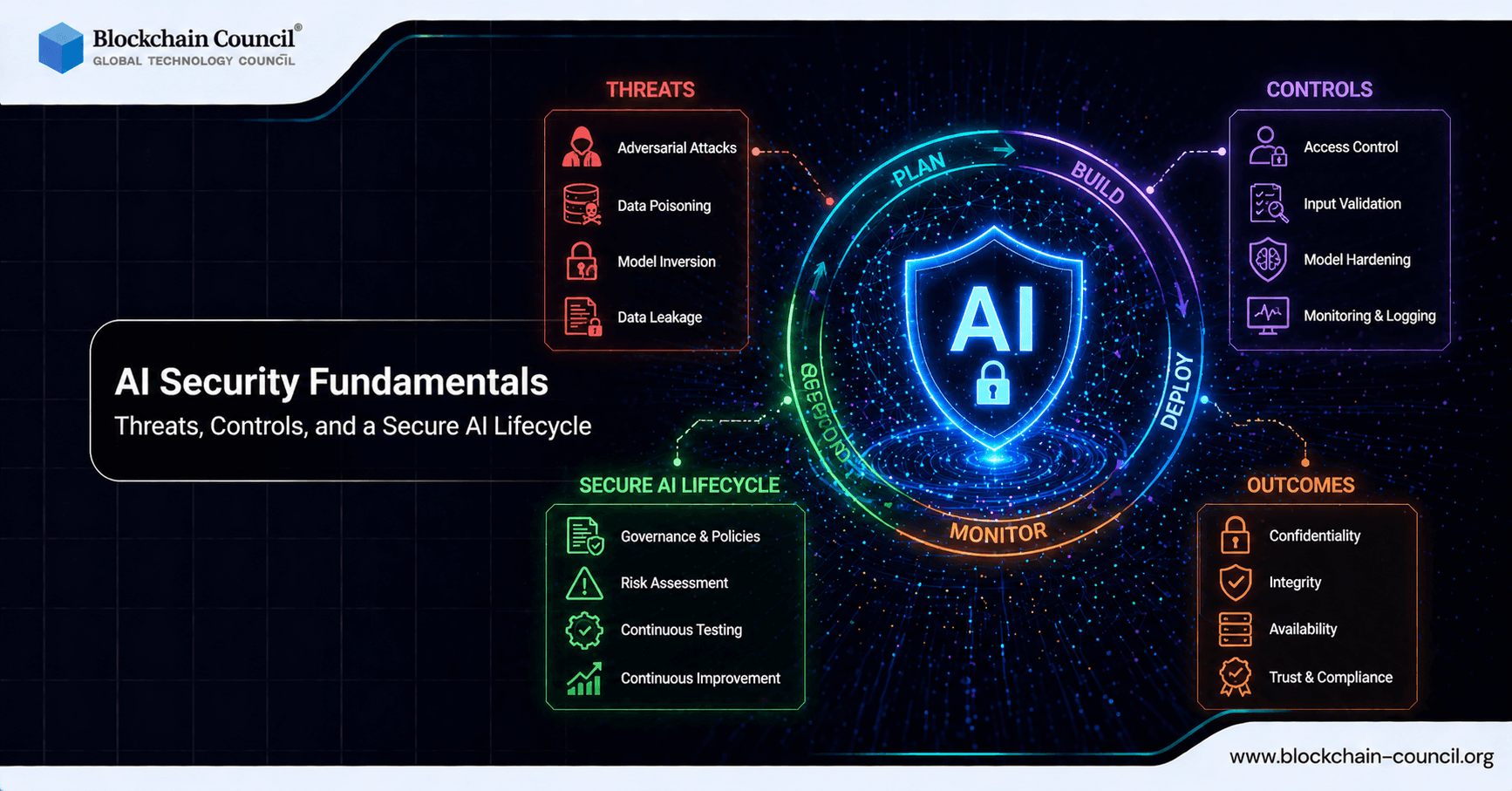
AI security fundamentals in 2026 are no longer optional for organizations adopting generative AI, LLM copilots, and agentic automation. As AI moves into core business workflows, it expands the attack surface beyond traditional IT security into data pipelines, model supply chains, and high-risk APIs. The result is a measurable rise in real-world incidents: the 2025 Stanford AI Index Report noted AI-related incidents in business increased by over 56% year-over-year. Security leaders also report that AI is amplifying threats, with 72% seeing unprecedented risk levels and 56% facing weekly threats, including a notable increase in AI-generated phishing and fraud.
A secure AI lifecycle spans data ingestion, model training, inference, and monitoring-build end-to-end understanding with an AI Security Certification, implement pipelines using a Python Course, and connect systems to real-world usage via an AI powered marketing course.

This guide covers the primary threats, the controls that matter most in 2026, and secure AI lifecycle basics you can apply across planning, training, deployment, and operations.
Why AI Security Changed in 2026
AI systems combine classic cybersecurity risks - credential theft, misconfigured cloud resources, and insecure APIs - with AI-specific failure modes such as data poisoning, prompt injection, and model extraction. The convergence of these risks is pushing enterprises toward formal governance frameworks, AI-tailored zero-trust architectures, and continuous monitoring aligned with widely used guidance like the NIST AI Risk Management Framework, along with privacy and sector regulations such as GDPR, HIPAA, and CCPA.
Gartner has also highlighted AI-enabled cyberattacks and misinformation as persistent emerging risks into 2026, reinforcing that AI security is now both a technical and governance challenge.
Top AI Security Threats Organizations Face
1) Data Breaches and Data Poisoning
AI systems ingest large volumes of data across multiple sources. That scale makes training data and feature stores attractive targets for theft and manipulation. Two high-impact outcomes follow:
Data breaches via weak APIs, misconfigured storage, or over-permissioned service accounts that expose sensitive training data, prompts, or embeddings.
Data poisoning where adversaries insert or alter training examples to degrade performance, embed backdoors, or bias outputs in specific scenarios.
Because poisoned data can be difficult to detect after the fact, security leaders increasingly treat dataset lineage and integrity as first-class security controls.
2) Prompt Injection, Jailbreaking, and Model Extraction in LLMs
LLM applications introduce new interaction patterns where untrusted input can influence system behavior. Common issues include:
Prompt injection that attempts to override system instructions, exfiltrate secrets from tools, or trigger unsafe actions.
Jailbreaking techniques that coerce models into bypassing policies, producing disallowed content, or revealing restricted information.
Model extraction attempts to reconstruct model behavior or steal proprietary logic through repeated queries, especially when rate limits and monitoring are weak.
These risks are particularly relevant for enterprise deployments of LLM-based assistants and coding copilots, where production usage can become a live attack channel.
3) AI-Amplified Cyberattacks (Phishing, Malware, Fraud)
Attackers use AI to scale social engineering, improve language quality, and automate targeting. Survey data from 2025 shows:
72% of security decision-makers report record-high risk levels.
56% face AI-related threats weekly.
50% report increases in AI-generated phishing, malware, and fraud attempts.
This shift does not only increase volume. It also increases believability and personalization, raising the baseline for identity, access, and verification controls.
4) Bias, Discrimination, and Adversarial Evasion
Security and safety overlap in AI. Manipulated data or adversarial inputs can trigger biased or discriminatory outcomes, or cause evasion where a model fails in precisely crafted edge cases. For regulated industries, these failures carry compliance and legal risk, not just model quality concerns.
Controls and Best Practices That Matter in 2026
Modern AI security programs use layered defenses across people, process, and technology. The most effective controls are those integrated into MLOps and application delivery pipelines, not added after deployment.
Governance Framework and Clear Accountability
Governance defines what gets protected, by whom, and under what risk tolerance. Practical steps include:
Create an AI inventory of models, datasets, prompts, tools, plugins, and third-party APIs in use.
Define roles and ownership, such as an AI risk officer or a cross-functional AI risk committee spanning security, privacy, legal, and engineering.
Establish AI security policies for data sourcing, model approval, deployment gates, and acceptable use.
Adopt defensible risk justification using approaches like cyber risk quantification (CRQ) to compare mitigation cost against likely loss exposure, especially for autonomous or agentic systems.
Zero-Trust Access Controls for Models, Data, and AI APIs
AI systems add high-value endpoints: inference APIs, model registries, vector databases, and orchestration layers that connect to enterprise tools. Applying zero-trust principles across these surfaces is essential:
Least privilege and RBAC across data stores, pipelines, model registries, and deployment platforms.
Strong identity controls such as MFA for privileged actions and short-lived credentials for services.
Rate limiting and abuse prevention to reduce model extraction attempts and prompt abuse.
Network and resource isolation for training environments and sensitive workloads.
Zero-trust is especially important when LLM applications can call tools such as email, ticketing systems, code repositories, and cloud controls. Treat tool invocation as a privileged operation requiring explicit authorization.
Data Security and Integrity Across the AI Supply Chain
Data is both the fuel and a primary liability. A 2026-ready baseline includes:
Encryption in transit and at rest for training data, embeddings, and logs.
Chain of custody controls using cryptographic signatures or integrity checks to track provenance and detect tampering.
Data minimization aligned to privacy requirements, limiting retention and exposure of personal or regulated data.
Controlled access to prompts and context, since prompts can contain sensitive business logic or user data.
Adversarial Testing and Red-Teaming as a Standard Pipeline Step
Reactive defense is insufficient against AI-specific threats. Security teams increasingly emphasize an adversarial mindset with continuous red-teaming. Key practices include:
Adversarial robustness testing to simulate evasion and poisoning patterns before release.
LLM red-teaming for prompt injection, jailbreak attempts, tool misuse, and data leakage scenarios.
Regression testing so that safety and security fixes remain effective after model updates.
Many teams operationalize this by embedding red-team suites into CI/CD and MLOps gates, rather than running periodic one-off assessments.
Monitoring, Logging, and Shadow AI Detection
AI security requires observability that spans both the application layer and the model layer. Focus areas include:
Centralized logging of prompts, tool calls, policy decisions, and model outputs with appropriate privacy controls.
Anomaly detection for spikes in requests, suspicious prompt patterns, repeated extraction-like queries, and unusual tool invocation.
Shadow AI monitoring to discover unsanctioned models, plugins, and external AI services used by employees.
This approach aligns with the NIST AI RMF emphasis on ongoing management and continuous improvement.
API and Third-Party Supply Chain Security
Modern AI applications are compositional, combining models, retrieval systems, plugins, and SaaS APIs. Reduce supply chain risk by:
Vendor and model evaluation covering security posture, logging capabilities, data handling, and incident response readiness.
Resource isolation so a compromised integration cannot pivot into critical systems.
Automated misconfiguration checks for cloud AI resources, storage buckets, and permissions.
Secure AI Lifecycle Basics: A Practical 6-Stage Checklist
Secure AI is built in, not added afterward. Use this lifecycle as a baseline for AI security fundamentals in 2026.
1) Planning and Design
Perform threat modeling early, including model, data, tool, and API threats.
Define governance, ownership, and risk acceptance criteria.
Determine which actions require human approval, especially for agentic workflows.
Security and GRC experts consistently emphasize that teams should perform threat modeling early in the AI lifecycle, before architectural decisions become difficult to reverse.
2) Data Sourcing and Training
Validate data provenance and document lineage.
Apply encryption, access controls, and integrity checks.
Run bias and quality checks to reduce discriminatory outcomes.
3) Development and Testing
Conduct adversarial testing for evasion, poisoning, and robustness.
Red-team prompt injection and tool-use misuse paths.
Verify safe failure modes and enforce policy boundaries.
4) Deployment
Enforce zero-trust for inference endpoints and tool connectors.
Implement rate limits, authentication, and secrets management.
Maintain environment separation for development, staging, and production model artifacts.
5) Operations and Monitoring
Monitor for abuse patterns, anomalies, and data leakage signals.
Integrate incident response playbooks for AI-specific events such as prompt injection, extraction attempts, and poisoning indicators.
Continuously identify shadow AI usage and unsanctioned integrations.
6) Maintenance and Compliance
Perform model validation after retraining, fine-tuning, or vendor upgrades.
Run periodic audits against internal policy and external obligations, including privacy and sector-specific requirements.
Reassess third-party risk and update controls as new threats emerge.
What to Expect Next: Agentic AI and Governance Pressure
By late 2026, agentic AI is expected to be more deeply embedded in cybersecurity operations, enabling faster detection and response. That speed introduces operational risk: autonomous agents capable of changing configurations, disabling controls, or triggering remediations require strict guardrails, CRQ-informed decisioning, and human oversight for high-impact actions. At the same time, purpose-built tools for AI security posture management (AI-SPM), explainability, and API protection are becoming standard as organizations connect LLMs to business-critical systems.
Conclusion: Build AI Security Fundamentals Into How You Ship AI
AI security fundamentals in 2026 center on one core reality: AI expands your attack surface across data, models, integrations, and human workflows. The most resilient programs combine governance, zero-trust access, data integrity, adversarial testing, and continuous monitoring across a secure AI lifecycle. With AI incidents rising rapidly and AI-amplified attacks becoming routine, organizations that treat AI security as an engineering discipline rather than a compliance checkbox will be better positioned to deploy AI safely at scale.
Effective defense requires layered controls across inputs, models, and outputs-develop this capability with an AI Security Certification, deepen modeling expertise via a machine learning course, and align systems with operational environments through a Digital marketing course.
FAQs
1. What are AI security fundamentals in 2026?
AI security fundamentals cover the basic principles for protecting machine learning systems. This includes securing data, models, and infrastructure. It focuses on preventing attacks and ensuring reliable performance.
2. Why is AI security more important in 2026?
AI is now widely deployed across industries and handles sensitive tasks. Threats have become more advanced and targeted. Strong security is essential to prevent misuse and failures.
3. What are the main threats to AI systems?
Key threats include data poisoning, adversarial attacks, model theft, and prompt injection. These attacks target different stages of the AI lifecycle. Each requires specific defenses.
4. What is the AI security lifecycle?
The AI security lifecycle covers all stages from data collection to deployment and monitoring. Security measures are applied at each stage. This ensures end-to-end protection.
5. What are the stages of a secure AI lifecycle?
Stages include data collection, preprocessing, model training, deployment, and monitoring. Each stage has unique risks. Securing all stages reduces vulnerabilities.
6. What is data security in AI systems?
Data security involves protecting datasets from unauthorized access and manipulation. It includes encryption, validation, and access control. Secure data ensures reliable models.
7. What is model security in AI?
Model security focuses on protecting models from tampering, theft, and misuse. It includes validation, monitoring, and access controls. Secure models produce trustworthy outputs.
8. What are adversarial attacks in AI?
Adversarial attacks use crafted inputs to manipulate model predictions. These inputs often appear normal. They exploit weaknesses in model behavior.
9. What is data poisoning in AI security?
Data poisoning involves injecting malicious data into training datasets. It affects how models learn. This can lead to incorrect or biased outputs.
10. What are key security controls for AI systems?
Key controls include access management, encryption, monitoring, and validation. These controls protect data and models. Layered defenses improve security.
11. How does access control improve AI security?
Access control limits who can interact with systems and data. It prevents unauthorized actions. Strong authentication reduces risk.
12. What role does encryption play in AI security?
Encryption protects data during storage and transmission. It ensures confidentiality and integrity. This is essential for compliance.
13. How does monitoring support AI security?
Monitoring tracks system performance and detects anomalies. It enables early detection of threats. Continuous monitoring improves response.
14. What is model drift and why does it matter?
Model drift occurs when performance changes due to new data patterns. It can reduce accuracy and increase risk. Monitoring helps detect and address drift.
15. What is the role of governance in AI security?
Governance defines policies, roles, and compliance requirements. It ensures accountability and structured management. Strong governance supports secure operations.
16. How can organizations implement a secure AI lifecycle?
Integrate security into every stage of development and deployment. Use best practices, tools, and monitoring. Continuous improvement is key.
17. What are best practices for AI security in 2026?
Use layered defenses, validate data, and monitor systems continuously. Apply least-privilege access and regular testing. Combine automation with human oversight.
18. How do regulations impact AI security?
Regulations require data protection, transparency, and accountability. Organizations must comply with laws like GDPR. Compliance reduces legal risks.
19. What challenges exist in AI security today?
Challenges include evolving threats, complex systems, and lack of standardization. Balancing performance and security is difficult. Ongoing adaptation is required.
20. What is the future of AI security fundamentals?
AI security will become more integrated and standardized. Advanced tools will improve detection and prevention. It will remain a critical part of AI development.
Related Articles
View All
AI & ML
Built to Catch AI Cheating: Rethinking Pre-Employment Assessments with HireValid
Explore how HireValid is rethinking pre-employment assessments with AI-resistant test design, integrity signals, candidate evidence, and human review to address AI-assisted cheating.

AI & ML
AI-Era Hiring Needs AI-Proof Tests: How HireValid Is Redefining Talent Assessment
Explore how HireValid is rethinking talent assessment for the AI era with job-relevant tests, anti-cheating design, integrity signals, and human-reviewed evidence of candidate ability.

AI & ML
Google Launches Gemini 4 Argon: Features and Capabilities
Google has launched Gemini 4 Argon, its flagship AI model for coding, finance, law, cybersecurity and science. Learn its key features, availability, pricing and safety details.
Trending Articles
AWS Career Roadmap
A step-by-step guide to building a successful career in Amazon Web Services cloud computing.
How Blockchain Secures AI Data
Understand how blockchain technology is being applied to protect the integrity and security of AI training data.

Can DeFi 2.0 Bridge the Gap Between Traditional and Decentralized Finance?
The next generation of DeFi protocols aims to connect traditional banking with decentralized finance ecosystems.