

AI Security in Healthcare: Protecting Patient Data, Securing Clinical Models, and Ensuring Safety
 Suyash Raizada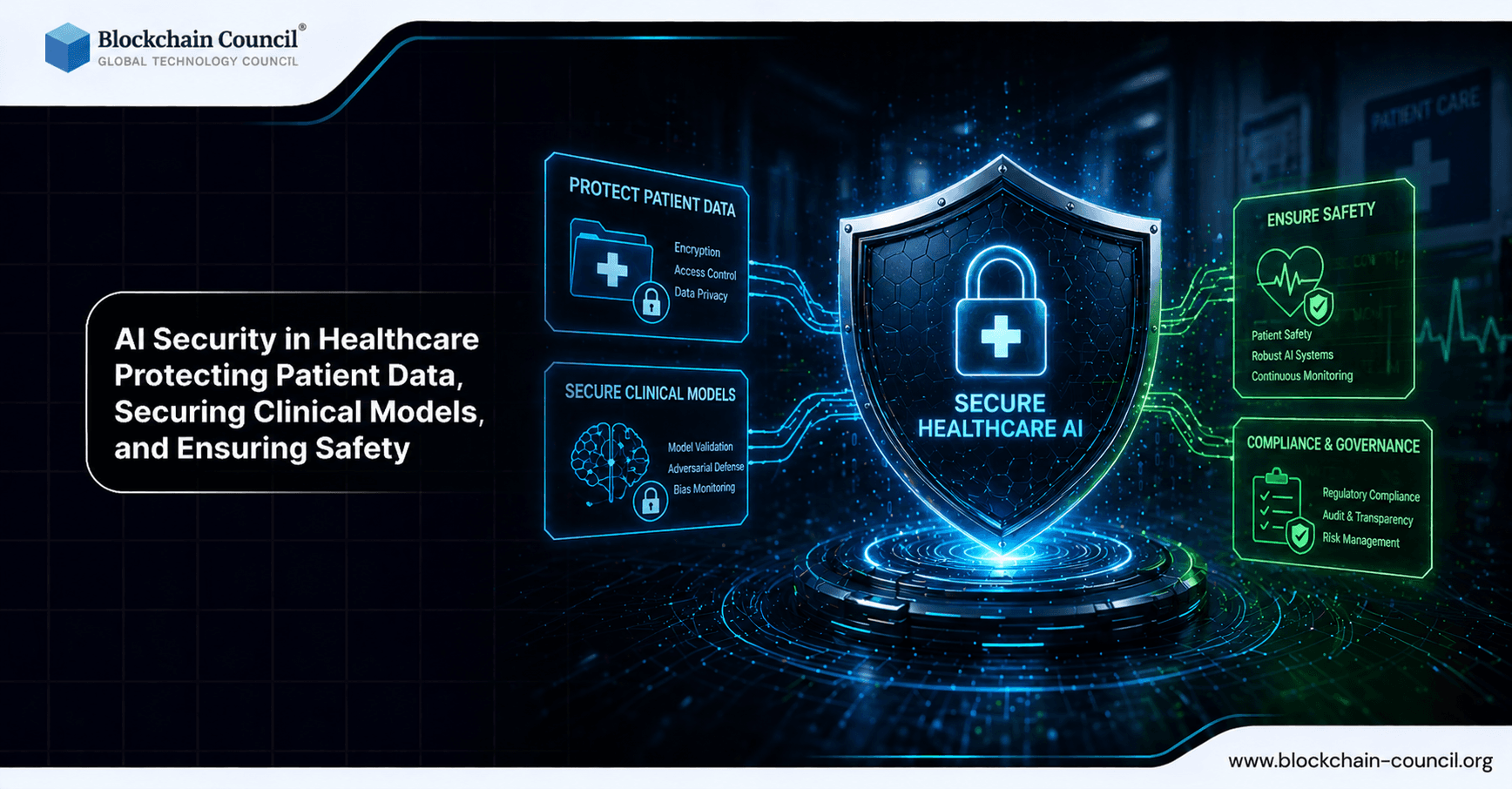
AI security in healthcare has become a front-line requirement as hospitals and health systems deploy machine learning and generative AI across diagnostics, clinical decision support, revenue cycle, and connected medical devices. The same capabilities that improve efficiency and care quality also expand the attack surface. In 2024, 92% of healthcare organizations reported AI-related cyberattacks, while the average breach cost reached $10.3 million per incident and often went undetected for 6 to 12 months. These realities make it essential to protect patient data, secure clinical AI models against manipulation, and ensure end-to-end safety across the AI lifecycle.
Protecting patient data and clinical AI systems is critical-build your expertise with an AI Security Certification, enhance technical skills via a Python Course, and explore real-world deployment through an AI powered marketing course.

Why AI Security in Healthcare Is Uniquely Difficult
Healthcare environments combine highly sensitive data, safety-critical workflows, and complex vendor ecosystems. AI increases risk in three distinct ways:
More data flows: AI pipelines require collecting, labeling, storing, and transmitting protected health information (PHI) and related metadata, creating more points for leakage.
New attack classes: Beyond classic ransomware and credential theft, attackers can target models with poisoning, adversarial inputs, and data pipeline exploits.
High-consequence failures: Model degradation or subtle manipulation can trigger misdiagnoses, treatment delays, or unsafe device behavior, not just IT downtime.
Industry risk assessments reflect these concerns. ECRI identified AI as the top health technology hazard for 2025, noting that clinical AI failures can escalate quickly when deployed at scale.
Threat Landscape: Patient Data, Models, and Clinical Operations
Patient Data Breaches and Privacy Violations
PHI has long been targeted, but AI adds new pathways to exposure through training datasets, inference logs, prompt histories, third-party tools, and model outputs. Global studies conducted through late 2025 showed 88% of organizations were concerned about AI privacy violations, yet only 41% felt confident in their generative AI controls. Only 38% reported effectively tracking AI bias and privacy risks, pointing to significant gaps in governance and monitoring.
Attackers also exploit human behavior. AI-generated phishing surged more than 1,000% year-over-year, increasing the likelihood of credential compromise and downstream access to clinical systems.
Clinical Model Manipulation and Integrity Attacks
Clinical AI models can be attacked directly or indirectly through the data supply chain. Common risks include:
Model poisoning: injecting harmful or biased examples into training data to alter predictions.
Adversarial inputs: crafting inputs that cause misclassification, for example through subtle changes to medical images or structured EHR fields.
Data pipeline exploits: compromising labeling processes, feature stores, or model registries to introduce silent failures.
Research indicates that some attacks can succeed using only 100 to 500 samples with a success rate above 60%, which lowers the barrier for attackers and increases the need for robust validation and ongoing monitoring.
System-Wide Safety and Interconnected Vulnerabilities
Healthcare AI does not run in isolation. It depends on identity systems, networks, cloud services, APIs, medical devices, and electronic health record platforms. Insecure interoperability can spread vulnerabilities across connected entities and vendor networks, amplifying the blast radius of a single compromise. This is why secure-by-design engineering and coordinated governance are increasingly emphasized across the sector.
Regulatory and Governance Momentum
Regulatory guidance is evolving alongside adoption. Recent developments include HHS guidance emphasizing AI transparency and accountability, and a surge in state-level AI legislation, with over 250 bills introduced in 2025 and 33 enacted. While requirements vary by jurisdiction, the direction is consistent: healthcare organizations should be able to explain AI use, manage risk, protect privacy, and demonstrate oversight.
In practice, AI security in healthcare must align with established obligations such as HIPAA while adding AI-specific controls for model risk management, auditability, and lifecycle governance.
Secure-by-Design AI: A Practical Security Framework
Secure-by-design principles reduce risk before deployment by treating the AI system as a production clinical asset with defined safety requirements. A practical framework addresses people, process, and technology controls across the full AI lifecycle.
Step 1: Data Protection for PHI and AI Pipelines
Strong encryption for data at rest and in transit, including backups and data exports.
Access controls using least privilege, role-based access control, and multi-factor authentication for data stores, notebooks, model registries, and evaluation environments.
Audit trails for PHI access and data transformations, with immutable logging where feasible.
Data minimization and de-identification where appropriate, plus clear retention rules for prompts, transcripts, and inference logs.
Organizations often struggle to apply these controls consistently when AI must integrate with legacy clinical systems. Closing that gap requires shared standards for identity, logging, and policy enforcement across the full technology stack.
Step 2: Model Integrity and Robustness
Dataset provenance checks to validate source integrity and detect tampering in labeling and ingestion pipelines.
Secure model supply chain with signed artifacts, controlled registries, and cryptographic verification for model versions.
Adversarial and resilience testing prior to go-live, including red-team exercises that involve both cybersecurity and data science teams.
Guardrails for generative AI to reduce sensitive data exposure and unsafe outputs, including prompt filtering, policy-based routing, and output validation.
Collaboration between security and data science teams is a recurring expert recommendation. Security professionals understand adversaries and incident response; data scientists understand model behavior and failure modes. Together, they can test robustness and design safer deployment patterns.
Step 3: Runtime Monitoring and Fast Incident Detection
Healthcare breaches can go unnoticed for months, so detection and response must be built into the AI system from the start. Emerging defenses apply AI and generative AI for:
Real-time anomaly monitoring of access patterns and clinical system behavior.
Behavioral analytics to detect suspicious use of accounts, APIs, and privileged tooling.
Automated compliance and triage to reduce time-to-identification, with some reports indicating incident identification shortened by up to 98 days.
Attackers use AI to scale phishing campaigns and generate malware variations, while defenders use AI to improve detection, containment, and prioritization. Human oversight remains essential, particularly in clinical contexts where false positives and false negatives carry direct care implications.
Step 4: Clinical Safety Controls and Human-in-the-Loop Design
AI security in healthcare addresses not only confidentiality and integrity, but also patient safety. Practical safeguards include:
Clinical escalation paths when model confidence drops or performance drift is detected.
Fallback workflows that maintain care continuity if AI services are degraded or unavailable.
Bias and performance monitoring across patient subgroups to prevent unequal care outcomes.
Clear accountability for approvals, overrides, and model updates.
Only 46% of organizations report alignment between generative AI and cybersecurity strategies, which can leave safety controls fragmented. Aligning teams around shared risk metrics and shared ownership is a key maturity milestone.
Real-World Use Cases: How Security Shows Up in Practice
AI-Powered Diagnostics with PHI-Aware Monitoring
Medical imaging AI can improve accuracy and throughput, but it also concentrates sensitive data and model value within a single workflow. Organizations increasingly use AI-based monitoring to flag abnormal access behavior and trigger real-time alerts when PHI access deviates from established patterns.
AI-Driven Anomaly Detection for Cyberattack Response
Healthcare security teams deploy AI to baseline normal network and application activity, then identify deviations. This reduces manual monitoring burdens and can surface suspicious lateral movement, credential misuse, and unusual API calls tied to AI services.
Defense Against Polymorphic Malware and Credential Attacks
Some implementations use AI-driven behavioral analysis and policy enforcement to limit breach radius, particularly in environments facing rapidly mutating malware and high-volume credential attacks. The goal is containment: restricting access, isolating affected services, and preserving clinical operations.
Blockchain for Consent, Traceability, and Secure Sharing
Blockchain-based approaches have been proposed for permissioned PHI sharing and consent management, where smart contracts can enforce data access rules and improve traceability. In healthcare environments, scalability and integration constraints are significant considerations, making Layer 2 designs and careful architecture important factors in any practical adoption strategy.
Implementation Checklist for Healthcare Leaders
Inventory AI assets: models, datasets, prompts, integrations, vendors, and endpoints.
Classify data: identify PHI exposure points in training, evaluation, and inference.
Secure the pipeline: signing, provenance, access controls, and immutable logging.
Test for adversarial risk: poisoning, prompt injection, model extraction, and drift.
Monitor continuously: anomalies, output risk, subgroup performance, and safety triggers.
Align governance: ensure generative AI and cybersecurity strategies share owners, metrics, and escalation paths.
Train staff: phishing resilience, deception awareness, and safe generative AI usage in clinical contexts.
To ensure safety and compliance in healthcare AI, combine knowledge with an AI Security Certification, deepen insights through a machine learning course, and understand stakeholder impact via a Digital marketing course.
Conclusion: Safer AI Requires Secure Systems, Secure Models, and Secure Governance
AI security in healthcare is now inseparable from patient safety and operational resilience. With AI-related incidents affecting the vast majority of organizations, attackers scaling phishing through AI, and model manipulation risks rising, healthcare leaders must treat AI as critical infrastructure. The path forward requires secure-by-design engineering, rigorous model integrity controls, continuous monitoring, and governance that connects cybersecurity, data science, and clinical accountability. When implemented well, AI can improve care while reducing risk. When implemented poorly, it can amplify hazards at scale.
FAQs
1. What is AI security in healthcare?
AI security in healthcare focuses on protecting medical data, models, and systems from threats. It ensures patient information remains confidential and accurate. Strong security supports safe and reliable clinical decisions.
2. Why is AI security critical in healthcare?
Healthcare systems handle sensitive patient data and life-critical decisions. Security failures can lead to data breaches or incorrect diagnoses. Protecting AI systems is essential for patient safety and trust.
3. What types of data are protected in healthcare AI systems?
Protected data includes patient records, medical images, and diagnostic results. This information is highly sensitive and regulated. Proper safeguards are required to prevent unauthorized access.
4. What are common security threats to healthcare AI systems?
Threats include data breaches, data poisoning, adversarial attacks, and unauthorized access. These can compromise both data and model performance. Continuous monitoring is necessary.
5. How can patient data be protected in AI systems?
Use encryption, access controls, and anonymization techniques. Limit data access to authorized users only. Regular audits help maintain compliance.
6. What is data anonymization in healthcare AI?
Data anonymization removes identifying information from patient data. This reduces privacy risks while allowing analysis. It supports compliance with data protection laws.
7. How does encryption improve healthcare AI security?
Encryption protects data during storage and transmission. It ensures only authorized parties can access sensitive information. This reduces the risk of data breaches.
8. What is model security in clinical AI systems?
Model security ensures that AI models are protected from manipulation or misuse. It includes safeguarding training data and monitoring outputs. Secure models produce reliable results.
9. How do adversarial attacks affect healthcare AI?
Adversarial attacks can manipulate inputs to produce incorrect diagnoses or predictions. This can lead to harmful outcomes. Robust models and validation reduce this risk.
10. What is model validation in healthcare AI?
Model validation involves testing accuracy, reliability, and safety before deployment. It ensures the model meets clinical standards. Regular validation maintains performance.
11. How does AI support patient safety?
AI can assist in diagnosis, treatment planning, and monitoring. When secure and accurate, it improves outcomes. Safety depends on reliable models and data.
12. What are compliance requirements for healthcare AI?
Compliance includes regulations like HIPAA and GDPR. These laws govern data protection and privacy. AI systems must meet these standards to operate legally.
13. How does HIPAA affect AI systems in healthcare?
HIPAA requires protection of patient health information in the US. AI systems must ensure confidentiality and secure data handling. Non-compliance can lead to penalties.
14. What is role-based access control in healthcare AI?
Role-based access control limits system access based on user roles. It ensures only authorized personnel can view or modify data. This improves security and accountability.
15. How can healthcare organizations detect AI security threats?
Use monitoring tools, anomaly detection, and regular audits. These methods identify unusual behavior or vulnerabilities. Early detection improves response.
16. What are best practices for securing clinical AI models?
Use secure data pipelines, validate models regularly, and monitor performance. Combine technical controls with governance policies. Continuous improvement is essential.
17. How does explainable AI improve healthcare security?
Explainable AI provides transparency in decision-making. It helps clinicians understand and verify outputs. This supports trust and compliance.
18. What is the role of human oversight in healthcare AI?
Human oversight ensures clinical decisions are reviewed by professionals. It reduces reliance on automated systems. This improves safety and accountability.
19. What challenges exist in healthcare AI security?
Challenges include data complexity, regulatory requirements, and evolving threats. Balancing innovation and security is difficult. Ongoing adaptation is required.
20. What is the future of AI security in healthcare?
AI security will become more advanced with stronger regulations and tools. Focus will remain on privacy, safety, and reliability. Secure AI will play a key role in healthcare innovation.
Related Articles
View All
AI & ML
NVIDIA’s New AI Models: Nemotron 3.5 Lightning, Cosmos 3 and the Future of Agentic AI
Explore NVIDIA Nemotron 3.5 Lightning and Cosmos 3, how they support agentic and Physical AI, and what these models reveal about NVIDIA’s broader vision for autonomous intelligent systems.

AI & ML
System One Models for Software
Explore how System One Models can be used in software to make fast, structured, probabilistic decisions for automation, routing, scoring, verification, and real-time applications.
AI & ML
System One Models for AI Agents
Explore how System One Models can support AI agents with fast, structured decisions, calibrated confidence, routing, verification, and reliable workflow automation.
Trending Articles

Top 5 DeFi Platforms
Explore the leading decentralized finance platforms and what makes each one unique in the evolving DeFi landscape.
How Blockchain Secures AI Data
Understand how blockchain technology is being applied to protect the integrity and security of AI training data.
Claude AI Tools for Productivity
Discover Claude AI tools for productivity to streamline tasks, manage workflows, and improve efficiency.