

AI Security Certification Guide: How to Choose the Right Credential and Prepare for the Exam
 Suyash Raizada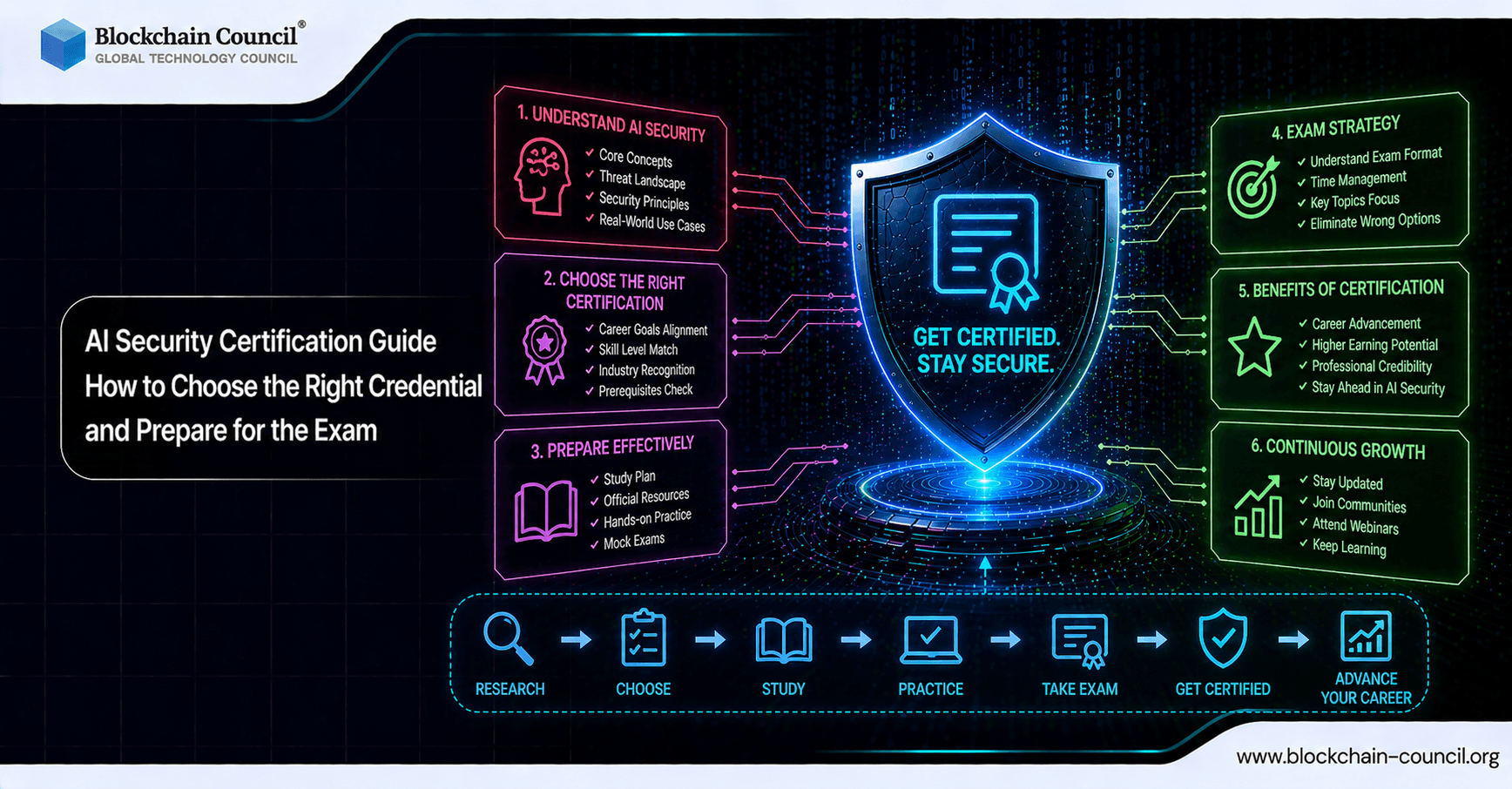
AI security certification options have expanded rapidly as organizations deploy generative AI, large language models (LLMs), and agentic systems into production. That growth brings new attack paths: prompt injection, data leakage through retrieval-augmented generation (RAG), model supply chain compromise, and unsafe tool use by autonomous agents. This AI security certification guide explains which credentials fit specific roles, which frameworks matter most in 2026, and how to prepare efficiently for exams.
Selecting the right AI security credential requires alignment with real-world threat models, not just theory-build practical depth with an AI Security Certification, reinforce implementation skills using a Python Course, and understand how these systems translate into production use via an AI powered marketing course.

Why AI Security Certifications Are Changing in 2026
Traditional cybersecurity certifications do not fully cover AI-specific risks. Employers increasingly expect professionals to understand AI threat modeling, AI governance, and detection strategies that account for LLM behavior. Certification providers have responded by introducing or updating programs that map directly to real-world AI security job tasks and emerging regulations.
Many modern credentials align to widely used frameworks and references, including:
OWASP LLM Top 10 for application-layer LLM threats such as prompt injection and sensitive data exposure
NIST AI Risk Management Framework (AI RMF) for end-to-end AI risk governance and lifecycle controls
MITRE ATLAS for adversary tactics and techniques against AI systems
Google Secure AI Framework (SAIF) for securing AI supply chains and monitoring AI behavior in cloud environments
ISO/IEC 42001 for AI management system requirements and audit-ready controls
A notable trend is the shift toward hands-on validation. Performance-based testing and lab environments are increasingly used to prove readiness against real AI threats, particularly for red teaming, purple teaming, and SOC automation roles.
Key AI Security Certifications in 2026 (and Who They Are For)
There is no universal best credential. The right choice depends on your role, responsibilities, and whether your primary goals are technical capability, governance credibility, or audit readiness.
Hands-On Technical Roles (Engineers, DevSecOps, Red Team)
If you build, integrate, or test AI systems, prioritize certifications that emphasize labs, threat modeling, and adversary simulation.
Practical DevSecOps CAISP: Often selected for its practical, browser-based labs covering OWASP LLM Top 10 concepts, MITRE ATLAS alignment, and threat modeling techniques such as STRIDE. It targets engineers, red teamers, and DevSecOps practitioners, with costs typically under $1,000 and a CPE-friendly structure.
SANS SEC598: A high-cost, advanced option focused on AI security automation and SOC applications, including RAG agents and detection-as-code patterns. SANS updated SEC598 with substantial new material on agentic AI and purple teaming, making it relevant for mature security operations teams.
GIAC AI Suite (launching through 2026): Emphasizes performance-based assessment with hands-on labs mapped to modern AI threat landscapes. For employers that value skills validation over theory, GIAC-style testing provides a strong signal of practical readiness.
If your goal is broader security engineering depth alongside AI, consider complementary training in Cybersecurity, DevSecOps, and Ethical Hacking to strengthen prerequisites for hands-on AI security work.
Governance and Leadership Roles (CISOs, Security Managers, Program Owners)
For leaders responsible for policy, risk acceptance, third-party oversight, and enterprise AI rollouts, governance-focused credentials can be more valuable than exploit labs.
ISACA AAISM: Designed for AI governance and risk management, with explicit alignment to regulatory expectations such as the EU AI Act. It is accessible for non-coders and suited to security managers who need to communicate risk to boards.
ISC2 Building AI Strategy Certificate: A short-format certificate covering AI fundamentals, regulations, and secure-by-design principles. It serves as a practical starting point for cybersecurity professionals who need structured AI strategy coverage without committing to a long exam track immediately.
For leaders building AI programs, certifications in AI, Cybersecurity Management, and Blockchain (for provenance and auditability use cases) can support cross-functional governance initiatives.
Audit, Assurance, and Compliance Roles
If you evaluate controls, prepare for audits, or support regulated sectors such as finance and healthcare, look for credentials tied to control frameworks and formal management systems.
ISACA AAIA: Focused on audit and assurance of AI systems, including control evaluation and risk themes such as bias and governance.
ISO/IEC 42001 Readiness and Certification: More than an exam, ISO 42001 adoption is typically an organizational effort requiring 12 to 18 months and extensive documentation. Many organizations map existing evidence from prior security and risk frameworks to reduce audit burden.
Many practitioners find it efficient to implement operational controls aligned with NIST AI RMF first, then pursue ISO 42001 when a compliance signal is required by customers, regulators, or procurement teams.
How to Choose the Right AI Security Certification
A practical selection process evaluates five dimensions against your daily responsibilities and target role.
1. Role Fit and Outcomes
Engineer or red team: Choose lab-heavy credentials (CAISP, SANS, GIAC) that demonstrate your ability to test and mitigate LLM threats.
Security leader: Choose governance-focused credentials (AAISM, Building AI Strategy) that show program-level competence.
Auditor or compliance: Choose assurance credentials (AAIA) and pursue ISO 42001 readiness if your organization needs a certifiable management system.
2. Framework Alignment (NIST, OWASP, MITRE, SAIF, ISO)
Select a credential that reflects your employer's reference frameworks. US-centric organizations often reference NIST AI RMF. European organizations may prioritize EU AI Act alignment. Cloud-heavy AI stacks benefit from SAIF concepts such as secure development and behavioral monitoring across the AI supply chain.
3. Hands-On Depth and Assessment Style
For technical roles, hands-on labs matter. Performance-based testing mapped to job tasks is a stronger indicator of readiness than memorization-style exams. Preparation that includes threat modeling, prompt injection testing, and monitoring design will translate directly into interview performance and day-to-day work.
4. Cost and Time-to-Value
Costs vary widely. Some certifications offer fast ROI through browser-based labs and lower fees, while others are premium-priced advanced courses. Evaluate total cost, time away from work, and whether your employer reimburses training expenses.
5. Industry Recognition and Career Signaling
Recognition differs by audience:
Engineering teams may value practical credentials that demonstrate real execution.
Boards and risk committees may prefer governance signals from established audit and risk bodies.
Security operations organizations may value training providers with strong SOC and detection curricula.
AI Security Exam Preparation: A Practical Plan
Preparation should mirror the job tasks the credential targets. The most efficient approach combines a framework-first baseline with hands-on repetition.
Step 1: Build a Baseline with Free Frameworks (1 to 2 Weeks)
Read the OWASP LLM Top 10 and map each category to examples in your environment (chatbot, RAG app, agent, or internal tool).
Review NIST AI RMF functions and draft a one-page AI risk register for a sample use case.
Review MITRE ATLAS to understand attacker goals such as model theft, data poisoning, and output manipulation.
This baseline improves comprehension regardless of which certification you pursue.
Step 2: Practice Hands-On Skills (2 to 6 Weeks)
For technical certifications, prioritize repetition in labs and realistic exercises:
Threat model an LLM feature using STRIDE: identify spoofing and tampering risks in tool calls, repudiation risks in logging gaps, information disclosure via prompts, denial-of-service via token flooding, and elevation of privilege through unsafe agent permissions.
Test prompt injection defenses: validate system prompt hardening, input validation, tool allowlists, and output filtering. Confirm that RAG retrieval cannot be steered to exfiltrate sensitive documents.
Design monitoring: log prompts, tool calls, model outputs, and policy decisions; define detections for anomalous tool use and repeated jailbreak attempts.
If you are following CAISP-style preparation, complete all browser-based labs and document what each mitigation changed in the system's risk profile. For SANS or GIAC paths, treat CyberLive-style labs as exam simulations, focusing on speed, accuracy, and repeatability.
Step 3: Governance and Compliance Study (1 to 3 Weeks)
For governance tracks such as AAISM or AAIA, focus on policy and controls rather than coding:
Create an AI policy outline covering acceptable use, data classification, human oversight, model change management, and third-party AI requirements.
Map controls to NIST AI RMF and identify evidence artifacts such as risk assessments, model cards, testing results, and access reviews.
Understand how EU AI Act themes connect to governance: risk classification, transparency, accountability, and documentation readiness.
For ISO/IEC 42001 readiness, plan a gap analysis and evidence collection workflow. Many organizations accelerate audit preparation by reusing existing control evidence from established security and risk frameworks.
Step 4: Final Review and Exam Tactics (Last 5 to 7 Days)
Build a one-page checklist of key threats and mitigations: prompt injection, data leakage, model supply chain, over-permissioned agents, and unsafe automation.
Re-run the hardest labs or practice tasks under timed conditions.
For governance exams, practice explaining controls in plain language as if presenting to a risk committee.
Career Outlook: What Employers Will Expect Next
As enterprises expand generative AI adoption, demand for validated AI security skills continues to grow. Hands-on certifications are expected to standardize skills proof for agentic AI risks, while regulatory pressure increases the value of governance and audit credentials. AI security work is also increasingly blending with automation and detection engineering, particularly in hybrid cloud environments where SOC teams deploy AI-assisted playbooks and monitor AI system behavior.
Effective preparation goes beyond exam topics into attack simulation and defense patterns-strengthen that capability with an AI Security Certification, deepen modeling knowledge through a machine learning course, and map skills to real deployment environments via a Digital marketing course.
Conclusion: Pick the Credential That Matches Your Job, Then Train Like the Job
The most effective AI security certification is the one that matches your responsibilities and proves the skills your employer needs. Engineers and red teamers should prioritize lab-based certifications aligned to OWASP LLM Top 10 and MITRE ATLAS. Leaders should prioritize governance credentials aligned to NIST AI RMF and regulatory expectations. Auditors and compliance teams should build toward ISO/IEC 42001 readiness when a certifiable management system is required.
Whichever path you choose, preparation works best when it is practical: threat model real AI features, test prompt injection defenses, design monitoring, and map controls to recognized frameworks. That approach not only helps you pass the exam, it makes the credential meaningful in production environments.
FAQs
1. What is an AI security certification?
An AI security certification validates your knowledge of securing machine learning systems. It covers topics like adversarial attacks, data privacy, and model protection. It helps demonstrate expertise to employers.
2. Why should you pursue an AI security certification?
Certifications help build credibility and improve career opportunities. They show that you understand AI risks and defenses. This is valuable in security and AI roles.
3. Who should get an AI security certification?
Professionals in cybersecurity, data science, and machine learning can benefit. It is also useful for developers and engineers working with AI systems. Beginners can start with foundational certifications.
4. What topics are covered in AI security certifications?
Topics include adversarial machine learning, data privacy, model security, and threat modeling. Some exams also cover compliance and governance. Coverage varies by certification.
5. How do you choose the right AI security certification?
Consider your experience level, career goals, and industry requirements. Review the syllabus and exam format. Choose certifications that align with your role.
6. What are beginner-friendly AI security certifications?
Beginner certifications focus on fundamentals like AI basics and security principles. They require minimal prior experience. These are good starting points for newcomers.
7. What are advanced AI security certifications?
Advanced certifications cover complex topics like adversarial attacks and secure MLOps. They often require prior knowledge and experience. These are suited for specialists.
8. How long does it take to prepare for an AI security exam?
Preparation time depends on your background and the exam difficulty. It can range from a few weeks to several months. Consistent study improves results.
9. What study materials are best for AI security certification?
Use official guides, online courses, and practice exams. Open-source tools and documentation are also helpful. Combining resources improves understanding.
10. How important are practice exams for preparation?
Practice exams help you understand the format and identify weak areas. They improve time management and confidence. Regular practice increases success rates.
11. What skills are required for AI security certification?
Key skills include understanding AI models, security principles, and risk management. Familiarity with programming and data handling is useful. Analytical thinking is important.
12. Can you pass an AI security exam without coding experience?
Some certifications focus more on concepts than coding. However, basic technical knowledge is beneficial. Advanced exams may require hands-on skills.
13. How much do AI security certifications cost?
Costs vary depending on the certification provider. Fees can range from affordable to premium levels. Additional costs may include study materials.
14. Are AI security certifications recognized globally?
Some certifications are widely recognized, while others are niche. Recognition depends on the provider and industry. Research reputation before choosing.
15. How do certifications help in career growth?
They demonstrate expertise and commitment to learning. Certifications can improve job prospects and salary potential. They also support career transitions.
16. What are common mistakes when preparing for AI security exams?
Common mistakes include lack of practice, ignoring weak areas, and poor time management. Relying on a single resource can also limit preparation. Balanced study is key.
17. How can you create an effective study plan?
Set clear goals, allocate time for each topic, and track progress. Include regular practice and revision. Consistency improves retention.
18. What is the role of hands-on practice in preparation?
Hands-on practice helps apply theoretical knowledge. It improves problem-solving skills and understanding. Practical experience is valuable for exams and real-world work.
19. How do you stay updated with AI security trends for exams?
Follow industry blogs, research papers, and online communities. Updates may be included in exam content. Staying informed improves readiness.
20. What is the future of AI security certifications?
Demand for AI security skills will continue to grow. Certifications will become more specialized and practical. They will play a key role in validating expertise.
Related Articles
View All
AI & ML
Jev AI: the complete guide to TypeSafe's System One Model
Explore Jev AI in this complete guide, including TypeSafe’s System One architecture, RLCD training, parallel sampling, typed decisions, calibrated confidence, performance, and automation use cases.
AI & ML
Jev AI: Complete Guide
Explore Jev AI in this complete guide, including how TypeSafe AI’s System One model works, its features, use cases, benefits, limitations, and role in software automation.

AI & ML
OpenAI Launches GPT-6.1 Terra: What’s New?
OpenAI has launched GPT-6.1 Terra, a faster and cheaper mid-tier model with stronger computer use, better image understanding and fewer errors. See what is new, what it costs, and who can use it.
Trending Articles
The Role of Blockchain in Ethical AI Development
How blockchain technology is being used to promote transparency and accountability in artificial intelligence systems.
How Blockchain Secures AI Data
Understand how blockchain technology is being applied to protect the integrity and security of AI training data.
What is AWS? A Beginner's Guide to Cloud Computing
Everything you need to know about Amazon Web Services, cloud computing fundamentals, and career opportunities.