

Top AI Certifications in 2026: How to Choose the Right Credential for Your Career Path
 Suyash Raizada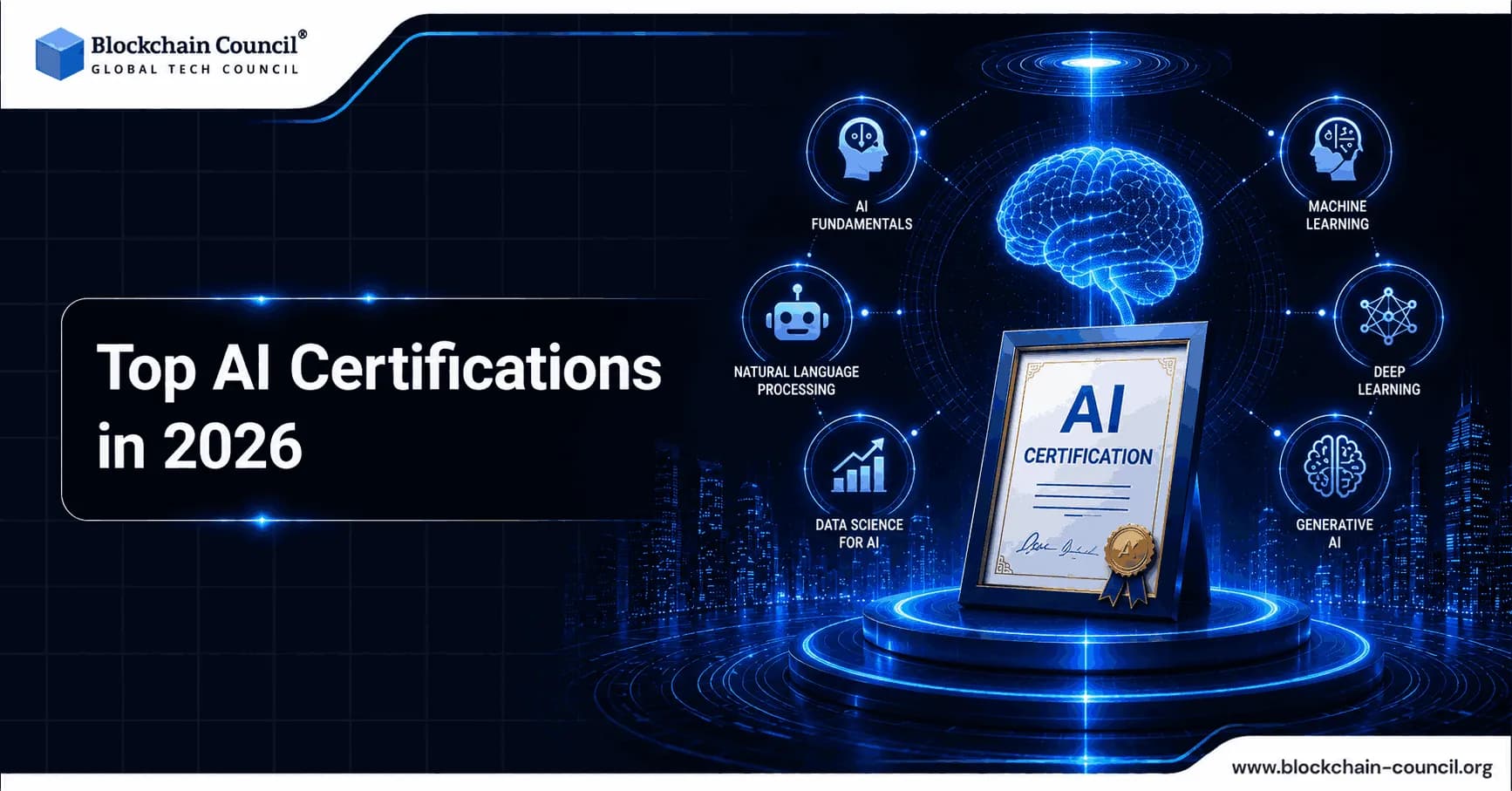
Top AI certifications in 2026 are no longer just resume boosters. As AI moves from pilots to production across industries, certifications increasingly act as structured proof that you can work with real AI systems, understand risks, and collaborate across technical and non-technical teams. In 2024, McKinsey reported that 65 percent of organizations were already using generative AI in at least one business function, and the World Economic Forum projected AI and big data roles among the fastest growing through 2028. Research from GIPMC has also highlighted that 75 percent of organizations want AI awareness even in non-technical roles, which explains the surge in both AI fundamentals certifications and role-based credentials.
This guide breaks down the main certification categories in 2026, highlights leading credentials, and offers a practical framework for choosing the right AI certification for your career path.

Top AI Certifications in 2026
Artificial Intelligence (AI) is no longer a futuristic concept-it's reshaping industries, transforming businesses, and creating millions of new career opportunities worldwide. From healthcare and finance to cybersecurity, education, and software development, organizations are rapidly adopting AI-powered solutions to improve efficiency and innovation.
According to the World Economic Forum's Future of Jobs Report, AI and Big Data roles are among the fastest-growing careers globally, while McKinsey reports that more than 70% of organizations have already adopted AI in at least one business function. As AI becomes an essential business capability, employers are actively seeking professionals with verified AI skills.
This is where AI certifications make a significant difference. A recognized certification validates your expertise, demonstrates your commitment to continuous learning, and helps employers identify professionals who possess practical AI knowledge.
In this guide, we'll explore why AI certifications matter in 2026, what makes a certification valuable, and the best AI certifications offered by Blockchain Council to help you build a successful career in Artificial Intelligence.
Why AI Certifications Matter in 2026
The AI industry is evolving faster than traditional education can keep up. New technologies such as Large Language Models (LLMs), AI Agents, Agentic AI, Retrieval-Augmented Generation (RAG), Context Engineering, and AI Governance are creating specialized job roles that require practical, up-to-date skills.
Employers increasingly prefer certified professionals because certifications provide evidence that candidates understand industry best practices and real-world AI applications.
AI certifications can help you:
Validate your AI knowledge with an industry-recognized credential.
Improve your chances of securing interviews for AI-related roles.
Stay updated with the latest AI technologies and frameworks.
Build practical skills through hands-on learning.
Increase earning potential in an AI-driven job market.
Demonstrate expertise to employers, clients, and business partners.
Whether you're a software developer, data analyst, business leader, entrepreneur, marketer, or IT professional, an AI certification can help you stay competitive in today's rapidly evolving technology landscape.
What Makes a Great AI Certification?
Not every certification delivers practical value. Before enrolling in any AI program, consider whether it offers:
Comprehensive coverage of modern AI concepts.
Hands-on projects and real-world use cases.
Industry-recognized certification.
Updated curriculum aligned with current AI trends.
Coverage of Generative AI, AI Agents, Prompt Engineering, and Responsible AI.
Flexible self-paced learning.
Lifetime certification validity.
Blockchain Council has developed its AI certification portfolio to meet these evolving industry requirements, helping professionals gain practical skills that employers value.
Best Blockchain Council AI Certifications in 2026
1. Certified Artificial Intelligence (AI) Expert™
The Certified Artificial Intelligence (AI) Expert™ certification is designed for professionals who want to develop a strong understanding of Artificial Intelligence from the ground up.
It covers essential AI concepts, machine learning fundamentals, neural networks, deep learning, Natural Language Processing (NLP), computer vision, recommendation systems, and practical AI applications across industries.
Learners also explore how AI is transforming healthcare, finance, retail, manufacturing, cybersecurity, and business operations.
This certification is ideal for:
Software Developers
Business Analysts
AI Enthusiasts
IT Professionals
Digital Transformation Leaders
Students entering AI careers
Learn more:
https://www.blockchain-council.org/certifications/certified-artificial-intelligence-ai-expert/
2. Certified Generative AI Expert™
Generative AI has become one of the most influential technologies of the decade. Organizations are leveraging tools like ChatGPT, Claude, Gemini, and open-source LLMs to automate content creation, customer support, coding assistance, research, and business workflows.
The Certified Generative AI Expert™ certification provides in-depth knowledge of Large Language Models, prompt engineering, Retrieval-Augmented Generation (RAG), AI safety, model evaluation, fine-tuning concepts, and enterprise AI implementation.
You'll learn how modern generative AI systems work and how businesses are integrating them into real-world applications.
This certification is ideal for:
AI Engineers
Software Developers
Product Managers
Marketing Professionals
Business Leaders
Entrepreneurs
Learn more:
https://www.blockchain-council.org/certifications/certified-generative-ai-expert/
3. Certified Prompt Engineer®
Prompt Engineering has evolved into one of the most valuable AI skills. Well-designed prompts significantly improve the quality, consistency, and reliability of AI-generated outputs.
The Certified Prompt Engineer® certification teaches advanced prompting techniques, prompt optimization, multi-step prompting, chain-of-thought methodologies, prompt evaluation, and enterprise AI workflows.
Professionals also learn how to work effectively with leading AI models such as ChatGPT, Claude, Gemini, and other enterprise-grade LLMs.
As organizations increasingly integrate AI into daily operations, Prompt Engineering has become an essential skill for technical and non-technical professionals alike.
Learn more:
https://www.blockchain-council.org/certifications/certified-prompt-engineer/
4. Certified Agentic AI Expert™
Agentic AI is redefining how artificial intelligence operates. Unlike traditional AI systems that respond to individual prompts, AI agents can plan, reason, use external tools, remember previous interactions, and autonomously complete multi-step tasks.
The Certified Agentic AI Expert™ certification equips professionals with the knowledge required to build and deploy intelligent AI agents capable of automating complex business processes.
The curriculum covers:
Agentic AI architecture
AI planning and reasoning
Memory management
Tool calling and function execution
Multi-agent collaboration
Autonomous decision-making
Enterprise AI automation
AI agent security and best practices
As enterprises increasingly adopt AI-powered automation, professionals with Agentic AI expertise are becoming highly sought after across technology, consulting, and enterprise organizations.
Best suited for:
AI Engineers
Software Developers
AI Architects
Automation Engineers
Technology Consultants
Learn more:
https://www.blockchain-council.org/certifications/certified-agentic-ai-expert/
5. Certified AI Agents Manager™
As organizations deploy multiple AI agents across departments, managing their performance, governance, security, and business alignment becomes critical.
The Certified AI Agents Manager™ certification focuses on operationalizing AI agents within enterprise environments. Rather than building models from scratch, professionals learn how to oversee AI deployments, measure business outcomes, manage risks, and optimize agent performance.
Key learning areas include:
AI Agent lifecycle management
Enterprise AI deployment
Agent orchestration
Performance monitoring
AI governance
Responsible AI implementation
Risk management
Business process optimization
This certification is ideal for professionals responsible for leading AI adoption initiatives within organizations.
Recommended for:
AI Project Managers
Product Managers
Digital Transformation Leaders
Operations Managers
Enterprise Architects
Learn more:
https://www.blockchain-council.org/certifications/certified-ai-agents-manager/
6. Certified AI Agentic Workflow Expert™
Modern enterprises rarely rely on a single AI model. Instead, they combine multiple AI agents, APIs, databases, vector stores, and automation tools into intelligent workflows capable of completing sophisticated tasks with minimal human intervention.
The Certified AI Agentic Workflow Expert™ certification teaches professionals how to design, build, and optimize these advanced AI workflows.
Topics covered include:
Multi-agent orchestration
Workflow automation
AI pipelines
Retrieval-Augmented Generation (RAG)
Vector databases
Enterprise integrations
AI workflow optimization
Performance evaluation
By mastering AI workflow design, professionals can significantly improve business productivity while reducing manual effort.
Ideal for:
AI Engineers
Automation Specialists
Software Developers
AI Consultants
Technical Architects
Learn more:
https://www.blockchain-council.org/certifications/certified-ai-agentic-workflow-expert/
7. Certified AI Context Engineer™
One of the biggest challenges in enterprise AI is ensuring that Large Language Models receive accurate, relevant, and contextual information. Context Engineering has emerged as a critical discipline that focuses on improving AI responses by optimizing the information supplied to models.
The Certified AI Context Engineer™ certification introduces professionals to techniques for building intelligent AI systems that generate more reliable, consistent, and business-specific outputs.
You'll learn about:
Context Engineering fundamentals
Knowledge retrieval
Retrieval-Augmented Generation (RAG)
Context optimization
Vector databases
Semantic search
Memory systems
Enterprise AI architecture
Organizations implementing enterprise AI increasingly require professionals capable of improving AI accuracy through better context management rather than simply writing prompts.
Recommended for:
AI Developers
Prompt Engineers
AI Architects
Solution Engineers
LLM Application Developers
Learn more:
https://www.blockchain-council.org/certifications/certified-ai-context-engineer/
8. Certified AI Strategy & Governance Expert™
As AI adoption accelerates, organizations must balance innovation with responsible governance. Governments worldwide are introducing regulations that require businesses to address AI ethics, transparency, compliance, and risk management.
The Certified AI Strategy & Governance Expert™ certification prepares professionals to create governance frameworks that ensure AI systems remain secure, ethical, compliant, and aligned with business objectives.
The curriculum includes:
AI governance frameworks
Responsible AI principles
AI risk management
Regulatory compliance
Enterprise AI policies
AI ethics
Model oversight
Governance best practices
This certification is particularly valuable for enterprises implementing AI at scale while preparing for evolving global AI regulations.
Ideal for:
Compliance Professionals
AI Governance Leaders
Risk Managers
CIOs
CTOs
Enterprise Executives
Learn more:
https://www.blockchain-council.org/certifications/certified-ai-strategy-governance-expert/
9. Certified AI Powered Leader™
Artificial Intelligence is transforming how organizations make decisions, develop products, engage customers, and drive innovation. Business leaders who understand AI are better positioned to lead digital transformation initiatives and create long-term competitive advantages.
The Certified AI Powered Leader™ certification is designed specifically for executives and decision-makers who want to leverage AI without requiring deep technical expertise.
Key topics include:
AI business strategy
Enterprise AI adoption
Innovation frameworks
AI-driven decision-making
Organizational transformation
Responsible AI leadership
AI investment planning
Future AI trends
The certification enables leaders to confidently identify AI opportunities, align technology initiatives with business goals, and lead successful AI transformation programs.
Best suited for:
CEOs
CXOs
Directors
Business Leaders
Entrepreneurs
Digital Transformation Executives
Learn more:
https://www.blockchain-council.org/certifications/certified-ai-powered-leader/
Which Blockchain Council AI Certification Should You Choose?
Choosing the right certification depends on your career goals and current level of expertise.
AI Courses: https://www.blockchain-council.org/ai-certification-courses/
Beginners should start with the Certified Artificial Intelligence (AI) Expert™ to build a strong foundation in AI concepts and applications.
If you're interested in Large Language Models and modern AI applications, the Certified Generative AI Expert™ is an excellent next step.
Professionals working extensively with ChatGPT, Claude, Gemini, or enterprise AI assistants will benefit from becoming a Certified Prompt Engineer®.
Developers looking to build autonomous AI systems should consider the Certified Agentic AI Expert™ and Certified AI Agentic Workflow Expert™ certifications.
Business leaders, managers, and executives can strengthen their strategic capabilities through the Certified AI Agents Manager™, Certified AI Strategy & Governance Expert™, and Certified AI Powered Leader™ certifications.
With AI continuing to evolve rapidly, selecting a certification aligned with your career objectives can help you build future-ready skills and remain competitive in one of the world's fastest-growing technology sectors.
AI Career Opportunities and Salary Outlook in 2026
Artificial Intelligence has become one of the fastest-growing career domains worldwide. Organizations across industries-including finance, healthcare, cybersecurity, retail, manufacturing, education, logistics, and technology-are actively investing in AI-driven solutions to improve productivity, automate repetitive tasks, and make better business decisions.
As AI adoption accelerates, professionals with verified AI skills are increasingly in demand. According to industry reports from the World Economic Forum and LinkedIn, AI-related roles continue to rank among the fastest-growing job categories globally.
Some of the most in-demand AI job roles include:
Artificial Intelligence Engineer
Generative AI Engineer
Prompt Engineer
AI Consultant
AI Solutions Architect
AI Product Manager
AI Automation Specialist
AI Governance Specialist
AI Strategy Consultant
AI Transformation Leader
Professionals with practical AI expertise and industry-recognized certifications are often better positioned to stand out in competitive hiring processes and demonstrate job-ready skills.
Why Employers Value Blockchain Council Certifications
Hiring managers are increasingly looking for professionals who can apply AI to solve real business challenges-not just understand theoretical concepts.
Blockchain Council certifications are designed with this practical approach in mind, helping learners build knowledge that aligns with modern enterprise AI adoption.
Key benefits include:
Industry-recognized certification
Comprehensive and updated curriculum
Self-paced online learning
Practical AI use cases
Coverage of Generative AI, Agentic AI, Prompt Engineering, AI Governance, and Enterprise AI
Lifetime access to learning resources
Globally accessible certification programs
Whether you're beginning your AI journey or expanding your existing expertise, Blockchain Council provides certifications designed for developers, business professionals, managers, and enterprise leaders.
Suggested AI Certification Roadmap
Rather than earning random certifications, it's better to follow a structured learning path.
Beginner Level
Start with:
This certification builds a solid understanding of AI concepts, machine learning fundamentals, neural networks, NLP, and business applications.
Intermediate Level
Once you're comfortable with AI fundamentals, expand your skills with:
These certifications focus on Large Language Models, prompt engineering, enterprise AI applications, and modern Generative AI workflows.
Advanced Level
Professionals looking to specialize should explore:
These certifications cover autonomous AI systems, workflow orchestration, Retrieval-Augmented Generation (RAG), Context Engineering, and enterprise AI automation.
Leadership Level
Managers and executives responsible for AI transformation can strengthen their strategic capabilities through:
These programs emphasize AI governance, responsible AI adoption, enterprise strategy, and organizational transformation.
Reddit queries:
Which AI certification is best for beginners?
The Certified Artificial Intelligence (AI) Expert™ is an excellent starting point. It introduces the core concepts of Artificial Intelligence, Machine Learning, Deep Learning, and AI applications without requiring advanced technical experience.
Which Blockchain Council certification focuses on Generative AI?
The Certified Generative AI Expert™ covers Large Language Models (LLMs), Prompt Engineering, AI safety, Retrieval-Augmented Generation (RAG), enterprise AI applications, and modern Generative AI technologies.
Which certification is best for learning AI Agents?
The Certified Agentic AI Expert™ is specifically designed to teach autonomous AI agents, reasoning systems, tool usage, planning, memory management, and enterprise AI automation.
Is Prompt Engineering still relevant in 2026?
Yes. Prompt Engineering remains an essential skill for working effectively with modern AI systems such as ChatGPT, Claude, Gemini, and enterprise Large Language Models. Professionals who understand prompt optimization can significantly improve AI-generated outputs and workflows.
What is Context Engineering?
Context Engineering focuses on providing AI models with accurate, relevant, and structured information to improve response quality. It has become an important discipline for enterprise AI systems and Retrieval-Augmented Generation (RAG) applications.
Which certification is best for business leaders?
The Certified AI Powered Leader™ helps executives understand AI strategy, business transformation, responsible AI adoption, and organizational innovation without requiring deep programming knowledge.
Are Blockchain Council certifications self-paced?
Yes. Most Blockchain Council certification programs are designed for flexible, self-paced online learning, allowing professionals to study according to their schedules.
How do Blockchain Council certifications help professionals?
These certifications validate practical AI skills, improve professional credibility, strengthen resumes, support career advancement, and help learners stay current with rapidly evolving AI technologies.
Conclusion
Artificial Intelligence is transforming nearly every industry, making AI skills more valuable than ever before. As organizations continue integrating Generative AI, AI Agents, automation, and intelligent decision-making into their operations, professionals with practical AI expertise will remain in high demand.
Choosing the right certification is the first step toward building a successful AI career. Blockchain Council offers a comprehensive portfolio of AI certifications that cater to beginners, developers, business professionals, managers, and executives alike.
Whether you want to master Artificial Intelligence fundamentals, specialize in Generative AI, build autonomous AI agents, optimize enterprise AI workflows, or lead AI transformation initiatives, Blockchain Council provides a structured learning path aligned with the latest industry trends.
Explore the complete collection of AI certifications from Blockchain Council and take the next step toward becoming a future-ready AI professional.
Explore Blockchain Council AI Certifications:
https://www.blockchain-council.org/certifications/certified-artificial-intelligence-ai-expert/
https://www.blockchain-council.org/certifications/certified-generative-ai-expert/
https://www.blockchain-council.org/certifications/certified-prompt-engineer/
https://www.blockchain-council.org/certifications/certified-agentic-ai-expert/
https://www.blockchain-council.org/certifications/certified-ai-agents-manager/
https://www.blockchain-council.org/certifications/certified-ai-agentic-workflow-expert/
https://www.blockchain-council.org/certifications/certified-ai-context-engineer/
https://www.blockchain-council.org/certifications/certified-ai-strategy-governance-expert/
https://www.blockchain-council.org/certifications/certified-ai-powered-leader/
Frequently Asked Questions (FAQs)
1. What is the best AI certification in 2026?
The best AI certification depends on your career goals. If you're looking for a comprehensive program covering Artificial Intelligence, Machine Learning, Generative AI, and real-world AI applications, the Certified Artificial Intelligence (AI) Expert™ from Blockchain Council is an excellent choice.
2. Which AI certification is most recognized by employers?
Employers typically value certifications that demonstrate practical, job-ready AI skills. Blockchain Council certifications are recognized globally and cover emerging technologies such as Generative AI, Agentic AI, Prompt Engineering, AI Governance, and AI Automation.
3. Are AI certifications worth it in 2026?
Yes. AI certifications validate your knowledge, improve your resume, strengthen your LinkedIn profile, and demonstrate your commitment to staying current with rapidly evolving AI technologies.
4. Which AI certification is best for beginners?
Beginners should start with the Certified Artificial Intelligence (AI) Expert™, as it introduces AI fundamentals, Machine Learning, Deep Learning, NLP, and real-world AI applications.
5. Which certification is best for Generative AI?
The Certified Generative AI Expert™ is ideal for professionals who want to learn Large Language Models (LLMs), Prompt Engineering, Retrieval-Augmented Generation (RAG), AI safety, and enterprise AI applications.
6. Which AI certification is best for developers?
Developers should consider:
Certified Artificial Intelligence (AI) Expert™
Certified Generative AI Expert™
Certified Agentic AI Expert™
Certified AI Agentic Workflow Expert™
Certified AI Context Engineer™
7. What is Agentic AI?
Agentic AI refers to autonomous AI systems that can plan, reason, use tools, retain memory, and execute multi-step tasks with minimal human intervention.
8. What is the difference between AI and Generative AI?
Artificial Intelligence focuses on enabling machines to perform intelligent tasks, while Generative AI creates new content such as text, images, code, videos, and audio using foundation models and Large Language Models.
9. What is Prompt Engineering?
Prompt Engineering is the practice of designing effective prompts that improve the accuracy, relevance, and consistency of AI-generated responses.
10. What is Context Engineering?
Context Engineering focuses on supplying AI models with structured, relevant, and accurate information to improve response quality, especially in enterprise AI systems using Retrieval-Augmented Generation (RAG).
11. Which AI certification covers AI Agents?
Blockchain Council's Certified Agentic AI Expert™ and Certified AI Agents Manager™ certifications focus on designing, deploying, and managing intelligent AI agents.
12. What is Retrieval-Augmented Generation (RAG)?
Retrieval-Augmented Generation (RAG) combines Large Language Models with external knowledge sources, allowing AI systems to generate more accurate, contextual, and up-to-date responses.
13. Which AI certification is best for business leaders?
The Certified AI Powered Leader™ is designed for executives and managers who want to lead AI transformation without requiring deep programming expertise.
14. How long does it take to complete an AI certification?
Completion time depends on your learning pace. Most self-paced AI certification programs can be completed within a few weeks to a few months.
15. Can I learn AI without coding?
Yes. Many AI certifications, especially those designed for business professionals and leaders, teach AI concepts, strategy, and applications without requiring advanced programming skills.
16. Which industries are hiring AI professionals?
AI professionals are in demand across healthcare, finance, banking, retail, cybersecurity, education, manufacturing, logistics, e-commerce, telecommunications, consulting, and government sectors.
17. What jobs can I get after an AI certification?
AI certifications can prepare you for roles such as:
AI Engineer
Generative AI Engineer
Prompt Engineer
AI Consultant
AI Product Manager
AI Solutions Architect
AI Automation Specialist
AI Governance Professional
AI Transformation Leader
18. What skills should I learn alongside AI?
Professionals should also develop skills in:
Prompt Engineering
AI Agents
Machine Learning
Python
APIs
Vector Databases
RAG
AI Security
AI Governance
Cloud Computing
19. Is AI replacing software developers?
No. AI is changing how developers work by automating repetitive tasks and increasing productivity. Developers who learn AI tools and workflows will have better career opportunities.
20. Which Blockchain Council AI certification should I choose?
Choose based on your career goals:
Beginners → Certified Artificial Intelligence (AI) Expert™
Generative AI → Certified Generative AI Expert™
Prompt Engineering → Certified Prompt Engineer®
AI Agents → Certified Agentic AI Expert™
AI Workflows → Certified AI Agentic Workflow Expert™
Context Engineering → Certified AI Context Engineer™
AI Governance → Certified AI Strategy & Governance Expert™
Leadership → Certified AI Powered Leader™
21. Will AI certifications improve my salary?
While no certification guarantees a salary increase, earning an AI certification can strengthen your resume, validate your expertise, and improve your competitiveness for AI-focused roles and career advancement.
22. What are the latest AI trends in 2026?
Key AI trends include Agentic AI, multimodal AI, enterprise AI agents, AI copilots, Context Engineering, Retrieval-Augmented Generation (RAG), AI governance, AI security, and autonomous workflow automation.
23. How do I become an AI Engineer in 2026?
Start by learning AI fundamentals, Machine Learning, Generative AI, Prompt Engineering, AI Agents, and practical AI development. Earning industry-recognized certifications and building hands-on projects can help prepare you for AI engineering roles.
24. Are Blockchain Council AI certifications self-paced?
Yes. Most Blockchain Council AI certifications are self-paced, allowing learners to study according to their own schedules while gaining practical AI knowledge.
25. Why should I choose Blockchain Council for AI certifications?
Blockchain Council offers industry-focused AI certifications covering Artificial Intelligence, Generative AI, Prompt Engineering, Agentic AI, AI Governance, AI Automation, and enterprise AI use cases. The programs are designed to help professionals build practical, career-ready AI skills aligned with current industry demands.
26. What are the most in-demand AI skills in 2026?
The most sought-after AI skills include Generative AI, Prompt Engineering, Agentic AI, Context Engineering, Retrieval-Augmented Generation (RAG), AI Automation, Machine Learning, AI Governance, and Large Language Model (LLM) development.
27. Which AI certification is best for working professionals?
Working professionals should choose certifications that offer flexible, self-paced learning and practical industry applications. Blockchain Council certifications are designed to help professionals upskill while balancing their careers.
28. Can beginners learn Artificial Intelligence without a technical background?
Yes. Many AI certification programs introduce AI concepts from the ground up, making them suitable for business professionals, students, marketers, managers, and entrepreneurs.
29. Which programming language should I learn for AI?
Python remains the most widely used programming language for Artificial Intelligence, Machine Learning, Data Science, and Generative AI development due to its extensive libraries and community support.
30. What is the difference between Machine Learning and Artificial Intelligence?
Artificial Intelligence is the broader field focused on enabling machines to perform intelligent tasks, while Machine Learning is a subset of AI that allows systems to learn patterns from data and improve performance without explicit programming.
31. What is the difference between AI, Machine Learning, and Deep Learning?
AI is the overarching field of intelligent systems. Machine Learning enables systems to learn from data, while Deep Learning uses neural networks with multiple layers to solve complex problems such as image recognition and natural language processing.
32. What is an AI Agent?
An AI Agent is an autonomous software system capable of reasoning, planning, using tools, remembering previous interactions, and completing multi-step tasks with minimal human intervention.
33. Why are AI Agents becoming popular?
AI Agents improve productivity by automating repetitive tasks, integrating with enterprise applications, assisting employees, and executing workflows across multiple systems.
34. What is Enterprise AI?
Enterprise AI refers to the implementation of Artificial Intelligence technologies within organizations to automate business processes, improve decision-making, optimize operations, and enhance customer experiences.
35. What is Responsible AI?
Responsible AI focuses on building and deploying AI systems that are ethical, transparent, secure, fair, accountable, and compliant with regulations.
36. What is AI Governance?
AI Governance involves establishing policies, frameworks, and controls that ensure AI systems are developed and used responsibly while minimizing risks and ensuring regulatory compliance.
37. What is AI Automation?
AI Automation combines Artificial Intelligence with workflow automation to reduce manual effort, improve efficiency, and automate business operations across various industries.
38. What is an LLM?
A Large Language Model (LLM) is an AI model trained on massive datasets to understand, generate, summarize, and analyze human language. Examples include GPT, Claude, Gemini, and Llama.
39. What is Multimodal AI?
Multimodal AI can understand and generate multiple types of content, including text, images, audio, video, and code, enabling more natural human-computer interactions.
40. What is AI Fine-Tuning?
Fine-tuning is the process of adapting a pre-trained AI model using domain-specific datasets so it performs better on specialized tasks or business applications.
41. How can AI improve business productivity?
AI can automate repetitive tasks, analyze large datasets, enhance customer support, generate content, improve forecasting, optimize workflows, and assist with decision-making, leading to greater productivity and operational efficiency.
42. What industries benefit the most from AI?
AI is transforming healthcare, finance, banking, insurance, retail, manufacturing, cybersecurity, education, logistics, transportation, legal services, marketing, and customer support.
43. Is Artificial Intelligence a good career in 2026?
Yes. AI continues to be one of the fastest-growing career fields, with increasing demand for professionals specializing in Generative AI, AI Engineering, AI Governance, Prompt Engineering, and AI Automation.
44. Can AI certifications help me switch careers?
Yes. AI certifications provide structured learning and demonstrate validated skills, making them valuable for professionals transitioning from software development, marketing, business analysis, project management, or other domains into AI-focused roles.
45. How do employers verify AI certifications?
Most employers verify certifications through digital certificates, credential verification portals, or unique certification IDs issued by the certification provider.
46. How often should AI professionals update their skills?
Because AI evolves rapidly, professionals should continuously update their knowledge by learning about emerging technologies, frameworks, models, tools, and industry best practices.
47. What should I learn after completing an AI certification?
After completing an AI certification, consider gaining hands-on experience by building AI applications, experimenting with LLMs, learning cloud AI services, and exploring advanced topics such as AI Agents, RAG, and AI Governance.
48. Are AI certifications recognized globally?
Many AI certifications are designed for a global audience and help professionals demonstrate AI expertise across industries and international job markets.
49. How do I choose the right Blockchain Council AI certification?
Select a certification based on your career goals, current skill level, and area of interest. Blockchain Council offers specialized certifications in Artificial Intelligence, Generative AI, Prompt Engineering, Agentic AI, AI Workflow Automation, Context Engineering, AI Governance, and AI Leadership.
50. Where can I explore all Blockchain Council AI certifications?
You can browse the complete collection of Blockchain Council AI certifications, compare learning paths, and choose the certification that aligns with your career goals by visiting the official Blockchain Council certification catalog.
Top 26 Artificial Intelligence Interview Questions and Answers (2026)
Preparing for an AI interview? Here are some of the most commonly asked Artificial Intelligence interview questions in 2026 along with concise answers.
1. What is Artificial Intelligence?
Artificial Intelligence (AI) is the simulation of human intelligence by machines, enabling them to learn, reason, solve problems, understand language, and make decisions.
2. What is Machine Learning?
Machine Learning is a subset of AI that enables systems to learn patterns from data and improve their performance without being explicitly programmed.
3. What is Deep Learning?
Deep Learning is a branch of Machine Learning that uses multi-layered neural networks to solve complex problems like image recognition, speech processing, and natural language understanding.
4. What is Generative AI?
Generative AI creates new content such as text, images, videos, code, and audio using Large Language Models (LLMs) and foundation models.
5. What is Prompt Engineering?
Prompt Engineering is the process of designing effective prompts that guide AI models to generate accurate, relevant, and high-quality responses.
6. What is Agentic AI?
Agentic AI refers to autonomous AI systems capable of reasoning, planning, remembering, using tools, and executing multi-step tasks independently.
7. What is an AI Agent?
An AI Agent is an intelligent software system that can perceive information, make decisions, and perform actions to achieve specific goals.
8. What is Retrieval-Augmented Generation (RAG)?
RAG combines Large Language Models with external knowledge sources to produce more accurate, contextual, and up-to-date responses.
9. What is Context Engineering?
Context Engineering focuses on supplying AI models with the right information and context to improve response accuracy and reliability.
10. What is a Large Language Model (LLM)?
A Large Language Model is an AI model trained on massive text datasets to understand and generate human language.
11. What is the difference between AI and Machine Learning?
AI is the broader field of intelligent systems, while Machine Learning is one approach used to build AI by enabling systems to learn from data.
12. What is the difference between Machine Learning and Deep Learning?
Machine Learning uses algorithms to learn from data, whereas Deep Learning uses deep neural networks capable of solving highly complex problems.
13. What are supervised and unsupervised learning?
Supervised learning uses labeled data for training, while unsupervised learning identifies hidden patterns in unlabeled data.
14. What is Reinforcement Learning?
Reinforcement Learning trains AI agents through rewards and penalties, enabling them to make sequential decisions.
15. What is Natural Language Processing (NLP)?
NLP enables computers to understand, interpret, and generate human language for applications such as chatbots, translation, and sentiment analysis.
16. What is Computer Vision?
Computer Vision enables AI systems to analyze images and videos for tasks such as object detection, facial recognition, and medical imaging.
17. What are AI Hallucinations?
AI hallucinations occur when an AI model generates incorrect or fabricated information while presenting it as factual.
18. What is Fine-Tuning?
Fine-tuning adapts a pre-trained AI model using domain-specific datasets to improve its performance on specialized tasks.
19. What are AI Tokens?
Tokens are the smallest units of text processed by Large Language Models during training and inference.
20. What is Temperature in AI?
Temperature controls the randomness of AI-generated responses. Lower values produce more deterministic outputs, while higher values increase creativity.
21. What is AI Governance?
AI Governance establishes policies, standards, and controls to ensure responsible, ethical, and compliant AI deployment.
22. What is Responsible AI?
Responsible AI focuses on fairness, transparency, accountability, privacy, and security throughout the AI lifecycle.
23. What is Explainable AI (XAI)?
Explainable AI makes AI decisions understandable and interpretable for humans, increasing trust and regulatory compliance.
24. What are Vector Databases?
Vector databases store embeddings and enable semantic search for Retrieval-Augmented Generation (RAG) and enterprise AI applications.
25. What are AI Agents used for?
AI Agents automate customer support, workflow automation, coding assistance, research, scheduling, data analysis, cybersecurity, and enterprise operations.
26. How do you start a career in Artificial Intelligence?
Start by learning AI fundamentals, Machine Learning, Generative AI, Prompt Engineering, AI Agents, and building practical projects. Earning an industry-recognized AI certification and creating a portfolio can strengthen your job prospects and prepare you for AI-focused roles.
27. What is a Neural Network?
A neural network is a machine learning model inspired by the human brain that consists of interconnected nodes (neurons) used to identify patterns and solve complex tasks.
28. What is an Embedding in AI?
An embedding is a numerical vector representation of text, images, or other data that captures semantic meaning, enabling similarity search and Retrieval-Augmented Generation (RAG).
29. What is Tokenization?
Tokenization is the process of breaking text into smaller units called tokens before it is processed by an AI model.
30. What is a Transformer Model?
A Transformer is a deep learning architecture that uses self-attention mechanisms to process sequences efficiently. Modern LLMs such as GPT, Claude, Gemini, and Llama are based on Transformer models.
31. What is Self-Attention?
Self-attention allows an AI model to determine which words or tokens are most relevant to each other when understanding context within a sentence.
32. What is an AI Copilot?
An AI Copilot is an intelligent assistant that helps users perform tasks such as coding, writing, research, customer support, and workflow automation.
33. What is Transfer Learning?
Transfer Learning is the technique of using a pre-trained model and adapting it for a new task instead of training a model from scratch.
34. What is Zero-Shot Learning?
Zero-shot learning enables AI models to perform tasks without being explicitly trained on examples for those specific tasks.
35. What is Few-Shot Prompting?
Few-shot prompting provides a small number of examples within the prompt to improve the quality and consistency of AI-generated responses.
36. What is Chain-of-Thought Prompting?
Chain-of-Thought prompting encourages AI models to explain intermediate reasoning steps before generating the final answer, often improving accuracy for complex tasks.
37. What is AI Bias?
AI bias occurs when an AI system produces unfair or inaccurate outcomes because of biased training data, algorithms, or design decisions.
38. What is Overfitting?
Overfitting happens when a machine learning model memorizes training data instead of learning general patterns, leading to poor performance on unseen data.
39. What is Underfitting?
Underfitting occurs when a model is too simple to capture the underlying relationships in the training data, resulting in poor predictive performance.
40. What is Model Training?
Model training is the process of teaching an AI model by exposing it to data so it can identify patterns and make predictions.
41. What is Model Inference?
Inference is the process of using a trained AI model to generate predictions or responses for new input data.
42. What are AI Parameters?
Parameters are the learned weights inside an AI model that determine how it processes information and generates outputs.
43. What is AI Fine-Tuning vs Prompt Engineering?
Fine-tuning modifies the model using additional training data, while Prompt Engineering improves outputs by designing better prompts without changing the model itself.
44. What is Hallucination Mitigation?
Hallucination mitigation involves techniques such as Retrieval-Augmented Generation (RAG), prompt optimization, guardrails, and human validation to reduce incorrect AI responses.
45. What are AI Guardrails?
AI guardrails are safety mechanisms that prevent AI systems from generating harmful, unsafe, or policy-violating outputs.
46. What is AI Alignment?
AI alignment ensures that AI systems behave according to human values, organizational objectives, and ethical principles.
47. What is an AI Workflow?
An AI workflow is a sequence of AI-powered tasks that automate business processes using models, APIs, databases, and decision logic.
48. What is Multi-Agent AI?
Multi-Agent AI involves multiple autonomous AI agents collaborating to solve complex problems, share information, and complete workflows efficiently.
49. What is AI Orchestration?
AI orchestration coordinates multiple AI models, tools, APIs, and agents to deliver complete end-to-end business solutions.
50. What is an MCP (Model Context Protocol)?
Model Context Protocol (MCP) is an open standard that enables AI models to securely connect with external tools, applications, databases, and enterprise systems through a standardized interface.
51. What is AI Memory?
AI memory enables AI agents to retain information from previous interactions, improving personalization, continuity, and long-term task execution.
52. What is Semantic Search?
Semantic search retrieves information based on meaning and context instead of relying solely on keyword matching.
53. What is Vector Search?
Vector search compares embeddings within a vector database to identify semantically similar content.
54. What is AI Evaluation?
AI evaluation measures the performance, accuracy, reliability, safety, and effectiveness of AI models using predefined metrics and benchmarks.
55. What is MLOps?
MLOps is the practice of deploying, monitoring, maintaining, and continuously improving machine learning models in production environments.
56. What is AI Security?
AI security protects AI models, training data, and inference systems from attacks such as prompt injection, model theft, adversarial attacks, and data poisoning.
57. What is Prompt Injection?
Prompt injection is an attack where malicious instructions manipulate an AI model into ignoring its intended behavior or revealing sensitive information.
58. What is Data Poisoning?
Data poisoning is a cyberattack in which attackers manipulate training datasets to influence an AI model's behavior and reduce its reliability.
59. What is Explainability in AI?
Explainability refers to the ability to understand and interpret how an AI system arrives at a particular decision or prediction.
60. What is the future of Artificial Intelligence?
The future of AI includes Agentic AI, enterprise automation, multimodal AI, AI-powered robotics, autonomous agents, AI governance, personalized AI assistants, and responsible AI systems that work alongside humans across industries.
Related Articles
View All
AI & ML
Can Code-Generating AI Improve Its Own Code? The Path to RSI
Code-generating AI can improve code artifacts through tests, tools, and agent loops, but true recursive self improvement remains experimental.

AI & ML
Built to Catch AI Cheating: Rethinking Pre-Employment Assessments with HireValid
Explore how HireValid is rethinking pre-employment assessments with AI-resistant test design, integrity signals, candidate evidence, and human review to address AI-assisted cheating.
AI & ML
AI-Era Hiring Needs AI-Proof Tests: How HireValid Is Redefining Talent Assessment
Explore how HireValid is rethinking talent assessment for the AI era with job-relevant tests, anti-cheating design, integrity signals, and human-reviewed evidence of candidate ability.
Trending Articles
The Role of Blockchain in Ethical AI Development
How blockchain technology is being used to promote transparency and accountability in artificial intelligence systems.

Top 5 DeFi Platforms
Explore the leading decentralized finance platforms and what makes each one unique in the evolving DeFi landscape.

Can DeFi 2.0 Bridge the Gap Between Traditional and Decentralized Finance?
The next generation of DeFi protocols aims to connect traditional banking with decentralized finance ecosystems.