
How AI Is Powering the Rise of Retail Investors
 Michael Willson
For decades, the world of investing was tilted toward institutions — the hedge funds, banks, and asset managers armed with expensive research, insider access, and sophisticated models. Ordinary investors, by contrast, had limited tools, slow data, and little confidence. But in just a few years, artificial intelligence has flipped that dynamic. AI is now giving retail investors analytical power once reserved for Wall Street.
Today, millions of individual investors can access real-time insights, predictive analytics, and market-forecasting models right from their phones. They can ask a chatbot to analyse a company’s earnings report, test a trading idea using historical data, or automate portfolio decisions with robo-advisors. The AI revolution has democratised finance, levelling the playing field between institutions and individuals.

Anyone who wants to understand the algorithm reshaping investing can start with the AI Certification. It explains how machine learning models interpret market data, process sentiment, and drive decision-making — exactly the knowledge base empowering this new wave of retail traders.
What Sparked the Rise of Retail Investing?
Retail investing used to mean buying a few mutual funds and checking prices once a month. That changed dramatically after the pandemic. Stimulus checks, low-fee trading platforms, and social media communities like Reddit’s WallStreetBets triggered an explosion of participation. Millions of new investors entered the market — curious, connected, and willing to learn.
Yet enthusiasm alone wasn’t enough. To stay competitive, retail investors needed better data and smarter tools. That’s where AI stepped in.
AI bridges the knowledge gap by simplifying complex market analysis. It turns raw data into actionable insights that anyone can understand. Instead of reading fifty analyst reports, a retail investor can now ask an AI system for a summary, complete with sentiment trends, price targets, and risk assessments.
The result? A more confident, data-driven generation of individual investors who make decisions faster and with greater conviction.
How AI Makes Markets More Accessible
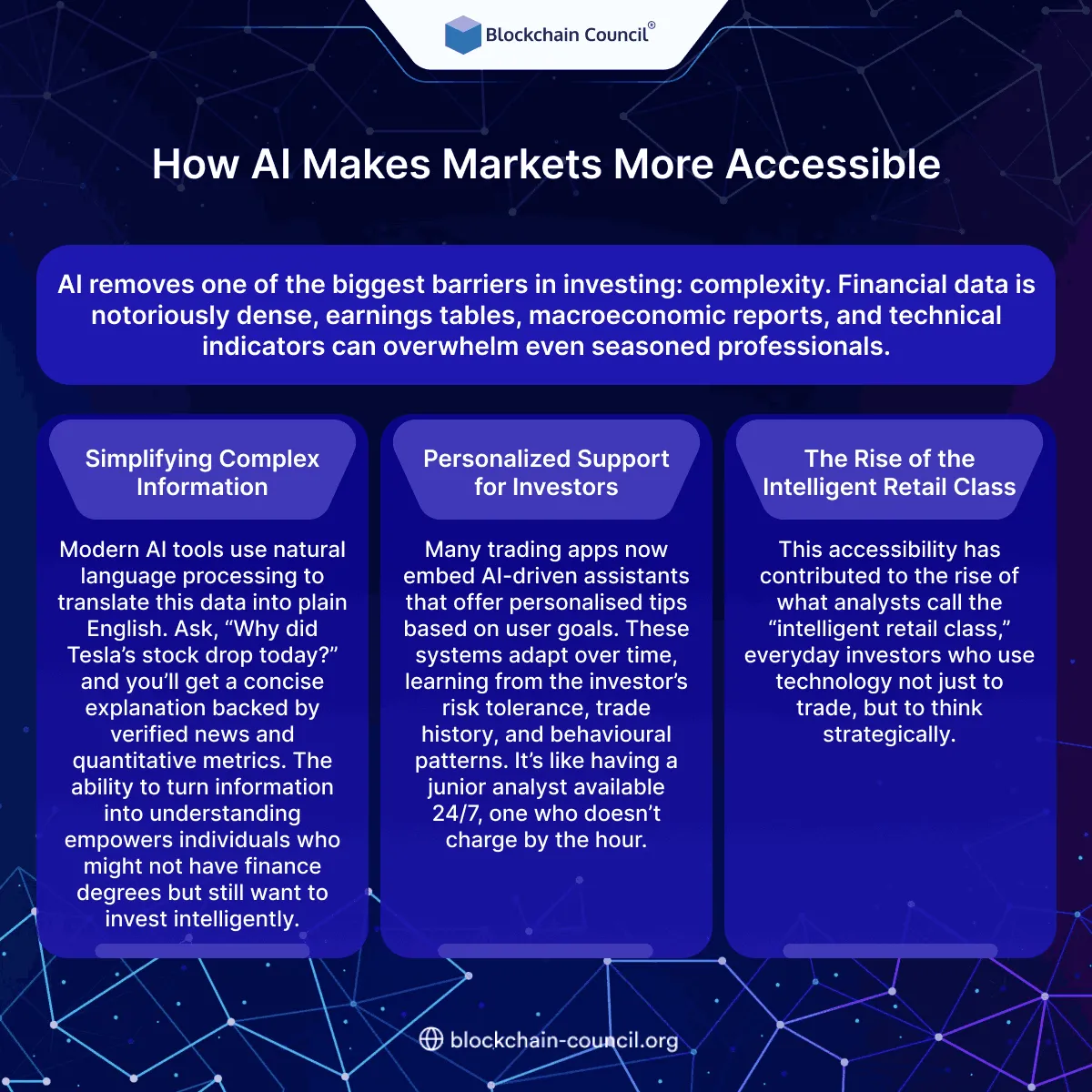
AI removes one of the biggest barriers in investing: complexity. Financial data is notoriously dense — earnings tables, macroeconomic reports, and technical indicators can overwhelm even seasoned professionals.
Modern AI tools use natural language processing to translate this data into plain English. Ask, “Why did Tesla’s stock drop today?” and you’ll get a concise explanation backed by verified news and quantitative metrics. The ability to turn information into understanding empowers individuals who might not have finance degrees but still want to invest intelligently.
Many trading apps now embed AI-driven assistants that offer personalised tips based on user goals. These systems adapt over time, learning from the investor’s risk tolerance, trade history, and behavioural patterns. It’s like having a junior analyst available 24/7 — one who doesn’t charge by the hour.
This accessibility has contributed to the rise of what analysts call the “intelligent retail class” — everyday investors who use technology not just to trade, but to think strategically.
How AI Fuels Confidence Through Information
Investing has always been as much about psychology as economics. The fear of losing money or the thrill of chasing gains often leads to impulsive decisions. AI counters this by grounding investors in data.
Instead of reacting emotionally to headlines, AI-powered platforms show historical context — how similar events affected markets in the past, what patterns might repeat, and what risks to consider. This evidence-based feedback loop reduces panic during downturns and overconfidence during rallies.
Some apps even use sentiment analysis to alert users when social media chatter reaches extremes, signalling that a trend might be overheating. It’s behavioural finance, automated.
In short, AI turns uncertainty into informed decision-making. Retail investors who once relied on gut feeling now rely on probabilities. That’s a seismic shift in market behaviour.
How Robo-Advisors Paved the Way
Before generative AI or conversational bots, robo-advisors were the first taste of automation for retail investors. These platforms — like Betterment, Wealthfront, and Schwab Intelligent Portfolios — use algorithms to build and manage diversified portfolios based on user goals.
AI took this idea further. It allowed these systems to incorporate real-time data, adjust asset allocations dynamically, and personalise risk profiles beyond static questionnaires. Some now monitor global news, inflation data, and even social sentiment to rebalance automatically.
This adaptive approach means portfolios evolve as markets do. What once required a full team of analysts can now be achieved by an algorithm — a major win for accessibility and cost reduction.
Retail investors no longer need $100,000 minimum balances to get professional-grade asset management. A few hundred dollars and a smartphone app now offer similar sophistication.
For those interested in how AI manages risk and constructs such portfolios, the AI Powered Investor Program provides a step-by-step breakdown of how algorithms identify opportunity, manage exposure, and adapt strategies in volatile markets.
How Generative AI Is Changing Retail Research
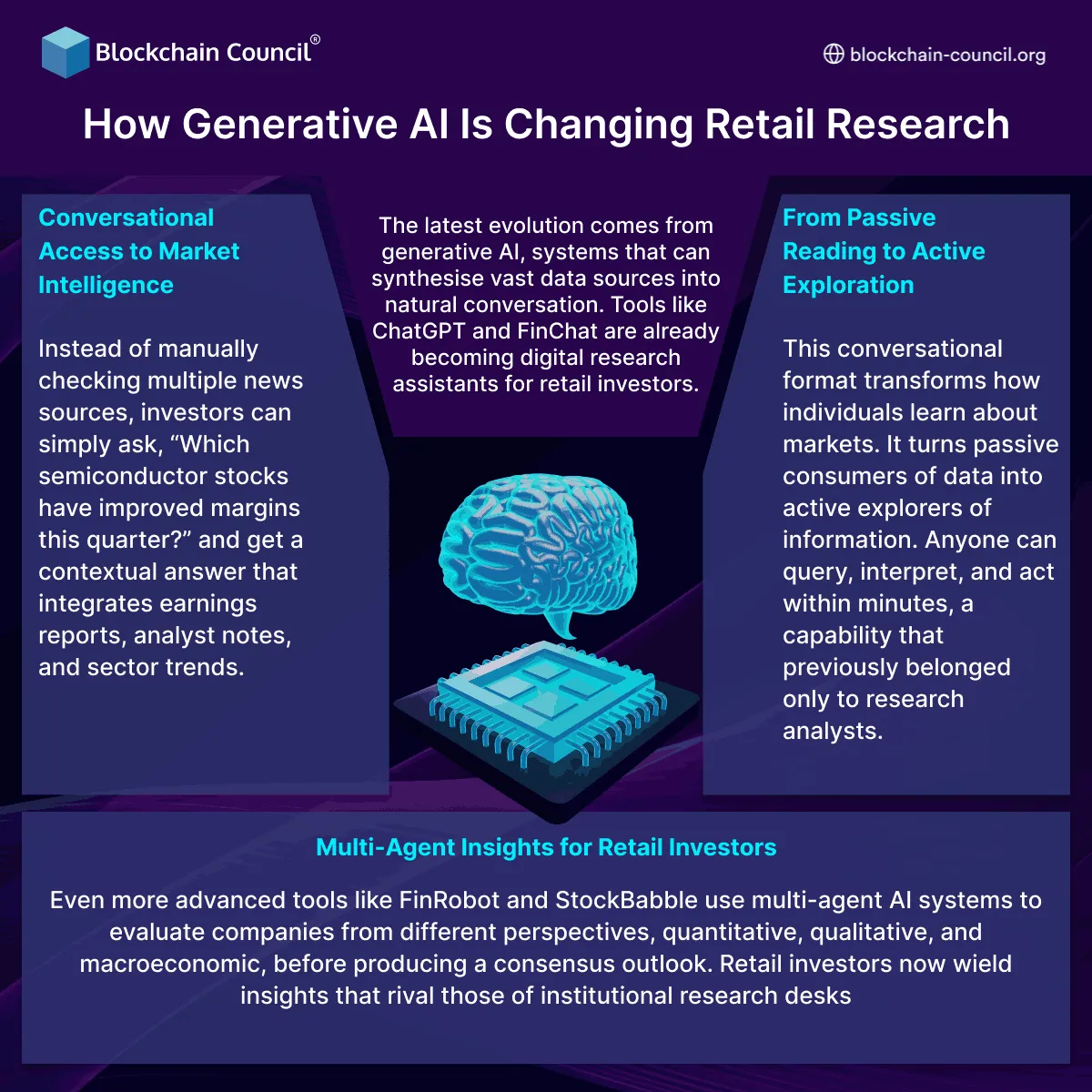
The latest evolution comes from generative AI — systems that can synthesise vast data sources into natural conversation. Tools like ChatGPT and FinChat are already becoming digital research assistants for retail investors.
Instead of manually checking multiple news sources, investors can simply ask, “Which semiconductor stocks have improved margins this quarter?” and get a contextual answer that integrates earnings reports, analyst notes, and sector trends.
This conversational format transforms how individuals learn about markets. It turns passive consumers of data into active explorers of information. Anyone can query, interpret, and act within minutes — a capability that previously belonged only to research analysts.
Even more advanced tools, like FinRobot and StockBabble, use multi-agent AI systems to evaluate companies from different perspectives — quantitative, qualitative, and macroeconomic — before producing a consensus outlook. Retail investors now wield insights that rival those of institutional research desks.
How AI Enhances Market Fairness
For years, one of the biggest complaints about financial markets was information asymmetry — the idea that professionals had better data than everyone else. AI chips away at that imbalance.
By making institutional-grade analytics available to the public, AI flattens the learning curve. Real-time alerts, pattern recognition, and predictive modelling are no longer privileges of hedge funds; they’re features in consumer apps.
This shift doesn’t just empower individuals — it improves markets overall. When more participants have access to reliable insights, price discovery becomes healthier. Speculative bubbles and misinformation have less room to thrive because more eyes are watching intelligently.
The transition is also pushing financial literacy to new heights. Investors are learning from their own data through interactive dashboards that show cause and effect — how decisions impact returns, taxes, and risk.
How AI Transforms Retail Trading Behaviour
The data suggests that AI tools aren’t just making retail investors smarter; they’re making them more engaged. According to eToro, roughly 30% of U.S. retail investors now use AI tools for portfolio management or stock selection, marking a 75% increase in just one year. Globally, nearly one in five individual investors already relies on AI for decision support.
This doesn’t just mean more trades — it means better trades. Retail participants who once followed trends now rely on models that evaluate fundamentals, market momentum, and macro trends simultaneously.
That sophistication is narrowing the gap between professional and personal investing. The result is a market that’s more participatory, more analytical, and — perhaps surprisingly — more stable.
How AI Creates a New Kind of Financial Ecosystem
The rise of retail AI investing has ripple effects across the entire financial system. Brokerages are embedding AI chatbots, regulators are developing transparency frameworks, and educators are designing new courses to train the next generation of investors.
The AI Powered Trading Program explores these shifts in depth — from algorithmic execution to behavioural reinforcement learning in retail platforms. It’s helping traders understand how AI systems learn from price data to optimise decision-making, not just automate it.
The Dawn of the Data-Empowered Investor
AI isn’t replacing human investors; it’s upgrading them. The new retail investor is analytical, curious, and proactive. They no longer depend on costly advice to understand opportunity — they can run their own simulations, read sentiment, and act strategically.
That evolution represents more than a technological change; it’s a cultural one. Investing has moved from exclusivity to inclusivity, from secrecy to transparency, and from reaction to prediction.
AI is the engine behind that transformation — a quiet force turning everyday people into informed market participants.
How AI Tools Are Shaping the Modern Retail Investor
The modern retail investor is no longer a passive participant but an active decision-maker, armed with data that once required institutional access. AI has fundamentally changed how individuals think, act, and learn about markets. Instead of focusing on gut instinct or social media tips, investors can now base decisions on quantified insights.
AI-driven platforms are teaching investors how to interpret indicators, recognise trends, and measure sentiment objectively. For example, an AI dashboard might show how certain economic data — like CPI or employment rates — correlates with stock price movements. These explanations turn investing into an educational experience rather than a guessing game.
Investors are beginning to understand risk in context, thanks to AI’s ability to simulate potential outcomes. They can test “what if” scenarios in seconds, seeing how inflation or a rate hike could affect portfolio performance. This capability builds maturity and independence, qualities that make retail investors more resilient and confident.
How Multi-Agent AI Systems Are Changing Market Research
Traditional market research involves analysts specialising in different domains — one focuses on company fundamentals, another on macroeconomics, another on behavioural data. AI has learned to do the same through multi-agent architectures.
In these systems, multiple AI agents work together like a digital research team. One agent analyses balance sheets, another tracks social sentiment, a third monitors technical charts, and a fourth compiles macro indicators like GDP or inflation forecasts. Together, they debate results, aggregate findings, and deliver a unified conclusion.
This kind of collaboration between AI models — used by systems like FinRobot — represents the next leap in financial intelligence. For retail investors, it means access to integrated insights without the need to hire specialists. They can view a company through every analytical lens, from financial health to public perception.
For professionals eager to understand how such ecosystems operate, the Agentic AI Certification offers deep insights into designing and deploying multi-agent frameworks that simulate complex decision-making — skills directly relevant to the future of AI-driven investing.
How AI-Powered Platforms Turn Novices into Analysts
In the past, learning how to evaluate stocks required months of study and financial literacy. Now, AI systems shorten that curve dramatically.
Generative AI can explain metrics like “price-to-book ratio” or “free cash flow” in plain English, contextualising what those numbers mean for a company’s outlook. For new investors, this lowers the intimidation barrier. Complex finance terms become accessible, actionable knowledge.
Some apps even let users ask questions like “Why is this stock undervalued?” or “What are the top-performing AI companies in renewable energy?” The answers are drawn from data sources once limited to institutional subscribers.
AI isn’t just giving investors access to information; it’s teaching them how to interpret it — one question at a time.
This is where learning meets empowerment. Courses such as the Data Science Certification teach investors to think like analysts — reading data critically, understanding correlation vs causation, and avoiding the traps of overfitting. The more retail investors understand how AI thinks, the smarter they become in using it.
How AI Helps Retail Investors Manage Risk Like Professionals
Risk management used to be the domain of institutional traders equipped with sophisticated models and real-time feeds. Today, retail investors can achieve the same precision through AI.
Machine learning algorithms can assess portfolio risk exposure in real time. They flag when an investor’s holdings become too concentrated in one sector or correlated assets. For example, if an investor’s tech-heavy portfolio mirrors the volatility pattern of the NASDAQ too closely, AI might recommend diversification into consumer goods or energy.
AI also calculates dynamic Value-at-Risk (VaR) — a measure of potential loss — adjusting it automatically as market volatility changes. What used to require teams of quants is now available to anyone with an app.
This doesn’t just protect investors; it teaches them discipline. Automated alerts keep them grounded during hype cycles, reducing impulsive decisions. By combining analytical rigour with behavioural coaching, AI acts as both a guardian and a guide.
How AI and Social Data Are Fueling Retail Momentum
Retail investors are heavily influenced by community sentiment — the buzz on social platforms often triggers collective action. AI now analyses this chatter to separate meaningful signals from noise.
Sentiment models scan thousands of posts per minute, tracking shifts in tone and engagement. If positive sentiment around a stock spikes too quickly without corresponding earnings strength, the system might classify it as speculative. Conversely, if pessimism persists even as fundamentals improve, it may flag a potential undervalued opportunity.
This insight gives retail investors a measurable advantage in understanding crowd psychology. It transforms emotional narratives into structured data.
AI-based tools like StockBabble were built precisely for this — translating chaotic market discussion into actionable intelligence. These systems act like filters, letting investors benefit from social energy while avoiding its pitfalls.
How Blockchain Adds Trust and Transparency to AI Investing
AI thrives on data, and blockchain guarantees that data’s integrity. In retail investing, where transparency builds confidence, the combination of these two technologies is pivotal.
Blockchain ensures that financial data — from price feeds to ownership records — remains tamper-proof. AI models trained on this verified data produce more reliable results. This reduces misinformation and manipulation risks that often disadvantage individual traders.
Some AI-driven platforms now record model outputs and recommendations on-chain, providing verifiable audit trails. That means investors can confirm that the advice they receive is based on consistent logic, not hidden adjustments.
This convergence of trust and intelligence is central to the future of retail finance. Professionals aiming to master both should explore blockchain technology courses that explain how decentralised ledgers enhance AI transparency and reliability.
How AI Encourages Long-Term Thinking Among Retail Investors
In the early 2020s, many retail investors were associated with short-term trading — meme stocks, crypto hype, and speculative surges. AI is helping to change that narrative.
Modern investing apps now use predictive analytics to show how consistent investing outperforms erratic trading over time. When users attempt to time the market, the system visualises potential losses versus holding strategies. These subtle nudges promote patience — a quality essential for wealth accumulation.
Some robo-advisors even gamify long-term planning, rewarding users who stay invested or reach savings milestones. It’s behavioural design powered by AI psychology, turning discipline into engagement.
This shift toward steady, evidence-based investing could reshape market stability in the coming years. Retail investors aren’t just more informed — they’re becoming more consistent.
How AI and Education Are Merging for the Retail Class
Education is the ultimate amplifier of AI’s benefits. Without understanding, even the best tools risk misuse. That’s why AI-driven financial education is expanding rapidly.
New platforms simulate real-world portfolios, letting users test AI recommendations in safe “sandbox” environments. Investors learn by doing — watching how algorithms respond to economic events.
Meanwhile, certification programs like the AI Powered Trading Program and the Marketing and Business Certification give aspiring professionals the hybrid skill set to bridge data science, behavioural economics, and client communication.
Together, education and AI are building not just smarter investors, but more informed citizens — people who understand how financial systems work rather than merely reacting to them.
How Technology Is Turning Retail Investors into Market Influencers
Retail investors now represent a significant force in global markets, accounting for more than 20% of daily trading volume in U.S. equities. What’s remarkable is that this influence is coordinated through technology.
AI recommendation systems amplify collective intelligence: if thousands of retail users act on similar AI-driven insights, they can move markets faster than institutions anticipate. This self-reinforcing loop — information creates participation, participation reshapes information — is redefining market dynamics.
Yet, this influence also carries responsibility. As more individuals rely on AI, ethical use and critical thinking become essential. Investors must learn to question models, verify data, and avoid herd behaviour even when it’s algorithmically dressed.
Those pursuing advanced tech certifications learn precisely this balance — using AI as an advisor, not an oracle.
The Empowered Future of Retail Finance
The rise of retail investors is no longer a trend; it’s a structural shift. AI has turned investing from an exclusive privilege into an accessible craft. What began with curiosity and smartphones has evolved into a global movement of self-educated, data-savvy individuals who think like analysts and act like strategists.
As more investors harness tools powered by technology, markets will become more transparent, fair, and participatory. AI isn’t just helping people trade — it’s teaching them to think critically about money, risk, and opportunity.
And that’s how artificial intelligence isn’t replacing investors — it’s upgrading them.
How AI Is Personalising the Retail Investing Journey
No two investors are alike. One might be a 25-year-old optimist investing every payday, another a 50-year-old protecting retirement savings. AI now recognises those nuances. Instead of offering one-size-fits-all recommendations, it tailors portfolios to individual life stages, goals, and personalities.
Machine learning models analyse behavioural data — how often someone trades, what risks they take, how long they hold positions — and then adjust strategies accordingly. A conservative investor might see a gradual shift toward bonds and dividend stocks, while a risk-tolerant user might get more exposure to high-growth sectors.
This level of individualisation creates a sense of partnership between the user and the technology. The system learns from the investor just as much as the investor learns from it. The result is a more intimate form of wealth management — not merely algorithmic but adaptive, like a digital advisor that truly knows its client.
For professionals eager to build such responsive systems, the AI Certification explains how personalisation models are trained and deployed ethically, ensuring fairness and compliance while maximising client satisfaction.
How AI Is Redefining Financial Communities
The modern investor doesn’t learn in isolation; they share insights, discuss strategies, and collaborate online. AI is now enhancing these communities by curating and moderating discussions in real time.
Social-trading platforms powered by AI can detect misinformation, highlight credible sources, and summarise trending opinions across thousands of comments. When a user community debates a stock or crypto asset, AI identifies consensus patterns — such as whether sentiment is driven by data or hype.
This transparency strengthens trust in digital investing communities. It’s no longer just chatter; it’s structured intelligence. These systems turn discussion into discovery, fostering more disciplined group decision-making.
Advisors who manage digital investment communities are already incorporating AI moderation and analytics tools — skills taught in Marketing and Business Certification programs, which cover how data can enhance engagement while maintaining ethical communication.
How AI-Driven Gamification Keeps Investors Engaged
Financial platforms are using AI not only for analysis but for motivation. Through gamification, algorithms create personalised milestones — investment streaks, diversification badges, or savings challenges — that make investing more interactive.
This design keeps users engaged with their portfolios instead of treating them like set-and-forget accounts. AI analyses behaviour patterns to determine which incentives work best: some investors respond to visual progress charts, others to community rankings or educational rewards.
This behavioural reinforcement increases consistency. Investors who stay engaged tend to make better long-term decisions and avoid emotional trading. The technology turns finance into a learning game — serious in outcome but accessible in experience.
How AI Enhances Financial Inclusion Globally
Perhaps the most transformative effect of AI isn’t in the developed markets, but in emerging ones. Millions of first-time investors in India, Africa, and Latin America are accessing stock markets through AI-powered mobile apps.
Language translation models and simplified interfaces allow users to receive investment advice in their native languages. Even those with minimal financial education can navigate portfolio dashboards guided by voice-based AI assistants.
AI also enables micro-investing — allowing users to buy fractional shares or automate daily savings. These small contributions compound into long-term wealth, extending financial opportunity to groups once excluded from traditional systems.
This democratisation is being studied and refined in global tech certifications programs, which explore how multilingual models, regional data, and ethical AI design foster fair access to financial tools.
How AI Is Shaping the Next Generation of Financial Literacy
Financial education has long been static — a few workshops, outdated textbooks, and sporadic news coverage. AI brings it to life.
Intelligent learning platforms adapt to a user’s understanding level. A beginner might receive simple lessons on diversification, while an advanced learner gets portfolio simulation exercises. Every interaction feeds back into the system, ensuring personalised growth.
AI even analyses user mistakes, identifying patterns like over-trading or failing to rebalance, and suggests corrective learning modules. It’s education built directly into the act of investing — not separate from it.
For future financial coaches and educators, training through Data Science Certification enables them to design educational ecosystems that combine theory, analytics, and interactive learning.
How AI Protects Retail Investors From Fraud
The same tools that predict trends can also prevent losses. AI systems continuously scan trading networks for suspicious activity — pump-and-dump schemes, bot-generated spikes, or fake news campaigns designed to manipulate retail sentiment.
Fraud detection models look for inconsistencies: unusual volume surges, coordinated social activity, or duplicate wallet addresses in crypto markets. When anomalies appear, AI alerts both investors and regulators before damage spreads.
This preventive capacity is critical in an age when misinformation travels faster than facts. By protecting users proactively, AI builds confidence in digital investing platforms.
Combining this detection capability with tamper-proof ledgers studied in blockchain technology courses ensures that data integrity underpins every trade, report, and transaction.
How AI Is Influencing Institutional Behaviour
Interestingly, as retail investors adopt AI, institutions are beginning to adapt their strategies in response. Hedge funds now track retail sentiment data gathered from AI analysis tools, using it as a new signal for market entry and exit.
Retail influence — once ignored — is now measurable and actionable. This two-way feedback loop between individual and institutional investing creates a more dynamic ecosystem where no player dominates the flow of information.
AI acts as the great equaliser, turning retail behaviour into a legitimate macro factor. That change is forcing professional traders to acknowledge the collective intelligence of millions of individuals armed with smart tools.
How AI and Ethics Intersect in Retail Investing
As AI gains influence, ethical responsibility becomes paramount. Retail investors must understand that algorithms reflect the biases of their data. Transparent design, fair access, and accountability are not optional — they’re essential.
Developers and platforms must ensure that AI systems don’t amplify inequality by favouring users with more data or capital. Investors, meanwhile, must learn to use AI critically — verifying outputs, questioning assumptions, and understanding risk.
Ethical training now forms a core component of certifications like the Agentic AI Certification, which prepares professionals to build trustworthy systems that empower rather than exploit.
How AI Is Driving Financial Ecosystem Integration
AI isn’t just improving investing; it’s connecting the entire financial value chain. Payment apps, brokerage platforms, tax planners, and budgeting tools are merging into unified ecosystems where every data point feeds smarter decisions.
This integration means retail investors no longer manage separate financial lives. AI links spending, saving, and investing into one continuous feedback loop. For example, an app might detect unused cash in a checking account and recommend transferring it into a high-yield ETF — automatically.
Such seamless coordination requires robust technology frameworks and interoperability standards, ensuring data flows securely between systems. It’s the architecture behind the AI-driven personal finance era.
The Future: Retail Investing as an AI Partnership
Retail investing has evolved from isolated speculation to intelligent collaboration between humans and machines. AI doesn’t just assist investors; it co-invests in their understanding, confidence, and success.
The coming decade will see more personalised advisors, Decentralized data systems, and collaborative agentic AI models that treat every retail investor as a unique entity, not a statistic.
The true victory of AI isn’t that it replaces analysts or institutions — it’s that it transforms ordinary people into informed participants in the world’s most complex system: the global market.
Related Articles
View All
AI & ML
Freelancing with Vibe Coding Skills
Learn how vibe coding empowers freelancers to deliver faster, smarter, and more efficient AI-driven projects.

AI & ML
AI Agents in Coding: The Future of Development
Discover how AI agents are transforming software development by automating coding tasks and managing complex workflows.

AI & ML
How to Debug Code Using AI
Explore how AI tools can simplify debugging by identifying errors, suggesting fixes, and improving code quality efficiently.
Trending Articles

The Role of Blockchain in Ethical AI Development
How blockchain technology is being used to promote transparency and accountability in artificial intelligence systems.

AWS Career Roadmap
A step-by-step guide to building a successful career in Amazon Web Services cloud computing.

Top 5 DeFi Platforms
Explore the leading decentralized finance platforms and what makes each one unique in the evolving DeFi landscape.