

Can AI Outsmart High-Frequency Trading?
 Michael Willson
What Does It Mean for AI to Outsmart High-Frequency Trading?
The question of whether AI can outsmart high-frequency trading is no longer theoretical. High-frequency trading, or HFT, relies on speed. These systems use powerful infrastructure to make trades in microseconds. They exploit tiny price differences to make profits before anyone else can react. For years, HFT firms had the edge because they focused on hardware, co-location, and low-latency connections. But AI is changing the game. AI systems can detect patterns, adapt to new conditions, and process vast amounts of alternative data faster than traditional rule-based systems. That means AI has the potential to beat HFT not by being faster in raw execution, but by being smarter.
Investors who want to understand this transformation are turning to programs like the AI powered investor program. These structured pathways show how AI is shaping finance and how trading strategies that once seemed unbeatable are now being challenged by machine intelligence.

AI in High-Frequency Trading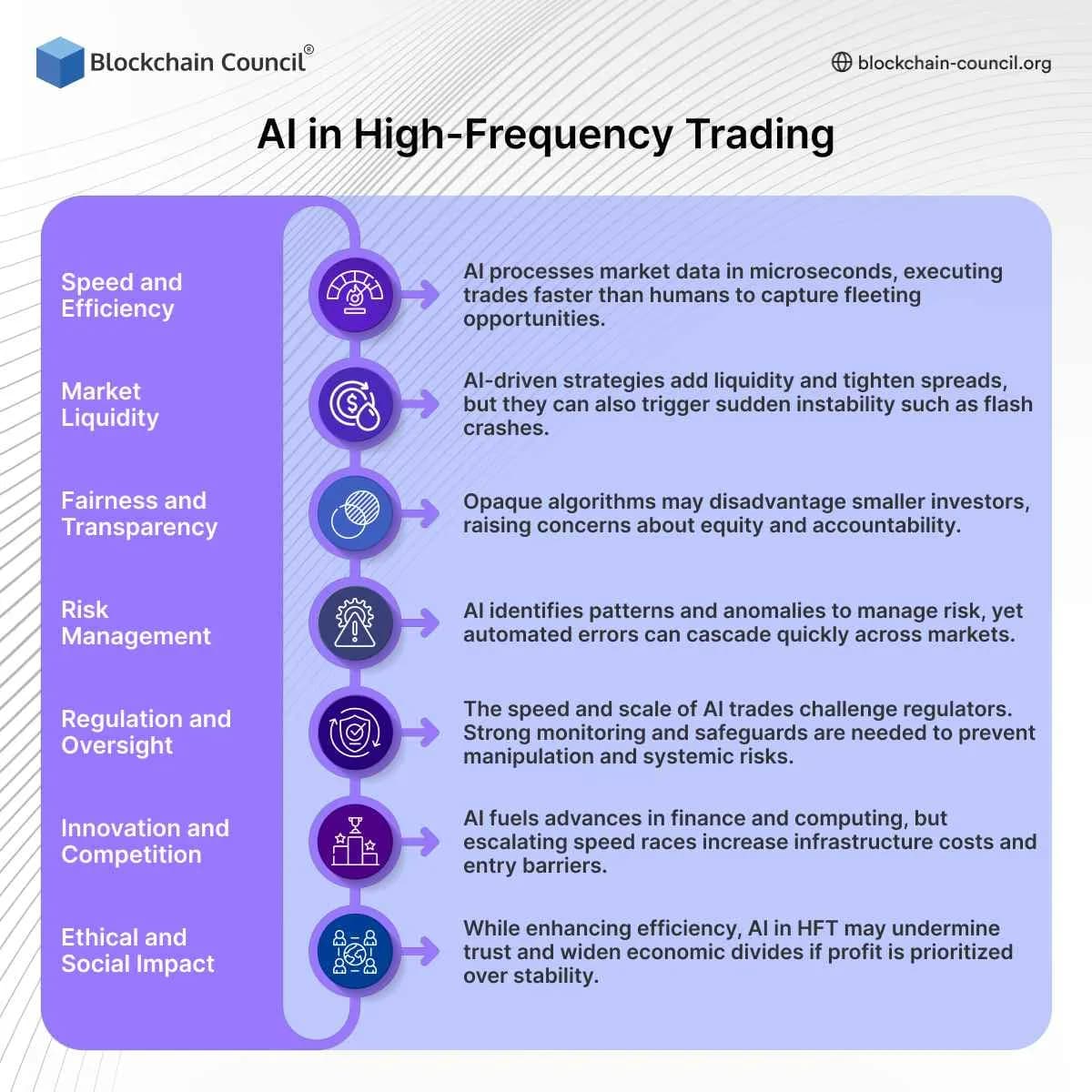
Speed and Efficiency
AI processes market data in microseconds, executing trades faster than humans to capture fleeting opportunities.
Market Liquidity
AI-driven strategies add liquidity and tighten spreads, but they can also trigger sudden instability such as flash crashes.
Fairness and Transparency
Opaque algorithms may disadvantage smaller investors, raising concerns about equity and accountability.
Risk Management
AI identifies patterns and anomalies to manage risk, yet automated errors can cascade quickly across markets.
Regulation and Oversight
The speed and scale of AI trades challenge regulators. Strong monitoring and safeguards are needed to prevent manipulation and systemic risks.
Innovation and Competition
AI fuels advances in finance and computing, but escalating speed races increase infrastructure costs and entry barriers.
Ethical and Social Impact
While enhancing efficiency, AI in HFT may undermine trust and widen economic divides if profit is prioritized over stability.
How Does High-Frequency Trading Work?
High-frequency trading is a subset of algorithmic trading that relies on ultra-fast technology. Firms place servers close to stock exchanges to minimize communication delays. They use field-programmable gate arrays and optimized software to reduce every possible microsecond. Their strategies include statistical arbitrage, latency arbitrage, and market making. The idea is to capture profits from small inefficiencies at a speed no human can match.
HFT has shaped modern markets for more than a decade. It provides liquidity but also raises concerns about fairness, since only firms with the best infrastructure can compete. Critics argue that it creates a market tilted toward the richest players, while defenders say it makes trading cheaper and more efficient for everyone.
How Is AI Being Used in High-Frequency Trading?
AI is being integrated into HFT systems at every level. Machine learning models are used to identify patterns in price movements. Deep learning systems analyze complex data from order books, detecting shifts that human-designed strategies may miss. Reinforcement learning models are applied to adapt strategies in real time, learning from the market itself.
Recent research highlights new approaches. One model called QuantAgent combines multiple AI agents that specialize in trends, patterns, and risk. Another, called EarnHFT, uses hierarchical reinforcement learning to improve cryptocurrency trading. These approaches show that AI is not just an add-on to HFT but a way to redefine how short-term trading strategies are built.
AI is also used for anomaly detection. Transformer-based models outperform older methods at spotting unusual patterns in order book data. This helps firms respond faster to volatility spikes or unusual activity. The result is that AI is making HFT smarter, not just faster. Understanding how AI interacts with rapid market dynamics is a core focus of many who pursue a Prompt Engineering Course.
What Advantages Does AI Have Over Traditional HFT?
Advantages of AI Over Traditional High-Frequency Trading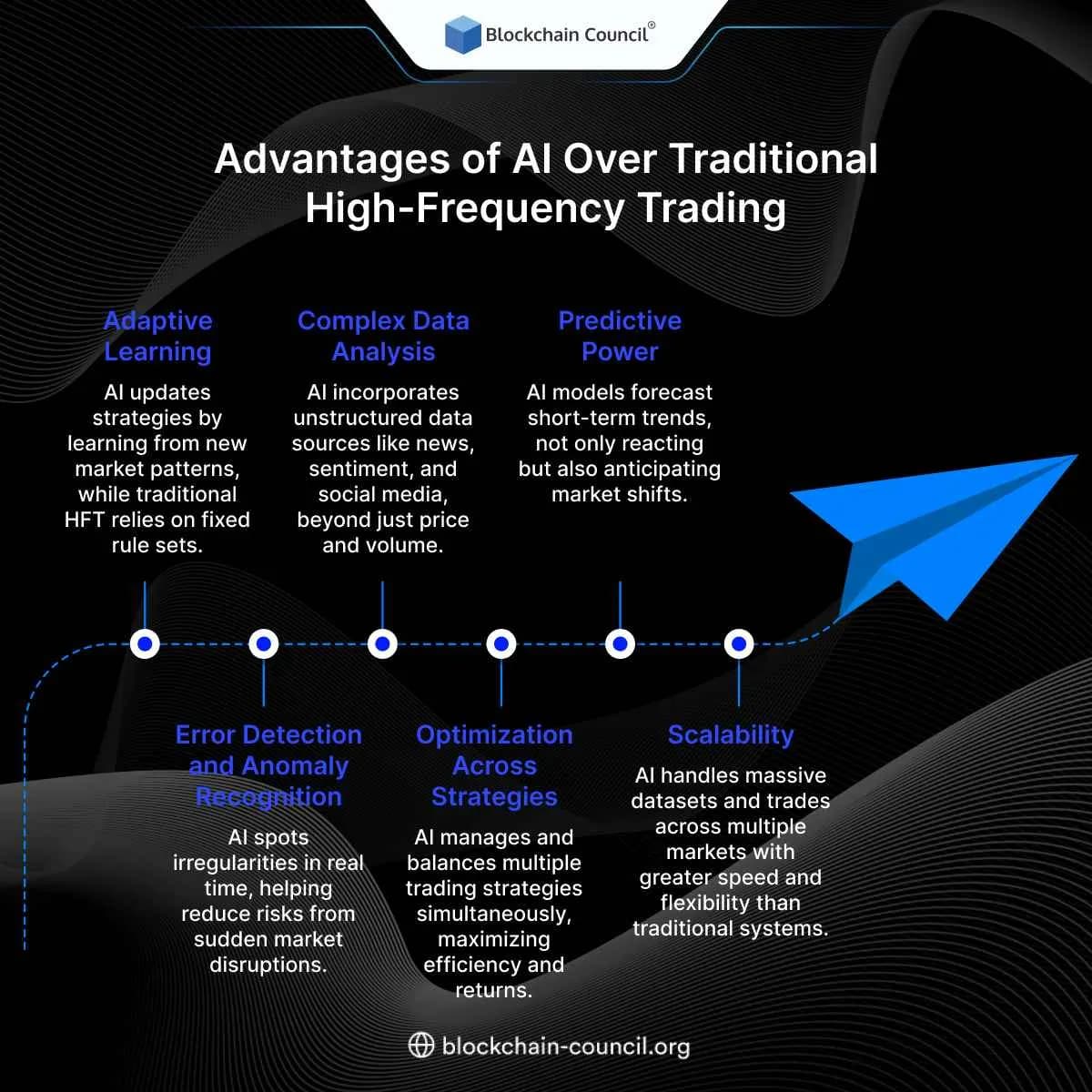
- Adaptive Learning
AI updates strategies by learning from new market patterns, while traditional HFT relies on fixed rule sets. - Complex Data Analysis
AI incorporates unstructured data sources like news, sentiment, and social media, beyond just price and volume. - Predictive Power
AI models forecast short-term trends, not only reacting but also anticipating market shifts. - Error Detection and Anomaly Recognition
AI spots irregularities in real time, helping reduce risks from sudden market disruptions. - Optimization Across Strategies
AI manages and balances multiple trading strategies simultaneously, maximizing efficiency and returns. - Scalability
AI handles massive datasets and trades across multiple markets with greater speed and flexibility than traditional systems.
AI brings several advantages. First, it improves signal quality. Instead of relying on simple price and volume patterns, AI can detect complex, non-linear relationships across multiple data streams. This allows firms to find opportunities that traditional models would ignore.
Second, AI adapts. Traditional HFT strategies often fail when market conditions change. AI models can retrain and adjust, making them resilient in volatile environments.
Third, AI improves risk management. By analyzing real-time data, AI can predict when a strategy may break down and adjust before losses occur.
Fourth, AI enables the integration of alternative data. HFT traditionally focused on market data. AI can process news, social media, and other real-time signals to predict short-term price movements. This widens the scope of trading opportunities.
Finally, AI automates complex tasks. Feature engineering, parameter tuning, and execution logic can all be optimized automatically. This reduces the need for manual oversight and speeds up deployment.
What Challenges Stop AI From Outsmarting HFT?
Despite its promise, AI faces challenges in outsmarting HFT. Latency is the biggest. Even if AI models make smarter decisions, they must still execute trades in microseconds. If the decision takes too long, the opportunity disappears.
Model complexity is another issue. Deep learning models may outperform traditional methods, but they are harder to explain. Regulators and firms themselves may hesitate to trust systems they cannot fully interpret.
Overfitting is a risk. Markets are unpredictable, and AI models trained on past data may fail when conditions change. Regime shifts can turn profitable strategies into losses overnight.
Infrastructure costs also matter. Running AI at HFT speeds requires enormous investment in computing power and connectivity. This limits access to firms with deep pockets.
Finally, regulation and market stability are concerns. If AI-driven trading becomes too dominant, it could create instability. The Bank of England has already warned that autonomous AI trading could lead to crises if left unchecked.
What Real-World Examples Show AI in Trading?
Several studies and experiments show AI outperforming traditional systems. A dual-competitive feature clustering model combined with neural networks was used to forecast short-term price movements in S&P 500 stocks. Results showed significant improvement over standard methods.
Firms like Citadel, Virtu, and Jump are known to be experimenting with AI in their HFT pipelines. Norway’s sovereign wealth fund uses AI to reduce costs by predicting internal flows and optimizing execution. New platforms are also bringing AI-enhanced HFT tools to retail investors, once reserved only for large institutions.
These examples suggest AI is not just theoretical in trading. It is already being deployed in real markets, showing measurable results.
Can Experimental AI Models Beat Traditional HFT Systems?
The newest AI research suggests that traditional HFT systems can indeed be outsmarted, but not in the way most people expect. Traditional HFT focuses on raw speed. Whoever can place an order a microsecond faster often wins the trade. AI shifts the battlefield. Instead of competing purely on speed, AI competes on insight. It looks for signals that others miss, even if it cannot shave off every last microsecond.
Take the QuantAgent framework. It uses multiple AI agents that each specialise in different tasks. One agent studies market trends, another tracks short-term patterns, while a third assesses risk. Together, they form a collaborative system that makes trading decisions faster and more flexibly than rule-based models. Tests show it can outperform established baselines in short trading intervals.
Another system, EarnHFT, applies hierarchical reinforcement learning to cryptocurrency markets. The model learns how to act at extremely granular time steps, where traditional strategies fail. Reports suggest it improves profitability by as much as 30 percent compared to older methods.
These examples highlight a key shift. AI does not need to replace HFT’s speed to beat it. Instead, it uses deeper analysis and adaptation to stay profitable in conditions where traditional HFT strategies break down.
Why Does Risk Management Matter in AI-Powered Trading?
One of the main advantages of AI over HFT is its ability to manage risk dynamically. Traditional systems follow fixed rules. When volatility spikes, those rules can cause cascading losses. AI, however, can detect anomalies in real time and adjust strategy instantly. Transformer-based anomaly detection models are already outperforming older systems in identifying unusual events in order book data.
For investors who want to gain skills in these areas, programs like an AI certification provide practical knowledge about how algorithms learn, adapt, and sometimes fail. Understanding these dynamics is essential for anyone trying to profit from AI-driven trading.
How Are AI Trading Programs Reshaping Finance?
The concept of an AI trading program has become a talking point in finance. These programs use AI to predict short-term market moves and execute trades without human input. They differ from traditional HFT because they are not limited to split-second arbitrage. Instead, they integrate broader data, from news headlines to social media sentiment, giving them a wider view of the market.
AI trading programs can also scale to retail investors. Firms are beginning to offer AI-enhanced trading platforms to everyday traders, once reserved only for large hedge funds. This democratization could produce billion-dollar companies and shift power away from a handful of elite firms.
What Skills Are Needed to Build Smarter Trading Models?
Behind every AI trading breakthrough is data. Engineers and quants need to understand how to structure, clean, and analyse it. That is why training in areas like the Data Science Certification is so valuable. Data science covers everything from feature engineering to predictive modelling, skills that sit at the heart of AI-driven finance.
Traders who once relied only on intuition now need to understand machine learning pipelines. Those who combine trading instincts with strong data science training are in the best position to design or evaluate profitable systems.
How Will Autonomous Agents Change Trading?
AI is evolving into systems that act more like agents than simple tools. Instead of waiting for instructions, they can make independent choices within set boundaries. This is particularly relevant in trading, where markets move too quickly for human oversight.
The Agentic AI Certification teaches professionals how to work with these autonomous systems. In finance, such knowledge is crucial. Traders must not only deploy agents but also monitor their decisions to prevent market manipulation or accidental instability. The firms that get this balance right could gain a strong competitive edge.
Why Are Tech Certifications Valuable for Financial Careers?
Financial trading is no longer limited to finance professionals. It now overlaps with computer science, mathematics, and engineering. Professionals entering this space often pursue tech certifications to broaden their skills beyond finance. These certifications cover areas such as cloud computing and cybersecurity, both of which play roles in trading infrastructure.
Someone trained in both finance and technology is better equipped to build or manage AI-driven trading systems. This combination of skills is increasingly the standard for firms operating at the cutting edge.
How Is Technology Expanding Trading Beyond Traditional Markets?
AI is tightly connected to advances in broader technology. High-performance computing makes it possible to train large trading models. Cloud services allow firms to scale without building physical infrastructure. Advances in hardware, such as GPUs and specialized AI chips, speed up both training and execution.
This connection means that the next generation of trading platforms will be as much technology companies as they are financial institutions. The boundaries between tech and finance continue to blur, creating new opportunities for entrepreneurs and investors alike.
Can Blockchain Make AI Trading More Transparent?
Transparency is a constant concern in trading. Many regulators worry that AI-driven trading could create hidden risks. Blockchain offers a possible solution by recording every transaction in a secure, transparent ledger. When combined with AI, it could make trading more trustworthy by providing an auditable trail of decisions.
Professionals who want to understand this intersection turn to blockchain technology courses. These programs explain how decentralized systems can support transparency and accountability in finance. For traders, blockchain may not improve execution speed, but it could build trust with regulators and clients.
How Is Marketing Shaping the AI Trading Industry?
The trading industry is not only about algorithms. Marketing plays a big role in how platforms attract investors and clients. Companies are already promoting AI-driven trading systems as more accurate, faster, and smarter than traditional methods. This positioning is creating new billion-dollar brands.
For professionals who want to connect business growth with AI innovation, the Marketing and Business Certification offers insights into how technology-driven services can be marketed responsibly. In finance, trust is everything. Companies that combine technical strength with transparent communication will stand out.
What Risks Could Hold Back AI in Trading?
AI’s potential in trading is massive, but risks remain. Overfitting is one of the biggest. Models that perform well in backtesting may fail in live markets. Latency is another problem. AI decisions still take time to compute, and in HFT, every microsecond matters.
There are also ethical and regulatory concerns. If AI systems behave unpredictably, they could destabilize markets. The Bank of England has already issued warnings about this risk. Firms must prove that their systems are not only profitable but also safe.
Another risk is adversarial manipulation. Just as hackers exploit weaknesses in software, bad actors may try to manipulate AI trading models with misleading data. Protecting systems from such attacks will require constant vigilance.
Will AI Replace Traditional High-Frequency Trading?
The future of high-frequency trading will not be a simple matter of replacement. Traditional HFT thrives on hardware and infrastructure. Firms invest millions in co-location, fibre optics, and custom chips to shave off microseconds. That advantage will not vanish overnight. What AI changes is the strategy layer on top of speed. Instead of competing on raw latency alone, firms can use AI to identify signals and opportunities that faster players may overlook.
In practice, this means AI will not destroy HFT but reshape it. The most successful firms will be those that combine the infrastructure of traditional HFT with the intelligence of AI-driven models. In such a world, pure speed is no longer enough. Intelligence becomes just as valuable as latency.
How Will Regulation Affect AI in Trading?
Regulators are already paying attention to AI in financial markets. The Bank of England has warned that autonomous AI trading systems could destabilize markets if they misfire. Similar concerns have been raised in the United States and Europe. Rules are being considered that would require firms to audit and explain their AI systems.
One challenge regulators face is the complexity of modern AI. Deep learning and reinforcement learning models are not always interpretable. This makes it hard to prove that they comply with fairness and stability requirements. Future regulations may demand explainability, even if it reduces performance. Firms that adapt early will benefit from trust, while those that resist may face restrictions.
The debate is global. In China, regulators are focused on controlling systemic risks while still encouraging AI innovation. In the European Union, transparency and accountability are at the center of the conversation. The regulatory environment will decide how quickly AI trading systems are adopted and how much wealth they generate.
Can AI Democratize Access to Advanced Trading?
One of the biggest questions is whether AI will make sophisticated trading tools available to more people. Traditional HFT is limited to large firms with deep pockets. But AI trading platforms are now being built for retail investors. These platforms offer predictive models and automated execution once reserved for hedge funds.
This democratization could disrupt the market. If retail investors gain access to AI trading programs, the power of HFT could weaken. However, there are risks. Retail investors may not fully understand the dangers of overfitting, volatility, or adversarial manipulation. Without proper safeguards, widespread use of AI trading tools could expose individuals to heavy losses.
Still, the long-term trend points to greater access. Just as discount brokers made stock trading mainstream, AI platforms may do the same for algorithmic trading. The result will not only be new billion-dollar companies but also a more competitive marketplace.
What Role Will Infrastructure Play in AI Trading?
Infrastructure remains a foundation of trading. Even the best AI model cannot execute trades without fast and reliable systems. This means that companies providing the hardware behind AI trading could also profit enormously. Chip makers, cloud service providers, and data pipeline firms are already benefiting from the rise of AI finance.
NVIDIA is one of the clearest examples. Its chips are essential for training large AI models, and its valuation has soared as demand for AI has grown. Future billionaires may not only come from trading firms but also from those who supply the tools that make AI trading possible.
This shows that outsmarting HFT is not just about algorithms. It is also about who controls the infrastructure that makes those algorithms practical.
How Do Economic Models Explain the Future of AI Trading?
Economists have developed models that explain why AI could create new concentrations of wealth. One is the Strategic Wealth Accumulation framework. It suggests that as automation spreads, the owners of AI systems capture more value while workers capture less. In finance, this means that firms owning AI trading platforms may accumulate enormous profits, creating a small number of very wealthy winners.
Another model, called the Capability Realization Rate framework, warns about overvaluation. It shows that markets may value AI firms far beyond what their actual performance justifies. This can create bubbles, where early stakeholders become billionaires on paper, but later investors lose money when reality catches up.
Both models underline the volatility of AI finance. Fortunes can be made quickly, but they can disappear just as fast. Outsmarting HFT with AI is not just about beating the market but also about surviving cycles of hype and correction.
Could AI Cause the Next Market Crisis?
While AI has the potential to outperform HFT, it also carries risks for market stability. If many firms deploy similar models, they could act in the same way during crises, amplifying volatility. In past flash crashes, automated systems caused sudden market collapses before human traders could intervene.
AI may increase this risk. Its models are more complex, less transparent, and harder to control. If multiple firms rely on similar AI trading systems, their collective actions could trigger systemic failures. Regulators are aware of this danger, which is why they are pushing for stronger oversight.
The future of AI trading may depend on how well the industry manages these risks. Outsmarting HFT is valuable, but not if it destabilizes the market for everyone else.
What Opportunities Exist for New Entrants?
For decades, HFT has been dominated by a handful of firms. Their infrastructure advantage made it nearly impossible for newcomers to compete. AI changes the equation. Firms no longer need to be the fastest to succeed. They need to be the smartest.
This opens the door to startups that focus on innovation rather than infrastructure. By using AI to integrate alternative data sources, design adaptive strategies, and manage risk, smaller firms can carve out space in the market. Some platforms are even offering AI trading capabilities to smaller funds and retail investors. This trend could diversify the industry and create new billionaire founders.
However, barriers remain. Building AI trading systems still requires significant capital, talent, and data. Not every newcomer will succeed, but those who do could disrupt the dominance of traditional HFT firms.
How Will Public Perception Shape AI in Trading?
Public perception of AI in finance is mixed. On one hand, people are excited about the potential for smarter investing and democratized access. On the other hand, they worry about fairness, transparency, and systemic risk. If the public sees AI trading as another way for elites to profit at everyone else’s expense, backlash will follow.
This perception matters because finance depends on trust. Platforms that communicate openly, market responsibly, and show social responsibility will attract users. Those that hide risks or exploit customers will face resistance. AI in trading is not just about technology; it is about building confidence.
Conclusion: Can AI Outsmart High-Frequency Trading?
AI can outsmart high-frequency trading, but not simply by being faster. It does so by being smarter, more adaptive, and more capable of using data in new ways. While traditional HFT will not disappear, AI is shifting the balance of power from pure latency to intelligence. The firms and investors that combine infrastructure with AI insight are most likely to dominate.
The path forward is not without risks. Regulation, volatility, and public trust will all shape how quickly AI trading grows. Wealth will be created, but fortunes could also be lost if hype exceeds performance. Outsmarting HFT is not just about algorithms but about responsibility, transparency, and resilience.
The next generation of billionaires may indeed come from AI finance, but they will need to balance innovation with caution. AI trading offers enormous potential, but only those who use it wisely will succeed in the long run.
Related Articles
View All
AI & ML
Built to Catch AI Cheating: Rethinking Pre-Employment Assessments with HireValid
Explore how HireValid is rethinking pre-employment assessments with AI-resistant test design, integrity signals, candidate evidence, and human review to address AI-assisted cheating.
AI & ML
AI-Era Hiring Needs AI-Proof Tests: How HireValid Is Redefining Talent Assessment
Explore how HireValid is rethinking talent assessment for the AI era with job-relevant tests, anti-cheating design, integrity signals, and human-reviewed evidence of candidate ability.

AI & ML
Google Launches Gemini 4 Argon: Features and Capabilities
Google has launched Gemini 4 Argon, its flagship AI model for coding, finance, law, cybersecurity and science. Learn its key features, availability, pricing and safety details.
Trending Articles
The Role of Blockchain in Ethical AI Development
How blockchain technology is being used to promote transparency and accountability in artificial intelligence systems.
AWS Career Roadmap
A step-by-step guide to building a successful career in Amazon Web Services cloud computing.

Top 5 DeFi Platforms
Explore the leading decentralized finance platforms and what makes each one unique in the evolving DeFi landscape.