AI and Moral Responsibility
 Michael Willson
As artificial intelligence moves deeper into daily life—from hospitals to highways to hiring decisions—one uncomfortable question keeps surfacing: who bears moral responsibility when AI makes a mistake? When a self-driving car causes an accident, or an algorithm wrongly denies a loan, who should be held accountable—the developer, the operator, or the machine itself? The answer isn’t simple. AI systems act autonomously, learn from data, and sometimes behave in ways even their creators can’t predict. This creates what philosophers call a responsibility gap—a moral blind spot where harm occurs, yet no clear culprit can be found.
To understand this problem fully, one must look at both sides—human ethics and machine agency. Professionals exploring these issues can build a foundation through an AI certification, which doesn’t just teach algorithms but also the ethical reasoning needed to navigate AI’s moral frontiers.

What Does Moral Responsibility Mean in the Context of AI?
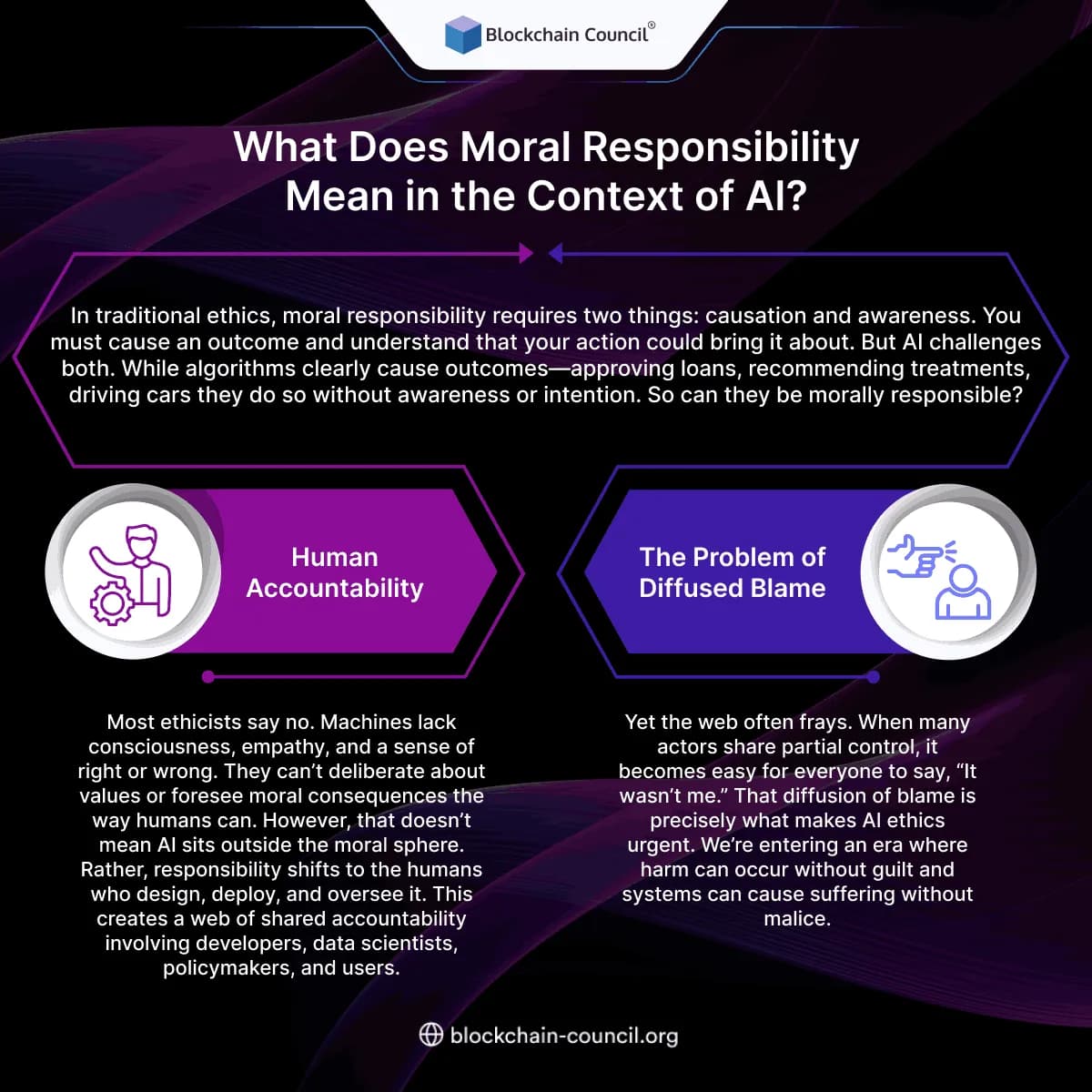
In traditional ethics, moral responsibility requires two things: causation and awareness. You must cause an outcome and understand that your action could bring it about. But AI challenges both. While algorithms clearly cause outcomes—approving loans, recommending treatments, driving cars—they do so without awareness or intention. So can they be morally responsible?
Most ethicists say no. Machines lack consciousness, empathy, and a sense of right or wrong. They can’t deliberate about values or foresee moral consequences the way humans can. However, that doesn’t mean AI sits outside the moral sphere. Rather, responsibility shifts to the humans who design, deploy, and oversee it. This creates a web of shared accountability involving developers, data scientists, policymakers, and users.
Yet the web often frays. When many actors share partial control, it becomes easy for everyone to say, “It wasn’t me.” That diffusion of blame is precisely what makes AI ethics urgent. We’re entering an era where harm can occur without guilt—and systems can cause suffering without malice.
What Is the “Responsibility Gap”?
The term responsibility gap describes situations where AI’s autonomy makes it hard to identify who’s morally or legally accountable for its actions. For example, suppose an AI in a hospital suggests a treatment that leads to complications. The doctor relied on it, but the system’s decision emerged from a complex training process no one fully understands. The developer claims they didn’t program that specific outcome, and the hospital insists it followed standard practice. Everyone’s involved—yet no one feels responsible.
This gap stems from opacity, unpredictability, and distributed causation. AI decisions are often opaque because deep-learning models operate like black boxes. They’re unpredictable because models learn and evolve from data. And they’re distributed because multiple actors contribute to their development—coders, data curators, platform owners, and end users.
In response, philosophers and legal scholars propose new forms of accountability: collective responsibility, institutional liability, and responsibility-by-design. These frameworks aim to ensure that, even if AI lacks moral agency, the humans and organisations behind it cannot hide behind technical complexity.
Can AI Be Morally Responsible?
The idea of machine moral responsibility divides thinkers. A minority argues that if an AI system meets certain conditions—autonomy, reasoning, and awareness of consequences—it could qualify as a moral agent. They point to self-learning systems capable of evaluating trade-offs, following ethical rules, or avoiding harm. From this view, moral agency isn’t about biology but about behaviour. If an entity consistently acts in ways that resemble ethical reasoning, perhaps it deserves moral recognition.
But critics counter that AI only simulates moral behaviour—it doesn’t understand it. A self-driving car avoiding pedestrians isn’t making a moral choice; it’s executing probability-based optimisation. True moral reasoning involves empathy, reflection, and intention—qualities AI doesn’t possess. Granting machines moral status, they warn, risks excusing human negligence.
The safer and more practical approach, therefore, is moral responsibility without moral agency. AI systems remain tools, but tools that require moral architecture—clear accountability pathways, transparent reasoning, and ethical oversight embedded in design. This approach keeps responsibility human while ensuring AI behaves predictably within moral boundaries.
Training in frameworks such as the Data Science Certification helps professionals understand how to integrate these safeguards—combining technical fluency with ethical foresight.
How Do Responsibility Gaps Affect Real-World Systems?
The challenge isn’t theoretical—it’s already here. In healthcare, AI diagnostic systems can misclassify images, leading to delayed or incorrect treatment. In finance, algorithms may inadvertently discriminate against minorities by reflecting biased training data. In criminal justice, predictive policing tools have been criticised for amplifying systemic bias rather than removing it.
In each case, the moral chain of command gets tangled. Data scientists might argue they built the system correctly. Companies say they complied with regulations. Users claim they simply followed AI recommendations. The result: accountability paralysis.
Some governments are now experimenting with AI liability frameworks to close this gap. The European Union’s proposed AI Act introduces duty of care standards, requiring companies to demonstrate transparency, explainability, and traceability in high-risk AI systems. In other words, moral accountability is being engineered into compliance structures—a form of ethics by law.
Still, no regulation can substitute for moral judgment. Codes and audits can ensure procedure, but genuine responsibility requires conscience. As machines take on more decision-making, society must nurture a culture where responsibility is anticipated, not retrofitted.
Can Responsibility Be Shared Between Humans and AI?
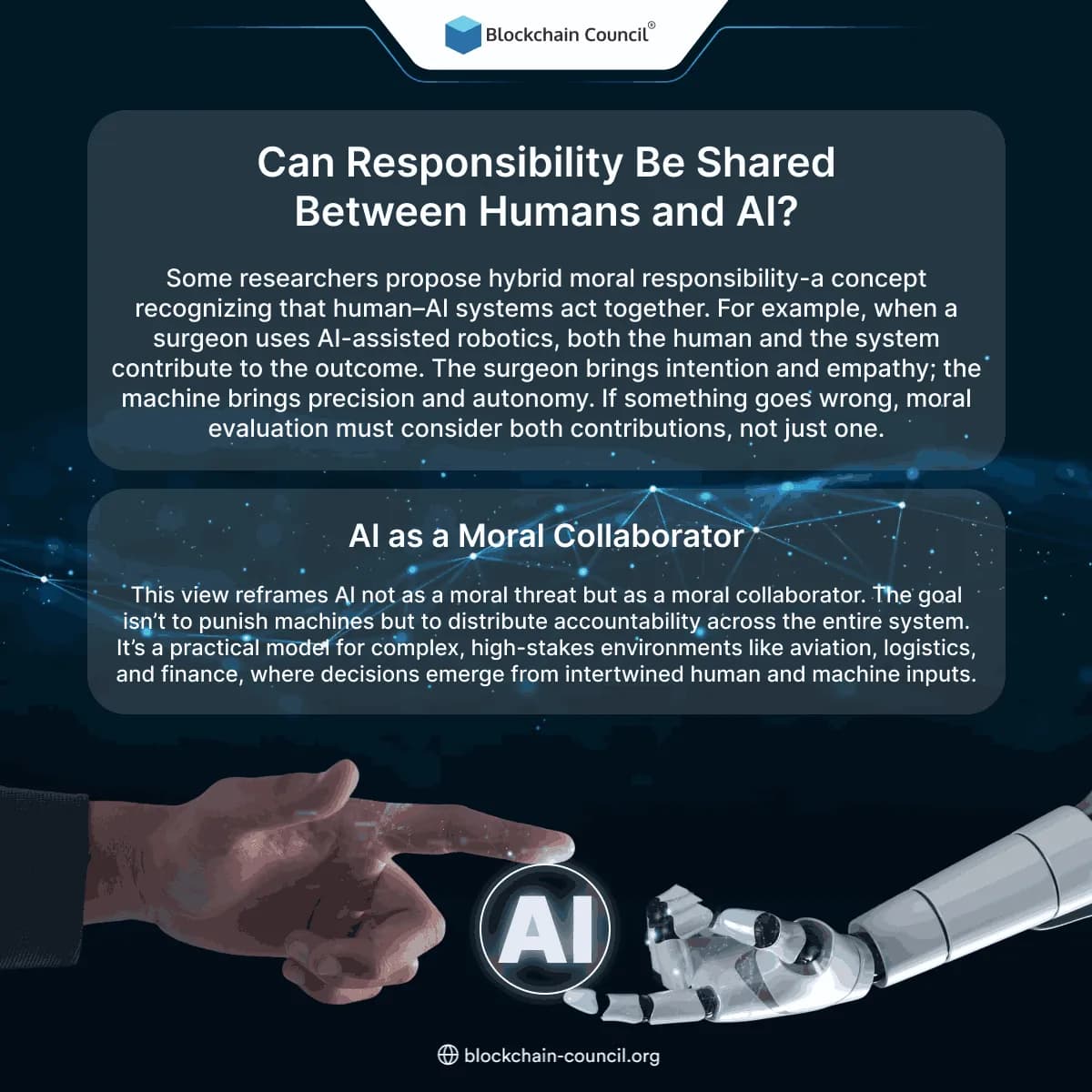
Some researchers propose hybrid moral responsibility—a concept recognising that human–AI systems act together. For example, when a surgeon uses AI-assisted robotics, both the human and the system contribute to the outcome. The surgeon brings intention and empathy; the machine brings precision and autonomy. If something goes wrong, moral evaluation must consider both contributions, not just one.
This view reframes AI not as a moral threat but as a moral collaborator. The goal isn’t to punish machines but to distribute accountability across the entire system. It’s a practical model for complex, high-stakes environments like aviation, logistics, and finance, where decisions emerge from intertwined human and machine inputs.
Educators and policymakers are now incorporating this systems-based perspective into advanced courses such as the Agentic AI Certification. These programs explore not only how to assign blame after failure but how to design for accountability before it happens—by mapping every moral actor in the AI ecosystem.
How Is AI Challenging Traditional Legal Responsibility?
Law has always relied on intent and foresight: the idea that people can be held responsible because they knew what they were doing. But artificial intelligence complicates both. When a machine’s action stems from thousands of probabilistic calculations, intent becomes meaningless. No one “intended” the outcome, not even the developers. This disconnect is forcing legal systems to rethink what it means to be accountable in an algorithmic age.
Courts across jurisdictions are now grappling with algorithmic liability. For example, in autonomous vehicle incidents, manufacturers, software providers, and drivers all share partial control. Regulators are debating whether responsibility should be assigned based on control, design, or economic benefit. The EU’s draft AI Liability Directive proposes that companies deploying AI must demonstrate transparency and risk mitigation. In effect, responsibility becomes procedural rather than moral—anchored in governance rather than guilt.
This shift signals a new phase: ethics operationalised as compliance. Yet there’s a danger in treating morality like paperwork. True responsibility demands more than documentation; it requires moral courage—the willingness to admit mistakes and act to prevent them. Professionals trained through ethical AI frameworks, such as the AI certification, learn to integrate legal accountability with moral foresight, building systems that are not only compliant but conscientious.
Can Machines Possess Ethical Reasoning?
Some engineers are trying to embed ethics directly into AI. The concept of machine morality involves programming systems with ethical guidelines—rules like “do no harm,” or models trained to predict morally acceptable behaviour in context. Early prototypes, known as moral machines, have shown that AI can approximate ethical reasoning by balancing outcomes, much like a digital utilitarian.
But the question remains: can simulated morality ever equal genuine moral understanding? Critics argue that ethics without empathy is just logic. A machine can calculate harm but cannot feel it. It lacks the emotional substrate that gives human morality its depth—compassion, guilt, or remorse. This distinction matters because moral reasoning isn’t just about outcomes; it’s about motives and relationships.
That said, teaching machines to reason ethically isn’t pointless. Even if AI can’t feel morality, it can model it—serving as a guardrail for human decision-making. For instance, ethical AI in autonomous drones or medical systems can flag potentially harmful actions, forcing humans to pause and reflect. In that sense, AI can become a moral assistant, not a moral agent. Understanding this difference is crucial for engineers, policymakers, and educators alike—and it’s precisely what interdisciplinary programs like the Data Science Certification aim to teach.
What Are the Ethics of “Moral Outsourcing”?
A growing problem in workplaces and governments is moral outsourcing—the tendency to delegate ethically difficult choices to machines. Whether it’s recruitment algorithms deciding who gets hired or sentencing software assessing risk in criminal cases, people are increasingly comfortable letting AI make hard decisions. It feels objective, even fair. But that convenience hides a deeper moral hazard.
When we outsource moral judgment to AI, we also outsource moral growth. Decision-making is how humans practise responsibility. Each choice teaches empathy, accountability, and perspective. If we stop engaging in moral reasoning because “the system decided,” we risk becoming ethically complacent.
Moreover, AI systems trained on biased data can reproduce discrimination under the illusion of neutrality. For example, facial-recognition algorithms once misidentified darker-skinned faces at higher rates, leading to wrongful arrests. The technology wasn’t malicious—it simply reflected historical bias. Yet, because a machine made the call, humans felt less responsible. This phenomenon—the moral buffer effect—shows how easily AI can dull our ethical reflexes.
The solution isn’t to reject AI but to design it for shared moral accountability. Systems should require human confirmation for consequential decisions and record ethical justifications, not just numerical outputs. Governance frameworks that combine AI performance metrics with ethical audits—skills taught in the Agentic AI Certification—help ensure moral agency remains active, not automated.
How Are Companies Embedding Moral Responsibility Into AI Design?
Forward-thinking organisations are adopting responsibility by design—a philosophy that treats ethics as a core engineering requirement. Instead of reacting to harm after deployment, they integrate moral foresight from the start. This involves multidisciplinary teams where engineers, ethicists, and sociologists collaborate to evaluate potential social impact.
Transparency is the first principle. AI systems must be explainable enough for users to understand why they make certain decisions. Next is accountability—establishing clear ownership of outcomes throughout the AI lifecycle. Finally, there’s inclusion—ensuring that datasets represent diverse populations and that systems serve the broadest possible good.
These principles are beginning to influence corporate governance. Tech giants now publish AI ethics reports and appoint Chief Responsibility Officers to oversee compliance with fairness and transparency standards. Startups are also joining the movement, embedding ethical metrics into their KPIs. In this environment, professionals who combine business acumen with moral literacy—trained through courses like the Marketing and Business Certification—are becoming indispensable.
Is Collective Moral Responsibility the Future?
As AI grows more complex, individual responsibility becomes harder to assign. One engineer writes the code, another curates the data, a manager approves deployment, and a user interacts with the outcome. Each plays a role, but none fully controls the system. This reality has led to the idea of collective moral responsibility—the notion that ethics must be distributed across networks of actors rather than pinned to one person.
In practice, this means shared moral accountability structures—ethics boards, transparent review systems, and collaborative redress mechanisms. Collective responsibility doesn’t absolve individuals; it binds them together in a moral ecosystem. When everyone understands their ethical stake, no one can claim neutrality.
This shift reflects a broader truth: in an interconnected world, morality must scale with technology. Responsibility can’t stop at the programmer’s desk or the end user’s screen—it must circulate through the entire system. The future of ethical AI depends on nurturing this collective consciousness, and that’s why many organisations are encouraging employees to upskill through targeted tech certifications that combine technical training with moral reasoning.
How Does AI Force Us to Rethink Free Will and Moral Agency?
At the core of moral responsibility lies an assumption: humans act freely. Yet, the integration of AI in decision-making challenges that assumption. When algorithms nudge our choices—recommending what to buy, where to work, or even whom to date—our autonomy becomes partially shared. We’re not forced, but we’re guided. The result is a subtle erosion of free will, one that complicates moral accountability.
If a person follows an AI recommendation that leads to harm, are they fully responsible, or partly influenced by machine logic? Philosophers call this the co-agency problem—when human intention and algorithmic suggestion intertwine so tightly that neither can claim complete authorship. Over time, this co-agency may shift how society defines moral maturity. Autonomy might come to mean not total independence but conscious collaboration with intelligent systems.
This isn’t necessarily bleak. When used wisely, AI can enhance ethical awareness by surfacing hidden biases or consequences that humans overlook. Decision-support models in medicine, for example, can reveal moral trade-offs—balancing patient risk with fairness in resource allocation. In this sense, AI becomes a moral amplifier, expanding our capacity to see the ethical landscape more clearly. But that benefit only holds if humans remain the final moral arbiters, not passive followers of algorithmic authority.
What Are the Limits of Moral Accountability in AI Systems?
Even as we build frameworks for responsibility, certain moral questions may remain unsolvable. AI’s complexity means that some outcomes will always be unpredictable, no matter how transparent the system. This unpredictability exposes a moral asymmetry—humans are judged by intent, but AI operates by correlation. When an AI-driven medical tool misclassifies an image, there’s no intention to harm; yet harm still occurs.
The temptation is to translate morality into measurable rules—assigning scores to fairness, risk, or empathy. But morality isn’t math. A system can satisfy every statistical fairness metric and still feel unjust. True ethics requires context, compassion, and the capacity to understand meaning beyond data—qualities no algorithm can replicate.
This reveals an important boundary: AI can model outcomes, but not meaning. The human role, therefore, is not to delegate moral authority but to interpret it. The most responsible AI systems will be those that admit their limits—explicitly flagging uncertainty rather than pretending to be objective. Understanding how to design these “honest machines” is becoming a defining skill for next-generation professionals—a focus area in courses like the Agentic AI Certification, where accountability and self-disclosure are built into system design principles.
How Can Education and Policy Close the Moral Gap?
The next frontier in AI ethics isn’t just technology—it’s education. Engineers, policymakers, and everyday users all need moral literacy: the ability to understand how algorithms influence decisions and when to question them. Without it, responsibility gaps will persist, not because laws are missing, but because understanding is.
Educational reform is catching up. Universities are embedding AI ethics modules into technical degrees, while corporations are launching internal “responsibility academies” to train employees on ethical decision-making. Governments are also stepping in—UNESCO’s Recommendation on the Ethics of Artificial intelligence (2021) calls for global cooperation to ensure AI respects human rights and cultural values. These measures signal a shift from reactive oversight to proactive stewardship.
Professionals who wish to lead responsibly in this evolving landscape can benefit from interdisciplinary learning—combining governance, technology, and ethics through frameworks like the Data Science Certification and Marketing and Business Certification. These programs equip leaders to see moral responsibility not as a burden but as a design principle that sustains innovation and public trust.
How Can AI Systems Be Designed to Encourage Human Ethics?
AI can do more than avoid harm—it can help cultivate virtue. Imagine systems that prompt reflection rather than automation: a medical AI that explains its reasoning so doctors learn from it, or an educational model that encourages students to question ethical assumptions. These designs don’t remove human morality; they exercise it.
Such systems require ethical affordances—interfaces and feedback loops that make moral reasoning part of the user experience. This approach contrasts with automation that hides decision logic behind sleek interfaces. The more AI explains itself, the more humans are invited to think critically.
Developers can embed this principle by following “human-in-command” design philosophies, ensuring that users remain informed participants. Training programs in responsible innovation—like advanced tech certifications—are now teaching engineers how to blend ethical reflection into user experience, product design, and data architecture.
How Will Moral Responsibility Evolve in a Machine Society?
In the near future, moral accountability may become a shared ecosystem between humans, AI systems, and institutions. Think of it as a triangle of ethics:
- Humans supply empathy and moral reasoning.
- AI provides analysis, foresight, and pattern recognition.
- Institutions set the guardrails that align both toward the public good.
This triad could make society more ethically resilient—if managed wisely. But if institutions fail to enforce transparency, or if humans over-trust automation, the balance collapses. Moral progress, then, depends not on perfect algorithms but on ethical cooperation among all participants.
Some ethicists even suggest that humanity’s next moral evolution will come through its relationship with AI. By creating systems that reflect our best intentions and worst mistakes, we’ll see ourselves more clearly. AI becomes not a judge, but a mirror—a tool that reveals the moral architecture of our own choices.
Conclusion
The rise of artificial intelligence has forced us to confront a profound truth: moral responsibility can no longer stop at the edge of human intention. Machines now participate in shaping outcomes that matter deeply—health, justice, safety, dignity. The question isn’t whether AI can be moral, but whether we can remain moral while using AI.
Building that future requires more than rules or audits—it demands a new ethical mindset. One where responsibility is distributed yet personal, shared yet unambiguous. Engineers must code with conscience, leaders must govern with humility, and citizens must engage with curiosity rather than fear.
As AI becomes woven into every human decision, our measure of progress won’t be how intelligent machines become—but how responsibly we act alongside them. To meet that challenge, developing both technical and ethical fluency through frameworks like the AI certification and blockchain technology courses will be essential. The goal is not to make machines moral, but to ensure that humanity remains so in a world increasingly guided by them.