

AI Literacy as a Core Career Competency
 Michael Willson
What Is AI Literacy and Why Is It Now Essential?
AI literacy is quickly becoming as fundamental as digital literacy was two decades ago. It refers to the ability to understand, use, and evaluate artificial intelligence tools effectively and responsibly. Just as workers once had to learn spreadsheets, email, and databases to stay relevant, they now need to grasp how AI models think, learn, and make predictions.
But AI literacy is more than knowing how to prompt ChatGPT or generate an image. It means understanding the logic behind these systems—how data is used, what biases may exist, and how outputs should be interpreted. It’s about being able to collaborate intelligently with AI rather than simply consuming its results.

Today’s job market reflects this shift clearly. According to recent workforce studies, more than two-thirds of employers say AI literacy is now a core requirement for most professional roles. AI is no longer a specialized field; it’s a shared competency across departments—from finance to education to marketing. Professionals who can think critically about AI’s impact are already outpacing those who cannot.
That’s why learning paths like the AI certification have become so valuable. They provide not just technical understanding but the ethical and strategic context to use AI responsibly. For both individuals and organizations, the question is no longer whether to learn AI, but how deeply to integrate it into every function of work.
AI literacy isn’t just about staying employable—it’s about staying empowered. As automation and algorithms increasingly shape business decisions, people who understand how AI works will have the confidence to question it, guide it, and innovate with it.
How Are Employers Defining AI Literacy in 2025?
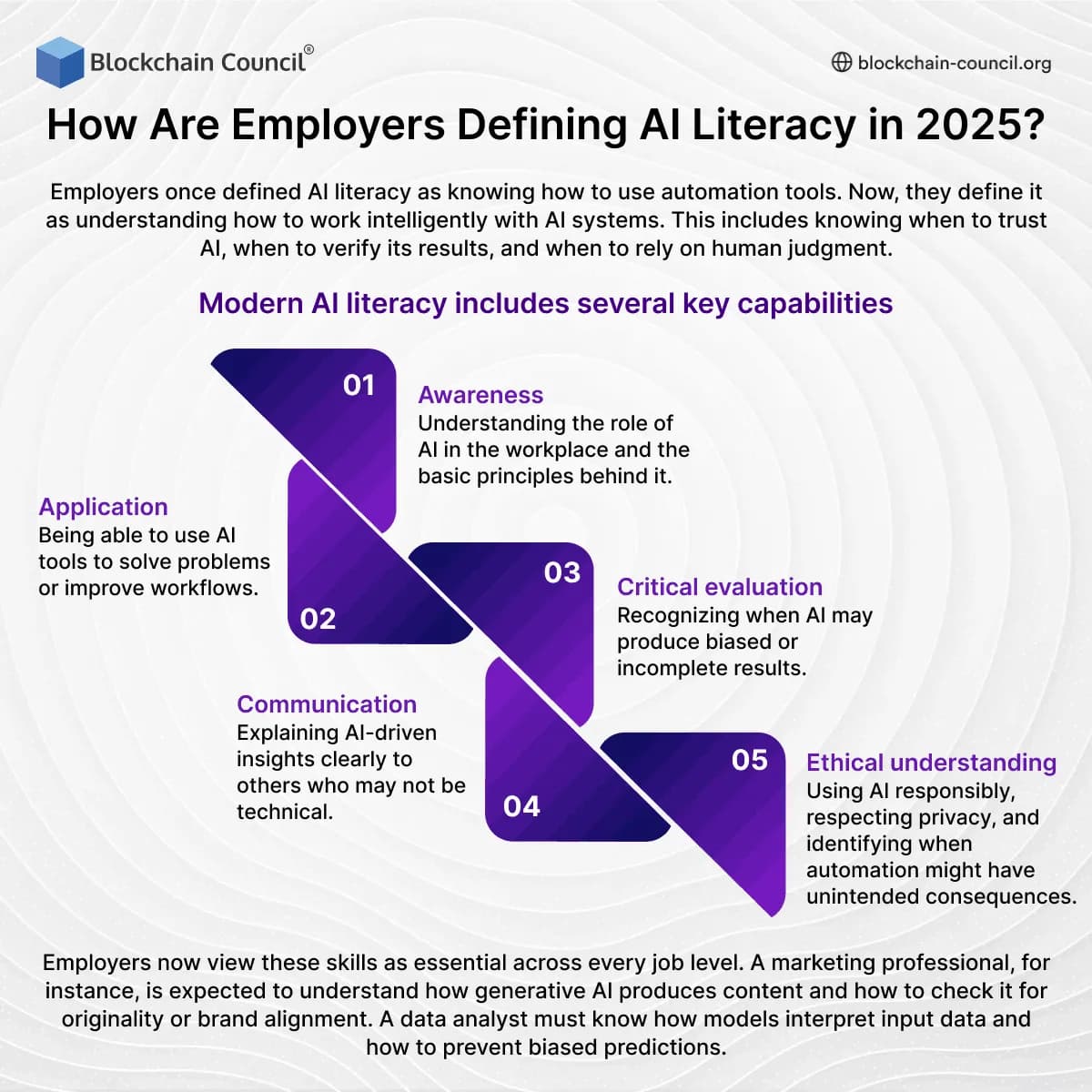
Employers once defined AI literacy as knowing how to use automation tools. Now, they define it as understanding how to work intelligently with AI systems. This includes knowing when to trust AI, when to verify its results, and when to rely on human judgment.
Modern AI literacy includes several key capabilities:
- Awareness: understanding the role of AI in the workplace and the basic principles behind it.
- Application: being able to use AI tools to solve problems or improve workflows.
- Critical evaluation: recognizing when AI may produce biased or incomplete results.
- Communication: explaining AI-driven insights clearly to others who may not be technical.
- Ethical understanding: using AI responsibly, respecting privacy, and identifying when automation might have unintended consequences.
Employers now view these skills as essential across every job level. A marketing professional, for instance, is expected to understand how generative AI produces content and how to check it for originality or brand alignment. A data analyst must know how models interpret input data and how to prevent biased predictions.
Surveys by LinkedIn and the OECD show that hiring managers increasingly use AI proficiency as a differentiator when reviewing candidates. Workers with AI literacy stand out because they can handle complexity without fear. They don’t need to call IT or data teams for every small problem—they can work directly with intelligent systems.
This shift means that AI literacy has become a career accelerator. Those who learn early become the trainers, supervisors, and strategists of tomorrow. Those who ignore it risk being managed by systems they don’t understand.
What Research Shows About the Global AI Literacy Gap
Despite the rising awareness, there’s still a massive gap between those who can use AI confidently and those who cannot. The OECD’s Bridging the AI Skills Gap report identifies AI literacy as the most unevenly distributed capability across the global workforce.
In high-income countries, digital workers are more likely to experiment with AI tools, while in emerging economies, access to training remains limited. Even within companies, disparities exist: tech departments may be fluent in AI, but marketing, HR, and finance teams often lag behind.
A survey by DataCamp found that only 24% of employees who use AI daily have ever received formal training. Most learn through trial and error, which leads to inconsistent use and misunderstanding of how models actually work. The result is a workplace where AI adoption outpaces comprehension.
This imbalance creates risk. Workers who use AI without understanding it can inadvertently spread misinformation, misinterpret analytics, or expose data to security threats. True literacy goes beyond curiosity—it requires structured learning and practice.
That’s why organizations are now treating AI training like a compliance requirement rather than an optional skill upgrade. Structured programs such as the Data Science Certification equip employees to handle data responsibly and interpret AI outputs accurately. These programs help companies close the literacy gap and prevent misuse.
The message from global research is clear: the world doesn’t just need more AI tools; it needs more AI-literate people to use them wisely.
Which Roles Are Most Impacted by the Rise of AI Literacy?
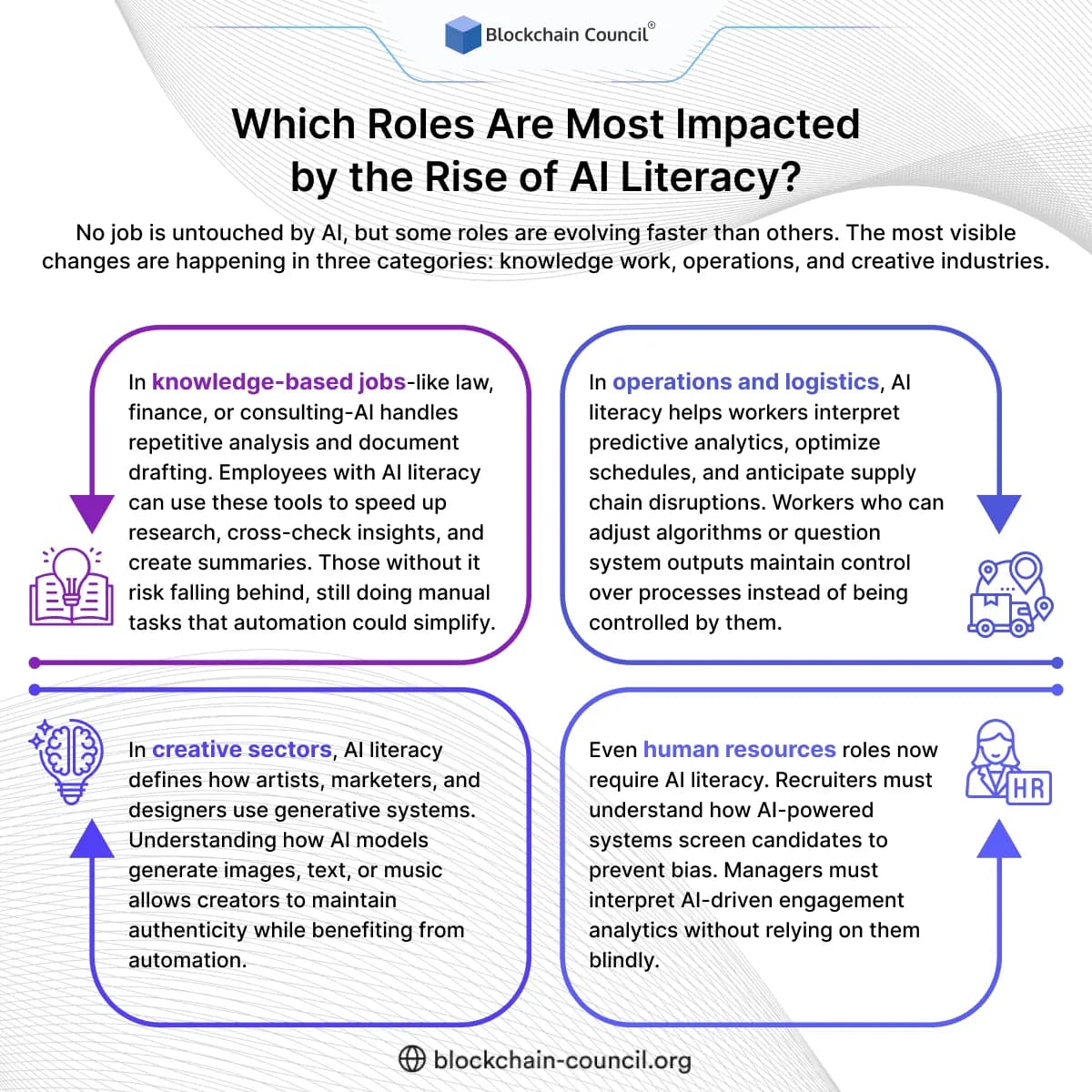
No job is untouched by AI, but some roles are evolving faster than others. The most visible changes are happening in three categories: knowledge work, operations, and creative industries.
In knowledge-based jobs—like law, finance, or consulting—AI handles repetitive analysis and document drafting. Employees with AI literacy can use these tools to speed up research, cross-check insights, and create summaries. Those without it risk falling behind, still doing manual tasks that automation could simplify.
In operations and logistics, AI literacy helps workers interpret predictive analytics, optimize schedules, and anticipate supply chain disruptions. Workers who can adjust algorithms or question system outputs maintain control over processes instead of being controlled by them.
In creative sectors, AI literacy defines how artists, marketers, and designers use generative systems. Understanding how AI models generate images, text, or music allows creators to maintain authenticity while benefiting from automation.
Even human resources roles now require AI literacy. Recruiters must understand how AI-powered systems screen candidates to prevent bias. Managers must interpret AI-driven engagement analytics without relying on them blindly.
In short, AI literacy is the new universal skill—like digital literacy in the early 2000s or basic computer literacy in the 1990s. The difference now is speed: AI adoption is happening faster than any previous wave of technology.
What Are the Core Components of AI Literacy?
AI literacy isn’t just one skill—it’s a blend of technical understanding, ethical awareness, and critical thinking. The core components include:
- Conceptual Understanding: Knowing how AI systems process data, recognize patterns, and make predictions. Workers should understand what “training a model” means and what its limitations are.
- Tool Proficiency: Being able to use AI tools effectively, from chatbots and virtual assistants to analytics dashboards.
- Data Awareness: Recognizing where data comes from, how it’s collected, and why data quality matters.
- Ethical and Social Awareness: Understanding bias, privacy, accountability, and fairness in AI systems.
- Critical Evaluation: Being able to verify AI outputs, check for accuracy, and use human judgment before making decisions.
- Collaboration with AI: Knowing how to delegate routine tasks to AI while focusing on human strengths such as strategy, creativity, and empathy.
This multidimensional skill set transforms employees from passive technology users into active AI collaborators. Certifications like the agentic ai certification teach exactly that—how to guide AI systems as intelligent assistants that support, rather than replace, human expertise.
AI literacy isn’t a checklist; it’s a mindset of curiosity, responsibility, and continuous learning.
How Can Workers Assess Their Current AI Literacy Level?
Understanding one’s AI literacy level starts with self-assessment. Workers should reflect on what they can do confidently versus what they find confusing or intimidating.
Here are some guiding questions:
- Can you explain what AI actually does in your workplace?
- Do you understand how your AI tools use data and make predictions?
- Can you identify possible biases in AI outputs?
- Are you able to correct or override an AI recommendation?
- Do you know the privacy rules governing the AI tools you use?
Researchers have even created measurement scales for AI literacy, such as the AI Competency Objective Scale (AICOS) and the AI Literacy Index (A-Factor). These tools evaluate not just technical skills but also ethical reasoning and confidence levels.
Companies can adopt similar assessments to identify skill gaps and plan training programs accordingly. The goal is not to test employees for perfection, but to help them understand their starting point and chart a clear growth path.
The beauty of AI literacy is that it’s learnable at any stage. Whether you’re an entry-level worker or a senior executive, structured learning through programs like tech certifications can bridge the gap quickly. The key is practice—using AI regularly and reflecting critically on its outputs.
How Do Credentials and Certifications Strengthen AI Literacy?
Formal credentials turn general awareness into verified competence. While free tutorials and self-study can build curiosity, certifications prove mastery and give workers a competitive edge in hiring and promotion.
The AI certification helps professionals understand how AI works under the hood—how models are trained, how data shapes results, and how to interpret predictions responsibly. It builds both technical and strategic literacy.
The Data Science Certification focuses on the foundation of AI—data. Understanding data pipelines, quality control, and feature engineering makes professionals more effective in any AI-driven environment.
The agentic ai certification equips learners to work with multi-agent systems that can collaborate, reason, and make decisions. This is the next phase of AI literacy: learning to manage AI partners rather than tools.
For leaders and strategists, the Marketing and Business Certification connects AI literacy with business goals, teaching how to align technology with customer experience and brand strategy.
Each of these credentials reinforces a simple truth: AI literacy isn’t optional anymore—it’s the language of modern work.
How Can Professionals Build a Personal Roadmap to AI Literacy?
Building AI literacy doesn’t happen overnight. It requires structure, curiosity, and consistent practice. A practical roadmap looks like this:
- Start with awareness. Learn basic concepts like machine learning, data bias, and model training.
- Experiment daily. Use AI tools in your routine work—content creation, analytics, scheduling, or brainstorming.
- Take structured courses. Enroll in beginner or intermediate programs that teach both technical and ethical principles.
- Join communities. Participate in AI discussion groups or forums to stay updated and exchange ideas.
- Apply what you learn. Create small projects—such as building a chatbot, automating reports, or analysing customer data.
- Document results. Keep a portfolio of how you’ve used AI tools effectively. It demonstrates literacy and initiative.
- Advance through certifications. As you progress, formalize your skills with credentials that validate your growth.
This approach turns learning into a lifelong process. The goal isn’t to master every tool, but to stay adaptable as AI evolves.
Professionals who follow this roadmap don’t fear disruption—they drive it.
How Are Organizations Embedding AI Literacy into Their Talent Strategies?
Forward-thinking companies are realizing that AI literacy isn’t just an individual skill—it’s a collective advantage. Organisations now treat AI understanding as part of talent development, much like communication or leadership.
Some firms integrate AI literacy into onboarding. New employees learn how the company uses automation, what tools are available, and what data ethics standards apply. Others host “AI fluency workshops” where teams collaborate to solve real business problems using AI.
Large corporations are also introducing AI literacy frameworks, mapping specific skill levels for different departments. For instance, data teams need advanced understanding, while customer service teams focus on conversational AI and workflow automation.
The result is a more confident workforce that uses AI responsibly rather than reactively. Instead of fearing job loss, employees view AI as a co-worker that helps them achieve more.
AI literacy also influences leadership. Executives who invest in understanding AI can guide digital transformation with clarity and empathy. They know when to trust algorithms, when to question them, and how to communicate changes to staff.
Organisations that treat AI literacy as a core competency build cultures of empowerment, not dependence. They create workplaces where humans and machines succeed together.
What Governance and Cultural Shifts Support AI Literacy?
True AI literacy thrives in an environment of openness and trust. Organisations must move away from secretive or top-down tech adoption and embrace transparency.
A strong AI culture includes:
- Ethical governance: clear policies for data privacy, bias prevention, and human oversight.
- Psychological safety: allowing employees to ask questions about AI decisions without fear.
- Collaboration over competition: sharing best practices across departments rather than keeping expertise siloed.
- Continuous education: integrating AI learning into performance goals and career paths.
Building this culture requires leadership alignment. Managers must model curiosity and humility by admitting what they don’t know and learning alongside their teams. When employees see leaders engaging openly with AI tools, they follow naturally.
Embedding AI literacy also supports diversity. Transparent algorithms and inclusive training ensure all employees—regardless of background—can benefit from technology equally. Ethical design rooted in accountability prevents misuse and bias.
AI literacy, therefore, is not just a technical initiative; it’s a cultural transformation.
What Metrics Can Track AI Literacy Across Teams?
Just like performance or engagement, AI literacy can be measured. Metrics help companies identify gaps and evaluate progress. Useful indicators include:
- Tool adoption rates: how many employees use AI tools confidently and regularly.
- Training participation: enrollment and completion of AI-related courses.
- Self-assessment results: how employees rate their comfort with AI concepts.
- Error and escalation rates: fewer manual errors indicate better understanding of automation.
- Ethical compliance: tracking adherence to responsible AI guidelines.
- Innovation output: measuring how often AI-inspired ideas lead to new projects or solutions.
These metrics turn abstract learning into tangible business outcomes. Companies that track them can link AI literacy directly to performance, retention, and innovation.
What Are the Future Trends in AI Literacy and Career Readiness?
AI literacy will soon be as basic as reading comprehension. As intelligent tools become embedded in every role, literacy will evolve from understanding to collaboration. Workers will need to manage AI systems proactively, not just use them passively.
Future trends include:
- Integration with education: Schools and universities are already adding AI literacy to core curricula, ensuring students graduate career-ready.
- AI mentors: personalised learning assistants powered by AI will help professionals track progress and recommend skills to learn next.
- Cross-functional literacy: hybrid roles will emerge where technical and human expertise blend—AI ethicists, creative technologists, and AI operations managers.
- Focus on governance and trust: as AI becomes more powerful, literacy will include understanding regulation and responsible deployment.
Companies that prepare now will build resilient, future-proof workforces. Employees who continue to learn will remain indispensable.
The story of AI literacy is, at its heart, the story of human adaptability. Every industrial revolution has rewarded those who learned new tools faster and used them more wisely. This time, the tools can think—but the thinkers still lead.
Related Articles
View All
AI & ML
OpenAI Dots vs Grok Bot vs Muse
Compare OpenAI Dots, Grok Bot, and Meta Muse to understand how these always-on AI agents differ in persistent work, computer use, connected apps, automation, and personal or business workflows.

AI & ML
What Is OpenAI Dots?
Learn what OpenAI Dots are, how these always-on AI agents work, and how they use GPT-6 Astra, cloud computers, connected apps, and persistent context to handle ongoing tasks.

AI & ML
OpenAI Launches GPT 6.1-Sol
OpenAI launches GPT-6.1 Sol, a new reasoning model offering near-Astra performance at lower cost for complex coding, computer use, agentic workflows, and professional tasks.
Trending Articles
The Role of Blockchain in Ethical AI Development
How blockchain technology is being used to promote transparency and accountability in artificial intelligence systems.
AWS Career Roadmap
A step-by-step guide to building a successful career in Amazon Web Services cloud computing.

Can DeFi 2.0 Bridge the Gap Between Traditional and Decentralized Finance?
The next generation of DeFi protocols aims to connect traditional banking with decentralized finance ecosystems.