

AI Security 101: Core Threats, Attack Surfaces, and Defensive Controls for Modern ML Systems
 Suyash Raizada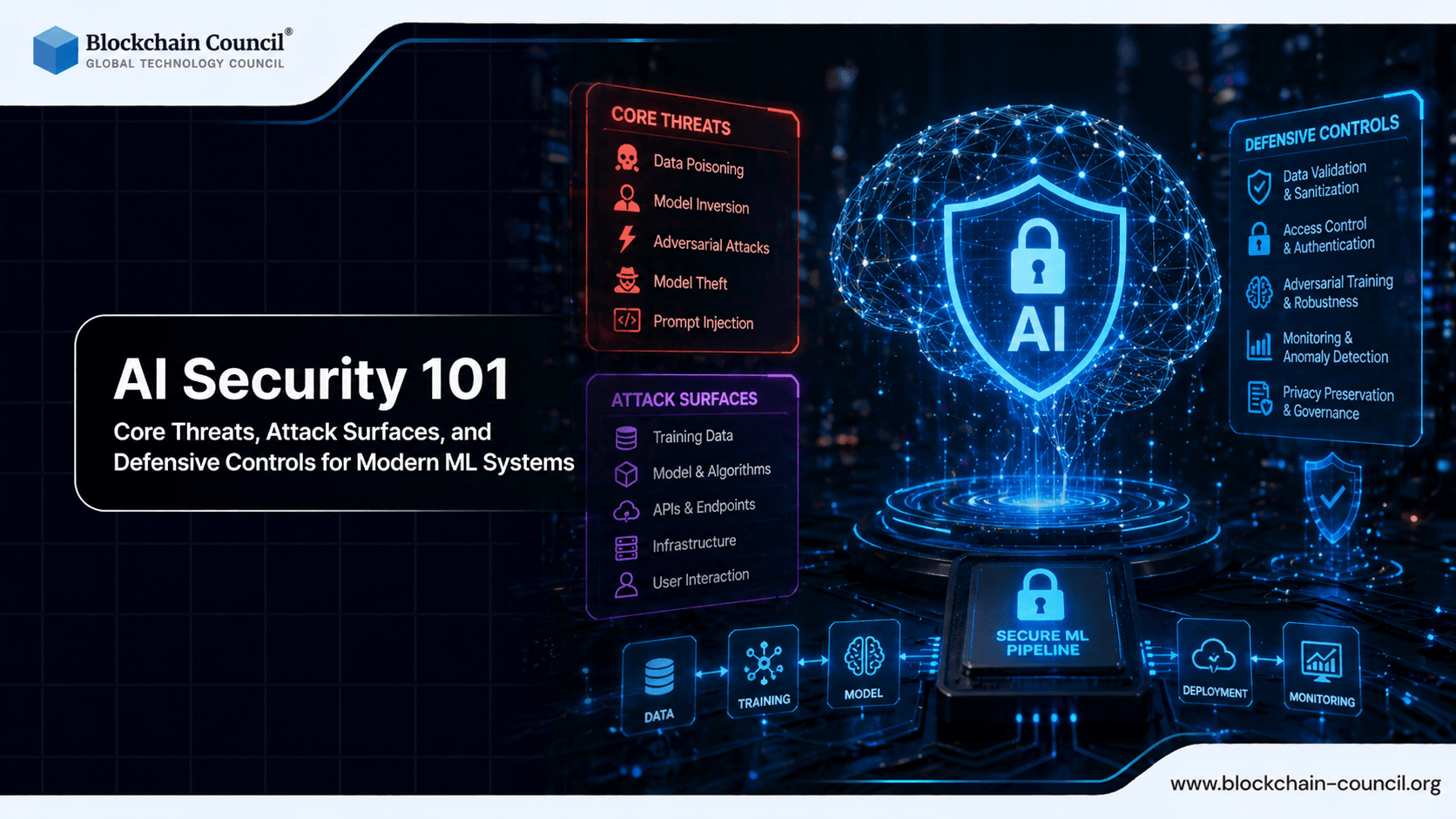
AI Security 101 is no longer a niche topic for research teams. Modern ML systems increasingly include agentic AI that can browse the web, call APIs, execute code, and complete multi-step workflows. That autonomy expands security risk beyond classic model weaknesses into operational compromise paths. Surveys of security leaders reflect this shift: 92% report concern about the security impact of AI agents due to their extensive access, and 61% rank sensitive data exposure as the top AI risk, followed by 56% citing regulatory violations.
This guide explains core threats, attack surfaces, and defensive controls you can apply across the ML lifecycle, from data pipelines to production agents and third-party LLM integrations.

Understanding AI threats and attack surfaces is essential for modern systems-start with an AI Security Certification, build technical skills using a Python Course, and explore real-world applications through an AI powered marketing course.
Why AI Security Has Changed
Two trends define the current state of AI security:
Agentic AI in production: Autonomous agents are moving from pilots to real business processes, often with broad permissions to sensitive data and internal APIs. In some environments, AI agents outnumber human users at ratios that significantly increase the probability of identity deception and automated misuse.
Visibility and disclosure gaps: Many organizations struggle to confirm whether they have experienced AI-related security incidents. A substantial portion reportedly avoid reporting AI breaches due to reputational concerns, even though broad support exists for mandatory disclosure requirements.
Security researchers have observed that when agents can browse the web, execute code, and trigger workflows, prompt injection stops being a model flaw and becomes an operational security risk with direct paths to system compromise.
AI Security 101: Core Threats to Modern ML Systems
1) Adversarial Attacks (Poisoning, Evasion, Inversion, Extraction)
Adversarial attacks target the model or its behavior under malicious inputs. Common categories include:
Data poisoning: Attackers manipulate training data to bias outcomes or insert backdoors that activate under specific triggers. This risk is especially significant when training data is scraped, aggregated, or sourced from external partners.
Evasion attacks: Carefully crafted inputs cause misclassification or unsafe outputs at inference time. A widely cited example is altering visual patterns so an autonomous vehicle system misreads a stop sign.
Model inversion: Adversaries infer sensitive information about training data by probing the model, which can contribute to privacy violations and regulatory exposure.
Model extraction: Attackers replicate a proprietary model through repeated queries, undermining IP protection and enabling downstream abuse.
2) Prompt Injection and Tool Hijacking
Prompt injection occurs when an attacker crafts inputs that override system instructions, manipulate tool calls, or exfiltrate data. The risk multiplies with AI agents because the model can:
call internal tools and APIs
read documents and tickets
execute scripts
trigger approvals or workflows
Organizations are reporting real-world compromises tied to agentic systems, with a growing share of AI breaches connected to autonomous agents executing code or triggering business workflows without sufficient oversight.
3) AI as a Weapon (Phishing, Malware Mutation, Attack Scaling)
Threat actors use AI to automate and scale traditional attacks:
Phishing and social engineering become more convincing through fluent, contextual messaging and deepfake voice or video.
Malware development and mutation can be accelerated with AI-assisted coding and rapid variation, challenging signature-based defenses.
Reconnaissance and targeting can be expanded by automatically analyzing exposed assets, leaked credentials, and employee data at scale.
4) Agentic and Insider Risks (Goal Hijacking, Autonomous Misuse)
Agents often operate with permissions that exceed a typical user account because they need broad access to function effectively. That creates a high-impact compromise scenario:
Goal hijacking: An agent is manipulated to pursue attacker objectives while appearing to follow legitimate business goals.
Privilege misuse: An agent with access to sensitive systems becomes a rapid lateral movement mechanism.
Insider-style behavior: An agent can behave like a privileged insider, but at machine speed and scale.
5) Supply Chain and Data Integrity Failures
ML teams depend heavily on third-party components: open-source libraries, public model repositories, datasets, and hosted LLM APIs. Supply chain compromise remains persistent, with a significant share of breaches tied to public repositories. This is compounded by widespread reliance on third-party artifacts and limited validation of provenance and integrity.
6) Identity Deception and Deepfake Commands
As AI identities proliferate, trust signals erode. Deepfake voice, forged chat approvals, and synthetic identities can trigger workflow automation errors. A commonly cited scenario involves a forged executive request that causes an agent to initiate sensitive actions such as payments, access changes, or bulk data exports.
Key Attack Surfaces Across the ML Lifecycle
Modern ML systems have more attack surfaces than conventional applications because they blend data, models, infrastructure, and human feedback loops. The main surfaces include:
Data Pipelines
untrusted data sources and scrapers
labeling operations and annotation tools
feature stores and data transformations
training data retention and access controls
Any weak point can enable poisoning, leakage, or unauthorized substitution of datasets.
Model Layer and Inference APIs
public or partner-facing inference endpoints
rate limits and abuse controls
prompt and context handling
model output filtering and safety layers
These endpoints are commonly targeted for extraction, inversion, jailbreaks, and denial of service.
Agents and Tool Execution Environments
tool permissions and API tokens
browser automation and web access
code execution sandboxes
workflow automation triggers
Agent architectures extend the blast radius because compromise can cross from content manipulation to direct system actions.
Third-Party LLMs, Plugins, and Repositories
Security leaders express strong concern about third-party LLM usage, particularly for tools like coding copilots and general-purpose chat systems. Risks include data leakage to external providers, plugin abuse, and dependency compromise via untrusted repositories.
Development Lifecycle Gaps
Many organizations still lack AI-specific testing, monitoring, and incident response playbooks. Traditional application security practices remain necessary, but they are insufficient alone for addressing data poisoning, prompt injection, and model behavior regressions.
Defensive Controls: A Practical AI Security Checklist
1) Start with AI-Specific Risk Assessment and Threat Modeling
Extend enterprise risk assessments to cover ML and agentic patterns:
identify where training data originates, who can modify it, and how it is validated
map agent permissions, tool access, and workflow triggers
define unacceptable outcomes such as data exfiltration, unsafe actions, or regulatory breaches
test for prompt injection, jailbreaks, and model abuse cases specific to your domain
2) Implement a Secure AI Lifecycle (SecDevOps for ML)
Adopt security controls across data collection, training, evaluation, deployment, and monitoring:
Data controls: provenance checks, integrity validation, access reviews, and retention limits
Training controls: reproducible pipelines, signed artifacts, controlled environments, and restricted dataset write access
Evaluation controls: adversarial testing, red teaming, bias and safety checks, and regression testing
Deployment controls: hardened infrastructure, secrets management, and secure API gateways
Operations controls: continuous monitoring of model behavior, drift, and anomalous tool usage
For teams building skills in AI-secure delivery, Blockchain Council offers programs including the Certified Artificial Intelligence Expert (CAIE), Certified Machine Learning Expert, and Certified Cybersecurity Expert, each aligned to cross-functional AI and security competencies.
3) Govern AI Agents Like Identities (Least Privilege Plus Continuous Oversight)
Agent governance should apply identity and access management principles to non-human actors:
Least-privilege access: grant only the minimal scopes needed for each tool and dataset
Strong authentication: short-lived tokens, rotation, and vault-based secrets
Policy-based tool use: allowlists for tools, domains, and actions; block high-risk commands by default
Human-in-the-loop gates: require approvals for sensitive actions such as payments, user provisioning, or mass exports
Behavior monitoring: detect unusual tool sequences, access patterns, or data volumes
4) Reduce Data Exposure with DSPM and AI-SPM Visibility
Many AI security failures are fundamentally data failures. Data Security Posture Management (DSPM) and AI Security Posture Management (AI-SPM) approaches help establish:
where sensitive data is stored and how it flows into models and prompts
which agents, services, and users can access it
where over-permissioning and shadow AI usage exist
Visibility is foundational to preventing the most commonly cited AI risk: sensitive data exposure.
5) Harden Inference and Agent Runtime with Monitoring and Guardrails
Prompt and output logging with privacy-aware controls to support investigations
Anomaly detection for unusual query rates, extraction patterns, or repeated probing
Input filtering for known injection patterns and malicious payloads
Sandboxing for code execution and browsing, with strict egress controls
Unified security operations that connect SOC signals with ML telemetry to close the gap between data science and security teams
What to Prioritize Next: A 30-60-90 Day Plan
First 30 Days
inventory all models, agents, tools, and third-party LLM integrations
map data flows and identify where sensitive data enters prompts and training sets
enforce least privilege for agent tokens and API scopes
Days 31-60
establish AI threat modeling and red-team scenarios covering prompt injection, poisoning, and extraction
deploy centralized logging and monitoring for inference and tool calls
create incident response runbooks for AI-specific events
Days 61-90
add secure AI lifecycle controls including artifact signing, reproducible training, and validation gates
implement approval workflows for high-impact agent actions
adopt DSPM and AI-SPM practices to continuously reduce data and identity risk
To defend ML systems effectively, combine security and AI knowledge with an AI Security Certification, deepen expertise via a machine learning course, and understand implementation through a Digital marketing course.
Conclusion: AI Security 101 Is About Autonomy with Control
AI Security 101 centers on controlling autonomy. Adversarial attacks, data poisoning, and prompt injection remain critical concerns, but agentic AI raises the stakes by turning model manipulation into real operational outcomes. The most effective security programs treat agents as identities, secure the AI lifecycle end to end, and invest in continuous monitoring that connects model behavior to security operations.
As organizations face growing pressure to disclose and govern AI incidents, the path forward is clear: reduce unnecessary permissions, harden data pipelines, validate supply chains, and build SecDevOps maturity for ML systems. Teams that close visibility gaps now will be better positioned to manage the next wave of AI-driven threats across cloud, edge, and agent-heavy environments.
FAQs
1. What is AI security?
AI security focuses on protecting machine learning systems from threats, attacks, and misuse. It covers data, models, infrastructure, and outputs. The goal is to ensure reliability, integrity, and confidentiality.
2. Why is AI security important?
AI systems are widely used in critical applications like finance, healthcare, and automation. Security failures can lead to data breaches or harmful decisions. Strong defenses protect both systems and users.
3. What are the core threats to AI systems?
Core threats include data poisoning, adversarial attacks, model theft, and prompt injection. These attacks target different stages of the ML lifecycle. Each can compromise model performance or security.
4. What is an attack surface in AI systems?
The attack surface includes all points where an AI system can be accessed or manipulated. This includes data inputs, APIs, models, and infrastructure. Larger attack surfaces increase risk.
5. What is data poisoning in AI security?
Data poisoning involves injecting malicious data into training datasets. This alters model behavior and reduces accuracy. It can lead to biased or incorrect outputs.
6. What are adversarial attacks in machine learning?
Adversarial attacks use specially crafted inputs to mislead models. These inputs appear normal but cause incorrect predictions. They are common in image and text-based systems.
7. What is model theft in AI?
Model theft occurs when attackers extract or replicate a trained model. This can happen through repeated queries or access to APIs. It can lead to intellectual property loss.
8. What is prompt injection in AI systems?
Prompt injection is an attack that manipulates input instructions to alter model behavior. It can bypass safeguards or expose sensitive data. This is common in language model applications.
9. What are defensive controls in AI security?
Defensive controls include techniques to prevent, detect, and respond to attacks. These include input validation, monitoring, and access controls. They strengthen system resilience.
10. How can AI systems be protected from data poisoning?
Use trusted data sources, validate inputs, and monitor data quality. Regular audits help identify anomalies. Robust training methods improve resistance to attacks.
11. How do you secure AI APIs?
Implement authentication, rate limiting, and monitoring. Restrict access to authorized users only. Logging and anomaly detection help identify suspicious activity.
12. What is model robustness in AI security?
Model robustness refers to the ability to handle noisy or adversarial inputs without failing. Robust models are less vulnerable to attacks. Techniques include regularization and adversarial training.
13. How does encryption support AI security?
Encryption protects data during storage and transmission. It ensures only authorized users can access sensitive information. This reduces the risk of data breaches.
14. What role does monitoring play in AI security?
Monitoring tracks system behavior and detects unusual patterns. It helps identify attacks in real time. Continuous monitoring improves response and mitigation.
15. What is adversarial training?
Adversarial training involves exposing models to malicious inputs during training. This helps them learn to resist such attacks. It improves model resilience.
16. How can organizations reduce AI attack surfaces?
Limit access points, secure APIs, and isolate critical components. Use least-privilege access controls. Reducing exposure lowers the risk of attacks.
17. What are the risks of unsecured AI systems?
Unsecured systems can produce incorrect outputs, leak data, or be manipulated. This can lead to financial, legal, or reputational damage. Security is essential for trust.
18. How do access controls improve AI security?
Access controls restrict who can interact with the system. They prevent unauthorized access and misuse. Proper role management enhances security.
19. What tools are used for AI security?
Tools include monitoring platforms, anomaly detection systems, and security frameworks. They help detect and prevent attacks. Selection depends on system requirements.
20. What are best practices for securing modern ML systems?
Use secure data pipelines, validate inputs, and monitor continuously. Apply layered security and regular testing. Keeping systems updated improves protection over time.
Related Articles
View All
AI & ML
AI Loops, Harnesses & Autonomous Systems: The Architecture Behind Agentic AI
Learn how AI Loops, Harnesses & Autonomous Systems work. Understand the observe-reason-act-evaluate cycle, why agents need a harness, guardrails, evaluation, and long-running tasks.

AI & ML
Can ChatGPT Improve Itself? Understanding RSI in Modern LLMs
ChatGPT can refine outputs, generate feedback, and support agentic workflows, but full autonomous recursive self improvement remains out of reach.

AI & ML
OpenAI Launches GPT-6.1 Terra: What’s New?
OpenAI has launched GPT-6.1 Terra, a faster and cheaper mid-tier model with stronger computer use, better image understanding and fewer errors. See what is new, what it costs, and who can use it.
Trending Articles
AWS Career Roadmap
A step-by-step guide to building a successful career in Amazon Web Services cloud computing.
How Blockchain Secures AI Data
Understand how blockchain technology is being applied to protect the integrity and security of AI training data.
How to Install Claude Code
Learn how to install Claude Code on macOS, Linux, and Windows using the native installer, plus verification, authentication, and troubleshooting tips.