

Will AI Create the Next Generation of Billionaires?
 Michael Willson
What Is Driving the Creation of AI Billionaires?
AI is already creating billionaires, and the trend is accelerating. From founders of startups to executives at tech giants, fortunes are being built as AI reshapes the global economy. Investment in artificial intelligence has reached record levels, with hundreds of billions flowing into research, infrastructure, and applications. New companies are achieving sky-high valuations in months, not years. The question is no longer whether AI will create billionaires, but how many and how quickly.
For investors and professionals who want to understand these shifts, the AI powered investor program offers a direct way to learn how AI influences financial markets and wealth creation. It is also closely linked to the rise of the AI trading program, which many see as a tool that could transform investment strategies in the years ahead.

Role of AI in Creating the Next Generation of Billionaires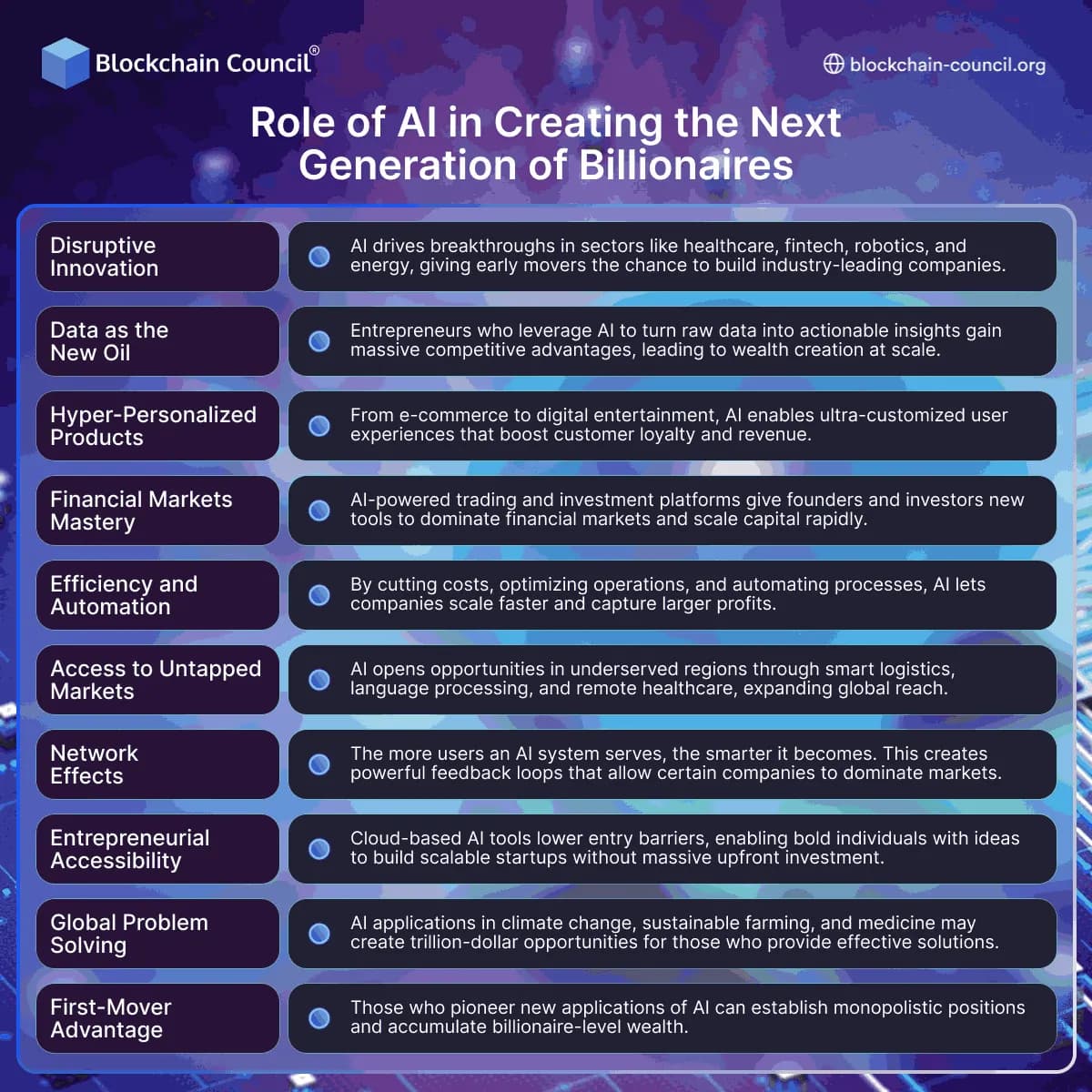
- Disruptive Innovation
AI drives breakthroughs in sectors like healthcare, fintech, robotics, and energy, giving early movers the chance to build industry-leading companies. - Data as the New Oil
Entrepreneurs who leverage AI to turn raw data into actionable insights gain massive competitive advantages, leading to wealth creation at scale. - Hyper-Personalized Products
From e-commerce to digital entertainment, AI enables ultra-customized user experiences that boost customer loyalty and revenue. - Financial Markets Mastery
AI-powered trading and investment platforms give founders and investors new tools to dominate financial markets and scale capital rapidly. - Efficiency and Automation
By cutting costs, optimizing operations, and automating processes, AI lets companies scale faster and capture larger profits. - Access to Untapped Markets
AI opens opportunities in underserved regions through smart logistics, language processing, and remote healthcare, expanding global reach. - Network Effects
The more users an AI system serves, the smarter it becomes. This creates powerful feedback loops that allow certain companies to dominate markets. - Entrepreneurial Accessibility
Cloud-based AI tools lower entry barriers, enabling bold individuals with ideas to build scalable startups without massive upfront investment. - Global Problem-Solving
AI applications in climate change, sustainable farming, and medicine may create trillion-dollar opportunities for those who provide effective solutions. - First-Mover Advantage
Those who pioneer new applications of AI can establish monopolistic positions and accumulate billionaire-level wealth.
How Big Is the AI Market Today?
The AI economy is massive and still growing. In 2024, global corporate investment in AI reached over 250 billion dollars. Private investment alone jumped more than 40 percent in a single year. Generative AI startups raised nearly 34 billion dollars in funding, proving investor confidence in the sector.
Analysts estimate that AI could add up to 20 trillion dollars to the global economy by 2030. This scale of growth is enough to mint a new class of billionaires, similar to how the internet created its first wave of tech moguls in the late 1990s and early 2000s. The difference is speed. AI companies are scaling faster, reaching billion-dollar valuations sometimes before turning a profit. Many aspiring entrepreneurs are turning to a Prompt Engineering Course to understand how to use AI as a wealth-building tool.
Who Are the New AI Billionaires?
The AI boom is already visible in the wealth rankings. Alexandr Wang, cofounder of Scale AI, became a billionaire in his twenties. His company provides data infrastructure critical to machine learning. Mira Murati, former CTO of OpenAI, launched a new venture called Thinking Machines Lab, with valuations in the billions. Reports suggest her founder stake places her in the billionaire category.
Even established corporations are producing new billionaires. Oracle’s surge in AI services created two new billionaires through stock and equity gains. This shows that not only startups but also traditional firms can generate billionaire wealth through AI expansion.
Media outlets now talk about dozens of new billionaires minted by AI startups and infrastructure providers. From chip makers to cloud service providers, those who own the foundations of AI are capturing the biggest rewards.
How Does Ownership Drive Billionaire Wealth in AI?
Equity ownership is the strongest driver of wealth in AI. Founders and early employees who hold significant shares can see their net worth rise exponentially when valuations soar. Investors who back startups early also reap huge returns when those companies go public or are acquired.
AI companies often benefit from platform and network effects. A model that becomes widely used can dominate the market, locking in customers and partners. This amplifies returns for shareholders. The global nature of AI also means that a single platform can serve millions worldwide with low marginal costs. That scale turns successful ventures into billionaire-making machines.
Access to capital is another factor. Training large AI models requires enormous investment in computing power, data, and talent. Those with the resources to fund such projects hold a clear advantage. As a result, wealth concentrates around those already positioned to invest at scale.
What Economic Models Explain AI Wealth Creation?
Economists are studying how AI shifts wealth. One model, called Strategic Wealth Accumulation under Transformative AI Expectations, shows that owners of AI systems can capture a bigger share of income as automation reduces labor’s role. Even before full automation arrives, expectations of AI’s potential can shift capital yields upward, concentrating wealth.
Another framework is the Capability Realization Rate model. It suggests that markets often overvalue AI companies compared to what their technology can actually deliver. This creates a mismatch that can inflate valuations. While some billionaires benefit from this hype, it also increases the risk of bubbles. If performance does not match valuations, corrections can wipe out paper wealth.
These models highlight both opportunity and caution. AI can create billionaires at record speed, but it can also destroy fortunes just as quickly if expectations collapse.
What Risks Could Limit AI Billionaire Growth?
The path to billionaire wealth through AI is not guaranteed. Many companies fail due to technical complexity or poor execution. Investors may lose money when startups overpromise and underdeliver. Regulation is another risk. Governments worldwide are scrutinizing AI for privacy, bias, and safety. Strict laws could limit certain business models, reducing profits.
Public opinion is also a factor. If societies see AI as a threat to jobs or fairness, companies may face resistance. This could affect adoption and revenue. Inequality is another issue. If only a few capture the benefits, political pressure may rise to redistribute gains. Billionaire wealth in AI could face backlash similar to criticism of tech monopolies today.
There is also the risk of concentration. Only a handful of firms control the compute and data needed for advanced AI. This makes it harder for new entrants to compete, potentially slowing the overall creation of billionaires outside this elite circle.
Which Industries Will Produce the Next AI Billionaires?
The next wave of billionaires is likely to emerge from industries where AI has the largest potential to disrupt operations and create value. Finance, healthcare, and entertainment are at the front of this list. Finance is already seeing AI trading systems handle billions of dollars in transactions every day. Healthcare companies are applying AI to drug discovery and personalized medicine, which could lead to breakthroughs worth billions. Entertainment is transforming as AI tools generate music, film scripts, and even entire digital worlds.
Each of these industries benefits from the same advantage: AI can scale rapidly. Once a model is trained, it can be applied across markets and borders with low marginal costs. That global reach multiplies the chances of billionaire wealth emerging quickly.
How Does AI Reshape Finance and Investment?
AI is rapidly changing finance. Trading desks now use algorithms that can react to news in milliseconds. Wealth managers use AI tools to optimize portfolios for clients. Startups are designing AI platforms that allow retail investors to use predictive models once available only to hedge funds. This democratization of financial AI could make early founders and investors in these platforms extremely wealthy.
The AI trading program is an example of how investors are beginning to treat algorithms as independent actors in markets. These programs analyze data from multiple sources, generate predictions, and execute trades without human input. The firms that control the most reliable AI trading tools will hold a significant edge. That edge could mint new billionaires in the financial sector.
What Role Will Education Play in AI Wealth Creation?
Knowledge is just as important as capital in the AI economy. Professionals who understand how to design, train, and deploy AI systems are in high demand. Universities and training institutes are rushing to meet this demand with structured programs that prepare students for careers in AI.
Many professionals are turning to an AI certification to gain credibility in this fast-changing field. These programs combine technical knowledge with practical applications, making graduates valuable in both startups and large corporations.
Investors who want to understand financial applications are also exploring programs like the Data Science Certification. Data science is the foundation of AI-driven finance, and certification provides the analytical tools needed to evaluate market trends and company valuations.
How Is AI Transforming Corporate Leadership?
Corporate leaders are recognizing that AI is not just a technical tool but a business driver. Executives who can integrate AI into their business models are positioning their companies for growth. The ability to manage AI-powered systems, align them with customer needs, and scale them globally is a new leadership skill set.
Specialized learning like the Agentic AI Certification prepares professionals to handle AI systems that act autonomously. Leaders with this expertise can ensure that AI aligns with company goals and ethical standards, giving them a competitive advantage in industries where mistakes could be costly.
Why Are Certifications Becoming Essential for AI Careers?
The demand for AI professionals is global. Companies in finance, healthcare, entertainment, and logistics are competing for talent. This makes certifications more important than ever. They provide a way to prove skills in a market where demand outstrips supply.
General tech certifications are helping professionals broaden their skill sets. From cloud computing to cybersecurity, these programs connect technical areas that intersect with AI. Graduates who combine AI expertise with other technical domains will be positioned for leadership roles, where compensation and equity stakes are highest.
How Will AI Impact Traditional Technology Careers?
AI is becoming inseparable from broader fields of technology. From software engineering to hardware design, nearly every area now integrates AI components. For example, chip designers are optimizing processors for AI workloads, creating an entirely new hardware industry.
Technology careers that once focused on narrow specializations are now shifting toward AI integration. Those who adapt quickly will not only secure high-paying roles but may also launch companies that scale into billion-dollar valuations. The next generation of billionaires may come as much from adapting existing technology businesses as from launching brand-new startups.
Will AI Create the Next Generation of Billionaires?
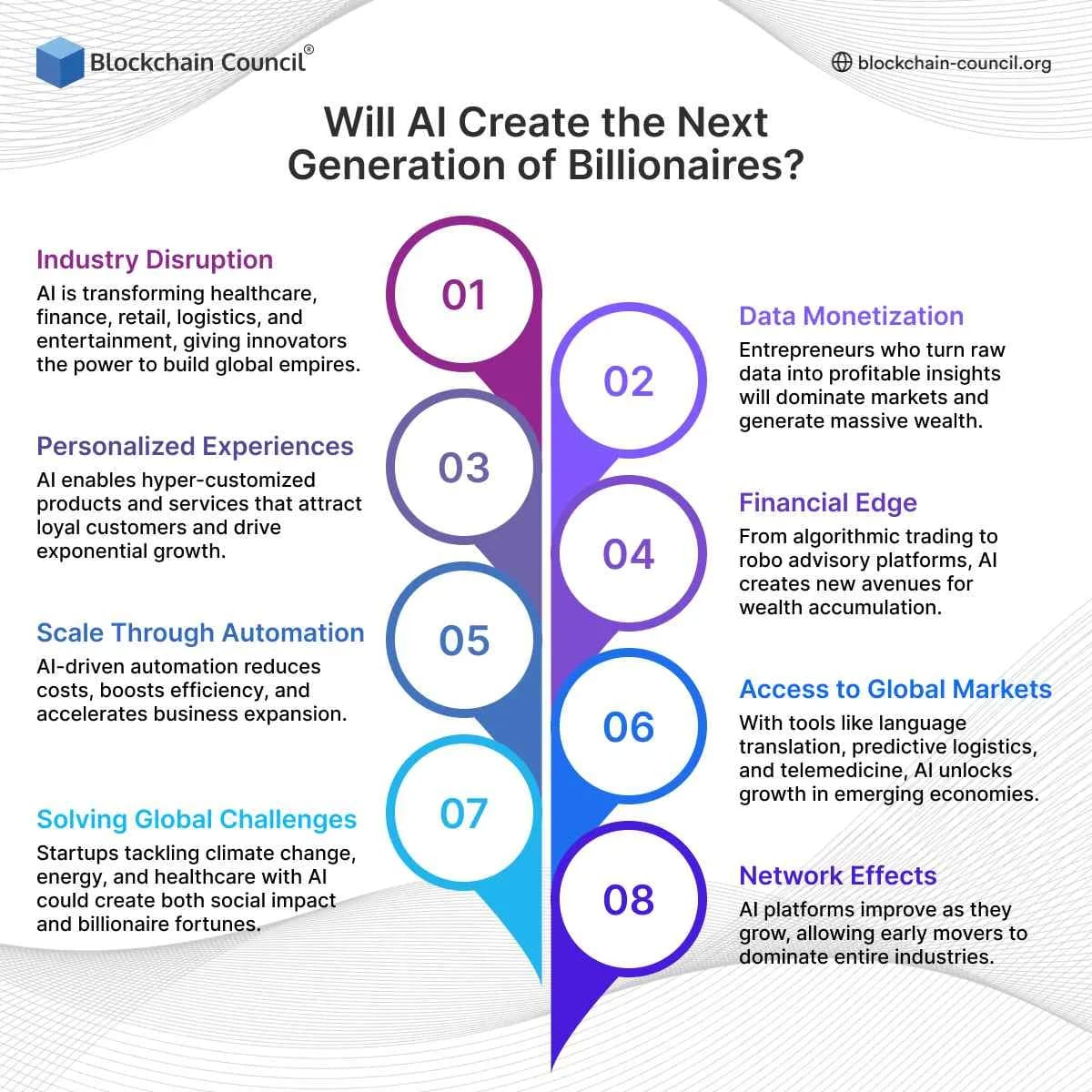
AI as a Wealth Engine
Artificial intelligence is reshaping industries and unlocking trillion-dollar markets, creating fertile ground for the rise of new billionaires.
- Industry Disruption
AI is transforming healthcare, finance, retail, logistics, and entertainment, giving innovators the power to build global empires. - Data Monetization
Entrepreneurs who turn raw data into profitable insights will dominate markets and generate massive wealth. - Personalized Experiences
AI enables hyper-customized products and services that attract loyal customers and drive exponential growth. - Financial Edge
From algorithmic trading to robo-advisory platforms, AI creates new avenues for wealth accumulation. - Scale Through Automation
AI-driven automation reduces costs, boosts efficiency, and accelerates business expansion. - Access to Global Markets
With tools like language translation, predictive logistics, and telemedicine, AI unlocks growth in emerging economies. - Solving Global Challenges
Startups tackling climate change, energy, and healthcare with AI could create both social impact and billionaire fortunes. - Network Effects
AI platforms improve as they grow, allowing early movers to dominate entire industries.
The Big Picture
AI will not just support entrepreneurs—it may define the world’s next generation of billionaires, just as the internet created tech titans two decades ago.
Can Blockchain Support AI Wealth Creation?
AI and blockchain are increasingly connected. AI systems generate massive amounts of data, and blockchain offers a way to secure, record, and verify that data transparently. This combination could open new industries around trust, audit, and compliance.
Programs like blockchain technology courses prepare professionals to understand how decentralized systems can support AI. Entrepreneurs who combine AI with blockchain may build platforms that dominate finance, healthcare records, or supply chains. These hybrid businesses have the potential to create significant wealth.
How Does Marketing Connect to AI Billionaire Creation?
Marketing is one of the areas most disrupted by AI. Personalized advertising, automated content generation, and predictive analytics are transforming how companies reach customers. Startups that build effective AI marketing tools can quickly capture massive user bases. This creates opportunities for founders and investors to become billionaires.
Programs like the Marketing and Business Certification are designed to help professionals adapt. These certifications connect business strategy with AI tools, giving marketers the ability to use automation responsibly while driving growth. Leaders who master this combination are likely to dominate in sectors where customer engagement determines success.
What Are the Barriers to Becoming an AI Billionaire?
Despite the opportunities, barriers remain. Access to capital and infrastructure is one of the biggest. Training large AI models requires massive investments in computing power and specialized talent. Not every entrepreneur can compete at this scale.
Regulation is another challenge. Governments are tightening rules around data privacy, algorithmic bias, and ethical use of AI. Companies that ignore these rules may face fines or be shut out of markets. For entrepreneurs, this means success is tied not only to technical skill but also to compliance.
Public perception can also act as a barrier. If people see AI as a threat to jobs or fairness, adoption may slow. Companies that fail to manage these concerns risk losing their social license to operate.
Which Models Predict the Future of AI Billionaires?
Economic models suggest that wealth concentration will increase as AI scales. The Strategic Wealth Accumulation framework shows that owners of AI systems can capture larger shares of income as labor is displaced. This means billionaires will likely emerge from those who own the platforms and infrastructure, not just those who use AI tools.
The Capability Realization Rate model warns that valuations may exceed real performance. While this can enrich early stakeholders, it also increases the risk of bubbles. For every billionaire created, there may be many investors who lose money when hype collapses.
These models underline the volatility of the AI economy. Fortunes will be made quickly, but they may also disappear just as fast.
How Will Regulation Shape the Future of AI Billionaires?
The rise of AI billionaires is not happening in isolation. Governments and international organizations are closely watching the growth of AI and its impact on wealth concentration. Regulations are already being drafted to manage data privacy, algorithmic bias, and monopoly power. These rules will play a central role in determining how wealth is distributed.
In the European Union, the AI Act is the first large-scale law designed to regulate artificial intelligence. It sets boundaries on what systems can and cannot do, including restrictions on biometric surveillance and requirements for transparency. For AI companies, compliance will be expensive, but those who succeed will have a clear advantage. Early movers who navigate these regulations can become dominant, and their wealth may rise dramatically.
In the United States, discussions around antitrust laws and AI ethics frameworks are becoming more common. Lawmakers are concerned that a handful of firms could control too much of the AI infrastructure, leading to extreme concentration of wealth. If stricter antitrust measures are introduced, billionaire creation may be spread more evenly among startups rather than being limited to tech giants.
Other regions, including China and India, are pushing national strategies for AI leadership. These strategies may accelerate billionaire creation by channeling resources into local companies. The global AI billionaire map will depend not just on market forces but also on how each government balances growth and fairness.
Will AI Billionaires Face Backlash?
Public opinion is likely to become a powerful factor in shaping the future of AI billionaires. As more fortunes are built from automation, people may begin to question who benefits from the AI economy. If workers lose jobs while billionaires gain wealth, resentment will grow.
We have seen similar trends in past technological revolutions. The Gilded Age produced industrial billionaires but also sparked political movements demanding reform. The rise of Big Tech created wealth for a few but raised concerns about privacy, data exploitation, and monopoly power. AI may follow the same pattern.
Billionaires who fail to share benefits could face public backlash, protests, or political campaigns to limit their power. Those who invest in education, job creation, and social programs may avoid criticism and secure their place in society. Future billionaires will need to manage both business growth and public trust.
Can AI Widen Inequality?
One of the strongest criticisms of AI-driven wealth is that it increases inequality. Economic models suggest that owners of AI platforms capture most of the value, while workers see their share of income decline. This is because automation reduces the need for labor in certain sectors.
If left unchecked, AI wealth could concentrate in the hands of a small elite. A few billionaires may control the infrastructure, data, and platforms that everyone else depends on. Meanwhile, workers could struggle with stagnant wages or job losses. This imbalance is likely to spark debates about taxation, universal basic income, or new ways to distribute AI wealth.
Without policy intervention, inequality will grow. But with smart governance, AI’s benefits could be shared more broadly. That balance will determine whether AI billionaires are seen as innovators or as symbols of inequality.
What Opportunities Exist for New Billionaires in Emerging Markets?
Most AI billionaires today are from the United States, China, and parts of Europe. However, emerging markets also hold promise. Countries in Africa, Latin America, and Southeast Asia are adopting AI for agriculture, healthcare, and finance. Entrepreneurs who create AI solutions tailored to local needs may capture massive growth.
For example, AI-powered fintech platforms in Africa are helping millions access banking services for the first time. Healthcare AI in India is providing affordable diagnostics in rural areas. If these companies scale globally, their founders could join the billionaire ranks.
The global reach of AI means that billionaires could come from anywhere. Local innovation, when combined with international capital, creates opportunities far beyond traditional tech hubs.
How Will Billionaires Be Made in Healthcare?
Healthcare is one of the biggest opportunities for AI. Drug discovery, patient diagnostics, and personalized medicine are areas where AI can reduce costs and accelerate breakthroughs. Startups working on AI-driven drug pipelines are already raising billions in funding.
If a single AI platform can reduce the time to develop a drug from years to months, it could transform the pharmaceutical industry. The companies that own such platforms could be worth tens of billions. Their founders and investors would see massive gains.
Beyond drugs, AI-powered diagnostic tools are scaling globally. Low-cost medical imaging solutions are reaching regions without enough doctors. Companies that dominate this space will hold not just wealth but also influence over public health. Healthcare AI billionaires may emerge faster than in almost any other industry.
What Role Will Entertainment Play in Creating AI Billionaires?
Entertainment is another sector where AI is already making an impact. Generative tools can create music, movies, and games at a fraction of the traditional cost. Platforms that allow users to co-create content with AI are gaining millions of users.
If an AI platform becomes the standard for film scripts or video game design, its founders could capture enormous market share. Streaming platforms that integrate AI-generated content may also create billionaires by reducing production costs while expanding output.
Cultural acceptance will matter here. If audiences embrace AI-generated entertainment, adoption will accelerate. If they resist, growth may be slower. Billionaires will emerge in entertainment AI, but the pace will depend on how quickly consumers adapt to new storytelling formats.
Could AI Billionaires Emerge From Infrastructure?
Not all billionaires will come from flashy applications. Some will come from the infrastructure behind AI. Companies building chips, cloud systems, and data pipelines are already seeing valuations soar. NVIDIA is an example of how supplying the tools for AI can be more lucrative than building applications.
Future billionaires may emerge from companies producing specialized AI chips, sustainable energy solutions for data centers, or advanced storage systems. Infrastructure is less visible but often more profitable in the long run. Those who own the foundations of AI will likely hold steady wealth even when trends shift.
What Will the Next Decade Look Like for AI Billionaires?
The next decade will likely produce hundreds of AI billionaires worldwide. Some will emerge from startups that scale rapidly. Others will come from established corporations adapting AI into their operations. A few may rise from emerging markets with innovative applications tailored to local needs.
At the same time, risks remain. Regulation, valuation bubbles, and public backlash could slow billionaire creation. Inequality may fuel calls for redistribution. Companies may face new taxes, antitrust measures, or ethical limits that reduce profitability.
The billionaire class of the AI era will not look identical to the internet moguls of the past. They will face more scrutiny, more regulation, and higher expectations. Success will depend not just on innovation but also on responsibility.
Conclusion: Will AI Create the Next Generation of Billionaires?
Yes, AI is already creating the next generation of billionaires, and the trend will only accelerate. From finance to healthcare to entertainment, AI offers unprecedented opportunities for wealth creation. Equity ownership, platform effects, and global scalability will continue to mint new fortunes.
But the rise of AI billionaires will also bring challenges. Regulation, inequality, and public trust will shape who thrives and who fails. Billionaires who embrace transparency, share benefits, and adapt to global demands will hold their wealth. Those who ignore these realities may see fortunes disappear as quickly as they were built.
The story of AI and billionaire creation is still being written. What is certain is that artificial intelligence will shape not only technology but also the wealth distribution of the future.
Related Articles
View All
AI & ML
NVIDIA Cosmos 3 Explained: The Next Generation of Physical AI
Explore NVIDIA Cosmos 3, an open foundation model for Physical AI that combines vision reasoning, world simulation, multimodal generation, and action prediction for robotics and autonomous systems.

AI & ML
Can an AI Model Create a Better AI Model Than Itself?
AI can already design architectures, optimizers, and training strategies that beat human baselines, but autonomous recursive self improvement remains unproven.

AI & ML
OpenAI Dots vs Grok Bot vs Muse
Compare OpenAI Dots, Grok Bot, and Meta Muse to understand how these always-on AI agents differ in persistent work, computer use, connected apps, automation, and personal or business workflows.
Trending Articles
AWS Career Roadmap
A step-by-step guide to building a successful career in Amazon Web Services cloud computing.
How Blockchain Secures AI Data
Understand how blockchain technology is being applied to protect the integrity and security of AI training data.
Claude AI Tools for Productivity
Discover Claude AI tools for productivity to streamline tasks, manage workflows, and improve efficiency.