AI and Social Justice
 Michael Willson
Artificial intelligence has moved from the labs of computer scientists into the fabric of everyday life. It shapes what we see on social media, determines who is offered a loan, helps decide who gets hired, and is even being tested in courts and welfare offices. These uses make AI powerful—but also raise questions about fairness and justice. When AI systems inherit the biases of the world they are trained on, they can reinforce inequalities rather than reduce them. This is why conversations about AI and social justice are more urgent than ever. If you want to understand how these debates connect to professional skills, an AI certification can be a practical entry point.
AI and Social Justice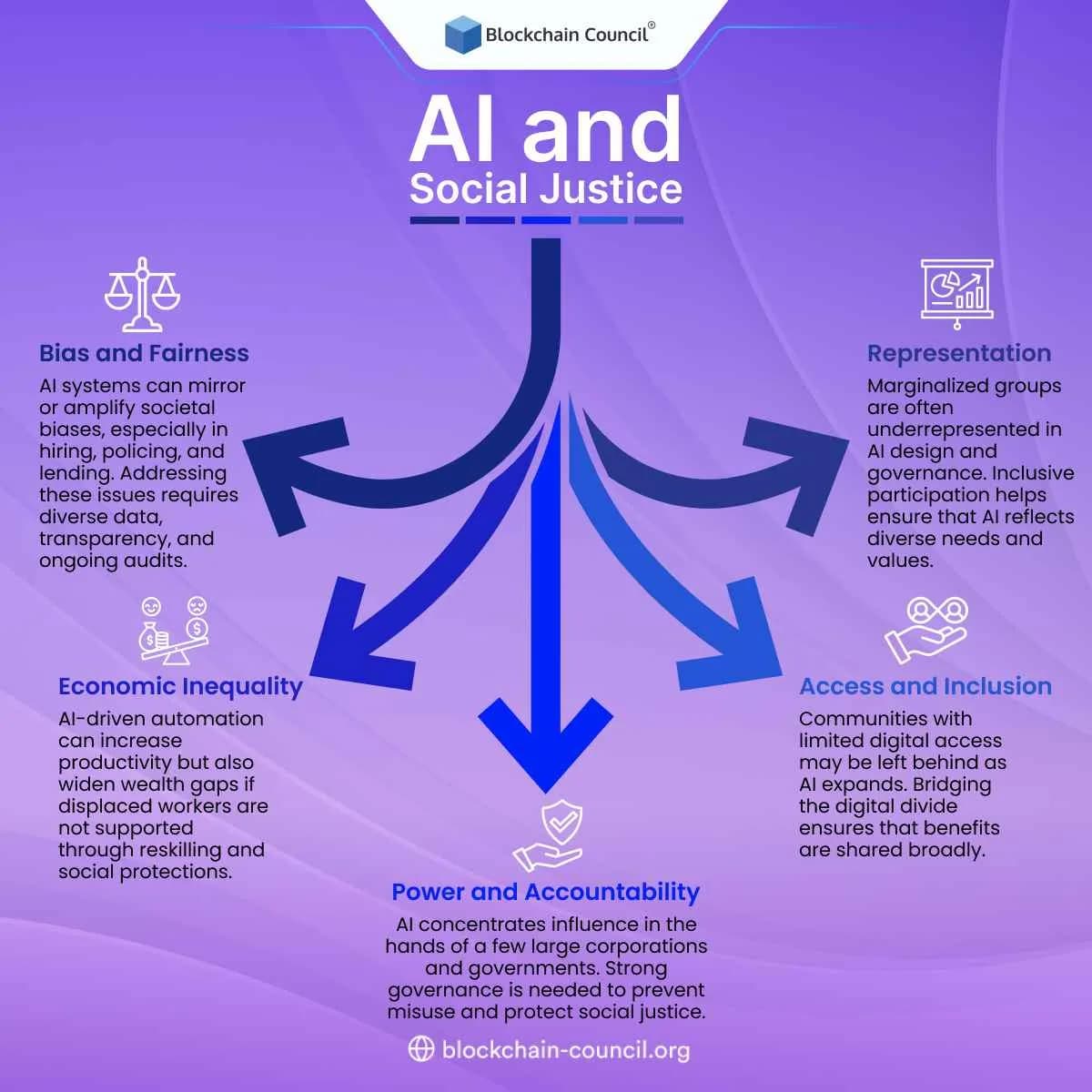
- Bias and Fairness
AI systems can mirror or amplify societal biases, especially in hiring, policing, and lending. Addressing these issues requires diverse data, transparency, and ongoing audits.
- Access and Inclusion
Communities with limited digital access may be left behind as AI expands. Bridging the digital divide ensures that benefits are shared broadly.
- Economic Inequality
AI-driven automation can increase productivity but also widen wealth gaps if displaced workers are not supported through reskilling and social protections.
- Representation
Marginalized groups are often underrepresented in AI design and governance. Inclusive participation helps ensure that AI reflects diverse needs and values.
- Power and Accountability
AI concentrates influence in the hands of a few large corporations and governments. Strong governance is needed to prevent misuse and protect social justice.
Why Social Justice Matters in AI
Social justice is about more than treating everyone the same. It involves recognising and addressing historic disadvantages, systemic discrimination, and unequal access to resources. In AI, justice means asking hard questions: Who designs these systems? Whose data is used? Who benefits and who is harmed? Without attention to these questions, AI risks becoming another tool that widens the gap between privileged and marginalised groups.

Consider predictive policing. On the surface, using AI to analyse crime data might seem fairer than relying on human intuition. But if the data reflects biased policing practices—such as over-policing in minority neighborhoods—the AI will replicate and even magnify those biases. Social justice requires not just technical accuracy but fairness in outcomes and awareness of context.
The Problem of Bias in Algorithms
Bias in AI has been documented across multiple domains. Facial recognition systems often misidentify women and people with darker skin tones at higher rates. Hiring algorithms trained on past company data sometimes learn to prefer male candidates because historical hiring patterns favored men. Even voice recognition systems have been found to perform worse for people with accents or speech impairments.
These examples are not just glitches. They reflect deeper problems with how AI is built. Data is never neutral; it carries the patterns of society. If historical data shows inequity, then algorithms trained on that data will reproduce inequity. For AI to support social justice, it needs to be designed with methods that actively correct for these biases rather than simply reflect them.
Fairness Versus Justice
A common misunderstanding in AI ethics is the difference between fairness and justice. Fairness often refers to technical measures such as equal error rates or statistical parity. For instance, an AI loan approval system might be adjusted to ensure that rejection rates are similar across demographic groups.
But justice goes further. It asks whether the system helps correct past disadvantages. For example, if communities have been historically excluded from credit, a “fair” system that continues to approve them at lower rates may still be unjust. Justice requires context-aware bias correction. Instead of pretending bias can be removed, designers must recognise structural inequities and adjust their models accordingly.
This shift is gaining recognition in research. New frameworks argue that AI systems should not only avoid harm but actively promote equity. Justice in AI is not neutrality—it is responsibility.
Representation and Participation
Another key question is who gets to shape AI. Most systems are designed by a small group of developers, often working for large corporations in wealthy countries. The voices of marginalised communities are rarely included in design, governance, or testing.
This lack of representation creates blind spots. For example, rural communities may not be considered when designing healthcare AI tools, or disability groups may be overlooked in accessibility features. To achieve social justice, AI must be built with communities rather than for them. Participatory design—where communities help define goals, datasets, and evaluation—ensures that AI serves real needs instead of reinforcing existing hierarchies.
Grassroots projects are already showing what this looks like. In India, community-based digital justice initiatives are experimenting with involving local voices in AI governance. Globally, movements are pushing for community review boards to oversee AI deployments in sensitive areas such as welfare and policing.
AI in Public Systems
Perhaps the most pressing concern is how AI is used in public services. Governments are deploying algorithms in areas like welfare distribution, legal aid, and policing. The stakes here are high: decisions can affect people’s access to food, housing, or freedom.
For example, some welfare systems use AI to flag fraudulent claims. While efficient in theory, these systems have sometimes falsely penalised vulnerable families. In the criminal justice system, risk assessment algorithms have been used to decide bail or sentencing. Critics argue that these tools often penalise people from minority backgrounds more harshly, because they are trained on biased data about crime and policing.
At the same time, AI also holds promise for increasing access to justice. Projects are emerging that use AI to help people navigate legal systems, draft documents, or understand their rights. The difference lies in design: are these systems built to empower communities, or to cut costs at their expense?
Work, Automation, and Inequality
The impact of AI on jobs is another social justice issue. Automation threatens to displace workers in industries ranging from manufacturing to customer service. While new jobs may be created, they often require different skills, leaving behind those without access to education or training.
Economic justice means ensuring that the benefits of AI are shared fairly. This includes policies for retraining, social safety nets, and equitable distribution of wealth generated by automation. Without these, AI risks deepening the divide between those who control technology and those whose livelihoods are disrupted by it.
International organisations such as the International Labour Organization stress the need for a people-centred approach. AI should enhance human dignity and rights, not undermine them. This means involving workers in decision-making and ensuring that new technologies support, rather than replace, their contributions.
Governance and Policy
Regulation plays a central role in aligning AI with social justice. UNESCO’s guidelines on AI ethics emphasise fairness, inclusivity, and accountability. Countries are also developing their own frameworks. Italy, for instance, recently passed one of the first comprehensive AI laws in Europe, covering harm, transparency, and oversight.
However, laws alone are not enough. Social justice requires governance models that involve communities directly. Proposals include participatory oversight boards, public input into AI design, and transparency mandates for companies. The idea is that AI systems should be subject not only to corporate interests but also to democratic accountability.
The Global Digital Divide
Another dimension of AI and social justice is access. Many communities lack the infrastructure—such as internet connectivity, computing power, or digital literacy—needed to benefit from AI. This digital divide risks creating a two-tier world where wealthier countries and groups accelerate ahead while others are left behind.
Bridging this divide is essential. It requires investment in digital infrastructure, education, and inclusive policies. Without this, AI will widen existing global inequalities instead of narrowing them.
Emerging Innovations for Justice
Encouragingly, researchers and practitioners are developing new approaches to integrate justice into AI. Context-aware bias correction methods aim to design systems that account for structural inequities. Community-led initiatives, such as participatory AI research roundtables, give marginalised groups a seat at the table. Some companies are moving toward embedding fairness into their system architecture rather than treating it as an afterthought.
The direction is clear: social justice is not optional in AI. It is becoming central to the legitimacy and success of these technologies.
AI and Social Justice: Global Case Studies and New Directions
Artificial intelligence has spread into systems that influence the most fundamental aspects of life—work, law, healthcare, and governance. While the first part of this article introduced the core concerns of bias, fairness, and representation, the next step is to look at how these issues play out in real-world settings. By studying global case studies and emerging debates, we can see both the dangers and the opportunities that AI brings to social justice.
AI in Criminal Justice
One of the most contested uses of AI is in criminal justice. Risk assessment algorithms are designed to estimate the likelihood that a defendant will reoffend. Judges in some jurisdictions have used these tools to inform bail or sentencing decisions. Yet independent audits have shown troubling patterns: individuals from minority backgrounds are more likely to be classified as high-risk, even when their actual reoffending rates are no higher than those of other groups.
This has led to growing calls for algorithmic transparency. Communities and advocacy groups argue that if AI is used in the justice system, people must be able to understand and challenge its decisions. Philosophically, this connects to deeper questions of fairness. Justice cannot simply be measured by statistical accuracy; it requires that outcomes be free from systemic discrimination.
Some initiatives are working in the opposite direction—using AI to expand access to justice. Chatbots and automated platforms can help people fill out legal forms, understand their rights, or connect with legal aid services. In this case, AI reduces barriers for those who cannot afford lawyers. The contrast shows that the design and intent of AI matter as much as the technology itself.
AI in Welfare Systems
Governments have begun adopting AI to manage welfare programs, aiming to reduce fraud and streamline distribution. But automated systems have also been shown to unfairly deny benefits to eligible families. In some cases, thousands of people were flagged for fraud due to flawed algorithms, pushing vulnerable households into deeper poverty.
From a social justice perspective, this raises a vital question: should efficiency take priority over equity? For welfare systems, errors in denying benefits are far more harmful than errors in approving them. Designing AI for justice means weighting harm differently, giving extra protection to those who are most vulnerable. This is a clear example of why technical fairness cannot be separated from moral reasoning.
AI in Employment and Hiring
Employers increasingly use AI for screening resumes, ranking candidates, or even analyzing facial expressions in interviews. But these systems can unintentionally encode discrimination. An algorithm trained on data from a company that historically hired mostly men might learn to downgrade women’s resumes. Another system might unfairly penalize people from certain socioeconomic backgrounds who lack access to elite schools.
Some governments are beginning to regulate AI in hiring. New York City, for instance, has rules requiring companies to audit their automated employment tools for bias. For workers, this represents progress, but it also reveals how AI reflects larger social structures. Addressing these issues requires collaboration between technologists, ethicists, and policymakers.
Professionals who want to tackle these challenges need skills that combine technical expertise and social awareness. This is where training like the Data Science Certification becomes vital. Understanding how to prepare, analyze, and evaluate data responsibly equips individuals to build systems that avoid reinforcing inequality.
AI and Economic Inequality
AI is often celebrated as a driver of productivity and innovation, but it also risks deepening inequality. Automation can replace routine jobs, leaving behind workers with fewer resources to retrain. Meanwhile, the financial rewards of AI tend to flow to those who already control capital, data, or technical expertise. This creates a widening gap between those who benefit and those who are displaced.
The International Labour Organization emphasizes the need for a people-centered approach to automation. This means policies for reskilling, strong labor protections, and ensuring that AI benefits are shared fairly. Without such measures, social justice in the workplace will be undermined.
For businesses, addressing inequality is not only an ethical responsibility but also a practical necessity. Consumers and employees increasingly expect companies to demonstrate fairness and accountability. Leaders can strengthen their ability to meet these expectations through programs like the Marketing and Business Certification, which emphasizes responsible use of AI in strategy and operations.
Fairness Versus Accuracy
A recurring debate in AI design is the trade-off between fairness and accuracy. An algorithm optimized purely for predictive accuracy may inadvertently discriminate against certain groups. Adjusting it for fairness may reduce overall accuracy. For example, in loan approvals, prioritizing fairness may mean approving more applicants from historically disadvantaged groups, even if it increases default risk slightly.
This raises philosophical questions about what values we should prioritize. Is a slightly less accurate but fairer system preferable? Many argue yes, especially in high-stakes areas like healthcare or criminal justice. Justice requires considering not only outcomes but also the broader impact on communities and individuals.
Participatory Governance Models
Traditional technology development has often excluded the voices of those most affected. Social justice demands a shift. Participatory models bring communities into the decision-making process. Instead of being passive recipients, people contribute to defining goals, shaping datasets, and setting evaluation criteria.
Examples of this approach include community-based AI projects in India and the Equitable AI Research Roundtable, which emphasizes inclusivity in design. These efforts show that justice cannot be achieved through technical fixes alone—it requires structural change in who has power over AI.
Global Perspectives on AI and Justice
The conversation about AI and social justice is not limited to Western contexts. In Africa, scholars emphasize relational ethics and the importance of community values. In Asia, Confucian traditions highlight harmony and responsibility in collective decision-making. Indigenous philosophies stress stewardship, sustainability, and respect for the non-human world.
Bringing these perspectives into AI design helps prevent a narrow, one-size-fits-all model of ethics. It ensures that systems reflect the diversity of human values and experiences. This is especially important as AI spreads into global markets, affecting societies with very different histories and needs.
Surveillance and Civil Liberties
Another area where AI intersects with social justice is surveillance. Facial recognition technologies are being deployed by governments for policing, border control, and public monitoring. While supporters argue these systems improve safety, critics warn they can erode civil liberties and disproportionately target marginalized communities.
For example, protests in several countries have highlighted how surveillance AI can be used to suppress dissent or unfairly profile groups. These issues demonstrate the importance of balancing security with freedom. Social justice requires transparency, accountability, and democratic oversight of surveillance technologies.
Building a Path Toward Justice
To align AI with social justice, multiple strategies are needed:
- Policy and law must set clear standards for fairness, accountability, and transparency.
- Education and training must equip professionals with both technical and ethical tools.
- Community participation must ensure that AI serves real needs rather than corporate or governmental interests alone.
- Global cooperation must prevent inequalities between countries from widening as AI advances.
The challenge is immense, but the opportunity is just as great. By centering justice, AI can be not only a tool for efficiency but also a driver of equity.
AI and Social Justice: Innovations, Education, and the Road Ahead
Innovations for Justice-Centered AI
Recent research shows that fairness cannot be an afterthought. Instead of treating bias as a technical bug, some developers are embedding justice into the very architecture of AI systems.
One promising idea is context-aware bias correction. Traditional approaches try to remove bias from data or balance error rates across groups. Context-aware methods go further: they acknowledge that some communities face structural disadvantages and adjust models accordingly. For example, in education technology, algorithms could be tuned not just to rank students but to provide additional support to those with fewer resources. This approach reframes AI from a neutral tool to a corrective one, actively working against inequality.
Another innovation is participatory AI design. Community review boards, citizen panels, and grassroots workshops are being used to involve affected groups in shaping AI. Instead of engineers deciding everything behind closed doors, communities help define what fairness means in their context. This shift recognizes that justice is not universal—it is lived and local.
Generative AI is also being reimagined with social justice in mind. While these systems raise concerns about bias, they also hold potential for amplifying marginalized voices. By training on diverse and inclusive datasets, generative AI can help preserve underrepresented languages, histories, and cultural expressions. When used responsibly, this creates a counterbalance to global homogenization.
Steps to Make Justice-Centered AI
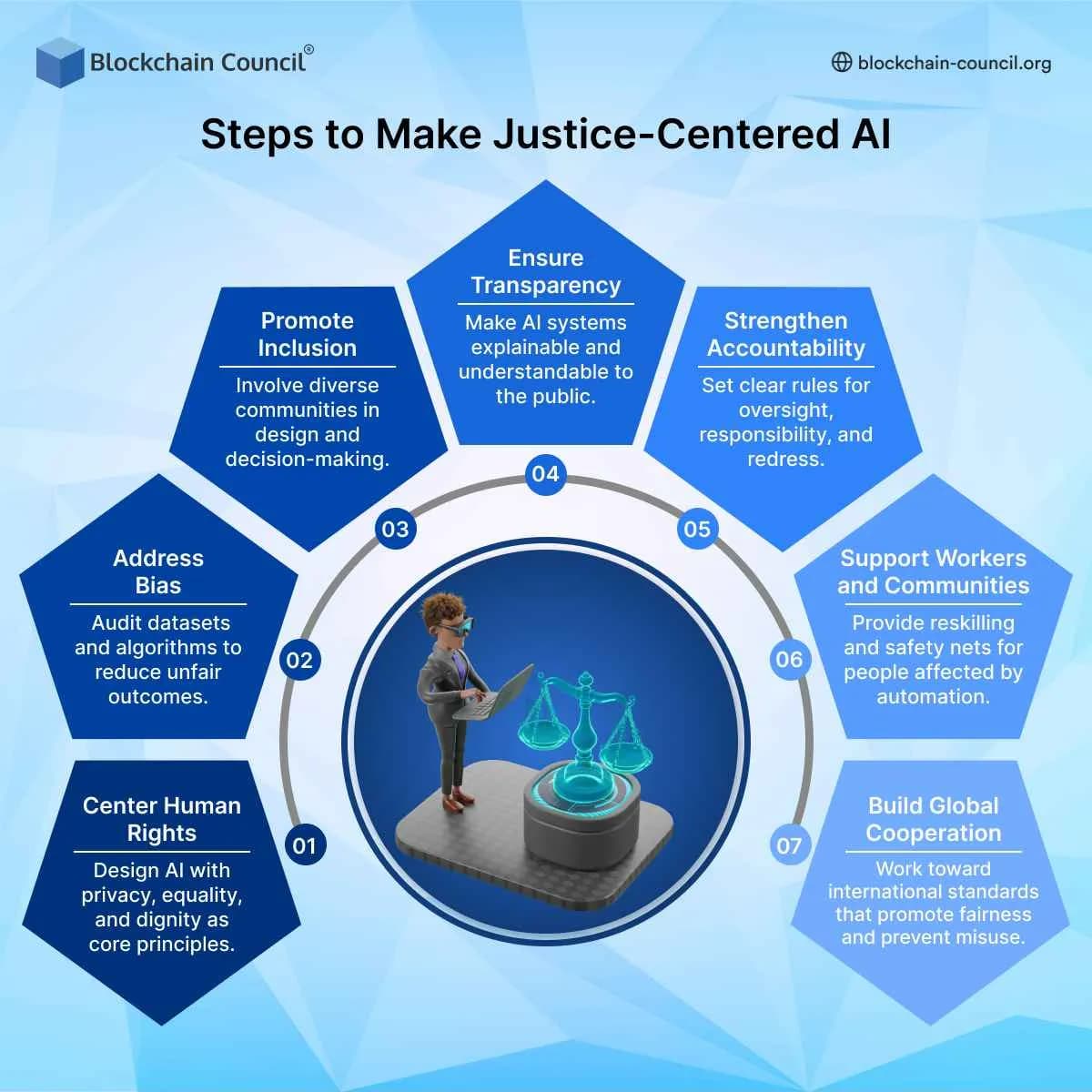
Step 1: Center Human Rights
Design AI with privacy, equality, and dignity as core principles.
Step 2: Address Bias
Audit datasets and algorithms to reduce unfair outcomes.
Step 3: Promote Inclusion
Involve diverse communities in design and decision-making.
Step 4: Ensure Transparency
Make AI systems explainable and understandable to the public.
Step 5: Strengthen Accountability
Set clear rules for oversight, responsibility, and redress.
Step 6: Support Workers and Communities
Provide reskilling and safety nets for people affected by automation.
Step 7: Build Global Cooperation
Work toward international standards that promote fairness and prevent misuse.
Transparency Through Blockchain
One of the challenges of AI is its opacity. Decisions are often made by models that even their designers cannot fully explain. This lack of transparency undermines accountability, especially when AI is used in high-stakes areas like policing or welfare.
Blockchain offers a way forward. By recording data and decisions on distributed ledgers, blockchain can create audit trails that are tamper-proof. Pairing AI with blockchain can ensure that decisions are not only accurate but also explainable and verifiable. For example, if an AI system denies someone a loan, blockchain records could provide a transparent explanation of why, reducing the risk of hidden bias.
Professionals looking to combine these fields can benefit from blockchain technology courses. Learning how blockchain supports transparency and accountability prepares individuals to design systems that people can trust.
Education for Equity-Driven AI
As AI spreads into every corner of society, education becomes central to social justice. Professionals need not only technical expertise but also ethical and philosophical grounding.
- The AI certification provides practical skills for building and deploying AI responsibly.
- The Data Science Certification prepares individuals to manage datasets in ways that minimize bias and enhance fairness.
- The Marketing and Business Certification equips leaders to use AI in ways that respect consumer rights while promoting inclusive growth.
- Broader tech certifications cover digital infrastructure, cybersecurity, and governance—ensuring that AI operates in secure and fair ecosystems.
These pathways ensure that professionals across sectors—engineers, analysts, business leaders, and policymakers—can align AI development with principles of equity.
Global Governance and Social Contracts
AI is raising the need for a new kind of social contract. Just as industrial revolutions in the past required new labor laws and protections, the AI revolution requires rules that balance innovation with justice.
Global governance frameworks are emerging. UNESCO’s guidelines highlight fairness, accountability, and inclusivity. The European Union is pushing forward with comprehensive AI laws. Other nations are developing local regulations, from data protection to transparency mandates. Yet governance cannot remain limited to the Global North. A just AI ecosystem must reflect global perspectives, including those of developing countries that often bear the brunt of technological inequality.
Philosophically, this raises questions about democracy in technology. Should citizens have a direct say in how AI is used in their communities? Increasingly, the answer is yes. Participatory governance models are being tested, giving communities input into decisions about surveillance, welfare systems, or education technologies. These models shift power from corporations to citizens, making AI more accountable to the people it affects.
Addressing the Digital Divide
The digital divide remains one of the greatest barriers to justice. AI depends on connectivity, computing power, and digital literacy—all of which are unevenly distributed. Wealthy countries and corporations enjoy cutting-edge systems, while poorer regions struggle with basic access. This divide risks creating a world where AI accelerates inequality rather than reducing it.
Bridging the divide requires investment in infrastructure, affordable internet, and inclusive education. It also demands attention to language and culture. Many AI systems are trained on English-language data, marginalizing speakers of other languages. Expanding datasets to include global voices is a practical step toward justice.
Surveillance, Privacy, and Freedom
The tension between safety and freedom is another social justice concern. AI surveillance technologies are expanding worldwide, from facial recognition in public spaces to predictive policing. While these tools can improve security, they can also be abused to suppress dissent or unfairly target minority groups.
Philosophy and ethics remind us that justice is not only about outcomes but also about rights. A safe society that sacrifices liberty may not be just. For this reason, AI surveillance must be governed by strict accountability, transparency, and democratic oversight. Without these safeguards, the promise of AI for justice risks becoming a tool for control.
The Future of Work and Dignity
Automation raises fundamental questions about the dignity of work. If machines take over routine tasks, what happens to the people who performed them? While some argue that AI will create new jobs, the transition is rarely smooth. Workers without access to retraining are left behind.
Social justice requires policies that protect workers during these shifts. This could include universal basic income, retraining programs, or social safety nets. But beyond economics, there is also a philosophical dimension: work is not only about survival, it is about purpose and dignity. Ensuring that people can find meaningful roles in an AI-driven economy is as important as ensuring they can earn a living.
A Vision for Justice-Centered AI
The road ahead is challenging but also full of potential. AI can be a tool for justice if it is built and governed with equity at its core. This means:
- Designing algorithms that correct for historic inequities rather than reproduce them.
- Embedding community participation into AI governance.
- Pairing AI with technologies like blockchain to ensure transparency.
- Equipping professionals with skills that blend technical and ethical expertise.
- Building global cooperation to prevent inequality between nations.
- Protecting civil liberties while advancing security.
This vision requires a cultural shift as much as a technical one. It demands that we see AI not as neutral but as embedded in social structures—and therefore responsible for shaping them more fairly.
Conclusion
Artificial intelligence and social justice are inseparable. Every algorithm, dataset, and deployment reflects choices about whose interests are served. Left unchecked, AI risks amplifying existing inequalities. But when guided by justice, it can help build a more equitable world.
The future depends on professionals, policymakers, and communities working together. Education through AI certs, data science programs, and blockchain courses prepares individuals to lead responsibly. Governance frameworks rooted in fairness provide boundaries. Community participation ensures legitimacy.
AI is not destiny. It is a tool we shape—and one that can shape us. By putting social justice at the center, we can ensure that AI enhances dignity, equality, and fairness for all.