

Agentic AI for Personal Finance: Smarter Budgeting, Investing, and Bill Payments
 Suyash Raizada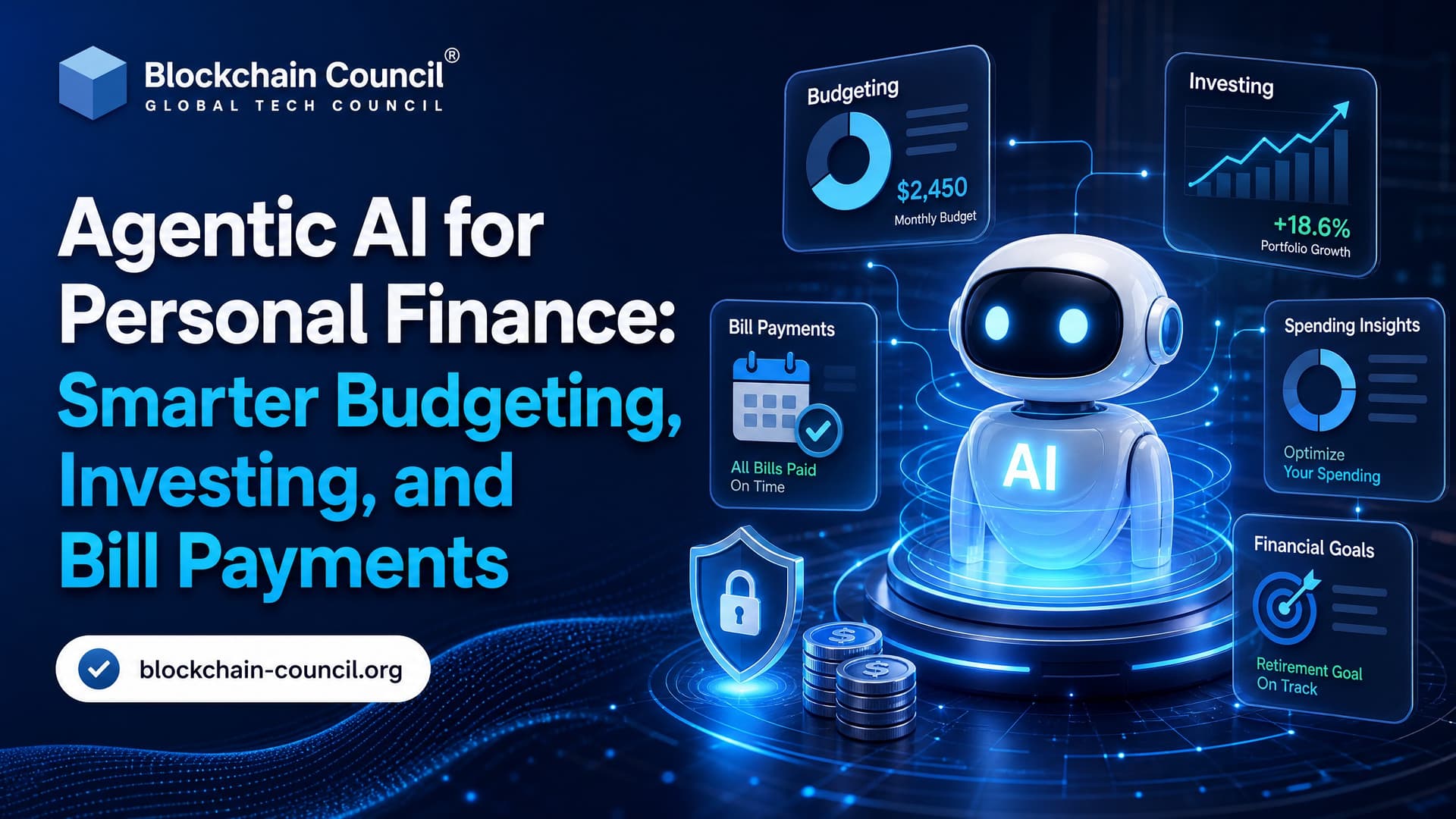
Agentic AI for Personal Finance is moving past chat-based money tips. Newer systems can watch your accounts, plan next steps, call banking or brokerage tools, and ask for approval before acting. That matters because personal finance is not one decision. It is a chain of small decisions made under changing cash flow, risk, fees, deadlines, and human habits.
The shift is already visible in banking and enterprise finance. The World Economic Forum has described agentic AI as a move from generative assistance to autonomous decision-making in financial services. Moody's has made a similar point, noting that finance teams are testing agents for forecasting, reconciliation, cash management, and risk monitoring. Consumer finance usually follows enterprise finance with a delay. This time, the gap may be short.

As adoption accelerates, professionals are increasingly turning to an AI Agentic Finance and Payment Certification to develop practical expertise in autonomous financial systems, intelligent payment workflows, and AI-driven decision-making.
What Agentic AI Means in Personal Finance
A standard AI chatbot answers a question. An agentic system works toward a goal. It breaks that goal into steps, uses external tools, checks results, and adjusts the plan.
In personal finance, that could mean you tell an agent: save $8,000 for an emergency fund, avoid overdrafts, keep rent and utilities current, and do not move more than $200 without asking me. The agent then monitors your accounts, forecasts upcoming bills, suggests spending limits, and may move money between accounts if you approve it.
Good finance agents usually combine four capabilities:
Goal planning: Create a debt payoff, savings, or investment plan across several accounts.
Tool use: Connect with bank APIs, brokerages, payment providers, card feeds, email billers, and budgeting apps.
Continuous monitoring: Detect unusual spending, low balances, portfolio drift, duplicate charges, and missed payments.
Human oversight: Explain actions, request consent for high-impact decisions, and keep an audit trail.
That last point is not optional. If an agent can move money, place trades, or change payment timing, you need permissions, logs, and a clear stop button.
As financial autonomy increases, agent identity and spending controls become critical. Give your AI Agents a wallet, budget, and identity with Blockchain0x to autonomously pay, get paid, and build onchain.
Why This Is Accelerating From 2024 to 2026
Banks and fintechs are replacing static dashboards with active systems. Salesforce and Domo have both highlighted banking pilots where agents support personalized financial planning, credit workflows, fraud detection, and customer service inside core financial systems rather than as isolated chatbots.
Enterprise finance is acting as a test lab. Providers like Auxis, CloudFactory, and Datarails report demand for AI-assisted budgeting, close management, expense review, and forecasting. Some case studies claim double-digit efficiency gains in reconciliations and financial close cycles when agents are embedded into real workflows. Treat those numbers carefully. Vendor case studies are not universal benchmarks. Still, they show where the market is heading.
There is also a practical reason personal finance fits well: most money tasks repeat. Bills have due dates. Card charges have merchants. Portfolios have target allocations. Subscriptions recur. Agents earn their keep when the work is structured but tedious.
Smarter Budgeting With Agentic AI
Traditional budgeting apps ask you to categorize past spending. That helps, but it is backward-looking. Agentic budgeting builds a rolling view of what is likely to happen next.
What an AI Budgeting Agent Can Do
Forecast cash flow: Estimate account balances after payroll, rent, subscriptions, card payments, and variable spending.
Adjust category limits: Raise or lower suggested spending caps based on real bills and upcoming obligations.
Track goals: Move excess cash toward savings, debt payoff, or investment targets when rules allow.
Detect waste: Flag unused subscriptions, duplicate charges, unusual fees, or merchants that changed price.
Nudge at the right time: Warn you before the weekend if your restaurant budget is already nearly gone.
One implementation detail matters here. If you build with transaction feeds such as Plaid, do not treat every pending card transaction as final. Plaid transaction objects can include a pending_transaction_id that links a posted transaction back to its earlier pending version. Ignore that field and your agent may double count a coffee shop charge, a hotel hold, or a grocery payment. That is how a clean demo turns into a broken budget.
For users, the most useful budgeting agent is not the one with the prettiest chart. It is the one that prevents avoidable mistakes: overdrafts, late fees, forgotten renewals, and spending that quietly breaks a savings plan.
Agentic Investing and Portfolio Management
Agentic investing sounds exciting, but it deserves caution. An agent can help with research, screening, portfolio drift, and scenario analysis. It should not become an unsupervised day trader with your retirement account.
The CFA Institute has written about agentic AI in investment workflows, especially for retrieval-augmented research, quantitative screens, and multi-agent analysis. In practice, an agent can scan filings, summarize earnings calls, compare valuation metrics, and build a watchlist from criteria you define.
Where Investing Agents Are Useful
Research screening: Filter securities by valuation, quality, volatility, sector exposure, dividend history, or ESG rules.
Portfolio rebalancing: Compare current holdings with a target allocation and propose trades when drift crosses a threshold.
Risk monitoring: Flag concentration in one stock, sector, country, asset class, or currency.
Goal alignment: Decide whether extra cash should go to debt repayment, emergency savings, a taxable brokerage, or retirement contributions.
My view is blunt: retail investors should use agentic investing first as a decision-support layer, not an execution layer. Let it draft the rebalance plan. Let it explain tax lots, risk, and fees. Then approve trades yourself unless the action is low-risk and rule-based, such as rebalancing inside a tax-advantaged account within a preset band.
Regulated wealth platforms will likely move faster than open consumer apps because they already run suitability checks, trade approval workflows, compliance supervision, and client records. That structure matters.
Automated Bill Payments That Do More Than Autopay
Autopay is useful, but it is dumb automation. It pays a bill on a preset date whether your balance is comfortable or not. Agentic AI can make bill payments cash-flow-aware.
A bill payment agent can collect bills from email, portals, card accounts, and open banking feeds. It extracts due dates, minimum payments, statement balances, fees, and recurring amounts. Then it builds a payment calendar.
What a Bill Payment Agent Can Optimize
Timing: Pay close enough to the due date to preserve cash, but early enough to avoid late fees.
Liquidity: Keep a minimum checking buffer before moving money.
Interest costs: Prioritize high-interest credit card balances when funds are tight.
Anomaly review: Pause if a utility bill jumps from $90 to $390 without explanation.
Disputes: Flag duplicate charges or unexpected subscription renewals for review.
Nvidia's agent examples have shown how machine-to-machine bill workflows can run continuously across payment systems and business applications. The consumer version of that pattern is simple: routine payments go through, exceptions come to you.
As AI-driven automation becomes more common across industries, professionals are increasingly exploring the NVIDIA AI Professional certification to gain hands-on knowledge of AI technologies, intelligent agents, and enterprise-scale AI applications.
Do not give an agent unlimited bill-pay authority. Set hard limits by merchant, category, amount, and account. For example: pay utilities up to $250 automatically, request approval above that, and never pay a new merchant without confirmation.
Security, Privacy, and Governance Cannot Be an Afterthought
Agentic AI for personal finance needs deeper access than a normal app. It may see income, debts, identity data, transaction history, brokerage positions, tax documents, and biller credentials. That raises the bar.
Look for these controls before trusting any agent with money movement:
Granular permissions: Read-only access should be separate from transfer or trade permissions.
Approval tiers: Low-risk actions can run automatically, while high-value transfers and trades need explicit consent.
Audit logs: Every recommendation, API call, approval, rejection, and transaction should be recorded.
Explainability: The agent should explain why it suggests an action in plain language.
Revocation: You should be able to disconnect accounts and stop automation quickly.
Model monitoring: Financial institutions need validation, testing, and escalation paths when agents behave unexpectedly.
Moody's and the World Economic Forum both stress governance because agentic systems can initiate action. In finance, a bad recommendation is a problem. A bad transaction is worse.
Skills Professionals Need Now
If you work in banking, fintech, wealth management, accounting, or product development, the skill set is changing. You do not need to become a machine learning researcher, but you do need to understand agent workflows.
Focus on:
Prompt design for tool-using agents
API permissions and consent flows
Retrieval-augmented generation for financial documents
Model risk management and audit trails
Data privacy, cybersecurity, and fraud controls
Regulatory limits around advice, suitability, and consumer protection
For structured learning, you can consider pathways such as Certified Artificial Intelligence (AI) Expert™ for AI foundations, Certified AI Developer™ for building AI systems, and Certified Cybersecurity Expert™ for security controls around financial data. If your work touches crypto wallets, tokenized assets, or Web3 payments, Certified Blockchain Expert™ is a relevant next step.
Professionals looking to complement their technical expertise with customer acquisition, brand strategy, and business growth skills may also find a Marketing Certification valuable.
What Comes Next
The next phase is not a single finance chatbot. It is a network of agents. Your budgeting agent may coordinate with a travel agent before you book a trip. An investing agent may adjust contribution suggestions after a career planning agent forecasts a salary change. A bill agent may work with your bank's overdraft protection rules.
That future is useful only if users stay in control. The best personal finance agents will be conservative by default, transparent about uncertainty, and strict about permissions. The worst ones will hide risky automation behind friendly language.
If you want to prepare, start small. Build or test a read-only budgeting agent that categorizes transactions, forecasts the next 30 days, and flags anomalies without moving money. Then add approval-based actions. For professionals, pair AI agent training with cybersecurity and governance skills before connecting anything to real accounts.
FAQs
1. What Is Agentic AI for Personal Finance?
Agentic AI for personal finance refers to autonomous AI systems that can analyze financial information, make recommendations, and perform financial tasks such as budgeting, investing, saving, and bill management on behalf of users within predefined rules.
2. How Does Agentic AI Differ from Traditional Financial Apps?
Traditional financial apps provide information and tools for users to manage finances manually, while Agentic AI can proactively make decisions, automate tasks, and optimize financial activities with minimal user intervention.
3. Why Is Agentic AI Gaining Popularity in Personal Finance?
People are looking for smarter ways to manage money, reduce financial stress, automate routine tasks, and improve financial decision-making through AI-powered assistance.
4. How Can Agentic AI Improve Budgeting?
Agentic AI can automatically categorize expenses, identify spending patterns, set budget goals, track progress, and recommend adjustments based on financial behavior.
5. How Does Agentic AI Help Users Control Spending?
It can monitor transactions in real time, detect unusual spending habits, provide alerts, and suggest ways to reduce unnecessary expenses.
6. What Role Does Agentic AI Play in Savings Management?
Agentic AI can identify opportunities to save, automate transfers to savings accounts, optimize savings goals, and adjust strategies based on income and spending patterns.
7. How Can Agentic AI Automate Bill Payments?
It can track due dates, schedule payments, ensure sufficient account balances, and automatically process bills to help users avoid late fees and missed payments.
8. How Does Agentic AI Reduce Financial Stress?
By automating routine financial tasks and providing personalized guidance, it helps users spend less time managing finances and more time focusing on their goals.
9. Can Agentic AI Help with Investment Decisions?
Yes, Agentic AI can analyze market data, assess risk profiles, recommend investment opportunities, and help users maintain diversified portfolios.
10. What Is Personalized Financial Planning with Agentic AI?
Personalized financial planning uses AI to create customized strategies based on a user's income, expenses, goals, risk tolerance, and financial history.
11. How Does Agentic AI Support Retirement Planning?
It can estimate future financial needs, recommend savings targets, monitor investment performance, and adjust plans as financial circumstances change.
12. Can Agentic AI Help Manage Debt?
Yes, it can analyze debt obligations, recommend repayment strategies, prioritize balances, and automate payments to reduce interest costs.
13. How Does Agentic AI Improve Financial Goal Tracking?
It continuously monitors progress toward goals such as saving for a home, building an emergency fund, or reducing debt and recommends corrective actions when needed.
14. What Benefits Does Agentic AI Offer for Personal Finance?
Benefits include automation, improved financial discipline, personalized recommendations, time savings, better budgeting, optimized savings, and enhanced financial awareness.
15. How Does Agentic AI Use Predictive Analytics?
It analyzes historical financial behavior to forecast future spending, income trends, savings opportunities, and potential financial risks.
16. Can Agentic AI Detect Financial Risks?
Yes, it can identify overspending patterns, missed payment risks, unusual account activity, and other factors that may negatively affect financial health.
17. What Privacy Concerns Exist with Agentic AI in Finance?
Users should consider how financial data is collected, stored, shared, and protected, as financial information is highly sensitive and requires strong security controls.
18. What Challenges Could Slow Adoption of Agentic AI for Personal Finance?
Challenges include trust issues, regulatory requirements, security concerns, integration complexity, and ensuring transparency in AI-driven financial decisions.
19. What Risks Should Users Be Aware Of?
Users should avoid relying entirely on autonomous financial systems without reviewing recommendations and maintaining oversight. While AI may excel at tracking spending habits, it does not fully understand personal priorities, life events, or the emotional factors that often influence financial decisions.
20. How Will Agentic AI Transform Personal Finance in the Future?
Agentic AI is expected to evolve into a highly personalized financial assistant capable of managing budgets, optimizing investments, automating payments, forecasting financial outcomes, and proactively helping users achieve their financial goals. As technology advances, these systems could become a central part of everyday money management, making personal finance more accessible, efficient, and intelligent.
Related Articles
View All
Agentic AI
Agentic AI in Cross-Border Payments: Faster, Cheaper, and Smarter Transactions
Agentic AI is making cross-border payments faster, cheaper, and smarter through autonomous routing, fraud checks, FX decisions, and liquidity control.

Agentic AI
Security Challenges of Agentic AI in Finance and Payment Ecosystems
Agentic AI in finance can approve payments, trade assets, and call APIs. Learn the main security, fraud, identity, and governance risks.

Agentic AI
Agentic AI Compliance in Finance: KYC, AML, and Reporting Automation
Agentic AI compliance in finance can automate KYC, AML alert triage, and regulatory reporting, but success depends on data, controls, and auditability.
Trending Articles
AWS Career Roadmap
A step-by-step guide to building a successful career in Amazon Web Services cloud computing.
How Blockchain Secures AI Data
Understand how blockchain technology is being applied to protect the integrity and security of AI training data.
Claude AI Tools for Productivity
Discover Claude AI tools for productivity to streamline tasks, manage workflows, and improve efficiency.